Chapter Preamble
Signals declared
Sig-D — Diagnostic (primary). Recognise congenital nephrotic syndrome and inherited steroid-resistant FSGS, and know when to seek a genetic cause.
Sig-T — Therapeutic (strong). Avoid futile immunosuppression in genetic disease, support the congenital case, and counsel transplant recurrence — while recognising the treatable CoQ10 exception.
Sig-M — Mechanistic (strong). How genetic defects of the podocyte and slit diaphragm break the filtration barrier, and why this makes the disease structural rather than immune.
Levels populated and omitted
Populated (19): L1–L14, L17–L20, L22. The mechanistic signal fires the concept maps (L6) and triads (L9); the therapeutic signal fires the absolute-risk table (L14) and templates (L17); the diagnostic signal drives the tables, rules, cases, pitfalls, and board items.
L15 / L16 preference-sensitive map and SDM scripts — omitted. No Sig-E; the genetic-versus-immune distinction is an evidence-driven diagnostic and therapeutic matter.
L21 reflective prompts — omitted. No Sig-E/V; the content is worked through the cases and pitfalls.
| 01 | PHASE A · LEVEL 1 · ORIENTATION & KNOWLEDGE Learning Objectives |
By the end of this chapter you should be able to:
Explain how the podocyte and slit diaphragm form the final filtration barrier.
Name the key inherited podocytopathy genes and their proteins.
Describe congenital nephrotic syndrome and its genetic causes.
Explain why genetic FSGS does not respond to immunosuppression.
Explain why genetic FSGS does not recur after transplantation.
Decide when to seek a genetic cause in steroid-resistant nephrotic syndrome.
Recognise the treatable coenzyme Q10 exception.
Manage congenital nephrotic syndrome and genetic FSGS.
| 02 | PHASE A · LEVEL 2 · ORIENTATION & KNOWLEDGE Executive Summary |
The podocyte and its slit diaphragm form the final filtration barrier, and genetic defects in their proteins disrupt the barrier, causing proteinuria, an FSGS lesion, and progressive CKD — the inherited podocytopathies.
Key genes include NPHS1 (nephrin), NPHS2 (podocin), WT1, and others (TRPC6, ACTN4, INF2, LAMB2).
Congenital nephrotic syndrome is nephrotic syndrome in the first three months of life, usually genetic — most often NPHS1 (congenital nephrotic syndrome of the Finnish type), with NPHS2, WT1, and LAMB2 other causes — after excluding congenital infection.
It causes massive proteinuria with the complications of hypoalbuminaemia, thrombosis, infection, and malnutrition.
Inherited steroid-resistant nephrotic syndrome and FSGS occur in children (often recessive, NPHS2) and adults (often dominant, ACTN4/TRPC6/INF2).
The central principle is that genetic (monogenic) FSGS is a structural podocyte defect, not an immune disease, so it does not respond to immunosuppression — and identifying it by genetic testing spares the patient futile and toxic immunosuppression.
This is why genetic testing is increasingly central in steroid-resistant nephrotic syndrome, especially when steroid-resistant, familial, syndromic, or early-onset.
Genetic FSGS also does not recur after transplantation, because the defect is intrinsic to the native podocytes, not a circulating factor — unlike primary immune FSGS, which can recur.
So distinguishing genetic from immune FSGS matters for both immunosuppression and transplant recurrence.
An important exception is coenzyme Q10 deficiency, a genetic podocytopathy that responds to coenzyme Q10 supplementation — a treatable genetic cause worth identifying.
Congenital nephrotic syndrome is managed supportively (albumin, nutrition, proteinuria reduction, thrombosis and infection prophylaxis), often progressing to nephrectomy, dialysis, and transplantation.
Genetic FSGS is managed by stopping futile immunosuppression, supportive RAAS blockade, CKD care, and transplantation.
The unifying lesson is that a genetic podocytopathy is structural, not immune — a fact that should change the treatment.
| 03 | PHASE A · LEVEL 3 · ORIENTATION & KNOWLEDGE Main Narrative |
The podocyte is the cell that makes the kidney's final filter, and when a gene that builds it is faulty, the filter leaks — producing nephrotic syndrome and the scarring pattern of FSGS. The inherited podocytopathies range from congenital nephrotic syndrome at birth to steroid-resistant FSGS in children and adults, and they carry a lesson that changes treatment: a genetic podocytopathy is a structural defect, not an immune disease, so it does not respond to immunosuppression and does not recur after transplantation. This chapter completes the inherited glomerular diseases with that lesson at its centre.
— The podocyte and the slit diaphragm
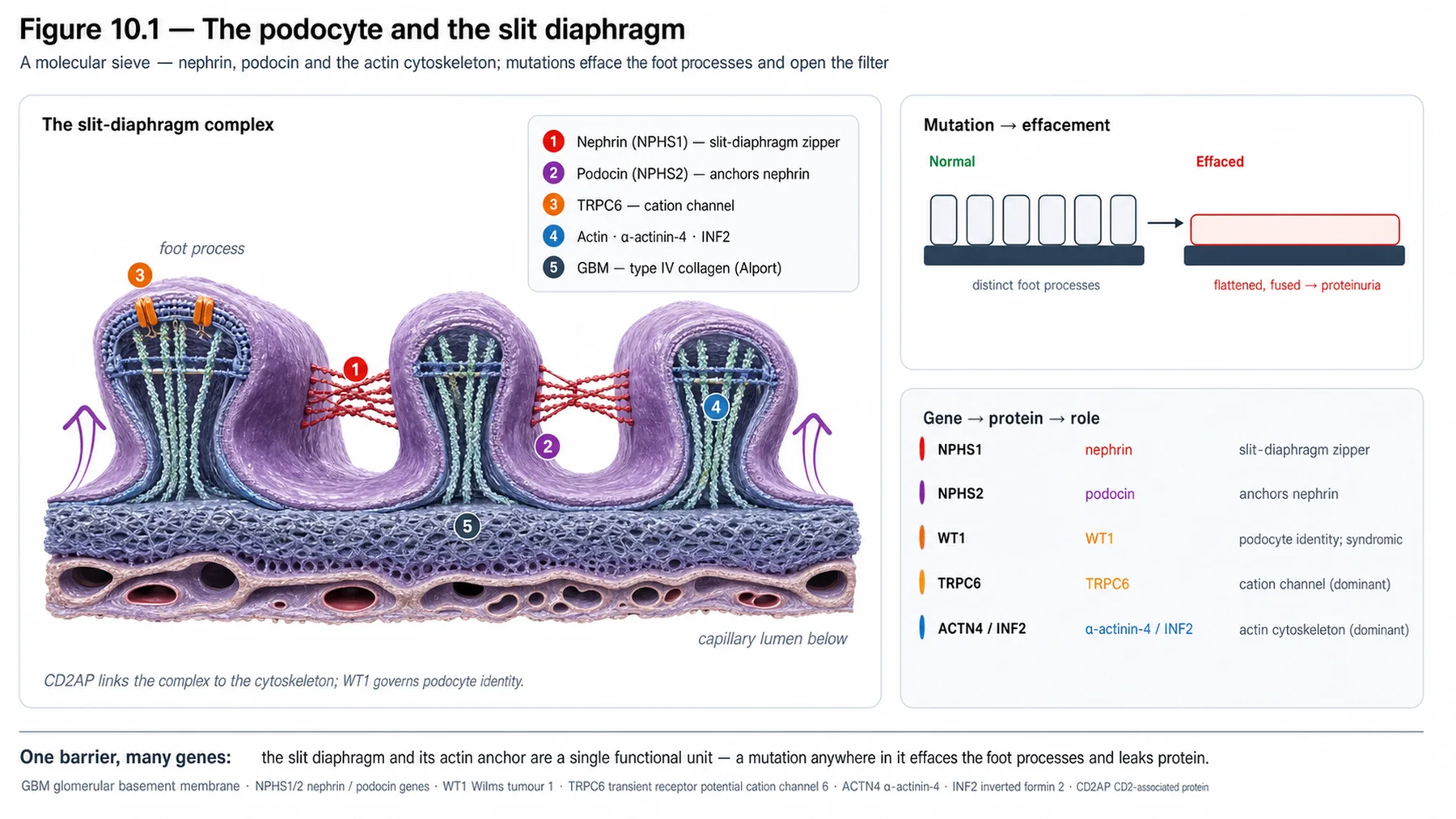
The glomerular filtration barrier has three layers — the endothelium, the basement membrane (the Alport chapter), and the podocyte — and the podocyte, with its interdigitating foot processes bridged by the slit diaphragm, forms the final and critical layer. The slit diaphragm is a specialised cell junction built of proteins including nephrin and podocin, and the podocyte's structure depends on its actin cytoskeleton and associated proteins. This apparatus maintains the size- and charge-selective barrier that normally retains protein in the blood. When a gene encoding one of these podocyte or slit-diaphragm proteins is defective, the barrier is disrupted, protein leaks into the urine (proteinuria, often nephrotic-range), and the injured podocytes give rise to the histological lesion of focal segmental glomerulosclerosis (FSGS) and progressive CKD. This is the unifying concept of the inherited podocytopathies: a genetic defect of the podocyte or its slit diaphragm breaks the final filtration barrier and causes proteinuric kidney disease. Crucially — and this is the thread that runs through the chapter — the defect is structural (a faulty building block of the filter), not immune, which determines how the disease behaves and how it should (and should not) be treated.
— The genes and congenital nephrotic syndrome
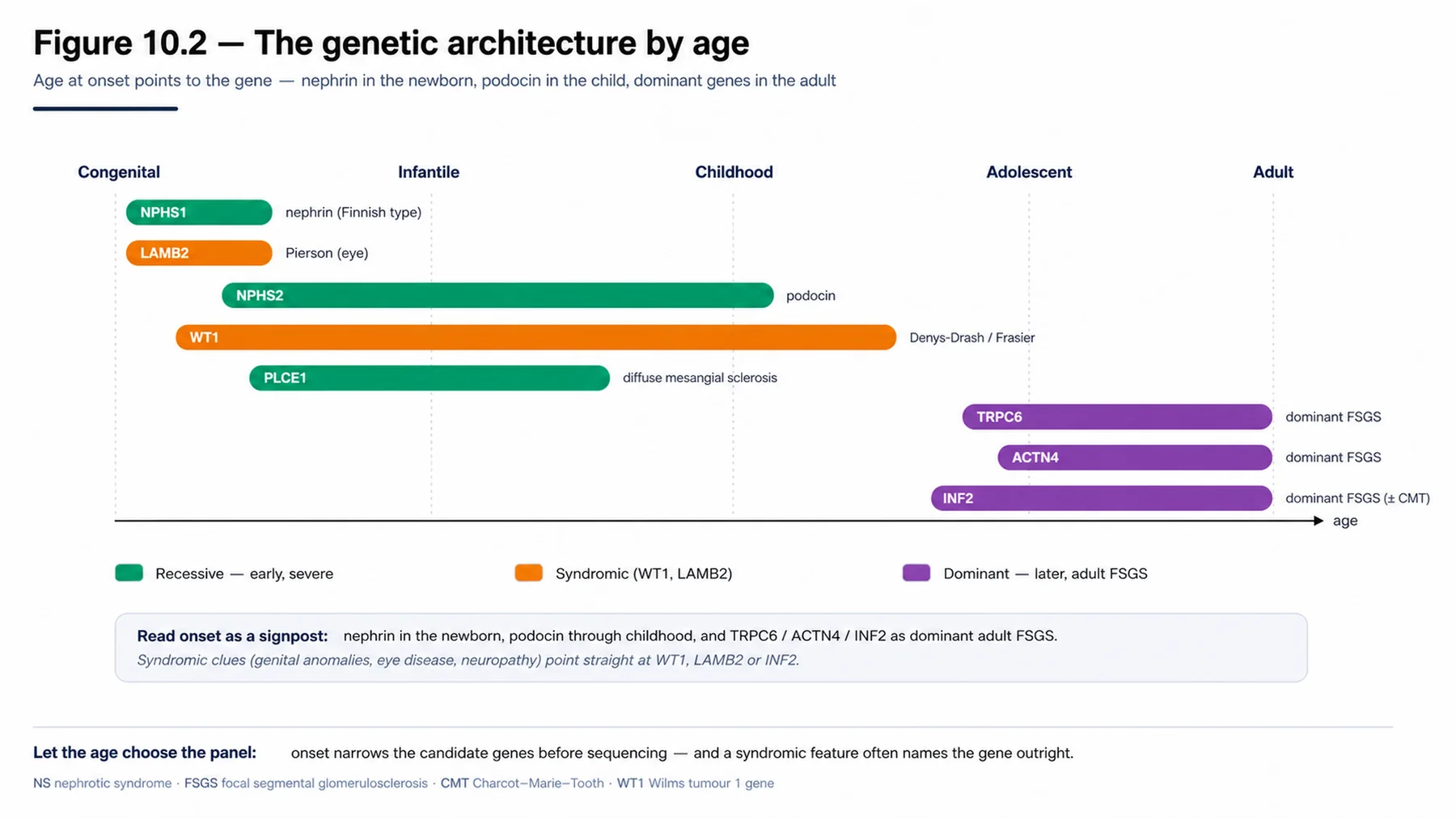
A growing list of genes cause inherited podocytopathies, and a few are central. NPHS1 encodes nephrin (the key slit-diaphragm protein); NPHS2 encodes podocin; WT1 (the Wilms tumour gene) regulates podocyte development; and others include TRPC6, ACTN4 (alpha-actinin-4), INF2, and LAMB2 (laminin). The earliest and most severe presentation is congenital nephrotic syndrome — nephrotic syndrome appearing within the first three months of life — which is usually genetic. The commonest cause is NPHS1 mutation, producing congenital nephrotic syndrome of the Finnish type (autosomal recessive, often evident in utero with a raised maternal alpha-fetoprotein, and presenting at or soon after birth with massive proteinuria); NPHS2 (podocin), WT1 (in syndromes such as Denys-Drash, which combines nephrotic syndrome with genital abnormalities and Wilms tumour risk), and LAMB2 (Pierson syndrome, with ocular features) are other genetic causes. Before attributing congenital nephrotic syndrome to a gene, secondary causes — particularly congenital infections (syphilis, cytomegalovirus, toxoplasmosis) — must be excluded, as some are treatable. Congenital nephrotic syndrome causes massive proteinuria with severe hypoalbuminaemia and its complications: oedema, a high risk of thrombosis and of infection, and malnutrition. It is a serious neonatal disease requiring intensive supportive care.
— Genetic FSGS: structural, not immune
Beyond the congenital cases, inherited podocytopathies present as steroid-resistant nephrotic syndrome and FSGS across the age range — in children (often autosomal recessive, classically NPHS2/podocin) and in adults (often autosomal dominant, such as ACTN4, TRPC6, INF2). And here lies the single most important clinical lesson of the chapter: genetic (monogenic) FSGS is a structural podocyte defect, not an immune disease, so it does not respond to immunosuppression. Primary FSGS is often treated with steroids and other immunosuppression on the assumption of an immune mechanism (a circulating permeability factor), but a patient whose FSGS is caused by a faulty podocyte gene has no immune process to suppress — the filter is structurally broken — so immunosuppression is futile and exposes them to its considerable toxicity for no benefit. This is why identifying genetic FSGS matters so much therapeutically: making the genetic diagnosis spares the patient pointless, harmful immunosuppression. It explains, too, the well-known clinical observation that genetic FSGS is steroid-resistant — not because the steroids were inadequate, but because there was never an immune target. The practical consequence is that genetic testing should be pursued in steroid-resistant nephrotic syndrome, so that the structural, immunosuppression-resistant cases are identified and not subjected to escalating, futile immunosuppression.
— Recurrence, transplantation, and the CoQ10 exception
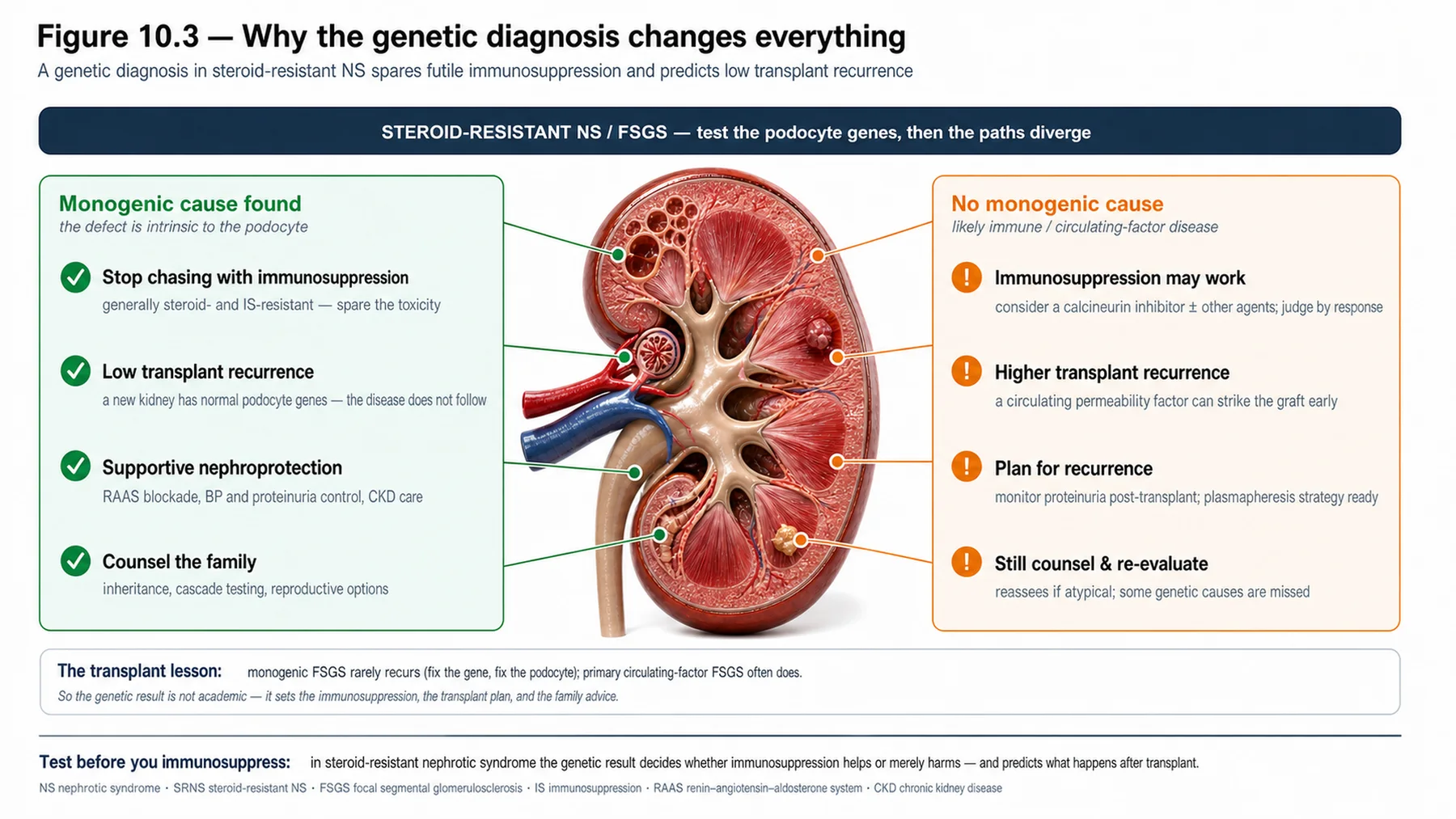
The structural-versus-immune distinction has a second major consequence, at transplantation. Genetic (monogenic) FSGS does not recur in a kidney transplant, because the defect is intrinsic to the patient's own native podocytes — a transplanted kidney with normal podocyte genes is not subject to the patient's mutation — so the prognosis for the graft is good. This contrasts sharply with primary (immune) FSGS, thought to be driven by a circulating permeability factor, which can recur in the allograft (sometimes within hours of transplantation, as the circulating factor attacks the new kidney). So distinguishing genetic from immune FSGS is essential for transplant counselling and recurrence risk: the patient with genetic FSGS can be reassured the disease will not recur, while the patient with primary immune FSGS must be warned of recurrence and monitored. There is, however, an important exception to the 'genetic means untreatable by drugs' rule that must not be missed: coenzyme Q10 biosynthesis defects (mutations in the COQ genes) cause a genetic podocytopathy with steroid-resistant nephrotic syndrome that responds to coenzyme Q10 supplementation — so this is a treatable genetic podocytopathy, and identifying it (by genetic testing) allows a specific, effective treatment. The lesson is to make the genetic diagnosis not only to avoid futile immunosuppression but also to catch the treatable exceptions.
— Management and the unifying lesson
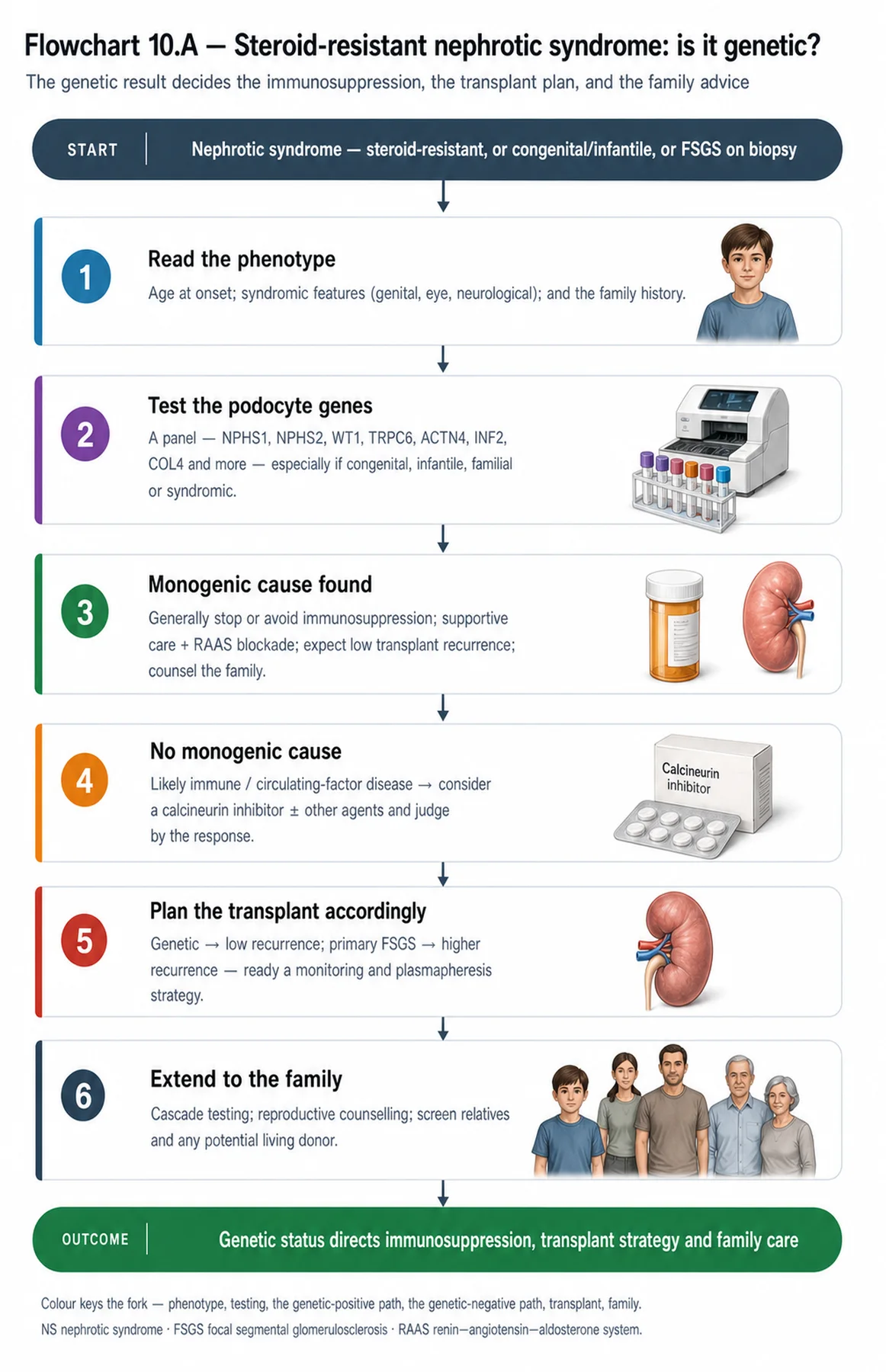
Management follows the diagnosis. Congenital nephrotic syndrome (the Finnish type and others) is managed with intensive supportive care: albumin infusions for the severe hypoalbuminaemia, high-protein and high-calorie nutrition, agents to reduce proteinuria (RAAS blockade and sometimes indomethacin), and prophylaxis against the thrombotic and infective complications — and, because the severe forms do not respond to other therapy, the course often leads to nephrectomy (to stop the protein loss), dialysis, and ultimately transplantation, which is effective and does not recur. Genetic steroid-resistant FSGS is managed by stopping (or not starting) futile immunosuppression once the genetic cause is confirmed, supportive RAAS blockade to reduce proteinuria, management of the CKD and the nephrotic complications, and transplantation when needed (with the reassurance of no recurrence) — except where a treatable genetic cause such as coenzyme Q10 deficiency is found, which is treated specifically. The unifying lesson of the chapter, and a fitting close to the inherited glomerular diseases, is that a genetic podocytopathy is structural, not immune — and that this single fact, established by genetic testing, changes everything: it predicts steroid resistance, spares futile and toxic immunosuppression, reassures about transplant recurrence, and occasionally reveals a treatable cause. The clinician who, faced with steroid-resistant nephrotic syndrome, pursues the genetic diagnosis rather than escalating immunosuppression serves the patient far better — which is the applied message of the inherited podocytopathies.
| 04 | PHASE A · LEVEL 4 · ORIENTATION & KNOWLEDGE Reference Tables |
Table 10.1 — The podocyte and slit-diaphragm proteins
| Element | Detail |
| Barrier | Endothelium + basement membrane + podocyte/slit diaphragm (final layer) |
| Slit diaphragm | Built of nephrin, podocin, and others; maintains the protein barrier |
| Genetic defect | Disrupts the barrier → proteinuria → FSGS lesion → progressive CKD |
| Key idea | An inherited podocytopathy is a STRUCTURAL defect, not immune |
Table 10.2 — Key genes
| Gene | Protein / association |
| NPHS1 | Nephrin — congenital nephrotic syndrome of the Finnish type |
| NPHS2 | Podocin — childhood steroid-resistant nephrotic syndrome/FSGS (recessive) |
| WT1 | Podocyte development — Denys-Drash, Frasier (genital anomalies, Wilms risk) |
| ACTN4 / TRPC6 / INF2 / LAMB2 | Adult dominant FSGS (ACTN4/TRPC6/INF2); Pierson (LAMB2) |
Table 10.3 — Congenital nephrotic syndrome
| Aspect | Detail |
| Definition | Nephrotic syndrome within the first 3 months of life — usually genetic |
| Causes | NPHS1 (Finnish type, commonest), NPHS2, WT1, LAMB2 |
| Exclude | Congenital infection (syphilis, CMV, toxoplasmosis) |
| Complications | Massive proteinuria → hypoalbuminaemia, thrombosis, infection, malnutrition |
Table 10.4 — Genetic versus immune FSGS
| Feature | Genetic (monogenic) FSGS | Primary (immune) FSGS |
| Mechanism | Structural podocyte defect | Immune / circulating permeability factor |
| Immunosuppression | Does NOT respond (futile) | May respond |
| Transplant recurrence | Does NOT recur | CAN recur (sometimes immediately) |
Table 10.5 — When to seek a genetic cause
| Trigger | Detail |
| Steroid-resistant | Genetic testing identifies structural, immunosuppression-resistant disease |
| Familial / syndromic / early-onset | Higher genetic yield; congenital nephrotic syndrome usually genetic |
| Why | Spares futile immunosuppression; informs transplant recurrence; catches treatable causes |
| Treatable exception | Coenzyme Q10 deficiency (COQ genes) → responds to CoQ10 supplementation |
Table 10.6 — Management
| Setting | Management |
| Congenital nephrotic syndrome | Albumin, nutrition, proteinuria reduction (RAAS/indomethacin), thrombosis/infection prophylaxis; often nephrectomy + dialysis → transplant |
| Genetic FSGS | STOP futile immunosuppression; supportive RAAS blockade; CKD care; transplant (no recurrence) |
| Treatable | Coenzyme Q10 supplementation if CoQ10 deficiency |
| Principle | Structural, not immune — the genetic diagnosis changes the treatment |
| 05 | PHASE B · LEVEL 5 · VISUALISE & MAP Imaging & Flowchart Specifications |
| 06 | PHASE B · LEVEL 6 · VISUALISE & MAP Concept Maps |
Each chain runs from mechanism to a named clinical action; read the arrows as “leads to.”
Podocyte / slit diaphragm. Genetic defect of a podocyte/slit-diaphragm protein → disrupted filtration barrier → proteinuria → FSGS → CKD → ACTION: recognise the inherited podocytopathy as a structural disease.
Congenital nephrotic syndrome. Nephrotic syndrome < 3 months → usually genetic (NPHS1 Finnish type, NPHS2, WT1, LAMB2) → exclude congenital infection → ACTION: support intensively; expect progression to transplant.
Genetic FSGS — not immune. Structural podocyte defect → no immune target → does NOT respond to immunosuppression → ACTION: make the genetic diagnosis and avoid futile, toxic immunosuppression.
Transplant recurrence. Genetic FSGS (intrinsic defect) does NOT recur; immune FSGS (circulating factor) CAN recur → ACTION: distinguish them to counsel transplant recurrence risk.
Treatable CoQ10. COQ-gene defect → a genetic podocytopathy that responds to coenzyme Q10 supplementation → ACTION: genetic-test to catch the treatable exception.
| 07 | PHASE B · LEVEL 7 · VISUALISE & MAP Decision Pathways |
| R1 | IF nephrotic syndrome presents within the first three months of life, THEN it is congenital nephrotic syndrome — usually genetic; exclude congenital infection and support intensively. |
| R2 | IF a patient has steroid-resistant, familial, syndromic, or early-onset nephrotic syndrome, THEN seek a genetic cause. |
| R3 | IF a genetic (monogenic) cause of FSGS is confirmed, THEN do not give immunosuppression — it is structural, not immune, and will not respond. |
| R4 | IF a patient has been on escalating immunosuppression for steroid-resistant FSGS, THEN test for a genetic cause and stop futile immunosuppression if found. |
| R5 | IF counselling a genetic-FSGS patient about transplantation, THEN reassure that it does not recur (unlike primary immune FSGS). |
| R6 | IF counselling a primary (immune) FSGS patient about transplantation, THEN warn of possible recurrence and monitor. |
| R7 | IF a genetic podocytopathy is found, THEN check for a treatable cause — coenzyme Q10 deficiency responds to supplementation. |
| R8 | IF congenital nephrotic syndrome is severe, THEN expect to manage with albumin/nutrition/prophylaxis and often nephrectomy, dialysis, and transplantation. |
| 08 | PHASE C · LEVEL 8 · CLINICAL REASONING Clinical Cases |
| CASE 1 | NEPHROTIC FROM BIRTH Usually genetic Congenital nephrotic syndrome |
Presentation
A neonate presents in the first weeks of life with massive proteinuria, severe hypoalbuminaemia, and oedema. The pregnancy had a raised maternal alpha-fetoprotein. A clinician is unsure of the cause and considers a course of steroids.
❖ Pause and reflect What is the likely cause, and would steroids help? |
Analysis
This is congenital nephrotic syndrome, most likely the Finnish type (NPHS1/nephrin), and steroids would not help. Nephrotic syndrome in the first three months of life is congenital nephrotic syndrome, which is usually genetic; the raised maternal alpha-fetoprotein and onset at birth fit congenital nephrotic syndrome of the Finnish type (an autosomal recessive NPHS1 mutation), the commonest cause. Other genetic causes (NPHS2, WT1, LAMB2) and — importantly — secondary congenital infections (syphilis, CMV, toxoplasmosis) should be considered, the latter because some are treatable. Steroids are inappropriate: this is a structural podocyte defect, not an immune disease, so it will not respond to immunosuppression. The management is intensive supportive care — albumin infusions, high-protein/calorie nutrition, agents to reduce proteinuria, and prophylaxis against thrombosis and infection — and the severe Finnish-type disease commonly progresses to nephrectomy, dialysis, and transplantation (which does not recur).
Plan
Diagnose congenital nephrotic syndrome (likely Finnish-type NPHS1), exclude congenital infection, and manage with intensive supportive care — not steroids — anticipating nephrectomy, dialysis, and transplantation. Don't give steroids for congenital (genetic) nephrotic syndrome.
Teaching point
Nephrotic syndrome in the first 3 months is congenital nephrotic syndrome — usually genetic (NPHS1 Finnish type); exclude infection and support intensively; steroids don't help.
Cross-reference
Exercises rules R1 and R8; the congenital-nephrotic concept map; Figure 10.1; Tables 10.2, 10.3, 10.6.
| CASE 2 | STOP THE STEROIDS Genetic FSGS is not immune Steroid-resistant FSGS |
Presentation
A child with steroid-resistant FSGS has been escalated to calcineurin inhibitors and further immunosuppression without response, accruing side effects. Genetic testing has not been done.
❖ Pause and reflect Why might the immunosuppression be failing, and what should be done? |
Analysis
The immunosuppression is likely failing because this is a genetic (monogenic) FSGS — a structural podocyte defect, not an immune disease — and the missing step is genetic testing. Steroid-resistant FSGS in a child raises the strong possibility of a monogenic cause (such as an NPHS2/podocin mutation), in which the filtration barrier is structurally broken by a faulty podocyte protein, so there is no immune process for immunosuppression to suppress. This explains both the steroid resistance and the failure of escalating calcineurin inhibitors and further immunosuppression — and means the patient is accruing the considerable toxicity of these drugs for no benefit. The right action is to perform genetic testing: if a monogenic cause is confirmed, the futile immunosuppression should be stopped, sparing further toxicity, and management switched to supportive RAAS blockade and CKD care. Continuing to escalate immunosuppression without testing repeats a futile and harmful strategy.
Plan
Perform genetic testing for a monogenic FSGS; if confirmed, stop the futile immunosuppression (sparing toxicity) and manage supportively with RAAS blockade and CKD care. In steroid-resistant FSGS, test for a genetic cause and stop futile immunosuppression.
Teaching point
Genetic FSGS is a structural podocyte defect, not immune — it doesn't respond to immunosuppression; test for a genetic cause in steroid-resistant FSGS and stop futile, toxic treatment.
Cross-reference
Exercises rules R2, R3, and R4; the genetic-FSGS concept map; Figure 10.2; Tables 10.4, 10.5.
| CASE 3 | WILL IT COME BACK? Genetic vs immune recurrence FSGS at transplantation |
Presentation
Two FSGS patients are being assessed for transplantation: one with a confirmed monogenic (genetic) FSGS, the other with primary FSGS thought to be immune-mediated. A clinician gives both the same recurrence counselling.
❖ Pause and reflect Do the two patients have the same recurrence risk? |
Analysis
No — their recurrence risks are opposite, and the counselling should differ. Genetic (monogenic) FSGS does not recur after transplantation, because the defect is intrinsic to the patient's own native podocytes; a transplanted kidney with normal podocyte genes is not subject to the patient's mutation, so the graft is not threatened by the original disease — the patient can be reassured. Primary (immune) FSGS, by contrast, is thought to be driven by a circulating permeability factor, which can attack the transplanted kidney and cause recurrence (sometimes within hours of transplantation), so this patient must be warned of the recurrence risk and monitored closely (with plasmapheresis and other measures considered if it recurs). Giving both the same counselling is wrong: the genetic-FSGS patient is needlessly alarmed or, worse, the immune-FSGS patient is falsely reassured. Distinguishing genetic from immune FSGS — which genetic testing helps do — is essential for transplant counselling.
Plan
Counsel the genetic-FSGS patient that the disease will not recur, and warn the immune-FSGS patient of the recurrence risk (with monitoring and a recurrence plan), rather than giving identical counselling. Distinguish genetic from immune FSGS for transplant recurrence risk.
Teaching point
Genetic FSGS does not recur after transplant (intrinsic defect); primary immune FSGS can recur (circulating factor) — counsel and monitor accordingly.
Cross-reference
Exercises rules R5 and R6; the transplant-recurrence concept map; Figure 10.2; Table 10.4.
| CASE 4 | THE TREATABLE ONE Coenzyme Q10 deficiency A treatable genetic podocytopathy |
Presentation
A child with steroid-resistant nephrotic syndrome has genetic testing revealing a coenzyme Q10 biosynthesis defect. A clinician, assuming all genetic podocytopathies are untreatable by drugs, plans only supportive care.
❖ Pause and reflect Is this genetic podocytopathy untreatable, or is there a specific therapy? |
Analysis
There is a specific, effective therapy — this is the important treatable exception. While most genetic podocytopathies are structural defects that do not respond to drug treatment (hence the emphasis on avoiding futile immunosuppression), coenzyme Q10 biosynthesis defects (mutations in the COQ genes) are a notable exception: this genetic podocytopathy with steroid-resistant nephrotic syndrome responds to coenzyme Q10 supplementation, which can improve the proteinuria and slow progression. So this child should receive coenzyme Q10 supplementation, not just supportive care. The case illustrates why making the precise genetic diagnosis matters not only to avoid futile immunosuppression but also to catch the treatable exceptions — a patient with a CoQ10 defect treated with supplementation does far better than one given only supportive care. The assumption that 'all genetic podocytopathies are untreatable' would deny this child an effective therapy.
Plan
Recognise the coenzyme Q10 deficiency as a treatable genetic podocytopathy and give coenzyme Q10 supplementation (not supportive care alone), alongside the usual supportive measures. Catch and treat the CoQ10 exception.
Teaching point
Coenzyme Q10 deficiency is a treatable genetic podocytopathy — it responds to CoQ10 supplementation; genetic testing catches this exception to the 'genetic = no drug response' rule.
Cross-reference
Exercises rule R7; the treatable-CoQ10 concept map; Figure 10.3; Tables 10.5, 10.6.
| 09 | PHASE C · LEVEL 9 · CLINICAL REASONING Clinical Implications |
One triad per mechanism the narrative exposed: the physiology, why it matters, and the clinical move.
MECHANISM Genetic defects of the podocyte or slit diaphragm break the final filtration barrier. |
WHY IT MATTERS They cause proteinuria, an FSGS lesion, and CKD — structurally, not through immunity. |
ACTION Recognise the inherited podocytopathy as a structural disease. |
MECHANISM Nephrotic syndrome in the first three months of life is usually genetic. |
WHY IT MATTERS Congenital nephrotic syndrome (often Finnish-type NPHS1) does not respond to steroids. |
ACTION Exclude congenital infection and support intensively, not with immunosuppression. |
MECHANISM Genetic FSGS is a structural podocyte defect with no immune target. |
WHY IT MATTERS Immunosuppression is futile and toxic in genetic FSGS. |
ACTION Test for a genetic cause in steroid-resistant FSGS and stop futile immunosuppression. |
MECHANISM Genetic FSGS arises from an intrinsic native-podocyte defect. |
WHY IT MATTERS It does not recur in a transplant, unlike immune FSGS. |
ACTION Distinguish genetic from immune FSGS to counsel transplant recurrence. |
MECHANISM Coenzyme Q10 biosynthesis defects cause a genetic podocytopathy. |
WHY IT MATTERS Unlike most, this one responds to a specific treatment. |
ACTION Genetic-test to catch the treatable coenzyme Q10 exception. |
| 10 | PHASE C · LEVEL 10 · CLINICAL REASONING Clinical Pearls |
| Inherited podocytopathies = genetic defects of the podocyte/slit diaphragm. | Slit-diaphragm proteins: nephrin (NPHS1), podocin (NPHS2), and others. |
| Defect → disrupted barrier → proteinuria → FSGS → CKD. | Congenital nephrotic syndrome = NS in the first 3 months — usually genetic. |
| Commonest: NPHS1 (congenital nephrotic syndrome of the Finnish type). | Other genes: NPHS2, WT1 (Denys-Drash/Frasier), LAMB2 (Pierson). |
| Exclude congenital infection (syphilis, CMV, toxoplasmosis). | Genetic FSGS is STRUCTURAL, not immune. |
| Genetic FSGS does NOT respond to immunosuppression — it is futile and toxic. | Test for a genetic cause in steroid-resistant/familial/syndromic/early-onset NS. |
| Genetic diagnosis spares futile immunosuppression. | Genetic FSGS does NOT recur post-transplant (intrinsic defect). |
| Primary immune FSGS CAN recur post-transplant (circulating factor). | Treatable exception: coenzyme Q10 deficiency → CoQ10 supplementation. |
| Congenital NS: albumin, nutrition, proteinuria reduction, prophylaxis → often nephrectomy/dialysis/transplant. | The genetic diagnosis (structural, not immune) changes the treatment. |
| 11 | PHASE D · LEVEL 11 · SAFETY & EVIDENCE Red Flags & Never-Do |
Panel A — Red flags
| ▲ | Nephrotic syndrome in the first 3 months of life — congenital nephrotic syndrome, usually genetic; don't give steroids. |
| ▲ | Steroid-resistant FSGS — seek a genetic cause; it may be structural, not immune. |
| ▲ | Escalating immunosuppression without response in FSGS — test for a genetic cause and stop if found. |
| ▲ | FSGS at transplant — distinguish genetic (no recurrence) from immune (can recur). |
| ▲ | A genetic podocytopathy — check for the treatable coenzyme Q10 deficiency. |
Panel B — Never do
| ✖ NEVER — give steroids for congenital (genetic) nephrotic syndrome. |
| ✖ NEVER — escalate immunosuppression in confirmed genetic FSGS — it is futile and toxic. |
| ✖ NEVER — give genetic and immune FSGS the same transplant recurrence counselling. |
| ✖ NEVER — assume all genetic podocytopathies are untreatable — catch the CoQ10 exception. |
| 12 | PHASE D · LEVEL 12 · SAFETY & EVIDENCE Common Pitfalls |
Pitfall 1 — Steroids for congenital NS
| ✖ | WRONG Giving steroids for congenital nephrotic syndrome. |
| ✓ | RIGHT Supporting intensively and excluding infection. |
| ✉ | WHY It is a structural (genetic) defect, not immune. |
Pitfall 2 — Futile immunosuppression
| ✖ | WRONG Escalating immunosuppression in steroid-resistant FSGS without testing. |
| ✓ | RIGHT Testing for a genetic cause and stopping futile immunosuppression. |
| ✉ | WHY Genetic FSGS is structural — immunosuppression cannot work. |
Pitfall 3 — Same transplant counselling
| ✖ | WRONG Counselling genetic and immune FSGS identically about recurrence. |
| ✓ | RIGHT Reassuring genetic (no recurrence) and warning immune (can recur). |
| ✉ | WHY The mechanisms differ — intrinsic vs circulating factor. |
Pitfall 4 — Missing the CoQ10 exception
| ✖ | WRONG Assuming a genetic podocytopathy is untreatable. |
| ✓ | RIGHT Checking for coenzyme Q10 deficiency and treating it. |
| ✉ | WHY CoQ10 deficiency responds to supplementation. |
Pitfall 5 — Not testing
| ✖ | WRONG Managing steroid-resistant nephrotic syndrome without genetic testing. |
| ✓ | RIGHT Pursuing the genetic diagnosis. |
| ✉ | WHY It changes immunosuppression, transplant counselling, and treatable-cause detection. |
| 13 | PHASE D · LEVEL 13 · SAFETY & EVIDENCE Evidence Grading |
GRADE A HIGH CONFIDENCE The effect is real and the estimate is stable. RCTs at low risk of bias; multiple concordant prospective cohorts; meta-analyses. |
GRADE B MODERATE CONFIDENCE The effect is likely real but may shift with new data. Observational studies, registries, mechanistic human studies. |
GRADE C LOW CONFIDENCE Rests on physiology, reasoning, or consensus rather than outcomes. Pathophysiological reasoning; extrapolation; consensus without outcomes. |
Graded statements (by evidence type)
| Statement | Grade | Basis (evidence type) |
| Genetic podocyte/slit-diaphragm defects cause FSGS and nephrotic syndrome. | A | Molecular genetics |
| Congenital nephrotic syndrome is usually genetic. | A | Clinical and genetic data |
| Genetic (monogenic) FSGS does not respond to immunosuppression. | A | Cohort and clinical data |
| Genetic FSGS does not recur after transplantation. | A | Transplant outcome data |
| Primary immune FSGS can recur after transplantation. | A | Transplant outcome data |
| Coenzyme Q10 deficiency responds to CoQ10 supplementation. | B | Case series and clinical data |
| Genetic testing should guide management in steroid-resistant nephrotic syndrome. | A | Guidelines and clinical data |
| 14 | PHASE E · LEVEL 14 · PATIENT DECISIONS Absolute Risk in Natural Frequency |
Natural-frequency estimates for orientation, from podocytopathy cohorts; they vary with age and setting. They convey the size of the decisions, expressed per 100 comparable patients.
| Per 100 patients… | Outcome | Roughly how many | See |
| Children with steroid-resistant nephrotic syndrome | Have a monogenic cause | A meaningful share — hence genetic testing | L13 row 3 |
| Confirmed genetic FSGS given immunosuppression | Respond | Very few — it is futile | L13 row 3 |
| Genetic FSGS transplanted | Have disease recurrence | Very few — it does not recur | L13 row 4 |
| Primary immune FSGS transplanted | Have disease recurrence | A substantial share — hence warn and monitor | L13 row 5 |
★ How to read these Read these as orientation, not promises; proportions vary with age and setting. The stable signals: a meaningful share of steroid-resistant nephrotic syndrome is monogenic, genetic FSGS doesn't respond to immunosuppression or recur, and immune FSGS can recur. Communicate them as people out of 100, not as a hazard ratio. |
| 17 | PHASE F · LEVEL 17 · APPLY & TEST Documentation Templates |
Paste-ready notes. Tick the boxes that apply and delete the rest; make the genetic-versus-immune distinction and its consequences explicit.
Template 1 — Diagnosis and the genetic question
Template 2 — Treatment and transplant
| 18 | PHASE F · LEVEL 18 · APPLY & TEST Cheat Sheet |
| Inherited podocytopathies = genetic podocyte/slit-diaphragm defects. | Proteins: nephrin (NPHS1), podocin (NPHS2), WT1, ACTN4/TRPC6/INF2, LAMB2. |
| Defect → barrier disruption → proteinuria → FSGS → CKD. | Congenital NS = NS in first 3 months — usually genetic. |
| NPHS1 = Finnish-type congenital nephrotic syndrome (commonest). | Exclude congenital infection (syphilis, CMV, toxoplasmosis). |
| Genetic FSGS = STRUCTURAL, not immune. | Genetic FSGS does NOT respond to immunosuppression (futile/toxic). |
| Test genetics in steroid-resistant/familial/syndromic/early-onset NS. | Genetic diagnosis spares futile immunosuppression. |
| Genetic FSGS does NOT recur post-transplant. | Immune FSGS CAN recur post-transplant (circulating factor). |
| Distinguish genetic vs immune for transplant counselling. | Treatable: coenzyme Q10 deficiency → CoQ10 supplementation. |
| Congenital NS: support → often nephrectomy/dialysis/transplant. | Structural, not immune — the genetic diagnosis changes treatment. |
| 19 | PHASE F · LEVEL 19 · APPLY & TEST Flashcards |
| CARD 1 | Q. What are inherited podocytopathies? A. Genetic defects of the podocyte or its slit diaphragm — the final layer of the glomerular filtration barrier — that disrupt the barrier, causing proteinuria, a focal segmental glomerulosclerosis lesion, and progressive CKD; key proteins include nephrin (NPHS1) and podocin (NPHS2). DETAILED. The defect is structural, not immune. CLINICAL. Recognise them as structural diseases of the filtration barrier. |
| CARD 2 | Q. What is congenital nephrotic syndrome and what causes it? A. Nephrotic syndrome appearing within the first three months of life, usually genetic — most often NPHS1 (congenital nephrotic syndrome of the Finnish type), with NPHS2, WT1, and LAMB2 other causes — after excluding congenital infections (syphilis, CMV, toxoplasmosis). DETAILED. It causes massive proteinuria with thrombosis and infection risk. CLINICAL. Exclude infection and support intensively; steroids don't help. |
| CARD 3 | Q. Why does genetic FSGS not respond to immunosuppression? A. Because it is a structural podocyte defect (a faulty building block of the filter), not an immune disease — there is no immune process to suppress — so immunosuppression is futile and exposes the patient to its toxicity for no benefit. DETAILED. It explains the steroid resistance. CLINICAL. Test for a genetic cause and avoid futile immunosuppression. |
| CARD 4 | Q. Why does genetic FSGS not recur after transplantation? A. Because the defect is intrinsic to the patient's own native podocytes; a transplanted kidney with normal podocyte genes is not subject to the patient's mutation — unlike primary immune FSGS, thought to be driven by a circulating permeability factor, which can attack the new kidney and recur. DETAILED. Genetic is intrinsic; immune is circulating. CLINICAL. Reassure genetic-FSGS patients about transplant; warn immune-FSGS patients. |
| CARD 5 | Q. When should a genetic cause be sought in nephrotic syndrome? A. In steroid-resistant, familial, syndromic, or early-onset disease (and congenital nephrotic syndrome is usually genetic) — because the genetic diagnosis spares futile immunosuppression, informs transplant recurrence risk, and can reveal a treatable cause. DETAILED. Genetic testing is increasingly central in steroid-resistant nephrotic syndrome. CLINICAL. Pursue genetic testing in steroid-resistant nephrotic syndrome. |
| CARD 6 | Q. What is the treatable genetic podocytopathy exception? A. Coenzyme Q10 biosynthesis defects (mutations in the COQ genes) cause a genetic podocytopathy with steroid-resistant nephrotic syndrome that responds to coenzyme Q10 supplementation — a treatable exception to the rule that genetic podocytopathies don't respond to drugs. DETAILED. Genetic testing catches it. CLINICAL. Check for and treat coenzyme Q10 deficiency. |
| CARD 7 | Q. How is congenital nephrotic syndrome managed? A. With intensive supportive care — albumin infusions for the hypoalbuminaemia, high-protein and high-calorie nutrition, agents to reduce proteinuria (RAAS blockade, indomethacin), and prophylaxis against thrombosis and infection — with the severe (Finnish-type) disease often progressing to nephrectomy, dialysis, and transplantation (which does not recur). DETAILED. It does not respond to steroids. CLINICAL. Support intensively and plan for transplantation in severe disease. |
| CARD 8 | Q. What is the unifying lesson of the inherited podocytopathies? A. That a genetic podocytopathy is structural, not immune — and this single fact, established by genetic testing, predicts steroid resistance, spares futile and toxic immunosuppression, reassures about transplant recurrence, and occasionally reveals a treatable cause. DETAILED. It should change the treatment. CLINICAL. Pursue the genetic diagnosis and let it guide the treatment. |
| 20 | PHASE F · LEVEL 20 · APPLY & TEST One-Minute Preceptor |
| SCENE 1 | The intern reaching for steroids in a neonate |
GET A COMMITMENT. “This neonate has nephrotic syndrome and you want to give steroids — is that right?”
PROBE FOR EVIDENCE. “Nephrotic syndrome usually gets steroids” — ask: “What causes nephrotic syndrome in the first three months, and is it immune?”
TEACH A GENERAL RULE. Nephrotic syndrome in the first 3 months is congenital nephrotic syndrome, usually genetic (a structural podocyte defect) — it doesn't respond to steroids; exclude infection and support intensively.
REINFORCE WHAT WAS RIGHT. Recognising the nephrotic syndrome was correct.
CORRECT A MISTAKE. Don't give steroids; manage congenital nephrotic syndrome supportively.
| SCENE 2 | The resident escalating immunosuppression |
GET A COMMITMENT. “This steroid-resistant FSGS isn't responding, so you're adding more immunosuppression — why?”
PROBE FOR EVIDENCE. “We need to suppress the disease harder” — ask: “What if this is a genetic, structural podocyte defect — is there anything for immunosuppression to suppress?”
TEACH A GENERAL RULE. Genetic FSGS is structural, not immune, so immunosuppression is futile and toxic — test for a genetic cause in steroid-resistant FSGS and stop futile immunosuppression if found.
REINFORCE WHAT WAS RIGHT. Recognising the lack of response was correct.
CORRECT A MISTAKE. Test genetics; stop futile immunosuppression if monogenic.
| 22 | PHASE F · LEVEL 22 · APPLY & TEST Board-Style Questions |
| Q 01 | Inherited podocytopathies cause kidney disease by: |
| A | An immune attack on the glomerulus |
| B | A structural defect of the podocyte/slit diaphragm disrupting the filtration barrier |
| C | Tubular obstruction |
| D | Vascular thrombosis |
Rationale They are structural defects of the podocyte/slit diaphragm (Figure 10.1, Table 10.1). A is immune disease; C and D are different. |
| Q 02 | The commonest genetic cause of congenital nephrotic syndrome is: |
| A | WT1 |
| B | NPHS1 (nephrin) — the Finnish type |
| C | COL4A5 |
| D | PKD1 |
Rationale NPHS1 (nephrin) causes congenital nephrotic syndrome of the Finnish type (case 1, Tables 10.2, 10.3). A occurs; C is Alport; D is ADPKD. |
| Q 03 | Genetic (monogenic) FSGS: |
| A | Responds well to immunosuppression |
| B | Does NOT respond to immunosuppression (it is structural, not immune) |
| C | Always recurs after transplant |
| D | Is an immune disease |
Rationale Genetic FSGS is structural, so immunosuppression is futile (case 2, Figure 10.2, Table 10.4). A, C, and D are wrong. |
| Q 04 | Genetic FSGS after kidney transplantation: |
| A | Always recurs |
| B | Does NOT recur (the defect is intrinsic to native podocytes) |
| C | Recurs within hours |
| D | Is unaffected by transplant |
Rationale Genetic FSGS does not recur, unlike immune FSGS (case 3, Table 10.4, rule R5). A and C describe immune FSGS; D is wrong. |
| Q 05 | Primary (immune) FSGS after transplantation: |
| A | Never recurs |
| B | Can recur (a circulating permeability factor) |
| C | Is identical to genetic FSGS |
| D | Cannot be monitored |
Rationale Immune FSGS can recur via a circulating factor (case 3, Table 10.4, rule R6). A, C, and D are incorrect. |
| Q 06 | When should a genetic cause be sought in nephrotic syndrome? |
| A | Never |
| B | In steroid-resistant, familial, syndromic, or early-onset disease |
| C | Only in adults |
| D | Only after transplant |
Rationale Genetic testing is indicated in these settings (Table 10.5, rule R2). A, C, and D are wrong. |
| Q 07 | Which genetic podocytopathy has a specific, effective treatment? |
| A | NPHS1 (Finnish type) |
| B | Coenzyme Q10 deficiency (responds to CoQ10 supplementation) |
| C | ACTN4 FSGS |
| D | WT1 disease |
Rationale Coenzyme Q10 deficiency responds to supplementation (case 4, Figure 10.3, Table 10.5). A, C, and D lack a specific drug treatment. |
| Q 08 | Steroids in congenital nephrotic syndrome of the Finnish type are: |
| A | First-line and effective |
| B | Inappropriate — it is a structural (genetic) defect, not immune |
| C | Curative |
| D | The standard of care |
Rationale It is a structural defect, so steroids don't work (case 1, Table 10.6). A, C, and D are incorrect. |