Applied Nephrology Master Series
Chapter 9
CAPD, APD and Prescription Optimization
Architecture | Dwell Time | Fill Volume | Exchanges | Icodextrin | Delivered Therapy | Burden
| CHAPTER MISSION Turn CAPD and APD from modality labels into adjustable physiologic systems: choose the delivery architecture that fits the patient, match dwell time and fill volume to membrane transport and residual kidney function, correct specific clearance or volume problems with the smallest effective prescription change, and verify what was actually delivered rather than what was programmed. |
|---|
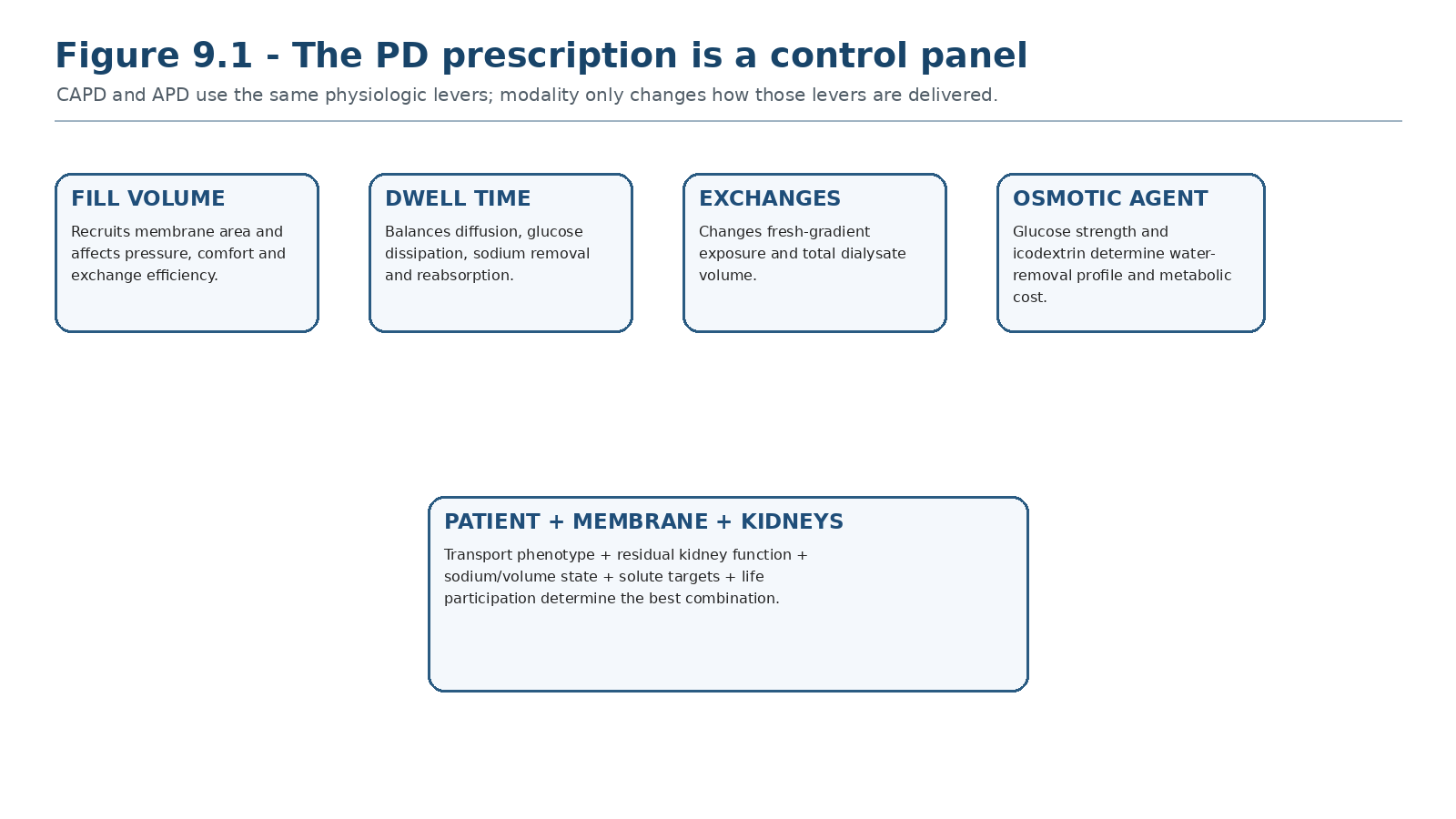
CAPD and APD use the same fundamental levers. The art of prescribing is choosing which lever to change for the dominant clinical problem while preserving residual kidney function, sodium-volume control, tolerability and life participation.
| MASTER PRINCIPLE Do not optimize the machine; optimize the patient. A technically elegant prescription that disrupts sleep, creates recurrent drain pain, increases glucose exposure or is not actually completed is not an optimized prescription. |
|---|
0. One-page chapter map
Table 9.1 - The eight decisions that govern PD prescription optimization.
| Decision | Core question | Bedside output |
|---|---|---|
| 1. Goal | What problem are we solving now? | Named target: volume, sodium, solute, phosphate, symptoms or burden |
| 2. Delivery | What treatment is actually being delivered? | Verified exchange/cycler record and adherence |
| 3. Membrane | How quickly does this membrane transport solute and dissipate glucose? | PET-informed dwell strategy |
| 4. Kidney | How much residual kidney support remains? | Renal contribution and escalation trigger |
| 5. Architecture | CAPD, APD or combined pattern? | Delivery mode matched to physiology and lifestyle |
| 6. Lever | Which one change is most likely to correct the mechanism? | Dwell/fill/cycle/day dwell/osmotic-agent change |
| 7. Trade-off | What might improve while something else worsens? | Explicit sodium, phosphate, glucose, sleep and pressure consequences |
| 8. Verify | Did the patient improve and was the prescription sustainable? | Clinical + measured + patient-reported reassessment |
Learning outcomes
Compare CAPD and APD without assuming that one modality is intrinsically superior.
Use transport phenotype, residual kidney function and the clinical target to choose dwell architecture.
Predict how fill volume, dwell time, number of exchanges, total dialysate volume and osmotic agent alter solute and fluid transport.
Optimize APD by distinguishing programmed treatment from delivered treatment, including lost dwell time and drain interruptions.
Recognize when short APD cycles protect ultrafiltration but compromise sodium or phosphate removal.
Use icodextrin deliberately for the long dwell rather than as a generic marker of an advanced prescription.
Use tidal PD selectively for drain intolerance or recurrent drain-related interruptions after correctable causes are excluded.
Reassess every prescription change for clinical benefit, glucose burden, sleep, pain, adherence and treatment burden.
| EVIDENCE POSTURE ISPD 2020 goal-directed recommendations and the 2021 membrane-function recommendations anchor the physiologic approach. The 2024 Cochrane update found low- to very-low-certainty randomized evidence insufficient to establish overall superiority of APD or CAPD. Icodextrin has stronger randomized evidence for improving long-dwell ultrafiltration. Evidence for adapted/tidal APD, sodium/phosphate optimization and remote-monitoring-enabled delivery is supportive but more context dependent. [1–10] |
|---|
1. CAPD and APD are architectures, not competing definitions of adequacy
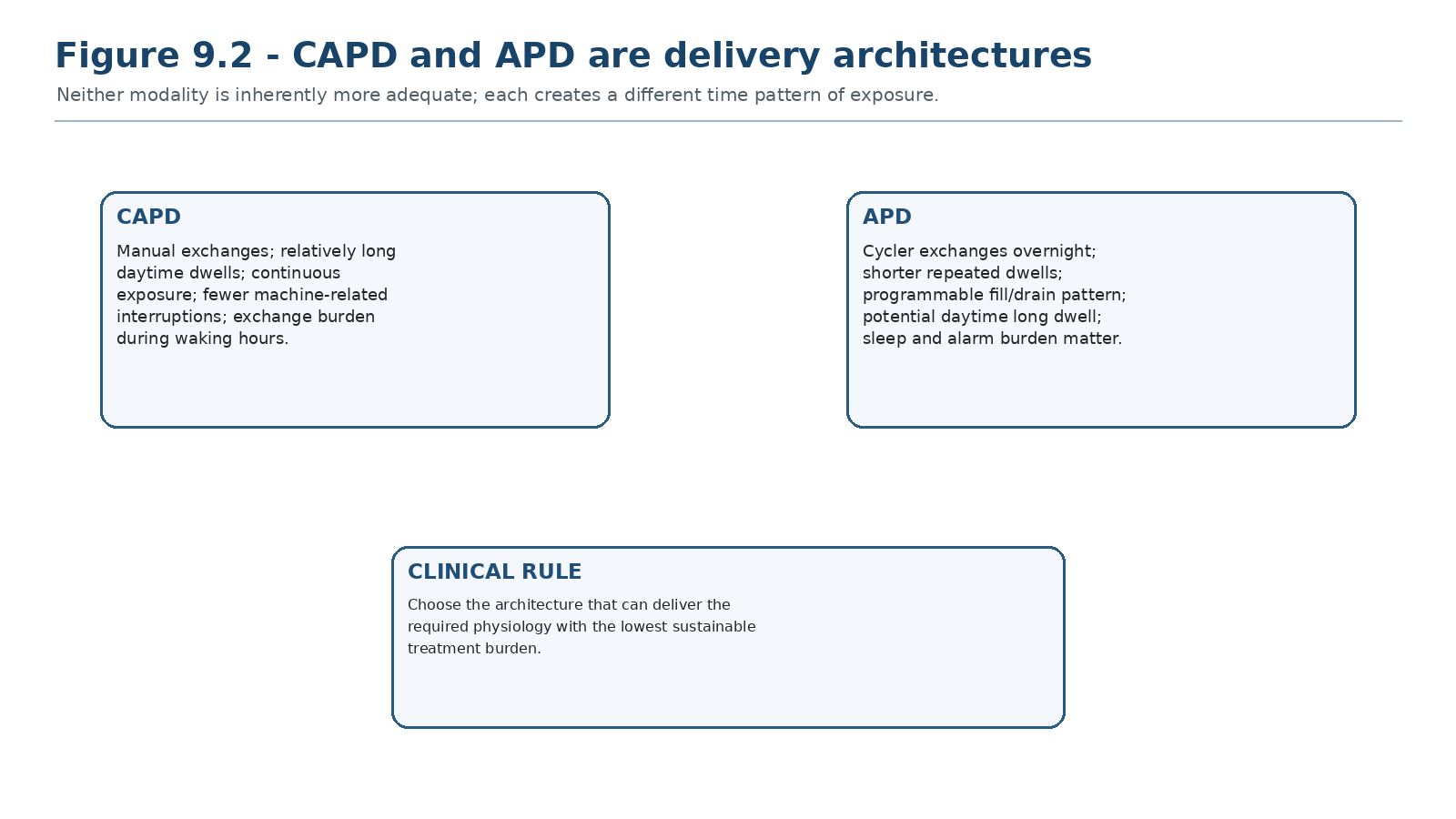
Both modalities can deliver high-quality PD when the prescription fits the membrane, residual kidney function, clinical goals and patient priorities. The randomized comparative evidence does not support a universal modality hierarchy.
CAPD delivers exchanges manually across the waking day, usually creating longer and more continuous dwells. APD uses a cycler to deliver repeated exchanges, commonly overnight, with or without one or more daytime dwells. These time patterns change the balance among ultrafiltration, small-solute clearance, sodium removal, phosphate removal and treatment burden. The 2024 Cochrane update included only two small randomized trials (131 participants) and judged the evidence very uncertain for mortality, hospitalization, peritonitis, residual kidney function, quality of life, volume status and adequacy. [3]
Table 9.2 - CAPD versus APD: what truly differs.
| Dimension | CAPD tendency | APD tendency |
|---|---|---|
| Exchange timing | Longer manual daytime dwells | Shorter repeated nocturnal dwells |
| Lifestyle burden | Interrupts daytime activity | Shifts treatment to sleep period |
| Machine dependence | None during exchanges | Cycler, power, supplies and alarms |
| Fast transporter UF | Long glucose dwell may lose UF | Shorter glucose dwells can protect UF |
| Sodium removal | Often greater per day | Can be lower when short dwells dominate |
| Phosphate removal | Long contact time may help | Can be lower with very short cycles, especially in slower transporters |
| Drain discomfort | Manual drain pattern | Repeated cycler drains may provoke pain/alarms |
| Data visibility | Manual logs/weights | Detailed cycle-level data possible on modern platforms |
| DO NOT AUTOMATE A fast transporter is not automatically an APD patient, and a slow transporter is not automatically a CAPD patient. Transport physiology narrows the prescription options; patient priorities and actual delivery complete the decision. |
|---|
2. Start optimization by naming the limiting outcome
“Increase dialysis” is not a diagnosis. A prescription can be adequate for urea and inadequate for sodium, adequate for volume and inadequate for phosphate, or biochemically satisfactory but intolerable. Each problem requires a different lever.
Table 9.3 - Clinical problem -> primary prescription question.
| Problem | Ask first | Typical lever domain |
|---|---|---|
| Volume overload | Intake, urine, net UF or sodium-removal mismatch? | Osmotic agent, dwell pattern, sodium strategy, day dwell |
| Low small-solute clearance | Collection/delivery valid? RKF changed? | Total effective exchange volume/contact time |
| Hyperphosphatemia | Diet/binders/RKF vs inadequate long contact time? | Longer dwell or architecture with greater contact time |
| Poor long-dwell UF | Fast PSTR or intrinsic low UF capacity? | Icodextrin, shorter glucose dwell, membrane pathway |
| High glucose burden | Is hypertonicity compensating for an uncorrected mechanism? | Icodextrin, sodium strategy, optimized dwell, RKF protection |
| Sleep disruption | Alarms, drain pain, long therapy or setup burden? | Mechanical correction, cycle redesign, tidal strategy, CAPD |
| Daytime burden | Manual exchange frequency incompatible with life? | APD or assisted exchange strategy |
| Recurrent noncompletion | Complexity, dexterity, cognition or device problem? | Simplify/assist rather than merely intensify |
3. The core prescription levers
Table 9.4 - Prescription lever -> physiologic effect -> trade-off.
| Lever | What it changes | Trade-off to anticipate |
|---|---|---|
| Fill volume | Membrane recruitment and solute mass transfer | Higher intraperitoneal pressure, reflux, leaks, discomfort |
| Dwell time | Diffusion time and osmotic-gradient decay | Longer can improve phosphate/creatinine but reduce glucose UF in fast PSTR |
| Exchange number | Fresh-gradient frequency and total dialysate turnover | More connections/CAPD burden or shorter APD dwells |
| Total therapy time | Total contact time | Sleep/time burden |
| Glucose concentration | Crystalloid osmotic force | Systemic/peritoneal glucose exposure |
| Icodextrin long dwell | Sustained colloid osmotic UF | One long dwell; product-specific safety considerations |
| Day dwell / last fill | Adds contact time and daytime removal | Abdominal fullness; long-dwell UF must be appropriate |
| Tidal fraction | Avoids complete repetitive drains | Residual volume, clearance implications and more complex programming |
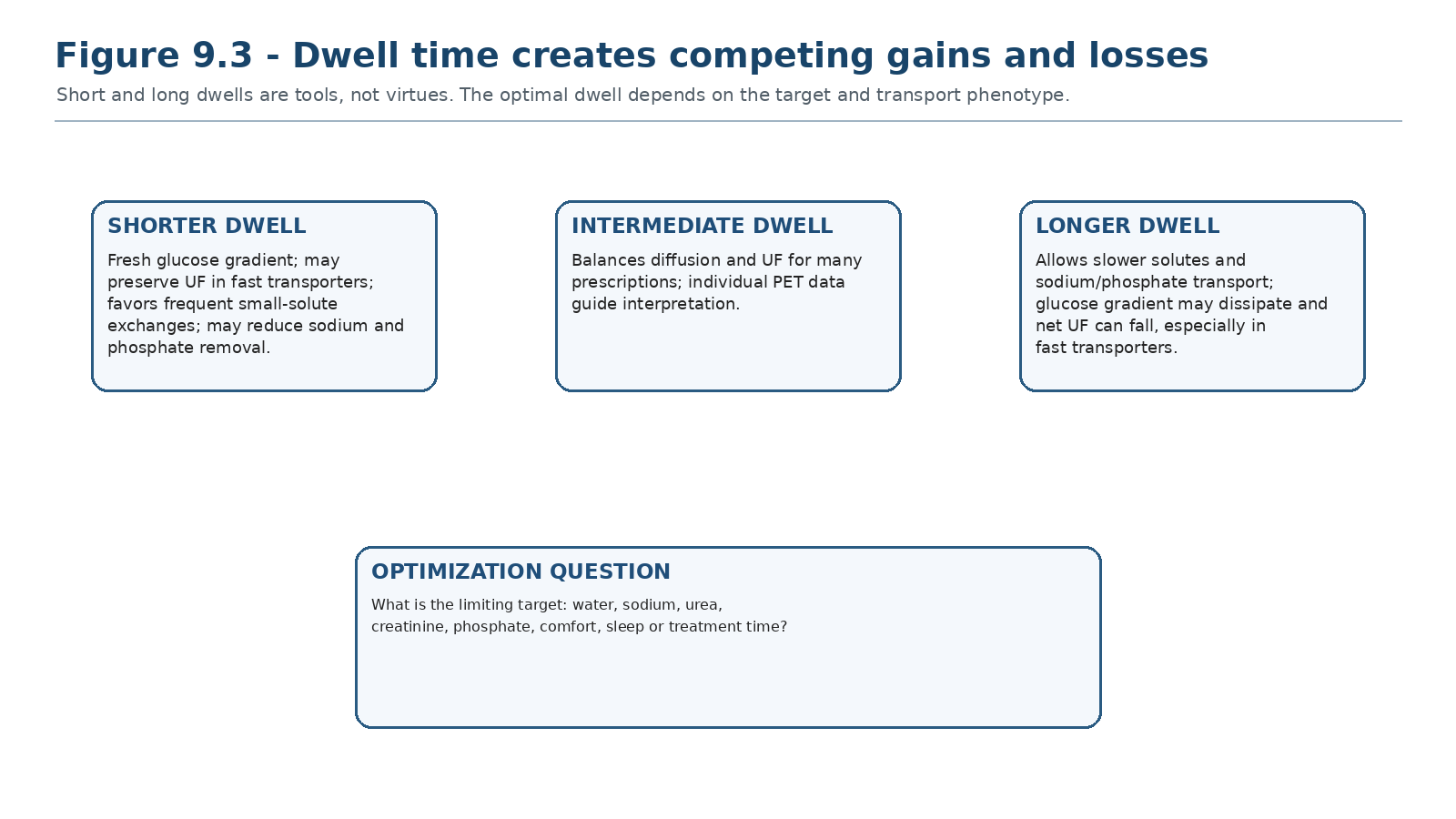
Optimization is target-specific: shorter glucose dwells can protect UF in fast transporters, whereas longer contact can improve slower solute and phosphate removal. There is no universally ideal dwell time.
4. Fill volume: recruit membrane without prescribing pressure
Larger intraperitoneal volumes can increase effective peritoneal surface recruitment and solute mass transfer, but the pressure response varies greatly among patients. Historical physiologic studies show that intraperitoneal pressure rises as fill volume increases and is related imperfectly to body size. The clinical prescription should therefore be individualized to tolerance, leak/hernia risk, respiratory mechanics and effective clearance rather than using a single adult fill-volume number as a universal target. [11,12]
Table 9.5 - Fill-volume reasoning.
| Finding | Interpretation | Direction |
|---|---|---|
| Low volume, comfortable, poor clearance | Potential under-recruitment / insufficient exchange mass | Increase carefully if anatomy and pressure tolerance allow |
| Reflux, dyspnea, abdominal tension | Pressure intolerance | Reduce fill; assess position and mechanical complications |
| New leak or hernia | Excess pressure may contribute | Lower intraperitoneal pressure and enter mechanical pathway |
| Obesity/large BSA | May require larger absolute volume for efficiency | Individualize; do not scale by weight alone |
| Frail/small patient | Standard large fill may be burdensome | Prioritize tolerance and effective rather than nominal dose |
| PRESSURE DISCIPLINE A larger patient does not automatically tolerate a larger intraperitoneal pressure, and a smaller patient is not necessarily adequately dialyzed by a small exchange. Treat fill volume as a titratable physiologic variable. |
|---|
5. Dwell time: match the target to the transport phenotype
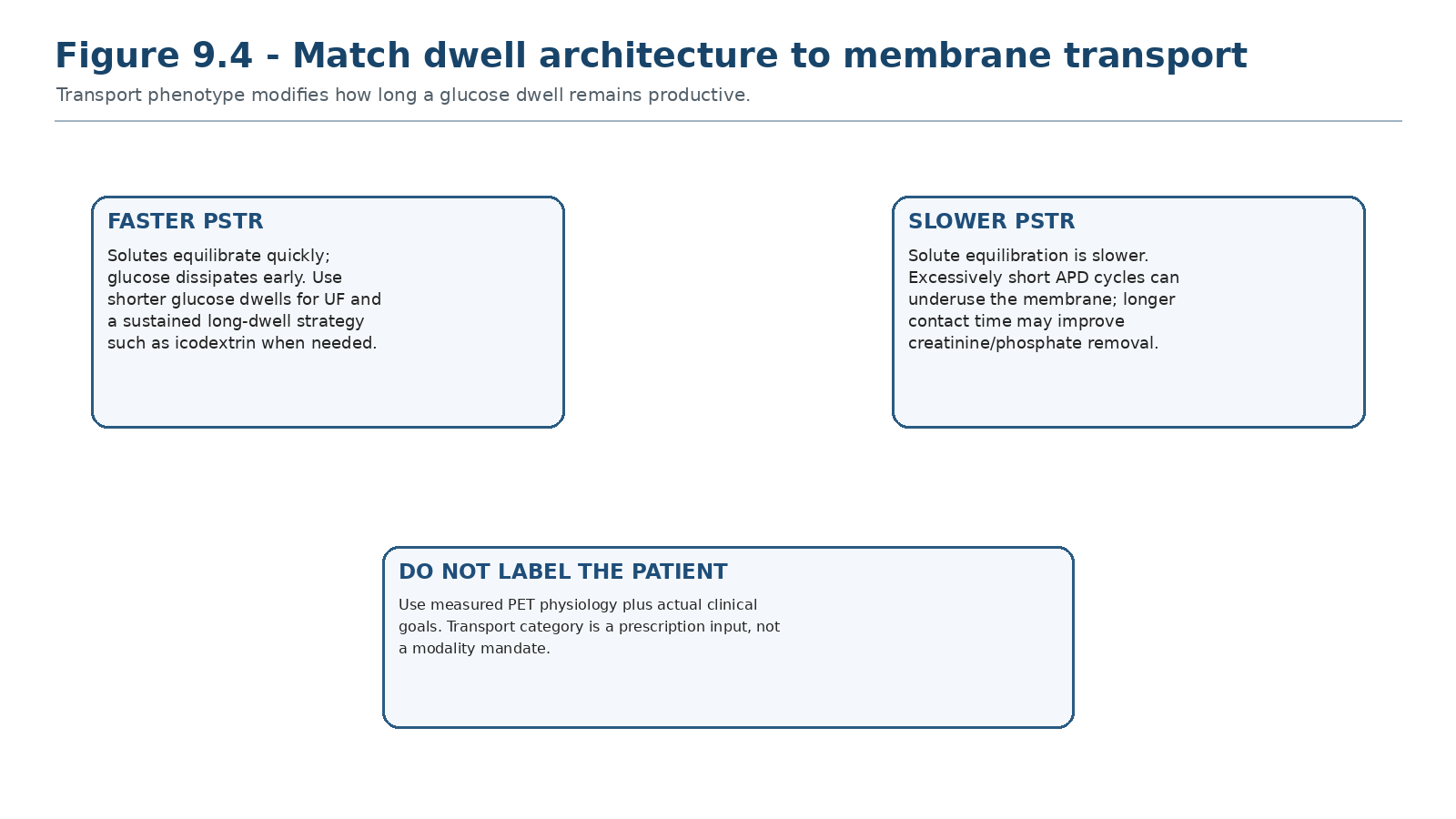
Faster PSTR favors shorter productive glucose dwells for UF; slower PSTR often needs more contact time for solute and phosphate transfer. Icodextrin changes long-dwell osmotic behavior and should be considered separately from glucose.
ISPD membrane recommendations emphasize that faster PSTR is associated with more rapid glucose absorption and lower net UF during long glucose dwells. Shortening glucose-based exchanges and using icodextrin for a long dwell can mitigate this physiology. Conversely, in slower transport, excessively short automated cycles may sacrifice creatinine and phosphate transfer even when urea clearance appears acceptable. [1,2,13–15]
Table 9.6 - Dwell strategy by transport pattern.
| Pattern | Useful strategy | Common error |
|---|---|---|
| Fast PSTR + poor long glucose UF | Short glucose dwells + icodextrin long dwell | Making every dwell hypertonic and long |
| Fast PSTR + sodium overload | Protect UF but ensure enough sodium-coupled contact | Equating high water UF with sodium removal |
| Slow PSTR + low creatinine/phosphate clearance | Longer contact and/or daytime dwell | Adding more very short APD cycles |
| Intermediate phenotype | Balance dwell objectives using measured response | Overfitting to transporter label |
| Changing membrane over time | Repeat membrane assessment when clinically indicated | Carrying forward an old PET forever |
6. Number of exchanges and total dialysate volume: more is not always better
Increasing the number of exchanges increases exposure to fresh dialysate gradients and can improve small-solute clearance, particularly when residual kidney function falls. But if total treatment time is fixed, adding cycles shortens dwell time. This can improve UF in a fast transporter while reducing phosphate or sodium removal in another phenotype. The prescriber must know whether the intervention increases total contact time, only divides existing time into more cycles, or both.
Table 9.7 - What happens when cycles are added?
| Change | Potential gain | Potential loss |
|---|---|---|
| More cycles, same total time | More fresh glucose gradients; shorter dwells | Less time per cycle for slower solutes |
| More cycles + longer treatment time | Higher total dialysate and contact | Greater burden/sleep disruption |
| More CAPD exchanges | More total daily clearance/UF opportunities | Manual connections and daytime interruption |
| Add daytime exchange to APD | More sodium/solute/phosphate contact | Daytime fullness and extra handling |
| Increase last-fill volume | More long-dwell exchange mass | Pressure/tolerance and long-dwell UF must fit |
7. CAPD optimization: use long dwell time intentionally
CAPD is not simply “four bags a day.” Its strengths are continuous contact, long dwell time, straightforward observation and relative independence from a machine. Its weaknesses are daytime exchange burden and the risk that a fast transporter spends too long in a glucose dwell after the osmotic gradient has dissipated.
Table 9.8 - CAPD optimization patterns.
| Problem | Mechanism | Possible response |
|---|---|---|
| Fast transporter, negative/poor long-dwell UF | Rapid glucose absorption | Use icodextrin for the longest dwell; shorten problematic glucose dwell |
| Low clearance with RKF decline | Total exchange dose no longer sufficient | Increase exchange volume/number if tolerated and indicated |
| High phosphate | Need more effective diffusive contact + non-dialytic control | Preserve long dwells; address diet/binders/RKF |
| Daytime work burden | Manual schedule incompatible with life | Re-time exchanges, simplify or consider APD |
| High glucose exposure | Osmotic overprescription or intake mismatch | Correct sodium/volume mechanism; use glucose-sparing long dwell when appropriate |
8. APD optimization: treat the night as a timed transport experiment
APD allows precise manipulation of total treatment time, number of cycles, fill volume, dwell time, drain thresholds and last fill. This flexibility can become counterproductive when the prescription is optimized for a machine metric instead of the patient. A shorter cycle may improve one target while undermining another; a longer night may increase clearance while damaging sleep and adherence.
Table 9.9 - APD control panel.
| APD variable | Physiologic purpose | Bedside check |
|---|---|---|
| Total night time | Total contact and treatment opportunity | Did the patient actually receive it? |
| Number of cycles | Fresh-gradient frequency | What dwell time does this create? |
| Fill volume | Exchange mass and membrane recruitment | Tolerance, pressure, leak risk |
| Drain settings | Avoid unnecessary interruption | Incomplete drain vs overdrain pain |
| Last fill | Long daytime contact | Icodextrin/glucose fit and daytime tolerance |
| Day exchange | Adds clearance/sodium/phosphate contact | Manual burden and schedule |
| Tidal mode | Reduces repeated complete drains | Use for a defined indication, not routine clearance inflation |
9. Adapted APD: vary the cycle because the targets differ
A small randomized crossover trial showed that an “adapted APD” strategy using different fill volumes and dwell durations within the same night improved several clearance measures and sodium removal compared with uniform cycles using the same total treatment duration and dialysate volume. This supports the physiology that one repeated cycle is not necessarily optimal for every transport target, but the evidence base is small and does not justify a universal adapted-APD protocol. [16]
Table 9.10 - Why vary cycles?
| Cycle type | Dominant aim | Trade-off |
|---|---|---|
| Shorter, smaller early cycles | Fresh gradient and UF | Less per-cycle slower-solute contact |
| Longer, larger later cycles | Creatinine/phosphate and sodium transfer | More pressure and glucose-gradient decay |
| Uniform conventional cycles | Simplicity and predictability | May not maximize competing goals |
| Customized mixed pattern | Mechanism-specific optimization | Programming complexity and evidence limitations |
| EVIDENCE CALIBRATION Adapted APD is a physiologically attractive strategy supported by a small crossover RCT. Treat it as a tool for selected patients, not an outcome-proven standard for all APD prescriptions. |
|---|
10. Sodium removal: the water number can mislead
A 2019 systematic review found lower dialytic sodium removal with APD than CAPD on average, despite no significant difference in UF, with substantial heterogeneity and strong modification by transport status. Short APD dwells can favor aquaporin-mediated free-water transport and sodium sieving. Persistent edema or hypertension despite apparently good UF should therefore trigger a sodium-balance review rather than automatic escalation of glucose. [17]
Table 9.11 - How to improve sodium removal when clinically needed.
| Mechanism | Prescription direction | Caution |
|---|---|---|
| Very short APD dwells | Increase time for small-pore sodium transport | Do not sacrifice needed UF in fast PSTR |
| No daytime dwell | Add appropriate long contact when needed | Assess daytime tolerance |
| Poor long glucose dwell UF | Use icodextrin | Follow product-specific safety rules |
| High dietary sodium | Reduce input first | Do not “dialyze around” uncontrolled intake |
| Falling RKF | Renal sodium removal lost | Reassess total sodium and water strategy |
11. Icodextrin: optimize the long dwell, not the whole day
Icodextrin produces sustained colloid osmotic ultrafiltration during a long dwell and is particularly useful when a glucose gradient dissipates before the dwell ends. In a 2020 meta-analysis of 19 randomized trials (1,693 participants), icodextrin improved ultrafiltration and reduced episodes of fluid overload compared with glucose-based long dwells. It should be prescribed for a defined long-dwell purpose rather than used as a proxy for “stronger dialysis.” [5]
Table 9.12 - Long-dwell selection.
| Situation | Glucose long dwell | Icodextrin long dwell |
|---|---|---|
| Fast PSTR | Gradient may dissipate with reabsorption | Often physiologically advantageous |
| Need sustained daytime/night UF | May require higher glucose exposure | Sustained colloid osmotic force |
| Good glucose long-dwell UF, low burden | May remain appropriate | No automatic need to switch |
| Diabetes/high glucose burden | Adds systemic glucose absorption | Glucose-sparing advantage |
| Low osmotic conductance | May not fully solve intrinsic membrane failure | Use within membrane-failure framework |
12. Phosphate: the reason urea-only optimization can fail
Phosphate behaves differently from urea. Observational studies show that phosphate clearance is influenced by PD modality, transport status and contact time, and may be lower in APD prescriptions dominated by short cycles. In a 2020 cohort, dialytic phosphate removal was lower in APD than CAPD/CCPD, while earlier studies similarly associated longer dwell regimens with greater phosphate clearance in slower transporters. These data do not make phosphate a stand-alone dialysis dose target, but they explain why hyperphosphatemia can persist despite apparently satisfactory Kt/V. [13–15]
Table 9.13 - Hyperphosphatemia on PD: prescription reasoning.
| Question | Why it matters | Action direction |
|---|---|---|
| RKF falling? | Renal phosphate removal may have dropped | Reassess total kidney + PD support |
| Diet/binders adequate? | Dialysis alone is not the whole phosphate strategy | Correct non-dialytic drivers |
| APD cycles extremely short? | Insufficient diffusive contact for phosphate | Lengthen selected dwells / add contact time |
| Slow transporter? | May need longer diffusion time | Avoid solving with more short cycles |
| Kt/V adequate? | Urea clearance does not guarantee phosphate control | Do not stop reasoning at Kt/V |
13. Glucose burden: the hidden price of a “successful” prescription
Glucose-based PD is effective because glucose supplies osmotic force, but absorbed glucose contributes metabolic load and long-term peritoneal exposure. The goal is not glucose avoidance at all costs; it is avoiding glucose that is compensating for a correctable problem such as high sodium intake, excessively long glucose dwells in fast PSTR, poor drain mechanics or underuse of icodextrin. Diabetes management must also account for changing glucose exposure when the PD prescription changes. [5,18,19]
Table 9.14 - When glucose exposure is rising.
| Ask | If yes | Response |
|---|---|---|
| Is congestion driven by sodium intake? | More glucose treats downstream water only | Correct sodium balance |
| Is the long dwell reabsorbing? | Higher glucose may give only temporary gain | Shorten glucose dwell/use icodextrin |
| Is RKF declining? | Total support genuinely fell | Increase PD support deliberately |
| Is catheter drainage impaired? | More osmotic force cannot fix outflow | Mechanical pathway |
| Is diabetes control worsening? | PD glucose is part of glycemic exposure | Coordinate insulin/diabetes plan |
14. Delivered APD: cycler alarms can erase the prescription
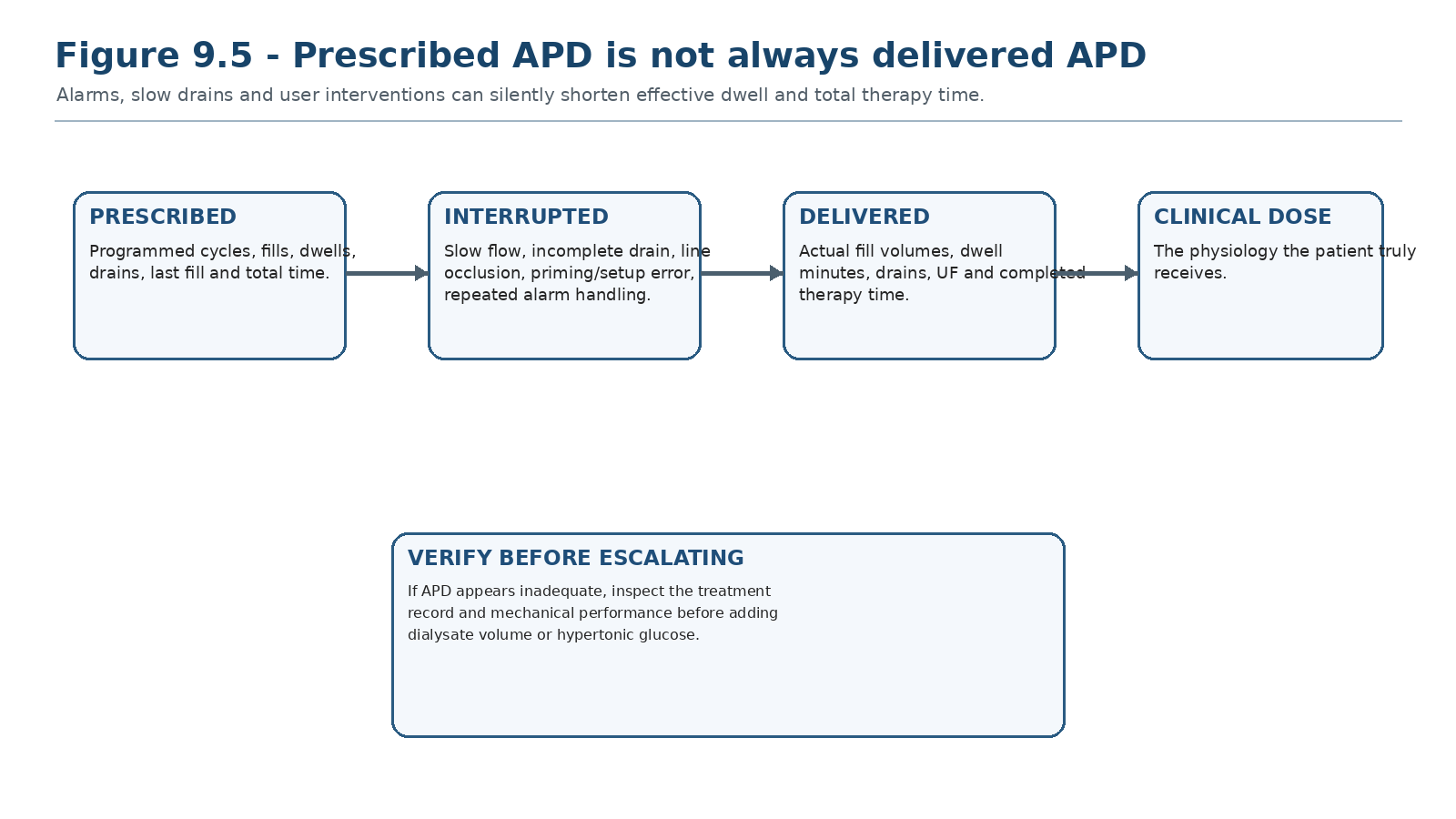
Modern cycler records can expose slow drains, incomplete cycles and lost dwell time. The clinical dose is what occurred, not what was entered into the program.
In a 2024 inpatient APD study, lost dwell time greater than 30 minutes occurred in 27% of treatments and greater than 60 minutes in 20%; slow outflow and inadequate drain volumes were major contributors. Although inpatient results do not directly define home APD performance, they demonstrate the principle that repeated drain interruptions can materially reduce effective therapy. [8]
Table 9.15 - APD record review after an unexplained problem.
| Look for | Meaning | Next action |
|---|---|---|
| Repeated slow-flow alarms | Drain resistance/position/constipation/device issue | Localize mechanism |
| Lost dwell time | Less true transport time than prescribed | Correct cause before increasing dose |
| Incomplete final drain | Residual volume / drain mechanics | Assess catheter and drain settings |
| Frequent user overrides | Burden, misunderstanding or recurrent fault | Retrain and diagnose |
| Large difference prescribed vs delivered UF | Mechanical, data or physiologic mismatch | Verify weights and drain record |
| Nightly variability | Position, bowel status, adherence or evolving catheter issue | Trend, do not rely on one night |
15. Drain pain and tidal PD: comfort can be a prescription endpoint
Drain pain is common enough to threaten sleep and technique persistence. PDOPPS data confirm that drain pain remains a clinically relevant patient-reported problem. Tidal PD leaves a residual intraperitoneal volume between cycles and can reduce pain from repeated complete drains; older physiologic literature suggests no inherent clearance advantage when total dialysate flow is comparable. It should therefore be used for comfort or selected drainage problems after mechanical causes are assessed, not as a routine “stronger” APD mode. [9,20,21]
Table 9.16 - Tidal PD reasoning.
| Situation | Tidal strategy? | First safeguard |
|---|---|---|
| Pain only at complete drain | Potentially useful | Exclude catheter/constipation/peritonitis causes |
| Recurrent low-drain alarms from overdrain | May reduce interruption | Confirm true drain mechanics |
| Poor clearance without pain | Not a default solution | Identify limiting transport/delivery variable |
| Progressive residual volume accumulation | Potential underdrain | Reassess tidal percentage and final drainage |
| New severe abdominal pain | Do not mask with programming | Clinical assessment first |
16. Remote monitoring: useful delivery intelligence, not a substitute for physiology
Remote monitoring can make treatment completion, alarms, UF and adherence visible between clinic visits. A 2025 cluster-randomized trial reported fewer deaths and cardiovascular/fluid-overload-related events in remote-monitoring-enabled APD, and a 2026 nationwide Taiwan cohort found associations with lower mortality, lower transfer to hemodialysis and fewer hospitalizations. These results are important but do not prove that remote monitoring itself is the active mechanism in every setting; implementation, response pathways and confounding remain relevant. Full digital-care architecture is developed in Chapter 18. [6,7]
| DATA RULE Remote data are clinically useful only when they trigger a defined response. A dashboard that records recurrent slow drains without anyone correcting the cause is surveillance without care. |
|---|
17. Prescription response by phenotype
Table 9.17 - Phenotype -> preferred first optimization direction.
| Phenotype | First direction | Avoid |
|---|---|---|
| Fast PSTR + poor long glucose UF | Shorter glucose dwells + icodextrin long dwell | Long hypertonic glucose dwells by reflex |
| Slow PSTR + low clearance/phosphate | Increase effective contact time | More very short cycles |
| Volume overload + good water UF | Assess sodium input/removal | Chasing even higher UF only |
| Anuria with rising solute burden | Increase total PD support while preserving tolerability | Assuming old incremental prescription remains sufficient |
| High glucose exposure | Correct mechanism + glucose-sparing long dwell where appropriate | Accepting hypertonicity as permanent baseline |
| Recurrent APD lost dwell | Fix delivery/mechanics | Increasing programmed dose |
| Drain pain | Mechanical review + selected tidal strategy | Normalizing nightly pain |
| Unsustainable treatment burden | Simplify/assist/change architecture | Defining nonadherence as patient failure |
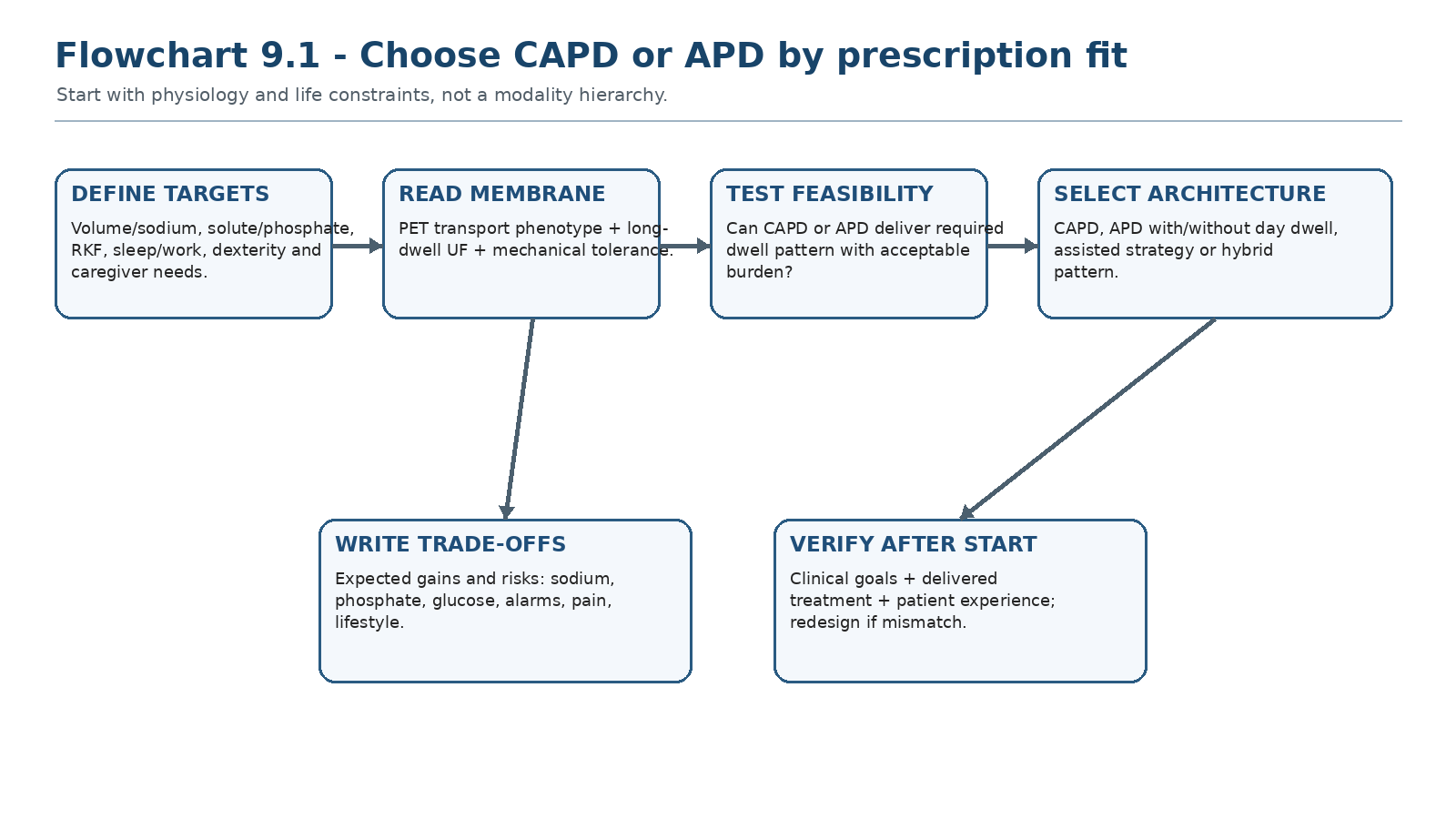
The correct modality is the one that can deliver the required dwell architecture and clinical goals with acceptable burden, support and reliability.
18. When a target is not met: a universal optimization algorithm
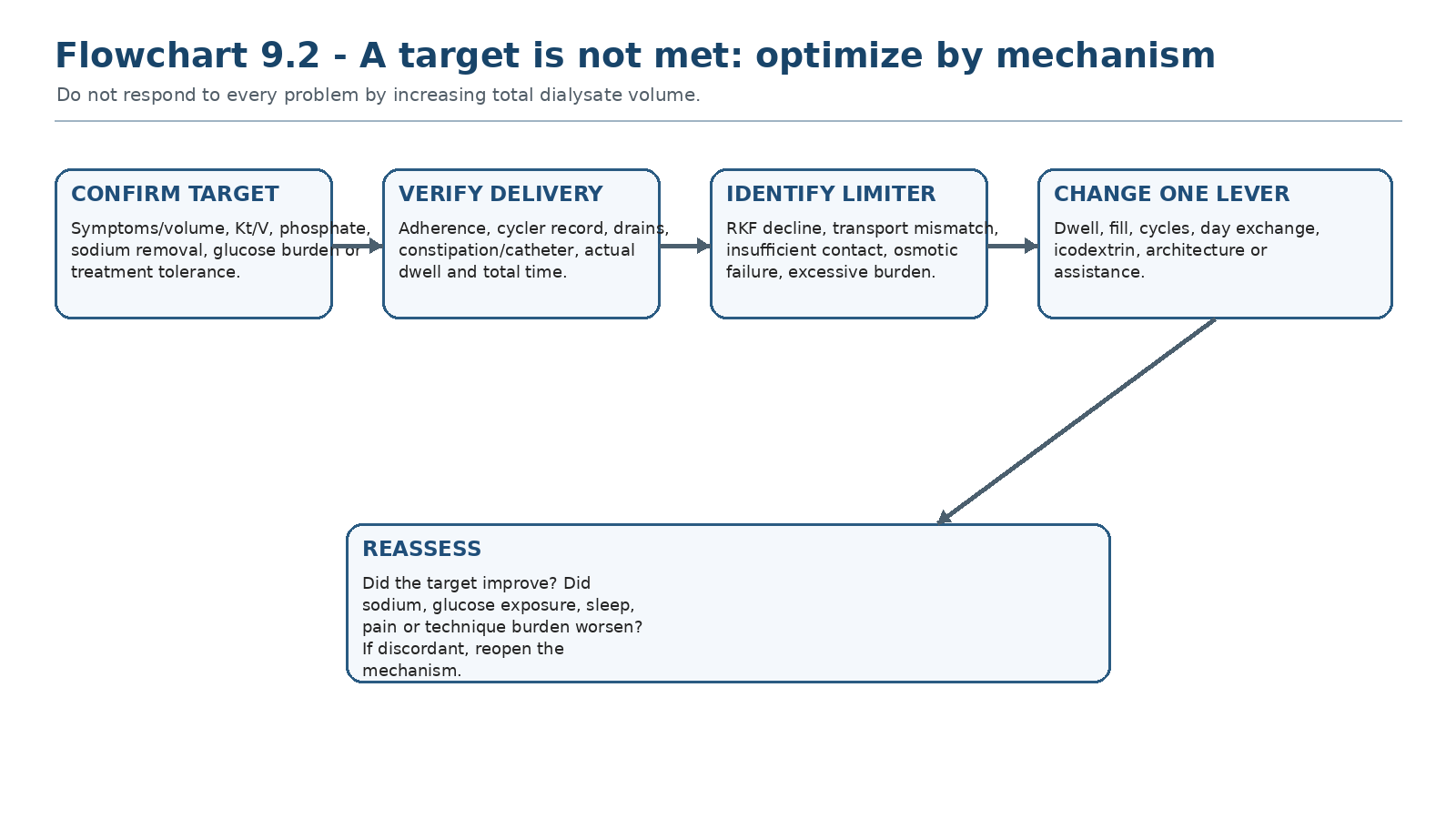
Confirm the target, validate actual treatment delivery, identify the limiting mechanism, change the smallest effective lever and reassess both benefit and trade-offs.
Table 9.18 - Reassessment after any prescription change.
| Domain | Pass criterion |
|---|---|
| Clinical | Symptoms/volume/biochemistry move in intended direction |
| Delivery | Prescription is actually completed |
| Membrane | Response matches expected transport physiology |
| Kidney | RKF/urine contribution remains protected where possible |
| Burden | Sleep, work, pain and exchange complexity acceptable |
| Metabolic | No unnecessary escalation of glucose exposure |
| Safety | No new leak, pressure intolerance, hypovolemia or mechanical problem |
| Plan | Next trigger for review is documented |
19. Recurrent APD alarms: troubleshooting the delivered prescription
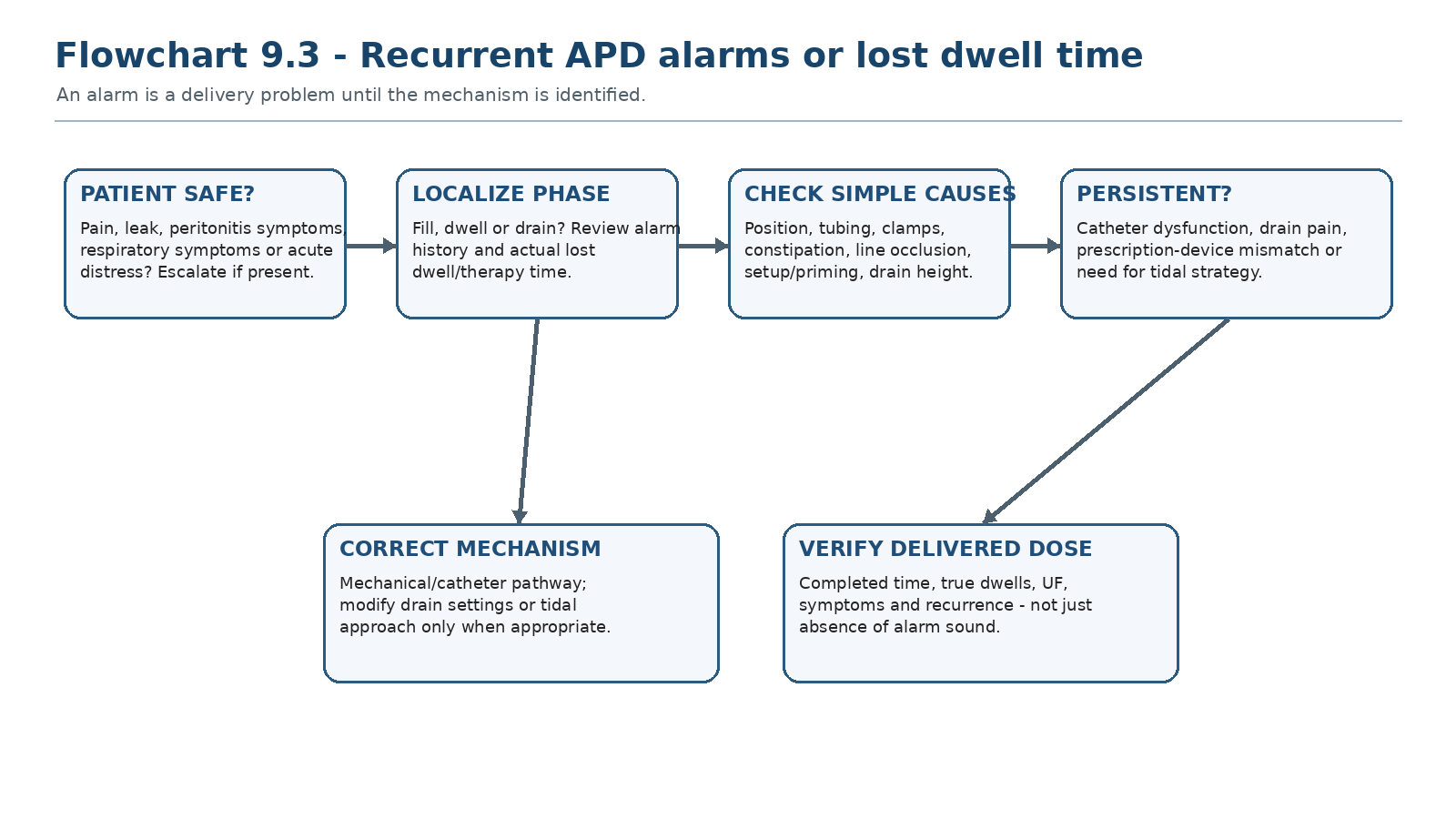
Repeated alarm silencing is not prescription optimization. Localize the treatment phase, exclude simple causes, enter the catheter/mechanical pathway when needed, and verify restored delivered therapy.
Table 9.19 - Alarm phenotype -> likely cause -> response.
| Pattern | Likely cause | Response |
|---|---|---|
| Slow drain after position change | Catheter/tubing geometry | Reposition; inspect; trend recurrence |
| Slow drain most nights | Constipation, catheter migration, drain settings | Bowel + catheter pathway |
| Pain at end drain | Overdrain/contact pain | Exclude pathology; consider tidal strategy |
| Low drain + abdominal swelling | Leak/sequestration | Stop “dose escalation”; investigate leak |
| Lost dwell from repeated alarms | Delivery inefficiency | Correct source, then reassess adequacy/UF |
| Alarm only in hospital | Setup/position/environment issue possible | Compare home data and nursing process |
20. Patient burden and life participation are prescription outcomes
The ISPD goal-directed framework explicitly places life participation, symptoms and treatment burden alongside biochemical and volume goals. A patient may prefer manual daytime exchanges to protect sleep, or APD to protect work and daytime independence. The choice can change with frailty, employment, caregiver availability, visual/dexterity decline, transplant planning or changing residual kidney function. [1,22]
Table 9.20 - Burden signals that should trigger redesign.
| Signal | Interpretation | Redesign option |
|---|---|---|
| Repeated skipped CAPD exchanges | Schedule burden or technique barrier | Re-time, simplify, assist or consider APD |
| Nightly APD sleep disruption | Alarms/pain/therapy duration | Correct mechanism; shorten/reconfigure or consider CAPD |
| Caregiver exhaustion | Hidden sustainability failure | Assisted PD/resource review |
| Patient declines day dwell | Life-participation conflict | Rebalance night time/cycles; discuss trade-off |
| Complex prescription errors | Cognitive/visual/manual overload | Simplify; retrain; assist |
| Adequate numbers, poor quality of life | Treatment goal mismatch | Shared redesign rather than numeric intensification |
21. Clinical pearls and common pitfalls
Table 9.21 - High-frequency prescription errors.
| Pitfall | Why it fails | Correction |
|---|---|---|
| APD is “better” than CAPD | RCT evidence does not establish superiority | Choose by fit and goals |
| Fast transporter = APD automatically | Oversimplifies sodium, day dwell and lifestyle needs | Match dwell pattern, not label |
| More cycles always means more dialysis | Shortens dwell when time fixed | Identify target and contact-time effect |
| Higher UF means better sodium removal | APD can remove proportionally more water | Assess sodium balance separately |
| Adequate Kt/V means phosphate is solved | Phosphate needs longer contact and RKF/non-dialytic control | Review phosphate specifically |
| Escalate programmed dose when APD inadequate | Actual delivery may be interrupted | Review cycler record first |
| Drain pain is normal | Pain reduces sleep and adherence and may signal pathology | Assess cause; consider tidal only when appropriate |
| Use hypertonic glucose indefinitely | Raises metabolic/membrane burden | Correct mechanism and use lowest effective osmotic dose |
| Keep old prescription as RKF falls | Total support declines silently | Reassess urine/RKF and total goals |
| Optimize numbers at the expense of life | Unsustainable treatment fails in practice | Include patient-reported outcomes |
| CLINICAL PEARL The best APD prescription is often the simplest one that delivers enough true dwell time. Complexity is not a marker of sophistication. |
|---|
| CLINICAL PEARL If sodium or phosphate is the problem, ask whether the prescription needs more contact time rather than more cycles. |
|---|
| CLINICAL PEARL A day dwell is a powerful APD lever because it adds time without further fragmenting the night. |
|---|
| CLINICAL PEARL When the prescription is failing, compare what was prescribed, what the machine delivered and what the patient tolerated - three different datasets. |
|---|
22. Mini-cases: prescription decisions, not trivia
Case 1 - Fast transporter with edema
A patient on CAPD has adequate small-solute clearance but negative UF during the longest glucose dwell and persistent edema. PET shows fast PSTR.
| BEST NEXT STEP Shorten the problematic glucose exposure and use icodextrin for the long dwell if appropriate. Reassess sodium intake/removal; do not simply make the long glucose dwell more hypertonic. |
|---|
Case 2 - Slow transporter on many short APD cycles
An anuric patient has acceptable weekly Kt/V but persistent hyperphosphatemia and low creatinine/phosphate clearance. Night therapy contains many short cycles.
| BEST NEXT STEP Do not add more short cycles reflexively. Increase effective contact time - selected longer dwells, longer total therapy and/or an appropriate daytime dwell - while addressing diet and binders. |
|---|
Case 3 - “Inadequate APD” with alarms
Laboratory adequacy falls after hospitalization. The cycler prescription is unchanged, but nightly records show repeated slow drains and 50-70 minutes of lost dwell time.
| BEST NEXT STEP Treat this as delivery failure. Correct constipation, position, tubing or catheter dysfunction and verify restored dwell time before prescribing more dialysate. |
|---|
Case 4 - Good UF, uncontrolled hypertension
An APD patient removes 1.2 L nightly yet gains weight between visits and has high BP. Short cycles dominate and dietary sodium is high.
| BEST NEXT STEP Separate water from sodium. Address sodium intake and assess sodium-removal architecture; consider longer contact/day dwell rather than pursuing still higher water UF. |
|---|
Case 5 - Drain pain destroying sleep
A stable APD patient wakes repeatedly with sharp pain at the end of complete drains. Catheter position and bowel status are satisfactory and there are no infection features.
| BEST NEXT STEP A selected tidal strategy can be reasonable to avoid repeated complete drainage. Reassess residual volume, delivered clearance and symptom response. |
|---|
Case 6 - Treatment burden despite “perfect numbers”
A working patient on CAPD has excellent biochemical and volume control but regularly misses midday exchanges because they are incompatible with employment.
| BEST NEXT STEP This is a prescription failure, not a character flaw. Reconfigure schedule or consider APD/assistance while preserving the physiologic targets. |
|---|
23. Active recall
MUST MEMORIZE
What did the 2024 Cochrane update conclude about overall APD versus CAPD superiority?
Which prescription variables determine the dwell architecture of APD?
Why can short APD cycles preserve UF yet reduce sodium or phosphate removal?
What is the main long-dwell role of icodextrin?
What is the difference between prescribed APD and delivered APD?
MUST REASON
A fast transporter has poor long-dwell glucose UF but excellent urea clearance. Which lever would you change first and why?
An anuric slow transporter has normal Kt/V but high phosphate. Explain why more short cycles may fail.
How can recurrent slow drains produce biochemical underdialysis without any change in the programmed prescription?
Why can CAPD produce greater sodium removal than APD despite similar net UF?
How do you decide whether to change CAPD to APD when the real problem is treatment burden rather than physiology?
USE AS REFERENCE
Table 9.4 prescription levers and trade-offs.
Table 9.17 phenotype-based first optimization direction.
Flowchart 9.3 recurrent APD alarms/lost dwell time.
24. Flashcards: active recall
1. Q: APD superior to CAPD? A: Not established. The 2024 Cochrane randomized evidence is insufficient/very uncertain.
2. Q: Fast PSTR long glucose dwell? A: Glucose dissipates rapidly; shorten glucose dwell and consider icodextrin for the long dwell.
3. Q: Slow PSTR with poor phosphate clearance? A: Increase useful contact time rather than simply adding short cycles.
4. Q: More APD cycles with same total time does what? A: Shortens each dwell.
5. Q: Why can APD sodium removal be lower? A: Short dwells accentuate free-water transport and sodium sieving.
6. Q: Icodextrin main niche? A: Sustained once-daily long-dwell UF, especially when glucose long-dwell UF is poor.
7. Q: Prescribed dose vs delivered dose? A: Programmed treatment versus what actually occurred after alarms, drains and interruptions.
8. Q: Lost dwell time matters because? A: Transport occurs during dwell; lost time reduces effective therapy.
9. Q: Drain pain at complete drain? A: Exclude pathology/mechanics; tidal PD may help selected patients.
10. Q: Tidal PD gives superior clearance by default? A: No; its main chronic role is comfort/drain management in selected patients.
11. Q: Adequate Kt/V but high phosphate? A: Urea does not represent phosphate; review contact time, RKF, diet and binders.
12. Q: Good UF but edema/high BP? A: Assess sodium intake/removal - water UF alone can mislead.
13. Q: Day dwell in APD can do what? A: Add long contact for sodium, solute and phosphate removal and long-dwell UF.
14. Q: Rising glucose requirement means? A: Reassess intake, RKF, dwell fit, mechanics and membrane before normalizing hypertonicity.
15. Q: When to switch CAPD/APD? A: When another architecture better delivers required physiology with sustainable burden.
16. Q: Remote monitoring role in Chapter 9? A: Verify delivery and detect problems; full digital-care framework belongs to Chapter 18.
17. Q: Optimization endpoint? A: Target achieved + treatment actually delivered + burden acceptable + no disproportionate trade-off.
18. Q: Best first response to unexplained low APD adequacy? A: Validate collection and inspect delivered cycler treatment before increasing dose.
25. Rapid troubleshooting table
Table 9.22 - Prescription problem -> likely mechanism -> next step.
| Problem | Likely mechanism(s) | Next step |
|---|---|---|
| Poor long-dwell UF | Fast PSTR or intrinsic low UF capacity | PET context; shorter glucose dwell/icodextrin or membrane pathway |
| Low Kt/V after stable period | Collection error, noncompletion, RKF loss | Verify delivery/collection + urine; then increase effective dose if needed |
| High phosphate on short-cycle APD | Insufficient contact time + non-dialytic factors | Longer selected dwell/day exchange + diet/binders |
| Good UF + high BP/edema | Sodium mismatch | Review sodium input/removal and dwell architecture |
| Recurrent slow-drain alarms | Constipation/catheter/position/setup | Mechanical pathway before dose escalation |
| Nightly drain pain | Overdrain/contact pain or pathology | Assess; tidal strategy only after exclusion |
| High glucose burden | Intake/RKF/dwell/membrane mismatch | Correct driver; glucose-sparing strategy |
| Patient missing CAPD exchanges | Lifestyle/technique burden | Simplify, assist or consider APD |
| APD prescription “adequate” but symptoms persist | Wrong target or delivery mismatch | Reopen goal-directed assessment |
26. Final revision sheet
| TEN TAKE-HOME RULES 1) CAPD and APD are delivery architectures, not adequacy rankings. 2) Randomized evidence does not establish universal APD superiority. 3) Name the clinical target before changing the prescription. 4) Dwell time is the central trade-off between UF and slower-solute/sodium/phosphate transfer. 5) Fast PSTR often benefits from shorter glucose dwells plus an icodextrin long dwell. 6) Slow PSTR may be harmed by too many short APD cycles. 7) Water UF is not sodium removal. 8) Inspect delivered APD before escalating programmed dose. 9) Drain pain and sleep burden are legitimate prescription outcomes. 10) Optimization succeeds only when the target improves sustainably with acceptable glucose and treatment burden. |
|---|
Table 9.23 - Final revision grid.
| Core concept | Remember |
|---|---|
| Architecture | CAPD = manual long daytime pattern; APD = programmable nocturnal cycles +/- day dwell |
| Evidence | 2024 Cochrane: insufficient/very uncertain RCT evidence for superiority |
| Fast PSTR | Shorter glucose dwell; icodextrin for long dwell when indicated |
| Slow PSTR | Protect contact time; avoid excessive cycle fragmentation |
| Sodium | Short APD can remove proportionally more water than sodium |
| Phosphate | Needs contact time; Kt/V is not a proxy |
| Icodextrin | Long-dwell sustained UF tool |
| APD delivery | Alarms/slow drains can erase dwell and true dose |
| Tidal | Selective comfort/drain strategy, not routine clearance enhancer |
| End point | Clinical + measured target + delivered treatment + sustainable burden |
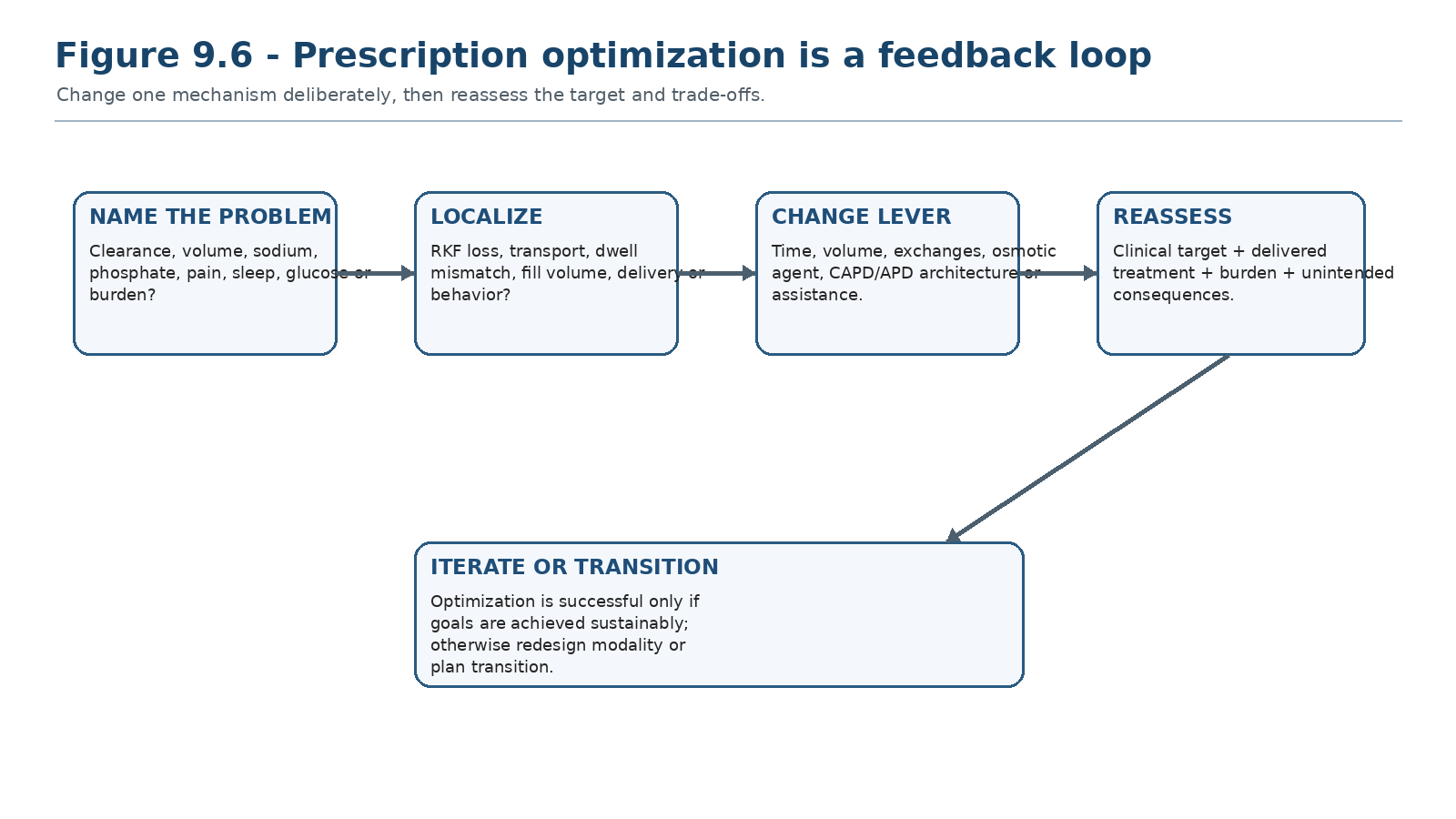
Name the problem -> localize the limiting mechanism -> change the smallest effective lever -> verify both benefit and trade-offs -> iterate or redesign the modality if the goals remain unsustainable.
| FINAL MENTAL MODEL Goal -> actual delivered therapy -> membrane transport -> residual kidneys -> CAPD/APD architecture -> dwell/fill/exchange/osmotic lever -> trade-offs -> reassessment -> redesign or transition when the prescription no longer serves the patient. |
|---|
Rapid oral viva
Why is APD not simply “more dialysis” than CAPD?
Walk through the prescription consequences of fast versus slow PSTR.
Explain why adding APD cycles can worsen phosphate clearance even while improving urea clearance.
How would you investigate low adequacy in a patient with frequent cycler alarms?
Explain when tidal PD is appropriate and what it does not accomplish automatically.
Give a goal-directed reason to switch from CAPD to APD and a separate reason to switch from APD to CAPD.
| SCOPE BOUNDARY This chapter teaches CAPD/APD architecture and prescription optimization. Peritonitis prevention/treatment follows in Chapter 10; exit-site/tunnel infection in Chapter 11; mechanical complications in Chapter 12; long-term membrane failure in Chapter 14; remote monitoring and connected cyclers are developed fully in Chapter 18. |
|---|
27. Selected authoritative references
1. Brown EA, Blake PG, Boudville N, et al. International Society for Peritoneal Dialysis practice recommendations: Prescribing high-quality goal-directed peritoneal dialysis. Perit Dial Int. 2020;40(3):244–253. https://doi.org/10.1177/0896860819895364. PMID: 32063219.
2. Morelle J, Stachowska-Pietka J, Oberg C, et al. ISPD recommendations for the evaluation of peritoneal membrane dysfunction in adults: classification, measurement, interpretation and rationale for intervention. Perit Dial Int. 2021;41(4):352–372. https://doi.org/10.1177/0896860820982218. PMID: 33563110.
3. Driehuis E, Eshuis M, Abrahams AC, Francois K, Vernooij RWM. Automated peritoneal dialysis versus continuous ambulatory peritoneal dialysis for people with kidney failure. Cochrane Database Syst Rev. 2024;9:CD006515. https://doi.org/10.1002/14651858.CD006515.pub2. PMID: 39258519.
4. Boudville N, de Moraes TP. 2005 Guidelines on targets for solute and fluid removal in adults being treated with chronic peritoneal dialysis: 2019 update of the literature and revision of recommendations. Perit Dial Int. 2020;40(3):254–260. https://doi.org/10.1177/0896860819898307.
5. Goossen K, Becker M, Marshall MR, et al. Icodextrin Versus Glucose Solutions for the Once-Daily Long Dwell in Peritoneal Dialysis: An Enriched Systematic Review and Meta-analysis of Randomized Controlled Trials. Am J Kidney Dis. 2020;75(6):830–846. https://doi.org/10.1053/j.ajkd.2019.10.004. PMID: 32033860.
6. Paniagua R, Ramos A, Avila M, et al. Remote monitoring of automated peritoneal dialysis reduces mortality, adverse events and hospitalizations: a cluster-randomized controlled trial. Nephrol Dial Transplant. 2025;40(3):588–597. https://doi.org/10.1093/ndt/gfae188. PMID: 39165115.
7. Chung MC, Yu TM, Cheng BC, et al. Remote Patient Monitoring-Enabled Automated Peritoneal Dialysis and Clinical Outcomes: A Nationwide Real-World Cohort Study from Taiwan. Clin J Am Soc Nephrol. 2026 Jul 14; ahead of print. https://doi.org/10.2215/CJN.0000001112. PMID: 42447366.
8. Browne MC, Elavia N, Flowers A, et al. Lost dwell time and cycler alarms in inpatient automated peritoneal dialysis at a tertiary care hospital. Ren Fail. 2024;46(2):2408432. https://doi.org/10.1080/0886022X.2024.2408432. PMID: 39352771.
9. Aga Z, McCullough K, Pisoni RL, et al. Peritoneal Dialysis-Related Drain Pain and Patient and Treatment Characteristics: Findings From the Peritoneal Dialysis Outcomes and Practice Patterns Study (PDOPPS). Am J Kidney Dis. 2023;82(6):779–782. https://doi.org/10.1053/j.ajkd.2023.04.005. PMID: 37393052.
10. Reimann F, Tomlins M. Prescribing and peritoneal dialysis. Aust Prescr. 2023;46(1):5–8. https://doi.org/10.18773/austprescr.2023.001. PMID: 38053668.
11. Ventura MJ, Amato D, Correa-Rotter R, Paniagua R; Mexican Nephrology Collaborative Study Group. Relationship between fill volume, intraperitoneal pressure, body size, and subjective discomfort perception in CAPD patients. Perit Dial Int. 2000;20(2):188–193. https://doi.org/10.1177/089686080002000205. PMID: 10809242.
12. Dejardin A, Robert A, Goffin E. Intraperitoneal pressure in PD patients: relationship to intraperitoneal volume, body size and PD-related complications. Nephrol Dial Transplant. 2007;22(5):1437–1444. https://doi.org/10.1093/ndt/gfl745. PMID: 17308323.
13. Debowska M, Gomez R, Pinto J, Waniewski J, Lindholm B. Phosphate clearance in peritoneal dialysis. Sci Rep. 2020;10(1):17504. https://doi.org/10.1038/s41598-020-74412-2. PMID: 33060672.
14. Badve SV, Zimmerman DL, Knoll GA, Burns KD, McCormick BB. Peritoneal phosphate clearance is influenced by peritoneal dialysis modality, independent of peritoneal transport characteristics. Clin J Am Soc Nephrol. 2008;3(6):1711–1717. https://doi.org/10.2215/CJN.00190108. PMID: 18815242.
15. Courivaud C, Davenport A. Phosphate Removal by Peritoneal Dialysis: The Effect of Transporter Status and Peritoneal Dialysis Prescription. Perit Dial Int. 2016;36(1):85–93. https://doi.org/10.3747/pdi.2014.00173. PMID: 26224788.
16. Fischbach M, Issad B, Dubois V, Taamma R. The beneficial influence on the effectiveness of automated peritoneal dialysis of varying the dwell time and fill volume: a randomized controlled trial. Perit Dial Int. 2011;31(4):450–458. https://doi.org/10.3747/pdi.2010.00146. PMID: 21454393.
17. Borrelli S, La Milia V, De Nicola L, et al. Sodium removal by peritoneal dialysis: a systematic review and meta-analysis. J Nephrol. 2019;32(2):231–239. https://doi.org/10.1007/s40620-018-0507-1. PMID: 29978446.
18. de Moraes TP, Pellizzari C, Lins PRG, Calice-Silva V. Current approaches to prescription and optimization of peritoneal dialysis: a practical review. J Bras Nefrol. 2026;48(2):e20250288. https://doi.org/10.1590/2175-8239-JBN-2025-0288en. PMID: 42284506.
19. Wijewickrama P, Williams J, Bain S, et al. Narrative Review of Glycemic Management in People With Diabetes on Peritoneal Dialysis. Kidney Int Rep. 2023;8(4):700–714. https://doi.org/10.1016/j.ekir.2023.01.040. PMID: 37069983.
20. Juergensen PH, Murphy AL, Pherson KA, Chorney WS, Kliger AS, Finkelstein FO. Tidal peritoneal dialysis to achieve comfort in chronic peritoneal dialysis patients. Adv Perit Dial. 1999;15:125–126. PMID: 10682086.
21. Vychytil A, Horl WH. The role of tidal peritoneal dialysis in modern practice: a European perspective. Kidney Int Suppl. 2006;(103):S96–S103. https://doi.org/10.1038/sj.ki.5001923. PMID: 17080119.
22. Corbett RW, Goodlet G, MacLaren B, et al. International Society for Peritoneal Dialysis Practice Recommendations: The view of the person who is doing or who has done peritoneal dialysis. Perit Dial Int. 2020;40(3):349–352. https://doi.org/10.1177/0896860820918822. PMID: 32301374.
| SOURCE NOTE Guidelines and contemporary evidence were checked 2 September 2026. CAPD-versus-APD outcome comparisons are presented with the low/very-low certainty identified by the 2024 Cochrane update. Adapted APD, tidal PD and remote-monitoring findings are not generalized beyond the populations and mechanisms studied. Exact cycler settings, drain algorithms, fill limits and product-specific icodextrin/glucose safety remain device-, patient- and program-specific. |
|---|