Chapter Preamble
Signals declared
Sig-D — Diagnostic (primary). Distinguish a hypertensive emergency from a severe-but-asymptomatic elevation by the presence of acute target-organ damage.
Sig-T — Therapeutic (strong). Lower the pressure by controlled, gradual reduction with the right agent, observing the scenario-specific exceptions.
Levels populated and omitted
Populated (17): L1–L5, L7, L8, L10–L14, L17–L20, L22. The therapeutic signal fires the absolute-risk table (L14) and templates (L17); the diagnostic signal drives the tables, rules, cases, pitfalls, and board items.
L6 / L9 mechanism levels — omitted. No Sig-M; the autoregulation mechanism was built in the nephrosclerosis chapter, and this is an acute-management chapter.
L15 / L16 preference-sensitive map and SDM scripts — omitted. No Sig-E; emergency blood-pressure management is time-critical, protocol-driven care.
| 01 | PHASE A · LEVEL 1 · ORIENTATION & KNOWLEDGE Learning Objectives |
By the end of this chapter you should be able to:
Define a hypertensive emergency and distinguish it from a severe asymptomatic elevation.
Recognise that acute target-organ damage — not the blood-pressure number — defines the emergency.
List the forms of acute target-organ damage.
Explain the controlled-reduction principle and why rapid lowering causes harm.
State the general emergency target for blood-pressure reduction.
Apply the scenario-specific exceptions — aortic dissection, acute stroke, pre-eclampsia.
Manage a severe asymptomatic elevation with gradual oral therapy, avoiding precipitous drops.
Choose appropriate intravenous agents for the emergency setting.
| 02 | PHASE A · LEVEL 2 · ORIENTATION & KNOWLEDGE Executive Summary |
A hypertensive emergency is severe hypertension (usually above about 180/120) accompanied by acute, ongoing target-organ damage; the damage, not the number, defines it.
A severe but asymptomatic elevation without acute target-organ damage is a hypertensive urgency, increasingly called severe asymptomatic hypertension.
The distinguishing feature is therefore the presence of acute target-organ damage, not the height of the blood pressure.
Acute target-organ damage includes hypertensive encephalopathy, acute stroke, acute coronary syndrome, acute heart failure with pulmonary oedema, aortic dissection, acute kidney injury or malignant nephrosclerosis, severe retinopathy, and eclampsia.
The cardinal principle of emergency treatment is controlled, gradual reduction — not rapid normalisation.
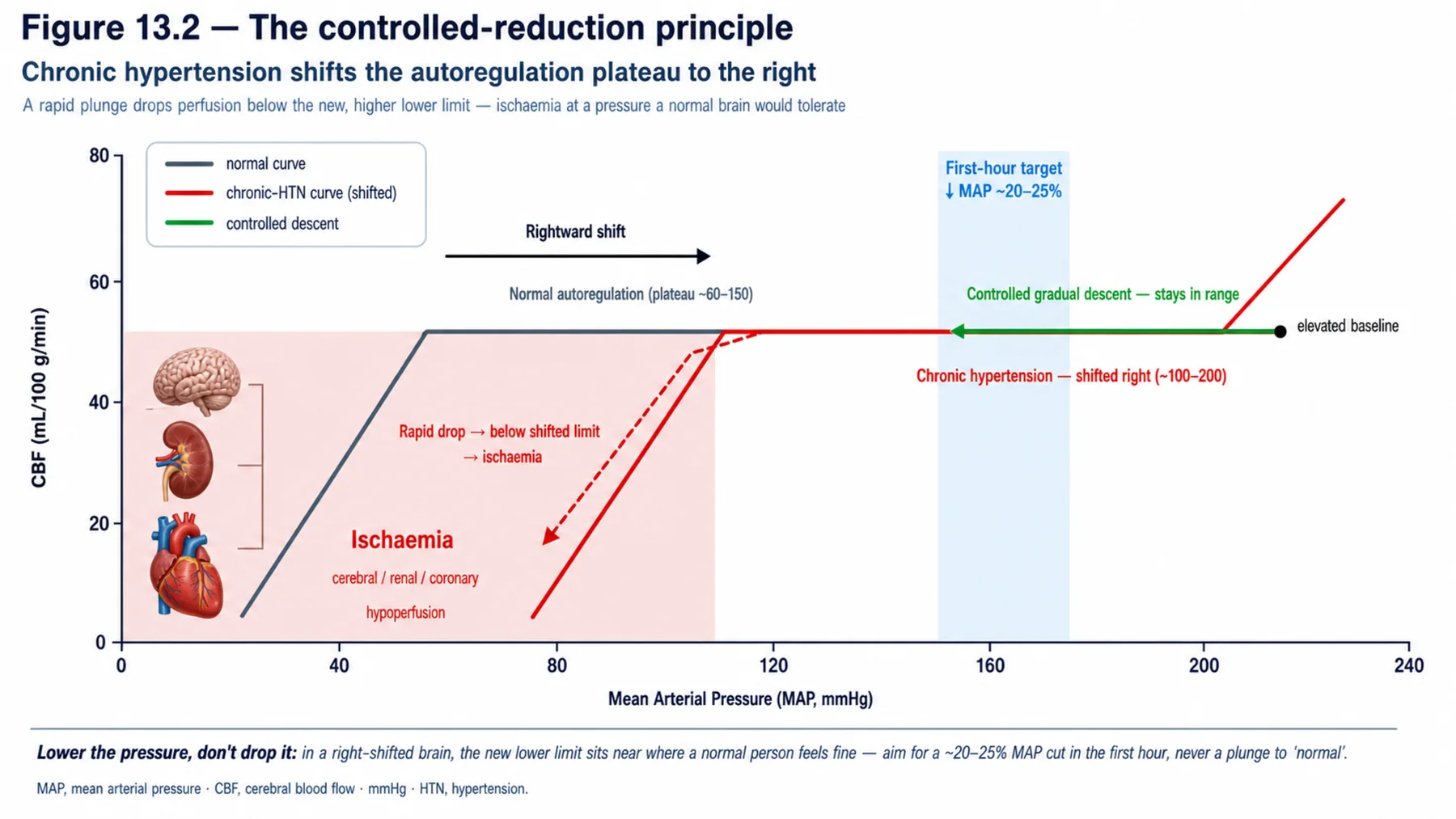
Chronic hypertension shifts the autoregulatory range upward, so lowering the pressure too fast drops organ perfusion below that range and causes ischaemia of the brain, heart, or kidney.
The general target is to reduce the mean arterial pressure by about 20 to 25% in the first hour, then to around 160/100 over the next several hours, and to normal over a day or two, using titratable intravenous agents in a monitored setting.
There are important scenario-specific exceptions to this general rule.
Aortic dissection requires rapid, aggressive lowering (a low systolic and heart rate), with a beta-blocker given first to reduce shear stress before a vasodilator.
Acute ischaemic stroke calls for permissive hypertension — the pressure is generally not lowered aggressively, to preserve the ischaemic penumbra.
Pre-eclampsia and eclampsia require blood-pressure control with magnesium sulphate and ultimately delivery.
A severe asymptomatic elevation, by contrast, is managed with gradual oral therapy over days, not intravenous or rapid lowering, and short-acting sublingual nifedipine is avoided because it causes a dangerous, uncontrolled drop.
The whole approach turns on first deciding whether acute target-organ damage is present.
| 03 | PHASE A · LEVEL 3 · ORIENTATION & KNOWLEDGE Main Narrative |
A very high blood-pressure reading triggers an instinct to bring it down fast — and that instinct, in most situations, is wrong. The management of severe hypertension turns on two questions: is there acute target-organ damage (making it an emergency), and, if so, how fast may the pressure safely be lowered? The answer to the second is almost always 'gradually,' because rapid lowering can cause the very organ ischaemia it is meant to prevent. This chapter sets out the emergency-versus-urgency distinction, the controlled-reduction principle, and the scenario-specific exceptions.
— Emergency versus urgency: the target-organ damage
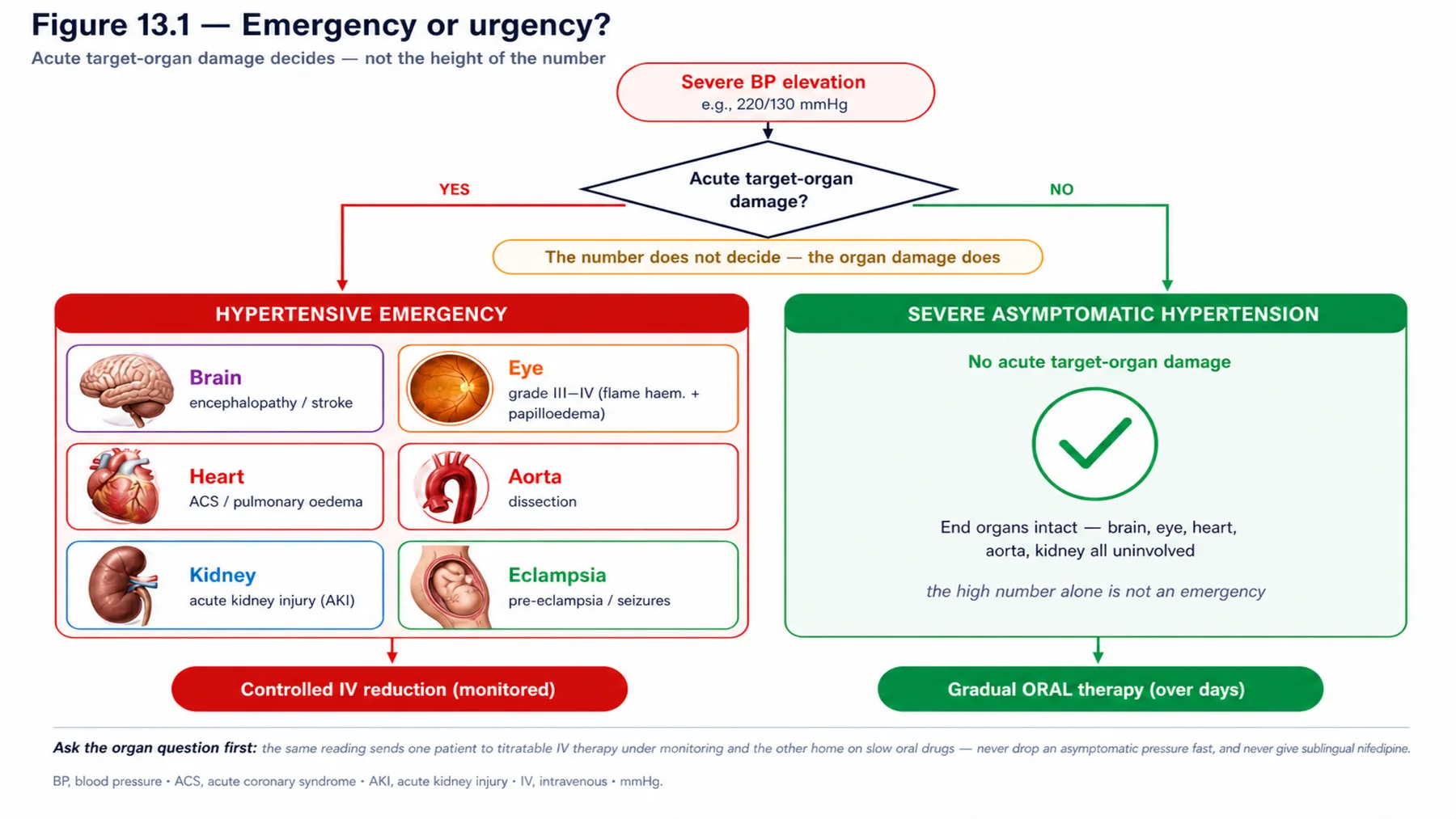
The first and most important judgement is whether a severe elevation is a hypertensive emergency or merely a severe asymptomatic elevation, and the distinction rests on acute target-organ damage, not on the blood-pressure number. A hypertensive emergency is severe hypertension (typically above about 180/120) accompanied by acute, ongoing damage to a target organ; a hypertensive urgency — increasingly called severe asymptomatic hypertension — is the same severe elevation without such damage. The number alone does not separate them: a patient at 220/130 with no acute organ damage has a severe asymptomatic elevation, while a patient at 180/110 with hypertensive encephalopathy has an emergency. The forms of acute target-organ damage define the emergencies: hypertensive encephalopathy (headache, confusion, seizures, visual disturbance from cerebral oedema), acute stroke, acute coronary syndrome, acute heart failure with flash pulmonary oedema, aortic dissection, acute kidney injury or malignant nephrosclerosis with a thrombotic microangiopathy, severe (grade III–IV) retinopathy, and eclampsia. So the assessment of a very high reading begins not with reaching for a drug but with looking for acute organ damage — because that determines everything that follows.
— The controlled-reduction principle
The cardinal rule of emergency treatment is controlled, gradual reduction — not rapid normalisation — and understanding why is essential. In chronic hypertension, the autoregulation of the brain (and the heart and kidney) resets: the range of pressures over which perfusion is kept constant shifts upward, so these organs become accustomed to a higher pressure and lose the ability to maintain perfusion at what would be 'normal' pressures for someone else. If the blood pressure is then lowered rapidly toward normal, it falls below the now-elevated lower limit of autoregulation, and organ perfusion drops — causing cerebral, coronary, or renal ischaemia, the very harm the treatment was meant to prevent. This is why the instinct to 'normalise' a frighteningly high pressure quickly is dangerous. The principle is to lower the pressure enough to halt the ongoing organ damage but slowly enough to stay within the shifted autoregulatory range, allowing it to readjust gradually. Controlled reduction is the single most important concept in managing severe hypertension.
— The general target and the agents
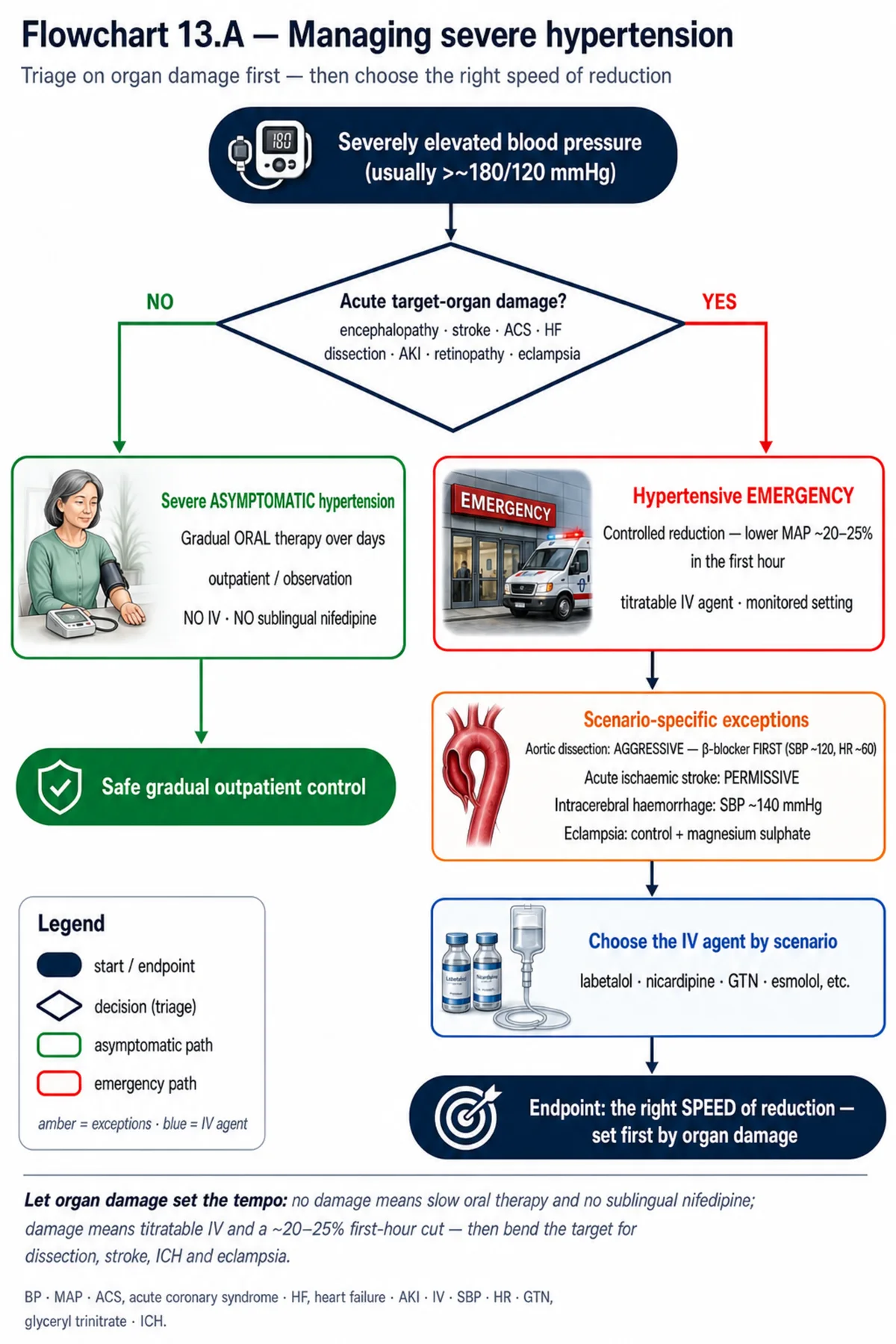
Translated into numbers, the general emergency target follows the controlled-reduction principle: reduce the mean arterial pressure by roughly 20 to 25% in the first hour, then toward about 160/100 over the next two to six hours, and to normal over the following day or two — a staged descent rather than an immediate normalisation. This is achieved with short-acting, titratable intravenous agents in a monitored setting (an intensive care or high-dependency unit), so the reduction can be controlled and adjusted minute to minute: labetalol, nicardipine, clevidipine, esmolol, glyceryl trinitrate, sodium nitroprusside, hydralazine, and phentolamine are the usual choices, selected by the clinical scenario. The titratability is the point — a continuous infusion that can be turned up or down avoids the overshoot of a bolus or a long-acting agent, keeping the descent controlled. The combination of a defined, gradual target and a titratable agent in a monitored setting is what makes safe emergency blood-pressure reduction possible.
— The scenario-specific exceptions
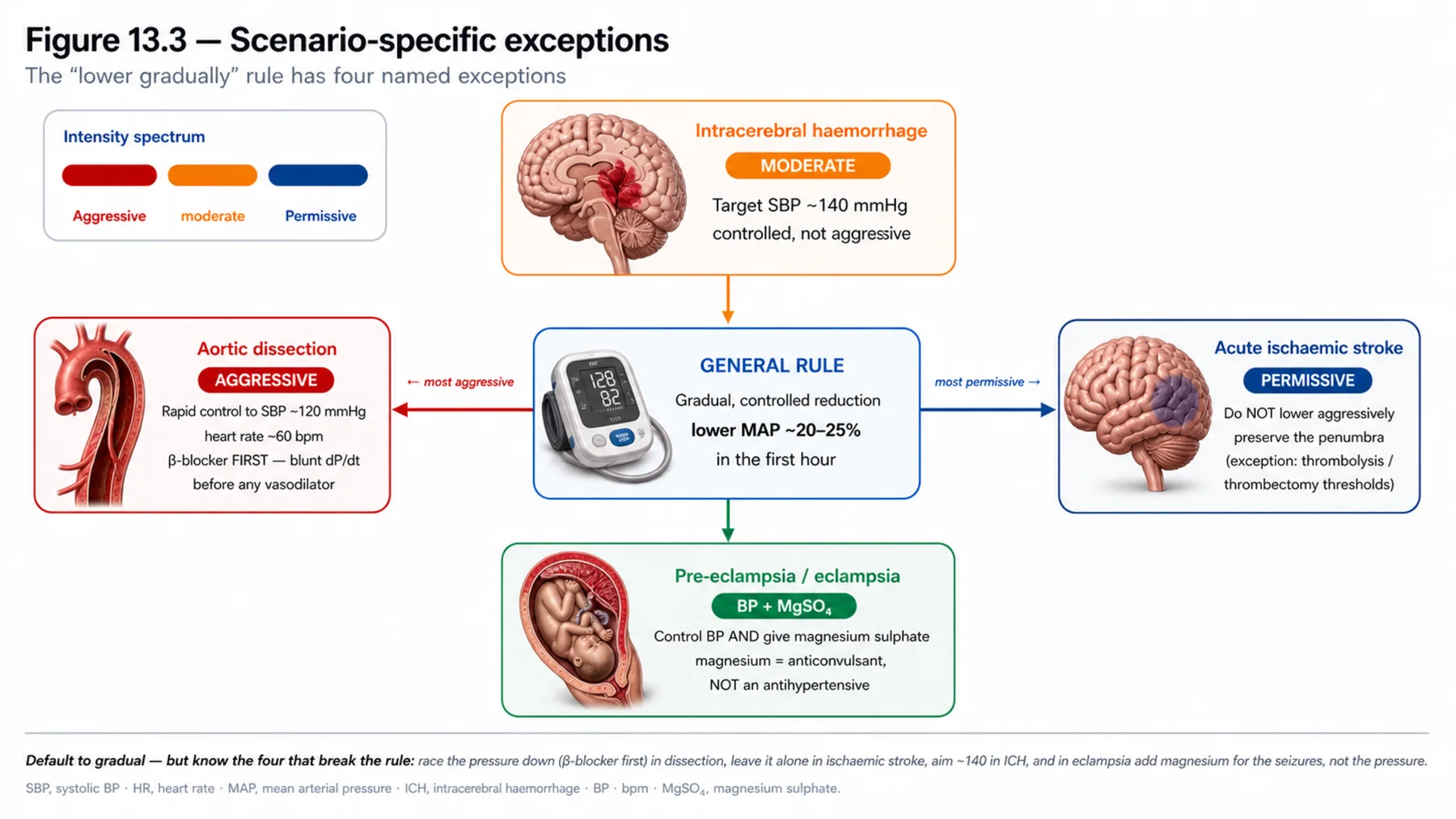
The general 'lower gradually' rule has important exceptions where the scenario dictates a different target, and knowing them is essential. Aortic dissection is the major exception in the aggressive direction: here the pressure (and the heart rate, and the rate of rise of pressure) must be lowered rapidly and to a low target (a systolic around 120 and a heart rate around 60) to reduce the shear stress propagating the dissection — and crucially a beta-blocker is given first to reduce the force and rate of cardiac contraction before a vasodilator, because a vasodilator alone would cause a reflex tachycardia that increases the shear stress. Acute ischaemic stroke is the major exception in the permissive direction: the pressure is generally not lowered aggressively (only if extremely high, or to specific thresholds before thrombolysis), because the elevated pressure is helping perfuse the ischaemic penumbra, and aggressive lowering can extend the infarct. Intracerebral haemorrhage calls for moderate lowering to around a systolic of 140. Pre-eclampsia and eclampsia require blood-pressure control together with magnesium sulphate (for seizure prophylaxis) and ultimately delivery, as the pregnancy chapter develops. And a phaeochromocytoma crisis is managed with alpha-blockade (phentolamine). The general rule is gradual reduction; the exceptions — aggressive for dissection, permissive for ischaemic stroke — must be known.
— The severe asymptomatic elevation
The severe asymptomatic elevation — a very high pressure without acute target-organ damage — is common, frequently mismanaged, and the mirror image of the emergency in its treatment. Because there is no acute organ damage and no ongoing harm being done, there is no benefit — and real risk — in lowering the pressure rapidly; the same controlled-reduction logic that governs the emergency applies even more strongly here, since there is no organ damage to justify any urgency. The correct management is to lower the pressure gradually with oral agents over days, in the outpatient or short-observation setting, by starting or adjusting the patient's usual antihypertensives — not with intravenous drugs and not in a rush. A specific and dangerous error to avoid is short-acting sublingual nifedipine, which causes a precipitous, uncontrolled drop in pressure and has caused ischaemic strokes and myocardial infarctions; it should never be used to 'treat' a high reading. The key insight is that a high number without acute organ damage is not an emergency and must not be treated as one — the harm of rapid lowering applies, while the benefit does not.
— Putting it together
The whole approach to severe hypertension can be reduced to a sequence. First, decide whether there is acute target-organ damage: if yes, it is an emergency; if no, it is a severe asymptomatic elevation. For the emergency, lower the pressure by controlled, gradual reduction — about 20 to 25% of the mean arterial pressure in the first hour, then staged over the next day or two — with a titratable intravenous agent in a monitored setting, unless the scenario is one of the exceptions: aggressive lowering with a beta-blocker first for aortic dissection, permissive hypertension for acute ischaemic stroke, moderate lowering for intracerebral haemorrhage, and control plus magnesium for eclampsia. For the severe asymptomatic elevation, lower gradually with oral agents over days and never with rapid intravenous or sublingual nifedipine. The unifying thread — and the lesson that links this chapter to the autoregulation physiology of the previous one — is that the danger in severe hypertension is as much from over-rapid lowering as from the high pressure itself, so the discipline is always to ask first whether there is acute organ damage, and then to lower the pressure at the right speed for the situation.
| 04 | PHASE A · LEVEL 4 · ORIENTATION & KNOWLEDGE Reference Tables |
Table 13.1 — Emergency versus urgency
| Term | Definition |
| Hypertensive emergency | Severe hypertension (usually > ~180/120) WITH acute target-organ damage |
| Severe asymptomatic (urgency) | The same severe elevation WITHOUT acute target-organ damage |
| The distinction | Acute target-organ damage — NOT the blood-pressure number |
| Implication | Decide this first — it determines the whole approach |
Table 13.2 — Acute target-organ damage
| System | Manifestation |
| Brain | Hypertensive encephalopathy; acute stroke |
| Heart | Acute coronary syndrome; acute heart failure / flash pulmonary oedema |
| Aorta | Aortic dissection |
| Kidney / eye / pregnancy | AKI / malignant nephrosclerosis (TMA); grade III–IV retinopathy; eclampsia |
Table 13.3 — The controlled-reduction principle
| Point | Detail |
| Autoregulation reset | Chronic HTN shifts the autoregulatory range upward |
| Risk of rapid lowering | Perfusion falls below the range → cerebral/coronary/renal ischaemia |
| General target | Reduce MAP ~20–25% in the first hour, then → ~160/100 over 2–6 h, normal over 24–48 h |
| How | Titratable IV agents in a monitored setting |
Table 13.4 — Scenario-specific targets
| Scenario | Target / approach |
| Aortic dissection | Rapid, aggressive (SBP ~120, HR ~60); BETA-BLOCKER FIRST, then vasodilator |
| Acute ischaemic stroke | Permissive hypertension — do not lower aggressively (preserve penumbra) |
| Intracerebral haemorrhage | Moderate lowering (SBP ~140) |
| Pre-eclampsia / eclampsia | Control + magnesium sulphate; delivery (Chapter 15) |
Table 13.5 — Intravenous agents
| Agent | Note |
| Labetalol, esmolol | Beta (± alpha) blockade — dissection, general use |
| Nicardipine, clevidipine | Calcium-channel blockers — titratable, widely used |
| Glyceryl trinitrate | Useful in acute coronary syndrome / pulmonary oedema |
| Nitroprusside, hydralazine, phentolamine | General / specific scenarios (phentolamine for phaeochromocytoma) |
Table 13.6 — Severe asymptomatic hypertension
| Point | Detail |
| No acute organ damage | No benefit — and real risk — from rapid lowering |
| Management | Gradual oral therapy over days; outpatient/observation |
| Avoid | Intravenous/rapid lowering; short-acting sublingual nifedipine (precipitous drop) |
| Key insight | A high number without acute organ damage is NOT an emergency |
| 05 | PHASE B · LEVEL 5 · VISUALISE & MAP Imaging & Flowchart Specifications |
| 08 | PHASE C · LEVEL 8 · CLINICAL REASONING Clinical Cases |
| CASE 1 | GO SLOW Controlled reduction Hypertensive encephalopathy |
Presentation
A patient presents with a blood pressure of 230/130, headache, confusion, and visual disturbance — hypertensive encephalopathy. An eager clinician wants to normalise the blood pressure as quickly as possible.
❖ Pause and reflect Should the blood pressure be normalised rapidly here? |
Analysis
No — this is a hypertensive emergency requiring controlled, gradual reduction, not rapid normalisation. The patient's chronic hypertension has shifted the cerebral autoregulatory range upward, so the brain depends on the higher pressure for perfusion; lowering the pressure too fast would drop it below the shifted lower limit of autoregulation and cause cerebral ischaemia — worsening, not helping, the encephalopathy. The correct approach is to reduce the mean arterial pressure by about 20 to 25% in the first hour with a titratable intravenous agent in a monitored setting, then more gradually over the next day or two, halting the ongoing damage while staying within the autoregulatory range. The instinct to normalise quickly is the danger.
Plan
Lower the mean arterial pressure by about 20 to 25% in the first hour with a titratable intravenous agent in a monitored setting, then gradually over 24 to 48 hours — controlled reduction, not rapid normalisation. Go slow to stay within the shifted autoregulatory range.
Teaching point
In a hypertensive emergency, reduce the MAP by ~20–25% in the first hour — controlled, gradual reduction; rapid normalisation causes organ ischaemia.
Cross-reference
Exercises the controlled-reduction principle; Figure 13.2; Tables 13.3, 13.5; autoregulation in Chapter 12.
| CASE 2 | HIGH, BUT NOT AN EMERGENCY Don't rush Severe asymptomatic hypertension |
Presentation
A patient is found to have a blood pressure of 220/120 at a routine visit but feels well, with no symptoms and no evidence of acute target-organ damage. A clinician reaches for sublingual nifedipine to bring it down quickly.
❖ Pause and reflect Is this an emergency, and should the pressure be lowered rapidly? |
Analysis
No — this is a severe asymptomatic elevation (a 'hypertensive urgency'), not an emergency, because there is no acute target-organ damage despite the high number. There is no ongoing harm being done, so there is no benefit — and real risk — in lowering the pressure rapidly; the controlled-reduction logic applies even more strongly here. The correct management is gradual oral therapy over days, by starting or adjusting the usual antihypertensives, in the outpatient or short-observation setting. Reaching for short-acting sublingual nifedipine is a dangerous error: it causes a precipitous, uncontrolled drop that has precipitated strokes and myocardial infarctions. A high number without organ damage is not an emergency.
Plan
Manage as a severe asymptomatic elevation — gradual oral therapy over days, adjusting the usual antihypertensives — and avoid sublingual nifedipine and any rapid lowering. Don't treat a high number without organ damage as an emergency.
Teaching point
A severe but asymptomatic elevation is not an emergency — lower gradually with oral agents over days, and never use sublingual nifedipine.
Cross-reference
Exercises the severe-asymptomatic content; Figure 13.1; Tables 13.1, 13.6.
| CASE 3 | THE AGGRESSIVE EXCEPTION Beta-blocker first Aortic dissection |
Presentation
A patient with severe hypertension and tearing chest pain radiating to the back is diagnosed with an acute aortic dissection. A clinician, mindful of 'controlled reduction,' plans a gentle, gradual blood-pressure reduction with a vasodilator alone.
❖ Pause and reflect Does the gradual-reduction rule apply to aortic dissection, and is a vasodilator alone appropriate? |
Analysis
No on both counts — aortic dissection is the aggressive exception, and a vasodilator alone is dangerous. Unlike most emergencies, dissection requires rapid, aggressive lowering of the blood pressure and heart rate (a systolic around 120 and a heart rate around 60) to reduce the shear stress propagating the dissection. And the sequence matters: a beta-blocker must be given first to reduce the force and rate of cardiac contraction, before a vasodilator — because a vasodilator alone causes a reflex tachycardia that increases the shear stress and can extend the dissection. So the controlled-reduction rule that governs hypertensive encephalopathy is reversed here: lower fast and aggressively, with rate control first.
Plan
Lower the blood pressure and heart rate rapidly and aggressively (systolic ~120, heart rate ~60), giving a beta-blocker first to reduce shear stress before adding a vasodilator. Apply the aggressive aortic-dissection exception with rate control first.
Teaching point
Aortic dissection is the aggressive exception — lower the BP and heart rate rapidly, beta-blocker FIRST (before a vasodilator) to reduce shear stress.
Cross-reference
Exercises the exceptions content; Figure 13.3; Tables 13.4, 13.5.
| CASE 4 | LET IT RUN Permissive hypertension Acute ischaemic stroke |
Presentation
A patient with an acute ischaemic stroke has a blood pressure of 200/110. A clinician wants to lower it promptly toward normal, concerned by the high reading.
❖ Pause and reflect Should the blood pressure be lowered aggressively in this acute ischaemic stroke? |
Analysis
No — acute ischaemic stroke is the permissive exception. The elevated pressure is helping to perfuse the ischaemic penumbra (the at-risk but salvageable tissue around the infarct core), so aggressive lowering can reduce that perfusion and extend the infarct. The pressure is therefore generally allowed to run high (permissive hypertension), with lowering reserved for extreme elevations or for specific lower thresholds before thrombolysis. This is the opposite of the encephalopathy case: there, the high pressure is causing harm and must be lowered (gradually); here, the high pressure is protective and must largely be left alone. Recognising the stroke as the permissive exception prevents the harm of unnecessary lowering.
Plan
Allow permissive hypertension — do not lower the pressure aggressively — reserving treatment for extreme elevations or the thresholds required before thrombolysis. Apply the permissive acute-ischaemic-stroke exception.
Teaching point
Acute ischaemic stroke is the permissive exception — don't lower the pressure aggressively; the elevation perfuses the penumbra.
Cross-reference
Exercises the exceptions content; Figure 13.3; Table 13.4.
| 10 | PHASE C · LEVEL 10 · CLINICAL REASONING Clinical Pearls |
| Hypertensive emergency = severe HTN (usually >180/120) WITH acute target-organ damage. | Severe asymptomatic (urgency) = severe HTN WITHOUT acute target-organ damage. |
| The distinction = acute organ damage, NOT the number. | Organ damage: encephalopathy, stroke, ACS, heart failure, dissection, AKI, retinopathy, eclampsia. |
| Cardinal rule: controlled, GRADUAL reduction — not rapid normalisation. | Chronic HTN shifts autoregulation up — rapid lowering → organ ischaemia. |
| General target: reduce MAP ~20–25% in the first hour. | Then → ~160/100 over 2–6 h, normal over 24–48 h. |
| Use titratable IV agents in a monitored setting. | Aortic dissection (exception): aggressive (SBP ~120, HR ~60); BETA-BLOCKER FIRST. |
| Acute ischaemic stroke (exception): permissive hypertension — don't lower aggressively. | Intracerebral haemorrhage: moderate (SBP ~140). |
| Pre-eclampsia/eclampsia: control + magnesium; delivery. | Severe asymptomatic: gradual ORAL therapy over days. |
| AVOID short-acting sublingual nifedipine (precipitous drop). | Always ask FIRST: is there acute organ damage? |
| 11 | PHASE D · LEVEL 11 · SAFETY & EVIDENCE Red Flags & Never-Do |
Panel A — Red flags
| ▲ | Severe hypertension with headache, confusion, seizures, or visual disturbance — hypertensive encephalopathy; controlled reduction. |
| ▲ | Severe hypertension with tearing chest/back pain — aortic dissection; aggressive lowering, beta-blocker first. |
| ▲ | Severe hypertension in acute ischaemic stroke — permissive; do not lower aggressively. |
| ▲ | A very high number with NO acute organ damage — not an emergency; lower gradually with oral agents. |
| ▲ | Anyone reaching for sublingual nifedipine — dangerous precipitous drop; do not use it. |
Panel B — Never do
| ✖ NEVER — normalise a hypertensive emergency's blood pressure rapidly — lower it gradually. |
| ✖ NEVER — treat a severe asymptomatic elevation as an emergency. |
| ✖ NEVER — give a vasodilator before a beta-blocker in aortic dissection. |
| ✖ NEVER — use short-acting sublingual nifedipine to lower blood pressure. |
| 12 | PHASE D · LEVEL 12 · SAFETY & EVIDENCE Common Pitfalls |
Pitfall 1 — Rapid normalisation
| ✖ | WRONG Normalising the blood pressure quickly in a hypertensive emergency. |
| ✓ | RIGHT Reducing the MAP by ~20–25% in the first hour, then gradually. |
| ✉ | WHY Chronic HTN shifts autoregulation up; rapid lowering causes organ ischaemia. |
Pitfall 2 — Treating the number
| ✖ | WRONG Treating a high reading without acute organ damage as an emergency. |
| ✓ | RIGHT Managing it as a severe asymptomatic elevation with gradual oral therapy. |
| ✉ | WHY Acute organ damage, not the number, defines the emergency. |
Pitfall 3 — Vasodilator first in dissection
| ✖ | WRONG Giving a vasodilator alone (or first) in aortic dissection. |
| ✓ | RIGHT Giving a beta-blocker first, then a vasodilator. |
| ✉ | WHY A vasodilator alone causes reflex tachycardia and increased shear stress. |
Pitfall 4 — Lowering in ischaemic stroke
| ✖ | WRONG Aggressively lowering the pressure in acute ischaemic stroke. |
| ✓ | RIGHT Allowing permissive hypertension. |
| ✉ | WHY The elevation perfuses the penumbra; lowering extends the infarct. |
Pitfall 5 — Sublingual nifedipine
| ✖ | WRONG Using short-acting sublingual nifedipine to bring a high reading down. |
| ✓ | RIGHT Using gradual oral therapy (or titratable IV if an emergency). |
| ✉ | WHY Sublingual nifedipine causes a dangerous precipitous drop. |
| 13 | PHASE D · LEVEL 13 · SAFETY & EVIDENCE Evidence Grading |
GRADE A HIGH CONFIDENCE The effect is real and the estimate is stable. RCTs at low risk of bias; multiple concordant prospective cohorts; meta-analyses. |
GRADE B MODERATE CONFIDENCE The effect is likely real but may shift with new data. Observational studies, registries, mechanistic human studies. |
GRADE C LOW CONFIDENCE Rests on physiology, reasoning, or consensus rather than outcomes. Pathophysiological reasoning; extrapolation; consensus without outcomes. |
Graded statements (by evidence type)
| Statement | Grade | Basis (evidence type) |
| Acute target-organ damage, not the number, defines a hypertensive emergency. | A | Guideline consensus |
| Rapid blood-pressure lowering can cause organ ischaemia in chronic hypertension. | A | Physiology and clinical data |
| The general emergency target is a ~20–25% MAP reduction in the first hour. | A | Guideline consensus |
| Aortic dissection requires aggressive lowering with a beta-blocker first. | A | Guidelines and physiology |
| Acute ischaemic stroke warrants permissive hypertension. | A | RCTs and guidelines |
| Severe asymptomatic hypertension should be lowered gradually with oral therapy. | A | Guideline consensus |
| Short-acting sublingual nifedipine causes dangerous precipitous drops. | A | Clinical data |
| 14 | PHASE E · LEVEL 14 · PATIENT DECISIONS Absolute Risk in Natural Frequency |
Natural-frequency estimates for orientation, from acute-hypertension management; they vary with the scenario. They convey the size of the decisions, expressed per 100 comparable patients.
| Per 100 patients… | Outcome | Roughly how many | See |
| Emergencies lowered rapidly vs gradually | Suffer organ ischaemia from the drop | More with rapid lowering | L13 row 2 |
| Severe asymptomatic elevations treated as emergencies | Are harmed by unnecessary rapid lowering | More than the gradually managed | L13 row 6 |
| Aortic dissections given a vasodilator before a beta-blocker | Suffer extension from reflex tachycardia | More than with rate control first | L13 row 4 |
| Acute ischaemic strokes lowered aggressively | Have a worse outcome (infarct extension) | More than the permissively managed | L13 row 5 |
★ How to read these Read these as orientation, not promises; outcomes vary with the scenario. The stable signals: rapid lowering harms in most emergencies, treating a high number without organ damage as an emergency harms, a vasodilator before a beta-blocker harms in dissection, and aggressive lowering harms in ischaemic stroke. Communicate them as people out of 100, not as a hazard ratio. |
| 17 | PHASE F · LEVEL 17 · APPLY & TEST Documentation Templates |
Paste-ready notes. Tick the boxes that apply and delete the rest; make the emergency/urgency decision and the reduction target explicit.
Template 1 — Severe-hypertension assessment and plan
Template 2 — Severe asymptomatic hypertension
| 18 | PHASE F · LEVEL 18 · APPLY & TEST Cheat Sheet |
| Emergency = severe HTN + acute organ damage. | Urgency / severe asymptomatic = severe HTN, NO organ damage. |
| The distinction = organ damage, not the number. | Organ damage: encephalopathy, stroke, ACS, heart failure, dissection, AKI, retinopathy, eclampsia. |
| Cardinal rule: controlled, GRADUAL reduction. | Chronic HTN shifts autoregulation up → rapid drop = ischaemia. |
| General target: MAP ↓ ~20–25% in first hour. | Then → ~160/100 over 2–6 h, normal over 24–48 h. |
| Titratable IV agents, monitored setting. | Aortic dissection: aggressive (SBP ~120, HR ~60); BETA-BLOCKER FIRST. |
| Acute ischaemic stroke: permissive — don't lower aggressively. | ICH: moderate (SBP ~140). |
| Pre-eclampsia/eclampsia: control + magnesium; delivery. | Severe asymptomatic: gradual ORAL over days. |
| NEVER sublingual nifedipine. | Ask FIRST: acute organ damage? |
| 19 | PHASE F · LEVEL 19 · APPLY & TEST Flashcards |
| CARD 1 | Q. What distinguishes a hypertensive emergency from a severe asymptomatic elevation? A. The presence of acute, ongoing target-organ damage — not the blood-pressure number. An emergency is severe hypertension with acute organ damage; a severe asymptomatic elevation (urgency) is the same high pressure without it. DETAILED. A 220/130 with no organ damage is not an emergency; a 180/110 with encephalopathy is. CLINICAL. Decide first whether acute organ damage is present. |
| CARD 2 | Q. What forms of acute target-organ damage define an emergency? A. Hypertensive encephalopathy, acute stroke, acute coronary syndrome, acute heart failure with pulmonary oedema, aortic dissection, acute kidney injury or malignant nephrosclerosis, severe retinopathy, and eclampsia. DETAILED. Each makes a severe elevation an emergency. CLINICAL. Look for these before reaching for a drug. |
| CARD 3 | Q. What is the controlled-reduction principle, and why does it matter? A. Lower the blood pressure gradually, not to normal rapidly — because chronic hypertension shifts the autoregulatory range upward, so a rapid drop falls below it and causes cerebral, coronary, or renal ischaemia. DETAILED. Rapid normalisation causes the harm it is meant to prevent. CLINICAL. Lower gradually to stay within the shifted autoregulatory range. |
| CARD 4 | Q. What is the general emergency reduction target? A. Reduce the mean arterial pressure by about 20 to 25% in the first hour, then toward about 160/100 over the next two to six hours, and to normal over a day or two — with titratable intravenous agents in a monitored setting. DETAILED. It is a staged descent, not an immediate normalisation. CLINICAL. Aim for ~20–25% MAP reduction in the first hour. |
| CARD 5 | Q. How is aortic dissection different, and what is given first? A. It is the aggressive exception — the pressure and heart rate are lowered rapidly to a low target (systolic ~120, heart rate ~60) to reduce shear stress — and a beta-blocker is given FIRST, before a vasodilator, because a vasodilator alone causes a reflex tachycardia that increases shear stress. DETAILED. Lower fast, with rate control first. CLINICAL. Beta-blocker before vasodilator in dissection. |
| CARD 6 | Q. Why is acute ischaemic stroke managed with permissive hypertension? A. Because the elevated pressure helps perfuse the ischaemic penumbra, so aggressive lowering can extend the infarct; the pressure is generally left high, with lowering reserved for extreme elevations or the thresholds before thrombolysis. DETAILED. It is the opposite of encephalopathy. CLINICAL. Do not lower the pressure aggressively in acute ischaemic stroke. |
| CARD 7 | Q. How is a severe asymptomatic elevation managed? A. With gradual oral therapy over days — starting or adjusting the usual antihypertensives in the outpatient or short-observation setting — not with intravenous or rapid lowering, because there is no acute organ damage to justify urgency. DETAILED. A high number without organ damage is not an emergency. CLINICAL. Lower gradually with oral agents over days. |
| CARD 8 | Q. Why is short-acting sublingual nifedipine avoided? A. Because it causes a precipitous, uncontrolled drop in blood pressure that can fall below the autoregulatory range and has precipitated ischaemic strokes and myocardial infarctions. DETAILED. It is a classic dangerous error in 'treating' a high reading. CLINICAL. Never use sublingual nifedipine to lower blood pressure. |
| 20 | PHASE F · LEVEL 20 · APPLY & TEST One-Minute Preceptor |
| SCENE 1 | The intern rushing the pressure down |
GET A COMMITMENT. “You want to normalise this encephalopathic patient's 230/130 quickly — why?”
PROBE FOR EVIDENCE. “The pressure is dangerously high” — ask: “What has chronic hypertension done to cerebral autoregulation, and what happens if you drop the pressure below it?”
TEACH A GENERAL RULE. Chronic hypertension shifts autoregulation upward, so rapid lowering drops perfusion below the range and causes ischaemia — reduce the MAP by only ~20–25% in the first hour.
REINFORCE WHAT WAS RIGHT. Recognising the emergency was correct.
CORRECT A MISTAKE. Lower gradually with a titratable IV agent, not to normal at once.
| SCENE 2 | The resident reaching for nifedipine |
GET A COMMITMENT. “This well patient has a 220/120 and you want to give sublingual nifedipine — is that safe?”
PROBE FOR EVIDENCE. “The number is very high” — ask: “Is there any acute organ damage, and what does sublingual nifedipine do to the pressure?”
TEACH A GENERAL RULE. Without acute organ damage this is a severe asymptomatic elevation, not an emergency; sublingual nifedipine causes a precipitous, uncontrolled drop and has caused strokes and infarcts — lower gradually with oral agents.
REINFORCE WHAT WAS RIGHT. Noticing the high reading was reasonable.
CORRECT A MISTAKE. Manage gradually with oral therapy; never use sublingual nifedipine.
| 22 | PHASE F · LEVEL 22 · APPLY & TEST Board-Style Questions |
| Q 01 | What defines a hypertensive emergency? |
| A | A blood pressure above 180/120 alone |
| B | Severe hypertension WITH acute target-organ damage |
| C | Any symptomatic hypertension |
| D | A diastolic above 110 |
Rationale Acute target-organ damage — not the number — defines the emergency (Figure 13.1, Table 13.1). A, C, and D miss the organ-damage criterion. |
| Q 02 | Why must the blood pressure be lowered gradually in most hypertensive emergencies? |
| A | To save drug costs |
| B | Chronic hypertension shifts autoregulation upward, so rapid lowering causes organ ischaemia |
| C | Because drugs work slowly |
| D | It need not be gradual |
Rationale Rapid lowering drops perfusion below the shifted autoregulatory range, causing ischaemia (case 1, Figure 13.2, Table 13.3). A, C, and D are wrong. |
| Q 03 | The general first-hour target in a hypertensive emergency is to reduce the: |
| A | Blood pressure to normal immediately |
| B | Mean arterial pressure by about 20–25% |
| C | Systolic to below 100 |
| D | Diastolic to 60 |
Rationale Reduce the MAP by ~20–25% in the first hour, then gradually (Table 13.3, case 1). A causes ischaemia; C and D are too aggressive. |
| Q 04 | In aortic dissection, the blood pressure should be lowered: |
| A | Gradually with a vasodilator alone |
| B | Aggressively, with a beta-blocker given first |
| C | Permissively |
| D | Not at all |
Rationale Dissection needs aggressive lowering with a beta-blocker first to reduce shear stress (case 3, Table 13.4). A causes reflex tachycardia; C and D are wrong. |
| Q 05 | In acute ischaemic stroke, the usual approach to a high blood pressure is: |
| A | Aggressive lowering to normal |
| B | Permissive hypertension — generally do not lower aggressively |
| C | Sublingual nifedipine |
| D | Immediate normalisation |
Rationale The elevation perfuses the penumbra, so lowering is generally avoided (case 4, Table 13.4). A, C, and D risk extending the infarct. |
| Q 06 | A blood pressure of 220/120 with no acute target-organ damage should be: |
| A | Treated as an emergency with IV agents |
| B | Managed as a severe asymptomatic elevation with gradual oral therapy |
| C | Lowered with sublingual nifedipine |
| D | Normalised within an hour |
Rationale Without organ damage it is a severe asymptomatic elevation, lowered gradually with oral agents (case 2, Table 13.6). A, C, and D over-treat dangerously. |
| Q 07 | Why is short-acting sublingual nifedipine avoided? |
| A | It is too weak |
| B | It causes a precipitous, uncontrolled drop that can precipitate ischaemic events |
| C | It raises blood pressure |
| D | It is only for emergencies |
Rationale Sublingual nifedipine causes a dangerous precipitous drop (case 2, Table 13.6). A, C, and D are incorrect. |
| Q 08 | Pre-eclampsia/eclampsia is managed with blood-pressure control plus: |
| A | A vasodilator alone |
| B | Magnesium sulphate (and ultimately delivery) |
| C | Permissive hypertension |
| D | Sublingual nifedipine |
Rationale Eclampsia requires control plus magnesium sulphate and delivery (Table 13.4; Chapter 15). A, C, and D are wrong. |