Chapter Preamble
Signals declared
Sig-D — Diagnostic (primary). Work the systematic five-step approach — pH, primary disorder, compensation, anion gap, delta ratio — to name every acid-base disturbance.
Sig-M — Mechanistic (strong). How pH is set by the bicarbonate-to-PCO2 ratio, how the two systems compensate, and why the anion gap and delta ratio reveal hidden disorders.
Levels populated and omitted
Populated (17): L1–L13, L18–L20, L22. The mechanistic signal fires the concept maps (L6) and triads (L9); the diagnostic signal drives the tables, rules, cases, pitfalls, and board items.
L14 absolute-risk — omitted. No Sig-T/E/V; this chapter teaches the method, and treatment outcomes belong with the disorder chapters that follow.
L15 / L16 preference-sensitive map and SDM scripts — omitted. No Sig-E; reading acid-base is a clinical method, not a values-driven choice.
L17 documentation templates — omitted. No Sig-P/T; the treatment templates belong with the disorder chapters (Chapters 11–12).
| 01 | PHASE A · LEVEL 1 · ORIENTATION & KNOWLEDGE Learning Objectives |
By the end of this chapter you should be able to:
Explain how pH is determined by the ratio of bicarbonate to PCO2 and the two regulating systems.
Use pH to identify acidaemia or alkalaemia and the dominant process.
Identify the primary disorder from the bicarbonate and PCO2.
Calculate and check whether compensation is appropriate, using the standard formulae.
Recognise that inappropriate compensation signals a mixed disorder.
Calculate the anion gap, correct it for albumin, and separate high-gap from normal-gap acidosis.
Use the delta ratio to detect a coexisting metabolic disorder.
Apply the full systematic approach to name every disturbance present.
| 02 | PHASE A · LEVEL 2 · ORIENTATION & KNOWLEDGE Executive Summary |
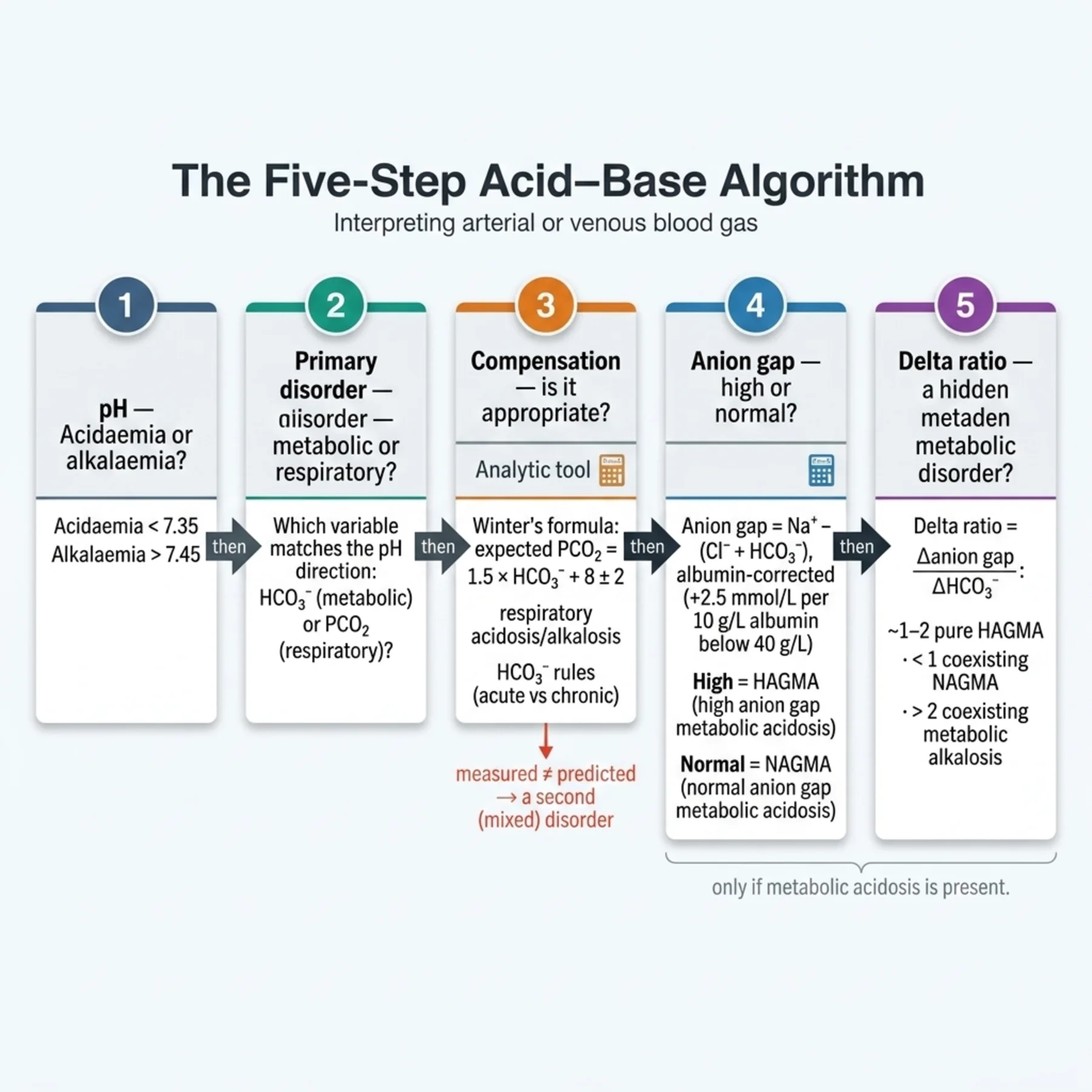
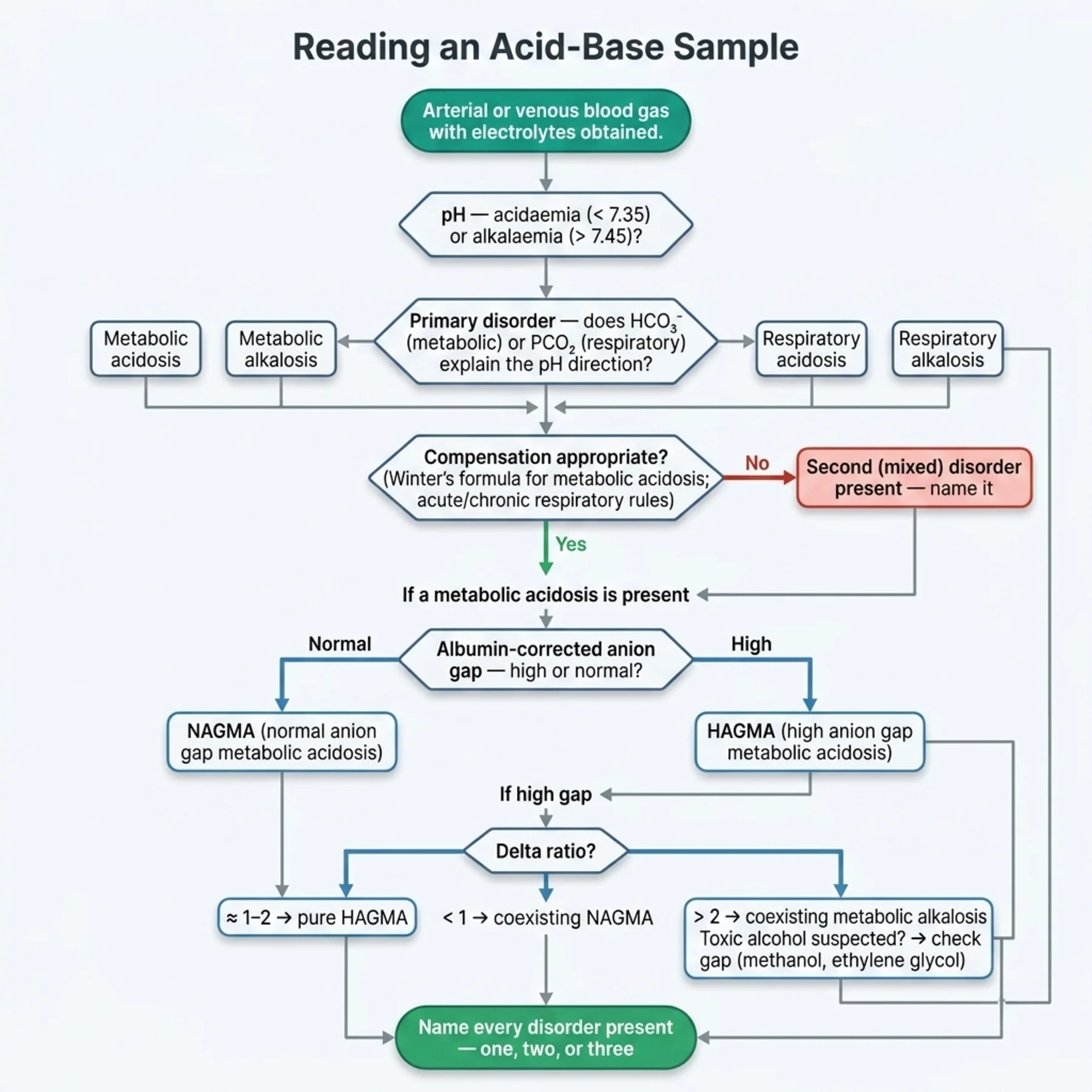
Acid-base interpretation is a fixed, five-step method that names every disturbance present, rather than a single glance at the pH.
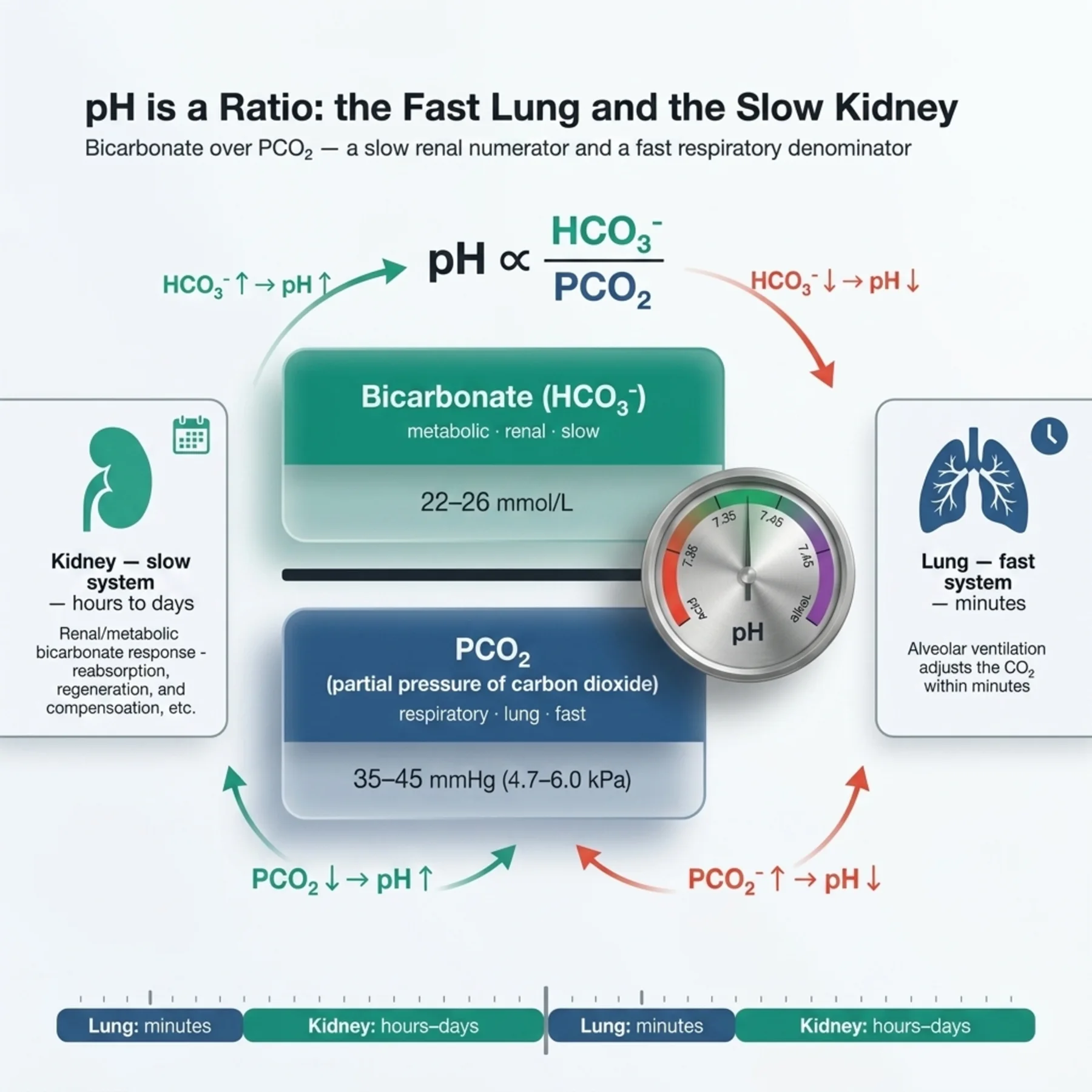
The pH is set by the ratio of bicarbonate (the metabolic, renal, slow component) to PCO2 (the respiratory, fast component).
Step one reads the pH: acidaemia below 7.35, alkalaemia above 7.45 — identifying the dominant process.
Step two names the primary disorder: a low bicarbonate (metabolic acidosis) or high PCO2 (respiratory acidosis) in acidaemia; a high bicarbonate (metabolic alkalosis) or low PCO2 (respiratory alkalosis) in alkalaemia.
Step three checks compensation: the unaffected system shifts to defend the pH, by predictable amounts given by standard formulae.
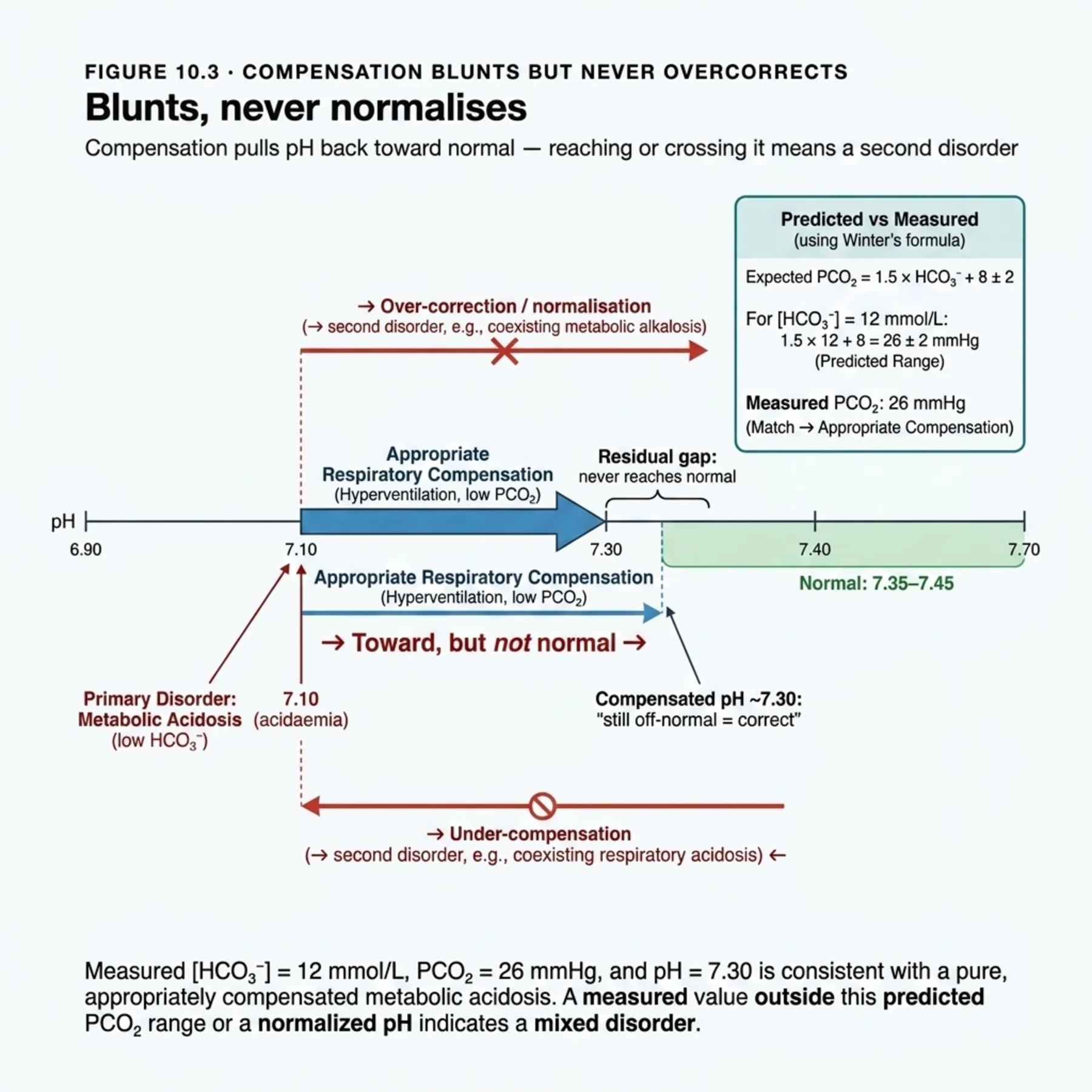
Compensation never fully normalises the pH and never overcorrects — so inappropriate compensation means a second, mixed disorder is present.
Winter's formula predicts the respiratory compensation for a metabolic acidosis; separate formulae cover the other disorders and acute versus chronic respiratory disturbances.
Step four calculates the anion gap in metabolic acidosis: a high gap means added acid, a normal gap means bicarbonate loss or chloride gain.
The anion gap is corrected for albumin, because hypoalbuminaemia lowers it and can mask a real gap.
Step five applies the delta ratio in a high-gap acidosis: the change in anion gap compared with the change in bicarbonate reveals a coexisting normal-gap acidosis or metabolic alkalosis.
The osmolar gap is checked when a toxic alcohol is suspected.
A mixed disorder is flagged whenever compensation is inappropriate or the delta ratio is abnormal.
The discipline of the five steps prevents the cardinal error of stopping at the pH and missing a second or third process.
This method is the foundation for the metabolic-acidosis, alkalosis, and mixed-disorder chapters that follow.
| 03 | PHASE A · LEVEL 3 · ORIENTATION & KNOWLEDGE Main Narrative |
Acid-base disorders intimidate because the numbers seem to move in confusing directions, but the confusion dissolves under a fixed method. The same five steps — pH, primary disorder, compensation, anion gap, delta ratio — applied in the same order, name every disturbance present, including the second and third ones that a glance at the pH would miss. This chapter builds the physiology and the method; the chapters that follow apply them to the specific disorders.
— The physiology in one ratio
The whole of acid-base balance turns on one relationship: the pH is set by the ratio of bicarbonate to the partial pressure of carbon dioxide. Bicarbonate is the metabolic component, regulated by the kidney (which reclaims filtered bicarbonate and excretes the daily acid load through ammoniagenesis and titratable acid) — a slow system, acting over hours to days. PCO2 is the respiratory component, regulated by ventilation — a fast system, acting in minutes. A normal pH (7.35 to 7.45) reflects a normal ratio, with bicarbonate around 22 to 26 and PCO2 around 40. Anything that lowers bicarbonate or raises PCO2 lowers the ratio and the pH (acidaemia); anything that raises bicarbonate or lowers PCO2 raises them (alkalaemia). Holding this single ratio in mind — and which system is fast and which slow — makes the rest of the method intelligible, because every step is just reading one part of the ratio and asking whether the other has responded as it should.
— Steps one and two: pH and the primary disorder
The method begins with the pH, which identifies the dominant process: a pH below 7.35 is acidaemia, above 7.45 is alkalaemia. Even in a mixed disorder the pH points to whichever process is winning. The second step names the primary disorder by looking at which component explains the pH. In acidaemia, a low bicarbonate means a metabolic acidosis and a high PCO2 means a respiratory acidosis. In alkalaemia, a high bicarbonate means a metabolic alkalosis and a low PCO2 means a respiratory alkalosis. The logic is simply to find the component whose abnormality matches the direction of the pH — the one that is the cause, not the compensation. Getting this right is the foundation, because the compensation check that follows is defined relative to the named primary disorder.
— Step three: is the compensation appropriate?
When a primary disorder shifts the pH, the unaffected system responds to defend it — compensation. A metabolic disorder is compensated by the lungs (fast: changing PCO2), and a respiratory disorder is compensated by the kidney (slow: changing bicarbonate, which is why respiratory disorders have an acute and a chronic pattern). The crucial properties are two: compensation never fully normalises the pH (it blunts but does not abolish the disturbance), and it never overcorrects (it does not push the pH past normal to the other side). These properties make compensation diagnostic. The expected degree is predictable: Winter's formula gives the expected PCO2 for a metabolic acidosis (1.5 times the bicarbonate plus 8, give or take 2); separate rules give the expected response for metabolic alkalosis and for acute versus chronic respiratory disorders. If the measured value matches the prediction, the compensation is appropriate and there is a single disorder. If it does not — too much or too little compensation — then a second disorder is present, because a compensating system cannot overshoot or undershoot its predicted response on its own. This is how the method finds mixed disorders that the pH conceals.
— Step four: the anion gap
When there is a metabolic acidosis, the fourth step calculates the anion gap — sodium minus the sum of chloride and bicarbonate — which is normally about 8 to 12 and represents the unmeasured anions (mostly albumin). A high anion gap means an unmeasured acid anion has been added (a high-anion-gap metabolic acidosis: the lactates, ketones, toxins, and uraemic anions of the next chapter), because the added acid consumes bicarbonate while its anion fills the gap. A normal anion gap means bicarbonate has been lost (gastrointestinal or renal) or chloride gained, with no unmeasured anion — a normal-anion-gap (hyperchloraemic) metabolic acidosis. The gap must be corrected for albumin, because albumin is the main unmeasured anion: hypoalbuminaemia lowers the baseline gap, so a 'normal' gap in a hypoalbuminaemic patient may actually be elevated, hiding a high-gap acidosis. Roughly, the expected gap falls by about 2.5 for every 1 g/dL the albumin is below normal, and this correction is added back. Missing the albumin correction is a common way to overlook a high-gap acidosis.
— Step five: the delta ratio
The fifth step interrogates a high-anion-gap acidosis for a hidden coexisting metabolic disorder, using the delta ratio — the change in the anion gap compared with the change in bicarbonate. In a pure high-gap acidosis, every unit of acid added raises the gap by one and consumes one bicarbonate, so the change in gap roughly equals the change in bicarbonate and the ratio is about 1 to 2. If the bicarbonate has fallen more than the gap has risen (ratio below 1), a normal-gap acidosis is also present — extra bicarbonate has been lost beyond what the added acid explains. If the bicarbonate has fallen less than the gap has risen (ratio above 2), a metabolic alkalosis (or a pre-existing high bicarbonate, as in chronic respiratory acidosis) is also present — the bicarbonate started high. The delta ratio thus detects triple disturbances and the metabolic disorders hiding behind a high-gap acidosis, which neither the pH nor the compensation check would reveal. Together with the osmolar gap (checked when a toxic alcohol is suspected, as the opening chapter described), it completes the analysis.
— Why the method matters
The discipline of working all five steps, in order, every time, is what separates competent acid-base interpretation from guessing. The cardinal error is to stop at the pH — to see acidaemia, name a metabolic acidosis, and move on — missing the respiratory acidosis the inappropriate compensation reveals, or the metabolic alkalosis the delta ratio exposes, or the high-gap acidosis the albumin correction uncovers. Each step answers a specific question the previous one could not: the pH gives the dominant process, the primary disorder names the cause, the compensation check finds a second respiratory-or-metabolic disorder, the anion gap subclassifies the acidosis, and the delta ratio finds a hidden metabolic disorder within a high-gap acidosis. A patient can have one, two, or three simultaneous disturbances, and only the full method names them all. The chapters that follow — metabolic acidosis, alkalosis and respiratory disorders, and the integration of mixed disorders — all presuppose this method; learn it once, apply it always.
| 04 | PHASE A · LEVEL 4 · ORIENTATION & KNOWLEDGE Reference Tables |
Table 10.1 — The five-step approach
| Step | Question | Tool |
| 1. pH | Acidaemia or alkalaemia? | pH < 7.35 or > 7.45 |
| 2. Primary disorder | Which component explains the pH? | HCO3 and PCO2 |
| 3. Compensation | Is it appropriate? | Winter's / respiratory formulae |
| 4. Anion gap | High-gap or normal-gap acidosis? | Na − (Cl + HCO3), albumin-corrected |
| 5. Delta ratio | A hidden metabolic disorder? | ΔAG / ΔHCO3 |
Table 10.2 — The primary disorders
| pH | Component | Primary disorder |
| Acidaemia (< 7.35) | Low HCO3 | Metabolic acidosis |
| Acidaemia (< 7.35) | High PCO2 | Respiratory acidosis |
| Alkalaemia (> 7.45) | High HCO3 | Metabolic alkalosis |
| Alkalaemia (> 7.45) | Low PCO2 | Respiratory alkalosis |
Table 10.3 — Compensation formulae
| Primary disorder | Expected compensation |
| Metabolic acidosis | Winter's: expected PCO2 = 1.5 × HCO3 + 8 (±2) |
| Metabolic alkalosis | PCO2 rises ~0.7 mmHg per 1 mmol/L rise in HCO3 |
| Respiratory acidosis | HCO3 rises ~1 (acute) or ~3.5–4 (chronic) per 10 mmHg PCO2 |
| Respiratory alkalosis | HCO3 falls ~2 (acute) or ~4–5 (chronic) per 10 mmHg PCO2 |
Table 10.4 — The anion gap
| Item | Detail |
| Calculation | Na − (Cl + HCO3); normal ~8–12 |
| Albumin correction | Add ~2.5 per 1 g/dL albumin below normal (else a gap is masked) |
| High anion gap | Added acid anion (HAGMA) — lactate, ketones, toxins, uraemic |
| Normal anion gap | Bicarbonate loss (GI/renal) or chloride gain (NAGMA) |
Table 10.5 — The delta ratio (in high-gap acidosis)
| ΔAG / ΔHCO3 | Interpretation |
| ~1–2 | Pure high-anion-gap metabolic acidosis |
| < 1 | Coexisting normal-anion-gap acidosis (extra bicarbonate lost) |
| > 2 | Coexisting metabolic alkalosis (or pre-existing high bicarbonate) |
| Use | Detects metabolic disorders hidden within a high-gap acidosis |
Table 10.6 — Clues to a mixed disorder
| Clue | Meaning |
| Compensation inappropriate | A second respiratory or metabolic disorder |
| Delta ratio abnormal | A coexisting normal-gap acidosis or metabolic alkalosis |
| Normal pH with abnormal HCO3/PCO2 | Opposing disorders cancelling |
| Wide osmolar gap | Unmeasured osmole — toxic alcohol (Chapter 1) |
| 05 | PHASE B · LEVEL 5 · VISUALISE & MAP Imaging & Flowchart Specifications |
| 06 | PHASE B · LEVEL 6 · VISUALISE & MAP Concept Maps |
Each chain runs from physiology to a named diagnostic action; read the arrows as “leads to.”
The pH ratio. pH = bicarbonate (renal, slow) / PCO2 (respiratory, fast) → lowering HCO3 or raising PCO2 → acidaemia; the reverse → alkalaemia → ACTION: read the pH, then find which component explains it.
Compensation. A primary disorder → the other system shifts to defend pH (never fully, never overcorrecting) → a predictable expected value → ACTION: compute the expected compensation; a mismatch means a second disorder.
The anion gap. Added acid → consumes bicarbonate, its anion fills the gap (HAGMA); bicarbonate loss/chloride gain → normal gap (NAGMA) → ACTION: calculate the gap (albumin-corrected) to subclassify the acidosis.
The delta ratio. In HAGMA, Δgap should equal Δbicarbonate (ratio ~1–2) → ratio < 1 means added NAGMA, > 2 means added alkalosis → ACTION: compute the delta ratio to find a hidden metabolic disorder.
The systematic method. pH → primary → compensation → anion gap → delta ratio → each finds what the last could not → ACTION: work all five steps, in order, every time — don't stop at the pH.
| 07 | PHASE B · LEVEL 7 · VISUALISE & MAP Decision Pathways |
| R1 | IF reading an acid-base sample, THEN work the five steps in order — pH, primary disorder, compensation, anion gap, delta ratio — every time. |
| R2 | IF the pH is abnormal, THEN it names the dominant process — acidaemia below 7.35, alkalaemia above 7.45 — even in a mixed disorder. |
| R3 | IF naming the primary disorder, THEN find the component (HCO3 or PCO2) whose abnormality matches the direction of the pH. |
| R4 | IF checking compensation, THEN compute the expected value — and recognise that inappropriate compensation means a second disorder, because compensation never overcorrects or under-shoots alone. |
| R5 | IF there is a metabolic acidosis, THEN calculate the anion gap and correct it for albumin — a low albumin masks a high gap. |
| R6 | IF the anion gap is high, THEN calculate the delta ratio to detect a coexisting normal-gap acidosis (< 1) or metabolic alkalosis (> 2). |
| R7 | IF a toxic alcohol is suspected, THEN check the osmolar gap alongside the anion gap. |
| R8 | IF any step is abnormal, THEN suspect a mixed disorder — do not stop at the pH and miss a second or third process. |
| 08 | PHASE C · LEVEL 8 · CLINICAL REASONING Clinical Cases |
| CASE 1 | WORKING THE STEPS Appropriate compensation A single metabolic acidosis |
Presentation
A patient has a pH of 7.28, a bicarbonate of 14, and a PCO2 of 29. A trainee names a metabolic acidosis and wonders whether the low PCO2 means a second disorder.
❖ Pause and reflect Is the low PCO2 a second disorder, or expected compensation? |
Analysis
It is expected compensation. The pH confirms acidaemia and the low bicarbonate confirms a primary metabolic acidosis. Applying Winter's formula — expected PCO2 = 1.5 × 14 + 8 = 29 (±2) — the measured PCO2 of 29 matches exactly, so the respiratory compensation is appropriate and there is a single disorder. The low PCO2 is the lungs blowing off CO2 to defend the pH, not a separate respiratory alkalosis. The compensation check answered the trainee's question definitively.
Plan
Diagnose a single, appropriately compensated metabolic acidosis, then proceed to the anion gap and delta ratio to subclassify and treat it. Use Winter's formula to confirm the compensation rather than over-calling a second disorder.
Teaching point
Expected compensation is not a second disorder — compute it (Winter's) to distinguish appropriate compensation from a mixed picture.
Cross-reference
Exercises rules R3 and R4; the compensation concept map; Figure 10.3; Tables 10.2, 10.3.
| CASE 2 | THE COMPENSATION DOESN'T FIT A second process Mixed disorder from inappropriate compensation |
Presentation
A patient has a pH of 7.20, a bicarbonate of 14, and a PCO2 of 40. The team names a metabolic acidosis and moves on.
❖ Pause and reflect Is a PCO2 of 40 appropriate for this metabolic acidosis? |
Analysis
No — and that is the clue. Winter's formula predicts an expected PCO2 of 1.5 × 14 + 8 = 29 for this degree of metabolic acidosis. The measured PCO2 of 40 is far higher than expected, meaning the lungs are not compensating as they should — a 'normal' PCO2 in a patient who should be hyperventilating. Because compensation never under-shoots on its own, this inappropriately high PCO2 reveals a second disorder: a coexisting respiratory acidosis. Stopping at 'metabolic acidosis' would have missed it.
Plan
Diagnose a mixed metabolic acidosis and respiratory acidosis, and investigate the respiratory cause (the failure to compensate) as well as the metabolic one. Always compute the expected compensation rather than accepting a 'normal' PCO2.
Teaching point
Inappropriate compensation means a second disorder — a 'normal' PCO2 in a metabolic acidosis that should hyperventilate is a hidden respiratory acidosis.
Cross-reference
Exercises rules R4 and R8; the compensation concept map; Figure 10.3; Tables 10.3, 10.6.
| CASE 3 | TWO ACIDOSES AT ONCE The delta ratio Hidden disorder within a high-gap acidosis |
Presentation
A patient with a high-anion-gap metabolic acidosis has an anion gap raised by 8 above normal, but a bicarbonate that has fallen by 16 from normal. The team assumes a pure high-gap acidosis.
❖ Pause and reflect Do the changes in anion gap and bicarbonate match, and what if they don't? |
Analysis
They do not match. In a pure high-gap acidosis the rise in the gap should roughly equal the fall in bicarbonate (delta ratio ~1–2). Here the gap rose by 8 but the bicarbonate fell by 16 — a delta ratio of about 0.5, well below 1 — meaning bicarbonate has been lost beyond what the added acid explains. That extra bicarbonate loss is a coexisting normal-anion-gap acidosis. The delta ratio has revealed a second metabolic disorder hidden inside the high-gap acidosis, which neither the pH nor the compensation check would show.
Plan
Diagnose a high-anion-gap metabolic acidosis with a coexisting normal-anion-gap acidosis, and investigate both (the added acid and the source of bicarbonate loss). Compute the delta ratio in every high-gap acidosis.
Teaching point
A delta ratio below 1 in a high-gap acidosis reveals a coexisting normal-gap acidosis — the gap rose less than the bicarbonate fell.
Cross-reference
Exercises rules R6 and R8; the delta-ratio concept map; Table 10.5; mixed disorders in Chapter 13.
| CASE 4 | THE HIDDEN GAP Correct for albumin The albumin-masked anion gap |
Presentation
A critically ill, hypoalbuminaemic patient (albumin 2.0 g/dL) has a metabolic acidosis with an anion gap calculated at 11 — 'normal.' The team concludes it is a normal-anion-gap acidosis.
❖ Pause and reflect Is an anion gap of 11 truly normal in a patient with an albumin of 2.0? |
Analysis
No — the gap must be corrected for albumin. Albumin is the main unmeasured anion, so a low albumin lowers the baseline anion gap; an uncorrected gap of 11 in a patient whose albumin is halved is actually elevated. Correcting upward (roughly adding 2.5 for each 1 g/dL the albumin is below normal, here about +5) gives a corrected gap of around 16 — a high-anion-gap acidosis that the uncorrected value concealed. Treating this as a normal-gap acidosis would misdirect the work-up entirely.
Plan
Correct the anion gap for the low albumin, recognise the high-anion-gap acidosis, and investigate for added acid (lactate, ketones, toxins, uraemia). Always correct the anion gap for albumin in hypoalbuminaemic patients.
Teaching point
Correct the anion gap for albumin — hypoalbuminaemia lowers the baseline and can mask a high-gap acidosis.
Cross-reference
Exercises rule R5; the anion-gap concept map; Table 10.4.
| 09 | PHASE C · LEVEL 9 · CLINICAL REASONING Clinical Implications |
One triad per mechanism the narrative exposed: the physiology, why it matters, and the diagnostic action it dictates.
MECHANISM The pH is set by the ratio of bicarbonate (slow, renal) to PCO2 (fast, respiratory). |
WHY IT MATTERS Every disturbance is a change in one component, with the other able to respond. |
ACTION Read the pH, then find which component explains its direction. |
MECHANISM Compensation defends the pH but never fully normalises it and never overcorrects. |
WHY IT MATTERS An inappropriate degree of compensation cannot arise from a single disorder. |
ACTION Compute the expected compensation — a mismatch means a second disorder. |
MECHANISM Added acid consumes bicarbonate while its anion raises the gap; bicarbonate loss does not. |
WHY IT MATTERS This distinguishes high-gap from normal-gap metabolic acidosis and their causes. |
ACTION Calculate the anion gap, corrected for albumin, in every metabolic acidosis. |
MECHANISM In a pure high-gap acidosis the rise in gap equals the fall in bicarbonate. |
WHY IT MATTERS A mismatch reveals a coexisting normal-gap acidosis or metabolic alkalosis. |
ACTION Compute the delta ratio to find a metabolic disorder hidden in a high-gap acidosis. |
MECHANISM Each step of the method answers a question the previous one could not. |
WHY IT MATTERS A patient can have one, two, or three simultaneous disturbances. |
ACTION Work all five steps, in order, every time — do not stop at the pH. |
| 10 | PHASE C · LEVEL 10 · CLINICAL REASONING Clinical Pearls |
| pH = ratio of bicarbonate (metabolic/renal/slow) to PCO2 (respiratory/fast). | Five steps: pH → primary → compensation → anion gap → delta ratio. |
| Step 1: pH < 7.35 acidaemia, > 7.45 alkalaemia (the dominant process). | Step 2: match the component (HCO3/PCO2) to the pH direction. |
| Metabolic acidosis (low HCO3) / respiratory acidosis (high PCO2) in acidaemia. | Metabolic alkalosis (high HCO3) / respiratory alkalosis (low PCO2) in alkalaemia. |
| Compensation never fully normalises pH and never overcorrects. | Winter's: expected PCO2 = 1.5 × HCO3 + 8 (±2) for metabolic acidosis. |
| Respiratory: acute vs chronic HCO3 response (renal compensation is slow). | Inappropriate compensation = a second (mixed) disorder. |
| Anion gap = Na − (Cl + HCO3); normal ~8–12. | CORRECT the anion gap for albumin (low albumin masks a high gap). |
| High gap = added acid (HAGMA); normal gap = HCO3 loss/Cl gain (NAGMA). | Delta ratio (ΔAG/ΔHCO3): ~1–2 pure; < 1 + NAGMA; > 2 + alkalosis. |
| Osmolar gap for toxic alcohols. | Don't stop at the pH — work all five steps to find every disorder. |
| 11 | PHASE D · LEVEL 11 · SAFETY & EVIDENCE Red Flags & Never-Do |
Panel A — Red flags
| ▲ | A 'normal' PCO2 in a patient who should be hyperventilating for a metabolic acidosis — a hidden respiratory acidosis. |
| ▲ | Compensation that does not match the formula — a second disorder is present. |
| ▲ | A 'normal' anion gap in a hypoalbuminaemic patient — correct for albumin; it may be a high-gap acidosis. |
| ▲ | A delta ratio far from 1–2 in a high-gap acidosis — a coexisting normal-gap acidosis or alkalosis. |
| ▲ | A normal pH with abnormal bicarbonate and PCO2 — opposing disorders cancelling out. |
Panel B — Never do
| ✖ NEVER — stop at the pH — work all five steps. |
| ✖ NEVER — accept a 'normal' PCO2 in a metabolic acidosis without checking Winter's formula. |
| ✖ NEVER — interpret the anion gap without correcting for albumin. |
| ✖ NEVER — assume a high-gap acidosis is pure without the delta ratio. |
| 12 | PHASE D · LEVEL 12 · SAFETY & EVIDENCE Common Pitfalls |
Pitfall 1 — Over-calling compensation
| ✖ | WRONG Calling the low PCO2 in a metabolic acidosis a second disorder. |
| ✓ | RIGHT Computing Winter's formula to see if it is expected compensation. |
| ✉ | WHY Appropriate compensation matches the formula and is not a separate disorder. |
Pitfall 2 — Missing inappropriate compensation
| ✖ | WRONG Accepting a 'normal' PCO2 in a metabolic acidosis. |
| ✓ | RIGHT Recognising that the expected PCO2 is low, so a normal value is a respiratory acidosis. |
| ✉ | WHY Compensation never under-shoots alone — a mismatch is a second disorder. |
Pitfall 3 — Ignoring the albumin
| ✖ | WRONG Reading an uncorrected anion gap as normal in a hypoalbuminaemic patient. |
| ✓ | RIGHT Correcting the gap for albumin. |
| ✉ | WHY Low albumin lowers the baseline gap and masks a high-gap acidosis. |
Pitfall 4 — Skipping the delta ratio
| ✖ | WRONG Assuming a high-gap acidosis is pure. |
| ✓ | RIGHT Computing the delta ratio to detect a coexisting disorder. |
| ✉ | WHY The delta ratio finds metabolic disorders hidden within a high-gap acidosis. |
Pitfall 5 — Stopping at the pH
| ✖ | WRONG Naming one disorder from the pH and moving on. |
| ✓ | RIGHT Working all five steps to name every disorder. |
| ✉ | WHY A patient can have two or three simultaneous disturbances. |
| 13 | PHASE D · LEVEL 13 · SAFETY & EVIDENCE Evidence Grading |
GRADE A HIGH CONFIDENCE The effect is real and the estimate is stable. RCTs at low risk of bias; multiple concordant prospective cohorts; meta-analyses. |
GRADE B MODERATE CONFIDENCE The effect is likely real but may shift with new data. Observational studies, registries, mechanistic human studies. |
GRADE C LOW CONFIDENCE Rests on physiology, reasoning, or consensus rather than outcomes. Pathophysiological reasoning; extrapolation; consensus without outcomes. |
Graded statements (by evidence type)
| Statement | Grade | Basis (evidence type) |
| pH is determined by the bicarbonate-to-PCO2 ratio. | A | Established physiology (Henderson-Hasselbalch) |
| Compensation never fully normalises pH and never overcorrects. | A | Established physiology |
| Winter's formula predicts respiratory compensation for metabolic acidosis. | A | Validated clinical formula |
| The anion gap distinguishes high-gap from normal-gap metabolic acidosis. | A | Established physiology |
| The anion gap must be corrected for albumin. | A | Established physiology |
| The delta ratio detects coexisting metabolic disorders in a high-gap acidosis. | B | Established clinical reasoning |
| A wide osmolar gap suggests an unmeasured osmole (toxic alcohol). | A | Established physiology |
| 18 | PHASE F · LEVEL 18 · APPLY & TEST Cheat Sheet |
| pH = HCO3 (renal/slow) / PCO2 (respiratory/fast). | FIVE STEPS: pH → primary → compensation → anion gap → delta ratio. |
| pH < 7.35 acidaemia; > 7.45 alkalaemia. | Acidaemia: low HCO3 (metabolic) / high PCO2 (respiratory). |
| Alkalaemia: high HCO3 (metabolic) / low PCO2 (respiratory). | Compensation never normalises pH; never overcorrects. |
| Winter's: expected PCO2 = 1.5×HCO3 + 8 (±2). | Respiratory: acute vs chronic HCO3 response. |
| Inappropriate compensation = mixed disorder. | Anion gap = Na − (Cl + HCO3); normal ~8–12. |
| CORRECT for albumin (+~2.5 per 1 g/dL below normal). | High gap = added acid; normal gap = HCO3 loss/Cl gain. |
| Delta ratio ΔAG/ΔHCO3: ~1–2 pure; <1 +NAGMA; >2 +alkalosis. | Osmolar gap → toxic alcohol. |
| Mixed clues: bad compensation, abnormal delta, normal pH with abnormal HCO3/PCO2. | NEVER stop at the pH. |
| 19 | PHASE F · LEVEL 19 · APPLY & TEST Flashcards |
| CARD 1 | Q. What determines the pH? A. The ratio of bicarbonate (the metabolic component, regulated slowly by the kidney) to PCO2 (the respiratory component, regulated rapidly by ventilation). DETAILED. Lowering bicarbonate or raising PCO2 lowers the pH; the reverse raises it. CLINICAL. Read the pH, then find which component explains it. |
| CARD 2 | Q. What are the five steps of acid-base interpretation? A. pH (acidaemia or alkalaemia), the primary disorder (which component explains the pH), compensation (is it appropriate), the anion gap (high or normal), and the delta ratio (a hidden metabolic disorder). DETAILED. Each step answers a question the last could not. CLINICAL. Work all five, in order, every time. |
| CARD 3 | Q. Why does inappropriate compensation indicate a mixed disorder? A. Compensation never fully normalises the pH and never overcorrects, so a measured value that does not match the expected (predicted) compensation cannot arise from a single disorder — a second disorder must be present. DETAILED. Winter's and the respiratory formulae give the expected value. CLINICAL. Compute the expected compensation and compare. |
| CARD 4 | Q. What does the anion gap distinguish, and why correct it for albumin? A. It distinguishes a high-anion-gap acidosis (added acid anion) from a normal-anion-gap acidosis (bicarbonate loss or chloride gain); albumin is the main unmeasured anion, so a low albumin lowers the baseline and can mask a high gap. DETAILED. An uncorrected 'normal' gap in hypoalbuminaemia may be elevated. CLINICAL. Calculate and correct the gap for albumin. |
| CARD 5 | Q. How is the delta ratio used? A. In a high-anion-gap acidosis, compare the change in anion gap to the change in bicarbonate: ~1–2 is pure, below 1 reveals a coexisting normal-gap acidosis, and above 2 reveals a coexisting metabolic alkalosis. DETAILED. It finds metabolic disorders hidden within a high-gap acidosis. CLINICAL. Compute the delta ratio in every high-gap acidosis. |
| CARD 6 | Q. How are respiratory disorders compensated, and why acute vs chronic? A. By the kidney changing bicarbonate, which is slow, so the bicarbonate response is small acutely and larger once renal compensation has had time — hence distinct acute and chronic expected values. DETAILED. Metabolic disorders, by contrast, are compensated quickly by the lungs. CLINICAL. Use the acute or chronic formula as appropriate. |
| CARD 7 | Q. What clues point to a mixed disorder? A. Compensation that does not fit the formula, an abnormal delta ratio, a normal pH with clearly abnormal bicarbonate and PCO2 (opposing disorders cancelling), and a wide osmolar gap. DETAILED. A patient can have one, two, or three disturbances. CLINICAL. Treat any abnormal step as a flag for a mixed disorder. |
| CARD 8 | Q. What is the cardinal error in acid-base interpretation? A. Stopping at the pH — naming one disorder and moving on — which misses the second or third process that the compensation check, the albumin-corrected anion gap, or the delta ratio would reveal. DETAILED. The method exists precisely to find hidden disorders. CLINICAL. Always work the full five steps. |
| 20 | PHASE F · LEVEL 20 · APPLY & TEST One-Minute Preceptor |
| SCENE 1 | The intern over-calling a second disorder |
GET A COMMITMENT. “You think the low PCO2 in this metabolic acidosis is a second disorder — why?”
PROBE FOR EVIDENCE. “The PCO2 is low” — ask: “What does Winter's formula predict the PCO2 should be?”
TEACH A GENERAL RULE. A metabolic acidosis should drive the PCO2 down by a predictable amount (Winter's); if the measured PCO2 matches, it's appropriate compensation, not a second disorder.
REINFORCE WHAT WAS RIGHT. Questioning the PCO2 was the right instinct.
CORRECT A MISTAKE. Compute Winter's — if it matches, call it a single, compensated metabolic acidosis.
| SCENE 2 | The resident who stopped at the pH |
GET A COMMITMENT. “You've called this a metabolic acidosis and moved on — are you sure that's all?”
PROBE FOR EVIDENCE. “The pH and bicarbonate fit” — ask: “Have you checked the compensation, the albumin-corrected anion gap, and the delta ratio?”
TEACH A GENERAL RULE. A patient can have two or three disorders at once — only the full five-step method, not the pH alone, names them all.
REINFORCE WHAT WAS RIGHT. Identifying the metabolic acidosis was a correct first step.
CORRECT A MISTAKE. Finish the steps — compensation, anion gap, delta ratio — before concluding.
| 22 | PHASE F · LEVEL 22 · APPLY & TEST Board-Style Questions |
| Q 01 | The pH is determined by: |
| A | Bicarbonate alone |
| B | The ratio of bicarbonate to PCO2 |
| C | PCO2 alone |
| D | The anion gap |
Rationale By Henderson-Hasselbalch, the pH reflects the bicarbonate-to-PCO2 ratio (Figure 10.1, rule R1). A and C are single components; D is a separate calculation. |
| Q 02 | A pH of 7.28, bicarbonate 14, PCO2 29 (Winter's predicts 29) represents: |
| A | A mixed metabolic and respiratory disorder |
| B | A single, appropriately compensated metabolic acidosis |
| C | A respiratory alkalosis |
| D | A metabolic alkalosis |
Rationale The low bicarbonate is the primary acidosis and the PCO2 matches Winter's prediction, so compensation is appropriate and there is one disorder (case 1, Table 10.3). A over-calls; C and D are wrong. |
| Q 03 | A pH of 7.20, bicarbonate 14, PCO2 40 (Winter's predicts 29) represents: |
| A | A pure metabolic acidosis |
| B | A metabolic acidosis with a coexisting respiratory acidosis |
| C | A respiratory alkalosis |
| D | Appropriate compensation |
Rationale The PCO2 is far higher than the expected 29, so the lungs are not compensating — a hidden respiratory acidosis (case 2, rule R4). A misses it; C and D are incorrect. |
| Q 04 | Why must the anion gap be corrected for albumin? |
| A | Albumin raises the gap falsely |
| B | Albumin is the main unmeasured anion, so low albumin lowers the gap and can mask a high-gap acidosis |
| C | Albumin has no effect |
| D | To convert units |
Rationale Hypoalbuminaemia lowers the baseline gap, so a 'normal' uncorrected gap may be elevated (case 4, Table 10.4, rule R5). A, C, and D are incorrect. |
| Q 05 | In a high-anion-gap acidosis, a delta ratio (ΔAG/ΔHCO3) below 1 indicates: |
| A | A pure high-gap acidosis |
| B | A coexisting normal-anion-gap acidosis |
| C | A coexisting metabolic alkalosis |
| D | A respiratory disorder |
Rationale If bicarbonate has fallen more than the gap has risen, extra bicarbonate has been lost — a coexisting normal-gap acidosis (case 3, Table 10.5, rule R6). A is ~1–2; C is > 2; D is a different axis. |
| Q 06 | A delta ratio above 2 in a high-gap acidosis suggests: |
| A | A coexisting normal-gap acidosis |
| B | A coexisting metabolic alkalosis (or pre-existing high bicarbonate) |
| C | A pure high-gap acidosis |
| D | A respiratory acidosis |
Rationale If the gap rose more than the bicarbonate fell, the bicarbonate started high — a coexisting metabolic alkalosis (Table 10.5). A is < 1; C is ~1–2; D is a different axis. |
| Q 07 | What does inappropriate compensation indicate? |
| A | A laboratory error |
| B | A second (mixed) disorder, because compensation never over- or under-shoots alone |
| C | Normal physiology |
| D | A pure disorder |
Rationale Compensation is predictable and never overcorrects, so a mismatch reveals a second disorder (rule R4, Figure 10.3). A, C, and D are incorrect. |
| Q 08 | The cardinal error in acid-base interpretation is to: |
| A | Calculate the anion gap |
| B | Stop at the pH and miss a second or third disorder |
| C | Check compensation |
| D | Correct for albumin |
Rationale Stopping at the pH misses disorders the later steps would reveal; the full method is essential (rule R8, L9). A, C, and D are correct steps, not errors. |