Chapter Preamble
Signals declared
Sig-D — Diagnostic (primary). Read the internal milieu as one integrated system — volume, tonicity, potassium, divalent ions, acid-base — with a single systematic framework.
Sig-T — Therapeutic (strong). Fluid stewardship: deliberate, evidence-based, harm-minimising prescribing of fluid and electrolytes, with daily review and deprescribing.
Sig-M — Mechanistic (strong). The recurring principles that unify the volume — content versus concentration, effective arterial blood volume, internal versus external balance, cerebral adaptation, the magnesium cofactor.
Sig-V — Evidence-dense (strong). The evidence that grounds stewardship — balanced fluids, the harm of overload and starch, the correction-rate limits — graded and reflected on.
Levels populated and omitted
Populated (20): L1–L14, L17–L22. As the four-signal capstone it fires nearly everything — concept maps and triads (Sig-M), the absolute-risk table and templates (Sig-T), and the reflective prompts (Sig-V) that close the volume.
L15 / L16 preference-sensitive map and SDM scripts — omitted. No Sig-E; this synthesis is about effective, evidence-based stewardship, not a values-driven choice.
| 01 | PHASE A · LEVEL 1 · ORIENTATION & KNOWLEDGE Learning Objectives |
By the end of this chapter you should be able to:
Read the internal milieu as one integrated system rather than isolated abnormalities.
Apply a single systematic framework spanning volume, tonicity, potassium, divalent ions, and acid-base.
State the recurring principles that unify the whole volume.
Treat fluid as a drug and prescribe it through the five Rs.
Practise fluid stewardship — deliberate, evidence-based, harm-minimising prescribing with daily review.
Name the iatrogenic harms that stewardship guards against.
Summarise the evidence that grounds modern fluid and electrolyte management.
See the clinician as the steward of the patient's internal milieu.
| 02 | PHASE A · LEVEL 2 · ORIENTATION & KNOWLEDGE Executive Summary |
The internal milieu is one integrated system, and the expert reads it as a whole — volume, tonicity, potassium, divalent ions, and acid-base together — not as isolated abnormalities.
The unifying framework rests on the volume's recurring principles, beginning with the content-versus-concentration distinction: sodium content sets the extracellular volume, water balance sets the sodium concentration.
What the body senses is the effective arterial blood volume, which explains both depletion and the underfill paradox of oedema.
Acid-base is read by the systematic method, never stopping at the pH, so mixed disorders are found.
Potassium is governed by internal (shift) and external (total-body) balance, and magnesium is the hidden cofactor behind refractory potassium and calcium.
Cerebral adaptation dictates the safe rate of correcting the dysnatraemias in both directions.
The clinical setting predicts the disturbance pattern, and across every disorder the rule is to treat the cause, correct the disturbance, and anticipate the predictable.
Fluid is a drug, prescribed through the five Rs — resuscitation, routine maintenance, replacement, redistribution, and reassessment — with an indication, a type, a dose, and a plan to review.
Fluid stewardship is the deliberate, evidence-based, harm-minimising prescribing of fluid and electrolytes, analogous to antimicrobial stewardship.
It guards against the iatrogenic harms this volume has named: fluid overload, hyperchloraemic acidosis, iatrogenic hyponatraemia, over-correction of the dysnatraemias, and electrolyte derangement.
The evidence grounds it: balanced crystalloids are gently preferred over saline, starch is avoided, fluid overload is harmful, and the correction-rate limits protect the brain.
Stewardship means the right fluid, the right dose, the right duration, daily review, and prompt deprescribing.
The internal milieu serves the whole patient, so management is integrated with the patient's overall goals and condition.
The clinician is the steward of the internal milieu — reading it as one system, prescribing deliberately, and minimising harm.
| 03 | PHASE A · LEVEL 3 · ORIENTATION & KNOWLEDGE Main Narrative |
This volume has moved through the disorders of fluid, electrolytes, and acid-base one system at a time — volume, water, potassium, the divalent ions, acid-base — but the body does not experience them separately. The internal milieu is one integrated system, and the patient on the ward has, simultaneously, a volume state, a tonicity, a set of electrolytes, and an acid-base status, all interacting. This closing chapter draws the volume together: the recurring principles that unify it, a single framework for reading the whole milieu, and the discipline — fluid stewardship — that turns knowledge into safe practice.
— The recurring principles
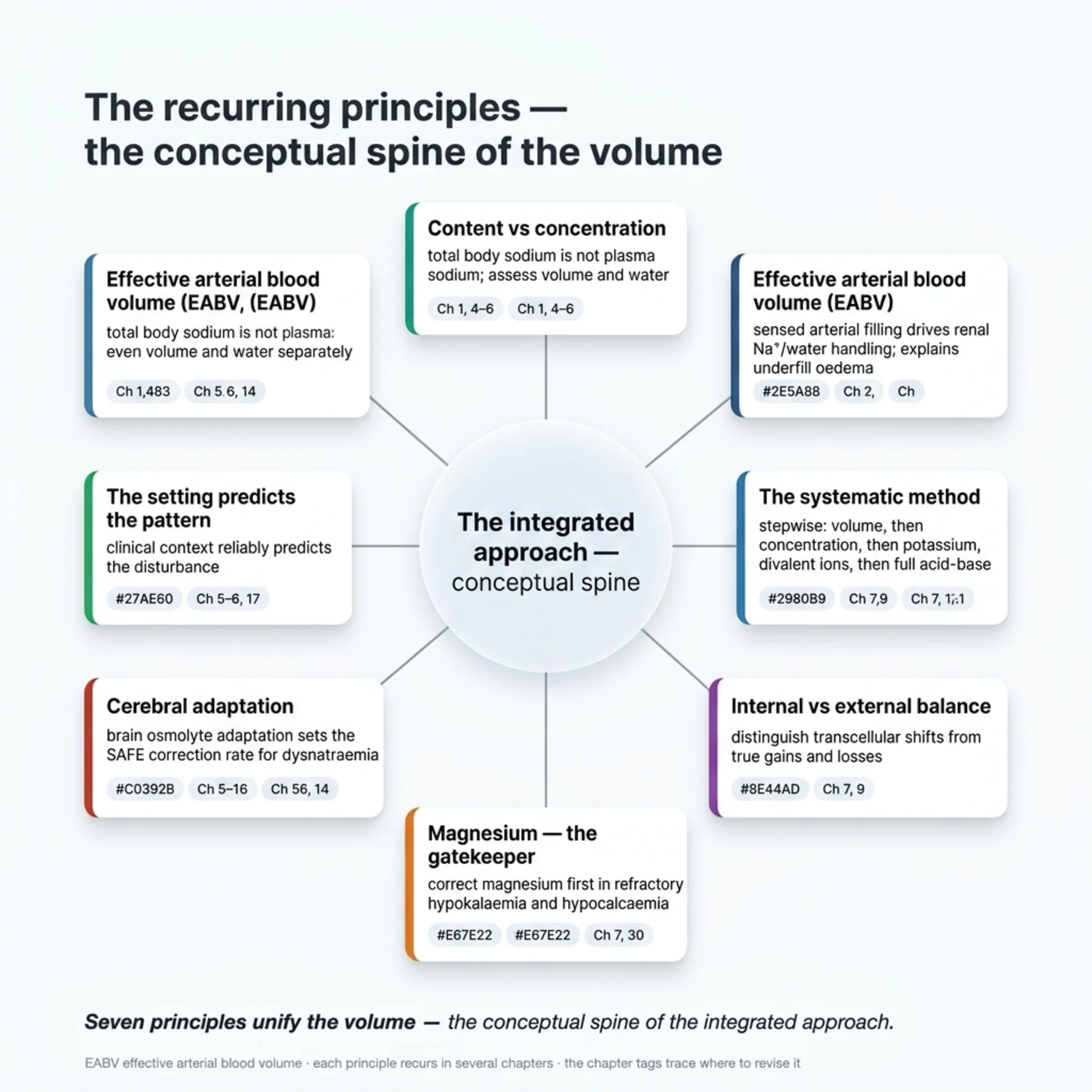
A handful of principles recur across every chapter and, learned once, organise the whole field. The first is the content-versus-concentration distinction of the opening chapter: sodium content determines the extracellular volume (the salt problem of oedema and depletion), while water balance determines the sodium concentration (the water problem of the dysnatraemias) — two separate axes that must not be confused. The second is that the body senses the effective arterial blood volume, not total volume, which is why a depleted patient and an overloaded underfill-oedema patient share a kidney phenotype. The third is the systematic acid-base method — pH, primary disorder, compensation, anion gap, delta ratio — applied without stopping early, so mixed disorders surface. The fourth is internal-versus-external balance for potassium — a shift into cells versus a true total-body change. The fifth is magnesium as the hidden cofactor behind refractory potassium and calcium. The sixth is cerebral adaptation, which makes the rate of correcting the dysnatraemias the central safety concern in both directions. And the seventh is that the clinical setting predicts the pattern. These principles, woven through the volume, are the conceptual spine of the integrated approach.
— One framework for the whole milieu
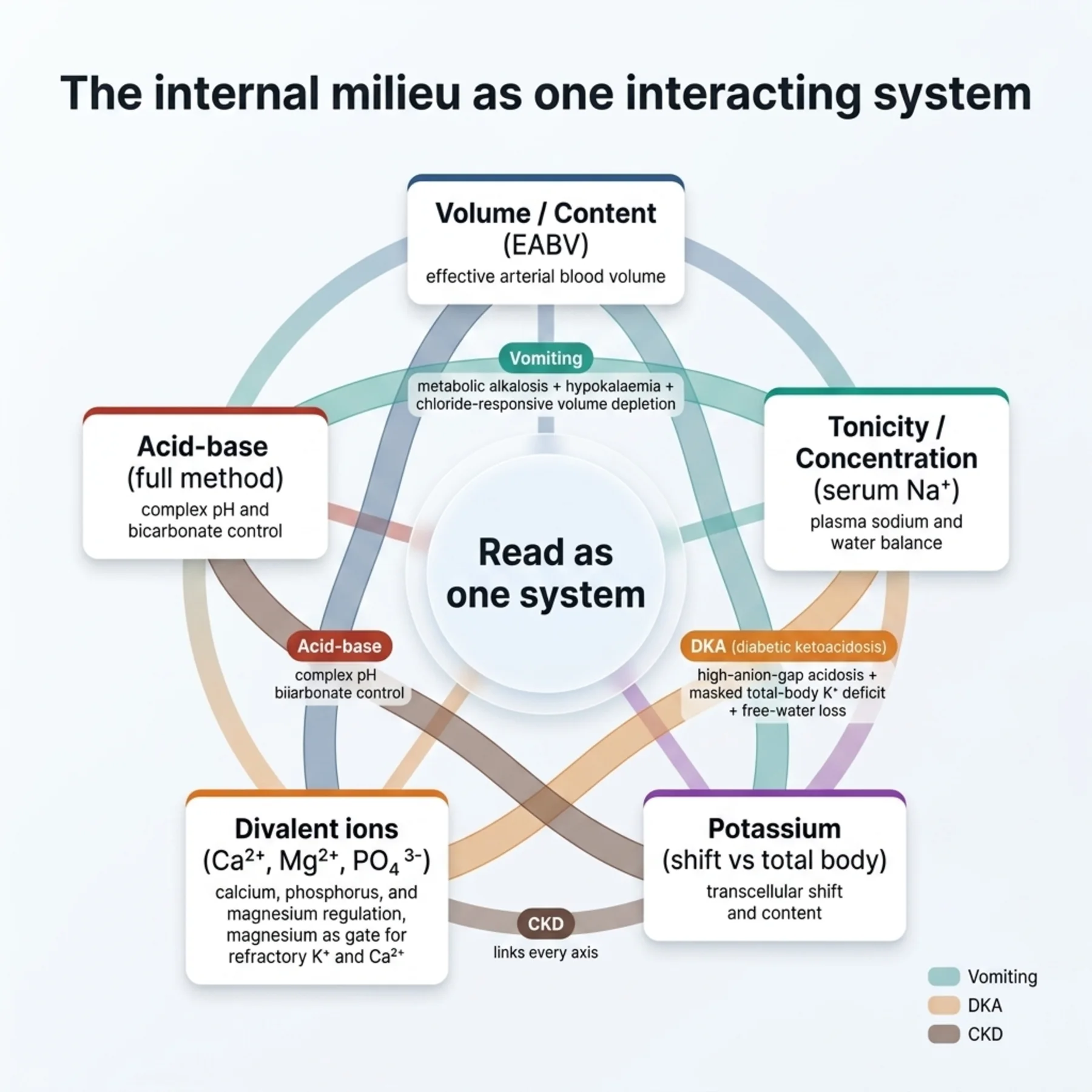
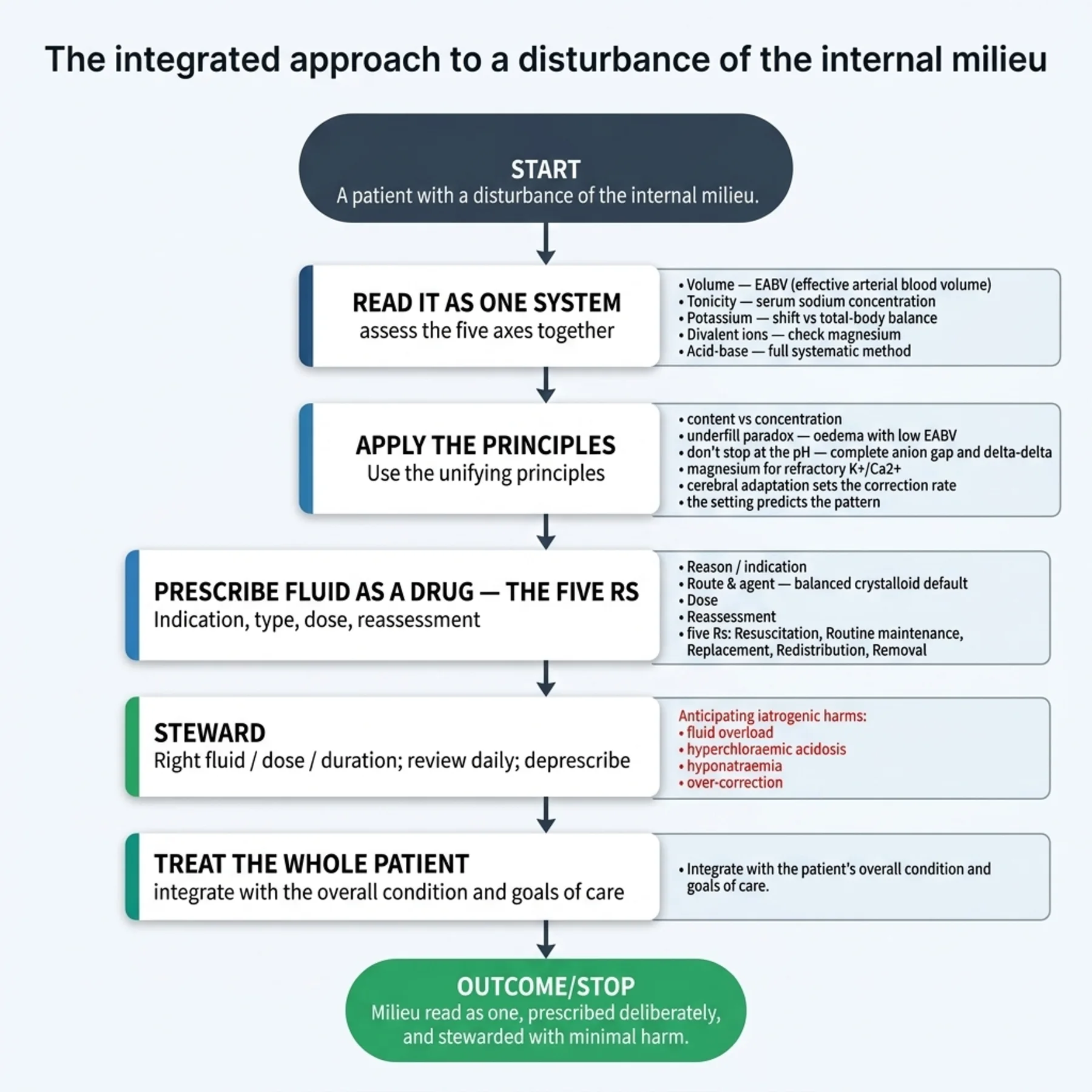
The integrated approach reads the milieu as a single system through one framework, asking, of every patient: what is the volume state (content), assessed by effective arterial blood volume and the clinical and laboratory signs; what is the tonicity (the sodium concentration, a water question); what is the potassium, and is any abnormality a shift or a true deficit or excess; what are the divalent ions, with magnesium checked whenever potassium or calcium is refractory; and what is the acid-base status, by the full systematic method. Crucially, these are read together, because they interact — the vomiting patient's alkalosis, hypokalaemia, hypochloraemia, and volume depletion are one process; the diabetic ketoacidosis patient's acidosis, potassium shifts, and water deficit are one process; the CKD patient's overload, hyperkalaemia, acidosis, and mineral disorder are one process. The expert does not assemble a list of separate abnormalities but reads a single, coherent disturbance of the internal milieu, and treats it as such — which is exactly what the mixed-disorder and specific-setting chapters were preparing.
— Fluid is a drug — the foundation of stewardship
The therapeutic spine of the volume, established in the fluids chapter, is that intravenous fluid is a drug — with an indication, a composition, a dose, a duration, and a set of toxicities — and must be prescribed as deliberately as any other. The five Rs organise that prescribing: resuscitation (rapid intravascular replacement, isotonic, reassessed against responsiveness), routine maintenance (daily needs, isotonic, modest, reassessed), replacement (matching ongoing losses), redistribution (accounting for shifts), and reassessment (the most neglected R, reviewing and deprescribing daily). Every fluid order should specify which R, which fluid, what rate and volume, and the plan to reassess. This deliberate, drug-like prescribing is the foundation of stewardship, because most of the iatrogenic harm in this field comes from fluid ordered reflexively — the wrong type, the wrong dose, never reviewed — and the discipline of the five Rs prevents exactly that.
— Fluid stewardship
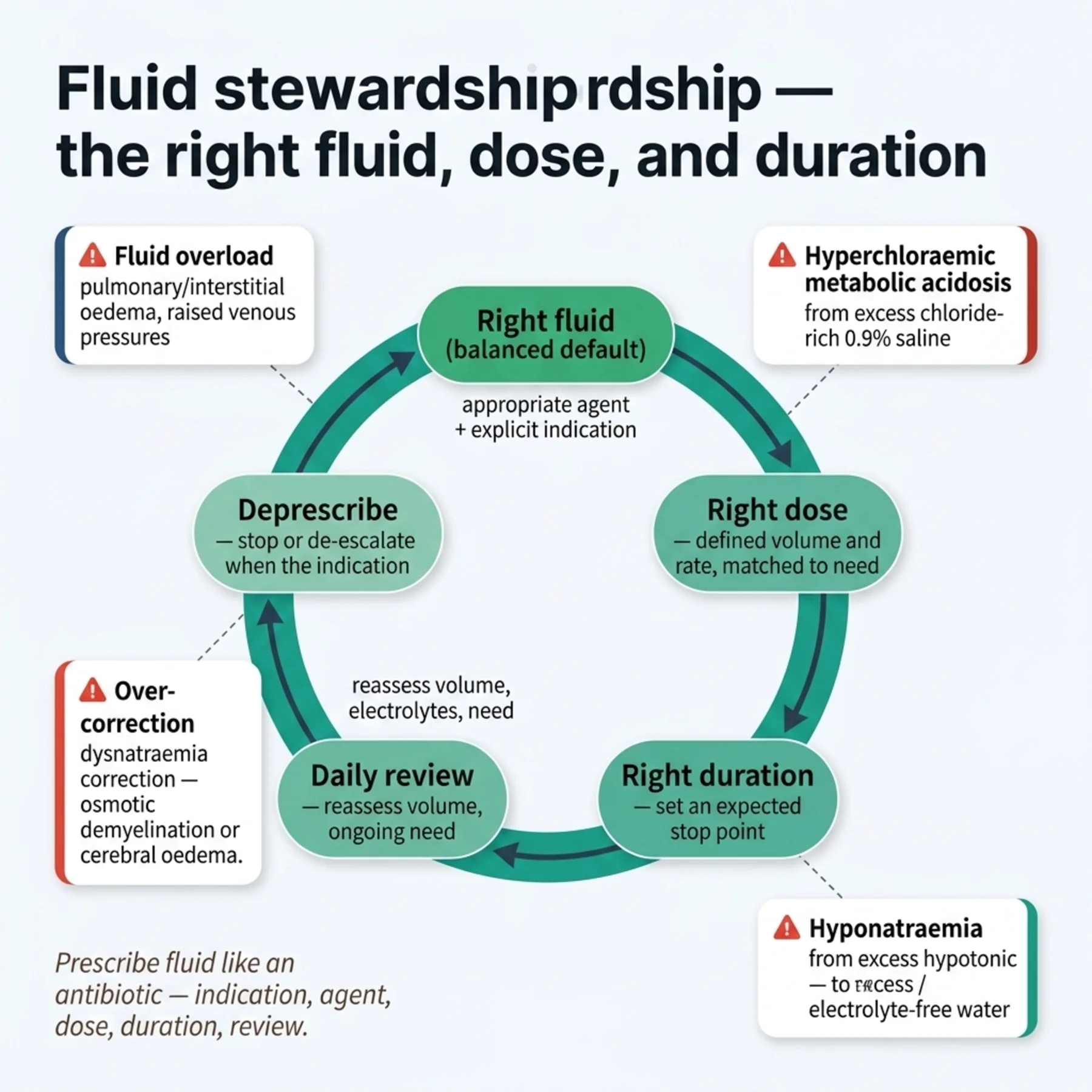
Fluid stewardship is the organising discipline of the chapter and a fitting close to the volume: the deliberate, evidence-based, harm-minimising prescribing of fluid and electrolytes, directly analogous to antimicrobial stewardship. Just as antimicrobials are powerful drugs whose careless use causes harm, so are fluids and electrolyte therapies, and stewardship applies the same disciplines: the right agent, the right dose, the right duration, daily review, and prompt de-escalation. It guards against the specific iatrogenic harms the volume has named at every turn — fluid overload (from over-resuscitation or unreviewed maintenance), hyperchloraemic acidosis (from large-volume saline), iatrogenic hyponatraemia (from hypotonic fluids), over-correction of the dysnatraemias (osmotic demyelination and cerebral oedema), rebound hyperkalaemia (from over-replaced shifts), and the electrolyte derangements of careless prescribing. Each is a prescribing harm, not a disease that befalls the patient, and each is preventable by the same stewardship: prescribe deliberately, monitor, review daily, and deprescribe. Stewardship is what converts the volume's knowledge into safe, harm-minimising practice.
— The evidence that grounds it
Stewardship is evidence-based, and the volume's evidence converges on a coherent set of conclusions. Balanced crystalloids are gently preferred over saline (less hyperchloraemic acidosis, a probable small kidney benefit, no clear mortality difference), so balanced is the reasonable default and large-volume saline is avoided. Synthetic starch harms the critically ill and is avoided, and albumin has no general resuscitation role. Fluid overload is associated with worse outcomes, so resuscitation gives way to de-resuscitation. Liberal and restrictive resuscitation strategies are broadly neutral, reinforcing that fluid has toxicity at both extremes and that individualisation matters. The correction-rate limits for the dysnatraemias are grounded in the cerebral-adaptation physiology and the demyelination and cerebral-oedema literature. The modern potassium binders enable RAAS blockade to continue. And bicarbonate is reserved, not given reflexively. The honest reading is that much of this evidence points to moderation — balanced fluids, avoided extremes, capped corrections, deliberate prescribing — which is the essence of stewardship: not a single dramatic intervention but a disciplined, evidence-aligned restraint.
— The steward of the internal milieu
The volume closes on an image of the clinician's role: the steward of the patient's internal milieu. The healthy kidney maintains that milieu effortlessly, integrating volume, tonicity, electrolytes, and acid-base moment to moment; when it fails — in acute illness, in CKD, on dialysis — the regulation must be supplied externally, and the clinician becomes the steward, reading the milieu as one system, prescribing fluid and electrolytes as deliberate drugs, respecting the evidence, anticipating the predictable harms, and minimising the iatrogenic damage that careless management causes. This stewardship serves the whole patient: the internal milieu is not an end in itself but the medium in which the patient lives, so its management is integrated with their overall condition, goals, and care. The expert in fluid, electrolyte, and acid-base medicine is not the one who knows the most formulae but the one who reads the milieu as a coherent whole, prescribes with the discipline of a steward, and keeps the patient — not the numbers — at the centre. That is the integrated approach, and it is where this volume has been leading from the first chapter's distinction between content and concentration to this last one's call to stewardship.
| 04 | PHASE A · LEVEL 4 · ORIENTATION & KNOWLEDGE Reference Tables |
Table 18.1 — The internal milieu as one system
| Axis | Question |
| Volume (content) | Effective arterial blood volume — depleted, euvolaemic, or overloaded? |
| Tonicity (concentration) | Sodium concentration — a water question (the dysnatraemias) |
| Potassium | Shift or true deficit/excess? (internal vs external balance) |
| Divalent ions | Calcium, phosphate, magnesium — magnesium the hidden cofactor |
| Acid-base | The systematic method — never stopping at the pH |
Table 18.2 — The recurring principles
| Principle | Where it recurs |
| Content vs concentration | Volume (salt) vs the dysnatraemias (water) |
| Effective arterial blood volume | Depletion and the underfill paradox |
| The systematic acid-base method | Mixed disorders — don't stop at the pH |
| Internal vs external balance | Potassium — shift vs total body |
| Magnesium the hidden cofactor | Refractory potassium and calcium |
| Cerebral adaptation → correction rate | The dysnatraemias, both directions |
| The setting predicts the pattern | Specific settings; treat-cause-correct-anticipate |
Table 18.3 — Fluid as a drug: the five Rs
| R | Action |
| Resuscitation | Isotonic crystalloid, reassessed against responsiveness |
| Routine maintenance | Daily needs — isotonic, modest, reassessed |
| Replacement | Match ongoing losses in composition |
| Redistribution | Account for shifts (sepsis, hypoalbuminaemia) |
| Reassessment | Review daily; deprescribe — the most neglected R |
Table 18.4 — Fluid stewardship
| Element | Detail |
| Definition | Deliberate, evidence-based, harm-minimising fluid/electrolyte prescribing |
| Analogy | Antimicrobial stewardship — right agent, dose, duration, review, de-escalation |
| Guards against | Overload, hyperchloraemic acidosis, iatrogenic hyponatraemia, over-correction, rebound, derangement |
| Practice | Right fluid/dose/duration; monitor; review daily; deprescribe |
Table 18.5 — The evidence that grounds stewardship
| Conclusion | Note |
| Balanced > saline (gently) | Less acidosis, probable small kidney benefit; avoid large-volume saline |
| Avoid starch; albumin no general benefit | Starch harms the critically ill |
| Fluid overload is harmful | Resuscitation → de-resuscitation |
| Liberal vs restrictive ~neutral | Individualise; toxicity at both extremes |
| Correction-rate limits protect the brain | Grounded in cerebral adaptation |
Table 18.6 — The integrated bedside framework
| Step | Action |
| Read the milieu as one | Volume, tonicity, potassium, divalent ions, acid-base — together |
| Apply the principles | Content/concentration, EABV, the method, magnesium, adaptation, the setting |
| Prescribe fluid as a drug | The five Rs — indication, type, dose, reassessment |
| Steward | Right fluid/dose/duration; review daily; deprescribe; anticipate harms |
| Keep the patient central | The milieu serves the whole patient |
| 05 | PHASE B · LEVEL 5 · VISUALISE & MAP Imaging & Flowchart Specifications |
| 06 | PHASE B · LEVEL 6 · VISUALISE & MAP Concept Maps |
Each chain runs from principle to a named bedside action; read the arrows as “leads to.”
One system. Volume, tonicity, potassium, divalent ions, and acid-base interact in one milieu → disturbances cluster (vomiting, DKA, CKD) → ACTION: read the axes together as a single coherent disturbance, not a list.
The recurring principles. Content/concentration, EABV, the systematic method, internal/external balance, magnesium, cerebral adaptation, the setting → a conceptual spine → ACTION: apply the recurring principles to organise any disturbance.
Fluid as a drug. Fluid has an indication, dose, duration, and toxicities → the five Rs → ACTION: prescribe fluid deliberately, specifying which R, what fluid, what dose, and the reassessment.
Stewardship. Careless prescribing causes overload, hyperchloraemic acidosis, hyponatraemia, over-correction → deliberate, evidence-based prescribing prevents them → ACTION: practise stewardship — right fluid/dose/duration, daily review, deprescribe.
The steward. The failing kidney can't regulate the milieu → the clinician supplies the regulation → ACTION: be the steward of the internal milieu, keeping the whole patient central.
| 07 | PHASE B · LEVEL 7 · VISUALISE & MAP Decision Pathways |
| R1 | IF assessing a patient, THEN read the internal milieu as one integrated system — volume, tonicity, potassium, divalent ions, acid-base — not as isolated abnormalities. |
| R2 | IF organising a disturbance, THEN apply the recurring principles — content versus concentration, effective arterial blood volume, the systematic method, magnesium, cerebral adaptation, the setting. |
| R3 | IF prescribing fluid, THEN treat it as a drug via the five Rs — specifying the indication, type, dose, and reassessment. |
| R4 | IF resuscitating, THEN default to a balanced crystalloid, avoid large-volume saline, avoid starch, and reassess responsiveness. |
| R5 | IF a patient is on fluid, THEN review it daily and deprescribe — the most neglected and most important step of stewardship. |
| R6 | IF correcting a disturbance, THEN anticipate the iatrogenic harms — overload, hyperchloraemic acidosis, hyponatraemia, and over-correction. |
| R7 | IF a potassium or calcium is refractory, THEN check the magnesium — the recurring hidden cofactor. |
| R8 | IF managing the internal milieu, THEN keep the whole patient central — the milieu serves the patient, not the reverse. |
| 08 | PHASE C · LEVEL 8 · CLINICAL REASONING Clinical Cases |
| CASE 1 | ONE COHERENT DISTURBANCE Read the milieu as a whole The integrated assessment |
Presentation
A patient with prolonged vomiting has a metabolic alkalosis, hypokalaemia, hypochloraemia, and volume depletion, with a low urine chloride. A trainee lists four separate problems to address individually.
❖ Pause and reflect Are these four separate problems, or one? |
Analysis
They are one coherent disturbance. The vomiting lost hydrochloric acid (the alkalosis), with the volume and chloride depletion maintaining it (saline-responsive, low urine chloride) and the hypokalaemia and hypochloraemia part of the same process. Reading them as four separate problems misses the unity — and the single treatment. The integrated approach recognises the whole picture as the upper-gastrointestinal-loss syndrome and treats it with one coherent intervention (saline with potassium chloride), which corrects the volume, the chloride, the potassium, and the alkalosis together. The milieu is one system, read and treated as such.
Plan
Recognise the single integrated disturbance of upper gastrointestinal loss and treat it coherently with saline and potassium chloride, stemming the vomiting; the four 'problems' resolve together. Read the milieu as one system, not a list.
Teaching point
The internal milieu is one system — read clustered disturbances as a single coherent process and treat them coherently.
Cross-reference
Exercises rules R1 and R2; the one-system concept map; Figure 18.1; Tables 18.1, 18.2; GI losses in Chapter 15, alkalosis in Chapter 12.
| CASE 2 | REVIEW THE DRIP Daily review and deprescribing Fluid stewardship |
Presentation
A patient resuscitated several days ago for hypovolaemia remains on continuous maintenance fluid that no one has reviewed, and is now oedematous and gaining weight. The team has not considered the fluid as a cause.
❖ Pause and reflect What stewardship failure has occurred here? |
Analysis
The neglected fifth R — reassessment. The maintenance fluid, appropriate during the resuscitation, was left running unreviewed after the indication passed, causing fluid overload — a prescribing harm, not a disease. This is the core failure stewardship guards against: fluid ordered and then forgotten, never reviewed, never deprescribed. The remedy is the discipline of daily review — asking of every fluid order whether it is still indicated — and prompt deprescribing once it is not, treating fluid with the same stewardship as an antimicrobial.
Plan
Stop the maintenance fluid, manage the overload, and institute daily fluid review with a stop date for every order; deprescribe when the indication passes. Practise fluid stewardship — the right fluid, dose, and duration, reviewed daily.
Teaching point
Fluid stewardship's core is daily review and deprescribing — unreviewed fluid causes overload, the commonest avoidable prescribing harm.
Cross-reference
Exercises rules R3, R5, R6; the stewardship concept map; Figure 18.3; Tables 18.3, 18.4; fluid as a drug in Chapter 2.
| CASE 3 | THE HIDDEN COFACTOR, AGAIN A recurring principle Magnesium across the volume |
Presentation
A patient has both a refractory hypokalaemia and a refractory hypocalcaemia, each failing to correct despite replacement. The team is treating the potassium and calcium separately and intensively.
❖ Pause and reflect What single recurring principle explains both refractory problems? |
Analysis
Hypomagnesaemia — the hidden cofactor that recurs across the volume. Magnesium is required for the kidney's potassium conservation (via ROMK) and for PTH secretion and action, so a low magnesium causes both a refractory hypokalaemia and a refractory hypocalcaemia, neither of which corrects until the magnesium is replaced. Treating the potassium and calcium separately and intensively misses the single unifying cause. This is the integrated approach in miniature: one recurring principle (the magnesium cofactor) explains two apparently separate refractory disturbances.
Plan
Check and replace the magnesium, after which both the potassium and the calcium will correct; treat the shared cause of the magnesium loss. Apply the recurring principle — refractory potassium or calcium means check the magnesium.
Teaching point
Magnesium is the recurring hidden cofactor — refractory hypokalaemia AND hypocalcaemia together point to it; replace it.
Cross-reference
Exercises rules R2 and R7; the recurring-principles concept map; Figure 18.2; Table 18.2; magnesium in Chapters 7 and 9.
| CASE 4 | THE STEWARD The whole patient The integrated synthesis |
Presentation
A complex patient with multiple, interacting fluid, electrolyte, and acid-base disturbances is being managed by a team focused intently on normalising each number, without an overall framework or attention to the patient's goals.
❖ Pause and reflect What is missing from this number-focused management? |
Analysis
The integrated, patient-centred stewardship that this volume has been building toward. The team is chasing individual numbers rather than reading the milieu as one system, applying the recurring principles, prescribing fluid as a deliberate drug, and stewarding against iatrogenic harm — and, crucially, has lost sight of the patient, for whom the internal milieu is a medium, not an end. The expert reads the whole milieu coherently, prescribes with the discipline of a steward, anticipates the predictable harms, and keeps the patient — their condition and goals — at the centre. That synthesis, not the mastery of any single number, is the mark of expertise.
Plan
Step back, read the milieu as one integrated system, apply the recurring principles, prescribe fluid and electrolytes as deliberate drugs with stewardship, anticipate the iatrogenic harms, and integrate the management with the patient's overall condition and goals. Be the steward of the internal milieu, keeping the patient central.
Teaching point
Expertise is reading the milieu as one system and stewarding it for the whole patient — not normalising numbers in isolation.
Cross-reference
Exercises rules R1 and R8; the steward concept map; Table 18.6; the whole volume.
| 09 | PHASE C · LEVEL 9 · CLINICAL REASONING Clinical Implications |
One triad per principle the synthesis exposed: the idea, why it matters, and the bedside move.
MECHANISM The internal milieu is one interacting system, not a set of independent values. |
WHY IT MATTERS Disturbances cluster as coherent processes (vomiting, DKA, CKD), not isolated abnormalities. |
ACTION Read the axes together and treat the single underlying disturbance. |
MECHANISM A handful of principles recur across every chapter of the volume. |
WHY IT MATTERS They organise the whole field into a navigable conceptual spine. |
ACTION Apply the recurring principles to make sense of any disturbance. |
MECHANISM Intravenous fluid is a drug with an indication, dose, duration, and toxicities. |
WHY IT MATTERS Most iatrogenic harm comes from fluid ordered reflexively and never reviewed. |
ACTION Prescribe fluid via the five Rs and review it daily. |
MECHANISM Careless fluid and electrolyte prescribing causes predictable iatrogenic harms. |
WHY IT MATTERS Stewardship — like antimicrobial stewardship — prevents them. |
ACTION Prescribe the right fluid, dose, and duration, review daily, and deprescribe. |
MECHANISM When the kidney fails, the clinician supplies the regulation of the milieu. |
WHY IT MATTERS The milieu serves the whole patient, not the other way round. |
ACTION Be the steward of the internal milieu, keeping the patient central. |
| 10 | PHASE C · LEVEL 10 · CLINICAL REASONING Clinical Pearls |
| The internal milieu is ONE integrated system — read the axes together. | Content (volume/salt) vs concentration (dysnatraemias/water) — the core distinction. |
| The body senses effective arterial blood volume (EABV). | Acid-base: the systematic method — never stop at the pH. |
| Potassium: internal (shift) vs external (total body) balance. | Magnesium = the hidden cofactor (refractory K and Ca). |
| Cerebral adaptation sets the correction rate (both dysnatraemias). | The setting predicts the pattern. |
| Treat the cause + correct + anticipate — everywhere. | Fluid is a DRUG — the five Rs (resuscitation/maintenance/replacement/redistribution/reassessment). |
| Default to balanced crystalloid; avoid large-volume saline and starch. | Fluid overload is harmful — resuscitation → de-resuscitation. |
| Stewardship: right fluid/dose/duration; review daily; deprescribe. | Guard against: overload, hyperchloraemic acidosis, hyponatraemia, over-correction. |
| Correction-rate limits protect the brain. | Be the STEWARD of the internal milieu — keep the whole patient central. |
| 11 | PHASE D · LEVEL 11 · SAFETY & EVIDENCE Red Flags & Never-Do |
Panel A — Red flags
| ▲ | A list of separate electrolyte/acid-base problems — step back and read the milieu as one coherent disturbance. |
| ▲ | Fluid running unreviewed for days — the neglected fifth R; review and deprescribe. |
| ▲ | Refractory hypokalaemia AND hypocalcaemia — the magnesium cofactor; replace it. |
| ▲ | Large-volume saline as the default resuscitation fluid — prefer balanced; avoid starch. |
| ▲ | A team normalising numbers without an overall framework or the patient's goals — read the milieu as one and keep the patient central. |
Panel B — Never do
| ✖ NEVER — read the milieu as isolated abnormalities rather than one integrated system. |
| ✖ NEVER — leave fluid running without daily review and a stop date. |
| ✖ NEVER — prescribe fluid reflexively rather than as a deliberate drug. |
| ✖ NEVER — lose sight of the whole patient while managing the numbers. |
| 12 | PHASE D · LEVEL 12 · SAFETY & EVIDENCE Common Pitfalls |
Pitfall 1 — A list, not a system
| ✖ | WRONG Treating each electrolyte and acid-base abnormality in isolation. |
| ✓ | RIGHT Reading the milieu as one coherent disturbance. |
| ✉ | WHY Disturbances cluster as a single process (vomiting, DKA, CKD). |
Pitfall 2 — Fluid on autopilot
| ✖ | WRONG Leaving fluid running unreviewed after the indication passes. |
| ✓ | RIGHT Reviewing daily and deprescribing. |
| ✉ | WHY Unreviewed fluid causes overload — the commonest prescribing harm. |
Pitfall 3 — Reflexive saline
| ✖ | WRONG Defaulting to large-volume 0.9% saline. |
| ✓ | RIGHT Defaulting to a balanced crystalloid. |
| ✉ | WHY Saline causes hyperchloraemic acidosis; balanced is gently preferred. |
Pitfall 4 — Missing the cofactor
| ✖ | WRONG Intensively replacing refractory potassium and calcium separately. |
| ✓ | RIGHT Checking and replacing the magnesium. |
| ✉ | WHY Magnesium is the recurring hidden cofactor behind both. |
Pitfall 5 — Numbers over patient
| ✖ | WRONG Chasing each number to normal without a framework or the patient's goals. |
| ✓ | RIGHT Reading the milieu as one and keeping the patient central. |
| ✉ | WHY The internal milieu serves the whole patient, not the reverse. |
| 13 | PHASE D · LEVEL 13 · SAFETY & EVIDENCE Evidence Grading |
GRADE A HIGH CONFIDENCE The effect is real and the estimate is stable. RCTs at low risk of bias; multiple concordant prospective cohorts; meta-analyses. |
GRADE B MODERATE CONFIDENCE The effect is likely real but may shift with new data. Observational studies, registries, mechanistic human studies. |
GRADE C LOW CONFIDENCE Rests on physiology, reasoning, or consensus rather than outcomes. Pathophysiological reasoning; extrapolation; consensus without outcomes. |
Graded statements (by evidence type)
| Statement | Grade | Basis (evidence type) |
| Fluid and electrolyte disturbances cluster as coherent, interacting processes. | A | Established physiology |
| Intravenous fluid is a drug requiring deliberate prescribing. | A | Consensus and clinical data |
| Balanced crystalloids are gently preferred over saline. | B | RCTs (SMART, PLUS, BaSICS) |
| Synthetic starch harms the critically ill. | A | RCTs |
| Fluid overload is associated with worse outcomes. | B | Observational and trial data |
| Hypomagnesaemia causes refractory hypokalaemia and hypocalcaemia. | A | Established physiology |
| Correction-rate limits for dysnatraemias protect the brain. | A | Physiology and clinical data |
| 14 | PHASE E · LEVEL 14 · PATIENT DECISIONS Absolute Risk in Natural Frequency |
Natural-frequency estimates for orientation, summarising the volume's stewardship evidence; they vary with context. They convey the size of the decisions, expressed per 100 comparable patients.
| Per 100 patients… | Outcome | Roughly how many | See |
| Resuscitated with balanced vs large-volume saline | Avoid a kidney event / acidosis | A small number more with balanced | L13 row 3 |
| Left fluid-overloaded vs de-resuscitated | Have a worse outcome | More when overloaded | L13 row 5 |
| Refractory hypokalaemia/hypocalcaemia given magnesium | Finally correct | Most — if magnesium was missing | L13 row 6 |
| Dysnatraemias corrected within the rate limits | Avoid brain injury | More than those over-corrected | L13 row 7 |
★ How to read these Read these as orientation, not promises; outcomes depend on context. The stable signals of stewardship: balanced fluids edge out saline, overload harms, magnesium rescues refractory deficits, and respecting the correction limits protects the brain. Communicate them as people out of 100, not as a hazard ratio. |
| 17 | PHASE F · LEVEL 17 · APPLY & TEST Documentation Templates |
Paste-ready notes. Tick the boxes that apply and delete the rest; make the integrated reading and the stewardship explicit.
Template 1 — The integrated assessment
Template 2 — The fluid stewardship checklist
| 18 | PHASE F · LEVEL 18 · APPLY & TEST Cheat Sheet |
| The internal milieu is ONE system — read the axes together. | Content (volume) vs concentration (water) — the core distinction. |
| Body senses EABV. | Acid-base: systematic method — never stop at the pH. |
| Potassium: internal (shift) vs external (total body). | Magnesium = hidden cofactor (refractory K/Ca). |
| Cerebral adaptation → correction rate (both dysnatraemias). | The setting predicts the pattern. |
| Treat cause + correct + anticipate. | Fluid is a DRUG — the five Rs. |
| Balanced default; avoid large-volume saline + starch. | Overload harms — resuscitation → de-resuscitation. |
| Stewardship: right fluid/dose/duration; review daily; deprescribe. | Guard against overload, hyperchloraemic acidosis, hyponatraemia, over-correction. |
| Correction-rate limits protect the brain. | Be the STEWARD — keep the whole patient central. |
| 19 | PHASE F · LEVEL 19 · APPLY & TEST Flashcards |
| CARD 1 | Q. Why read the internal milieu as one system? A. Because volume, tonicity, potassium, the divalent ions, and acid-base interact, so disturbances cluster as coherent processes (vomiting, diabetic ketoacidosis, CKD) rather than isolated abnormalities — and treating the single underlying disturbance corrects them together. DETAILED. The expert reads a coherent whole, not a list. CLINICAL. Read the axes together and treat the underlying process. |
| CARD 2 | Q. What are the recurring principles that unify the volume? A. Content versus concentration, effective arterial blood volume, the systematic acid-base method, internal versus external potassium balance, magnesium as the hidden cofactor, cerebral adaptation setting the correction rate, and the setting predicting the pattern. DETAILED. They form the conceptual spine of the field. CLINICAL. Apply the recurring principles to organise any disturbance. |
| CARD 3 | Q. What does it mean that fluid is a drug? A. Intravenous fluid has an indication, a composition, a dose, a duration, and toxicities, so it must be prescribed deliberately — via the five Rs (resuscitation, maintenance, replacement, redistribution, reassessment) — like any other drug. DETAILED. Most iatrogenic harm comes from reflexive prescribing. CLINICAL. Prescribe fluid via the five Rs and review it daily. |
| CARD 4 | Q. What is fluid stewardship? A. The deliberate, evidence-based, harm-minimising prescribing of fluid and electrolytes — analogous to antimicrobial stewardship — with the right agent, dose, and duration, daily review, and prompt deprescribing. DETAILED. It guards against overload, hyperchloraemic acidosis, hyponatraemia, and over-correction. CLINICAL. Prescribe the right fluid/dose/duration, review daily, and deprescribe. |
| CARD 5 | Q. What iatrogenic harms does stewardship guard against? A. Fluid overload, hyperchloraemic acidosis (large-volume saline), iatrogenic hyponatraemia (hypotonic fluids), over-correction of the dysnatraemias (demyelination and cerebral oedema), rebound hyperkalaemia, and electrolyte derangement — all prescribing harms, not diseases. DETAILED. Each is preventable by deliberate prescribing. CLINICAL. Anticipate and prevent the prescribing harms. |
| CARD 6 | Q. What does the evidence say grounds stewardship? A. Balanced crystalloids are gently preferred over saline, starch is avoided, fluid overload is harmful, liberal and restrictive strategies are broadly neutral (individualise), and the correction-rate limits protect the brain. DETAILED. Much of it points to moderation and restraint. CLINICAL. Default to balanced, avoid extremes, cap corrections, prescribe deliberately. |
| CARD 7 | Q. Why is magnesium called the hidden cofactor? A. Because it is required for the kidney's potassium conservation and for PTH, so hypomagnesaemia causes refractory hypokalaemia and refractory hypocalcaemia — a recurring principle that explains apparently separate refractory disturbances. DETAILED. It recurs throughout the volume. CLINICAL. Check the magnesium whenever potassium or calcium is refractory. |
| CARD 8 | Q. What does it mean to be the steward of the internal milieu? A. When the kidney fails to regulate the milieu, the clinician supplies the regulation — reading the milieu as one system, prescribing fluid and electrolytes as deliberate drugs, respecting the evidence, anticipating harms, and keeping the whole patient central. DETAILED. The milieu serves the patient, not the reverse. CLINICAL. Read the milieu as one, prescribe deliberately, and keep the patient central. |
| 20 | PHASE F · LEVEL 20 · APPLY & TEST One-Minute Preceptor |
| SCENE 1 | The intern with a problem list |
GET A COMMITMENT. “You've listed four separate problems in this vomiting patient — alkalosis, hypokalaemia, hypochloraemia, depletion. How will you treat them?”
PROBE FOR EVIDENCE. “One by one” — ask: “Are these four problems or one process, and what single treatment addresses them?”
TEACH A GENERAL RULE. The milieu is one system — these are one coherent disturbance of upper gastrointestinal loss, corrected together by saline with potassium chloride; read the whole, not a list.
REINFORCE WHAT WAS RIGHT. Identifying all four abnormalities was thorough.
CORRECT A MISTAKE. Treat them as one process with one coherent intervention.
| SCENE 2 | The resident who never reviews the fluid |
GET A COMMITMENT. “This patient's maintenance fluid has run unreviewed for days and they're now oedematous — what went wrong?”
PROBE FOR EVIDENCE. “The fluid was started appropriately” — ask: “What is the fifth R, and what happens to fluid that is never reviewed?”
TEACH A GENERAL RULE. Reassessment is the most neglected R; fluid is a drug that must be reviewed daily and deprescribed, or it causes overload — the core of stewardship.
REINFORCE WHAT WAS RIGHT. The initial resuscitation was appropriate.
CORRECT A MISTAKE. Stop the fluid, treat the overload, and review fluid daily from now on.
| 21 | PHASE F · LEVEL 21 · APPLY & TEST Reflective Prompts |
Genuine tensions this synthesis leaves open; sit with them as the volume closes.
The volume has taught system-by-system, yet the patient experiences one integrated milieu. How do you hold the detailed knowledge and the integrated reading at once, without losing either?
Fluid stewardship asks for restraint — less fluid, balanced not saline, capped corrections — yet the reflex in acute medicine is to act. How do you cultivate the discipline to do less when less is more?
Much of this volume's evidence points to moderation and individualisation rather than a single right answer. How do you act decisively while respecting that the extremes both carry harm?
The internal milieu is a means, not an end — it serves the patient. How do you keep the whole patient central when the numbers are so seductive to chase?
The expert is defined not by knowing the most formulae but by reading the milieu as a coherent whole. What does it take to move from the formulae to the synthesis?
| 22 | PHASE F · LEVEL 22 · APPLY & TEST Board-Style Questions |
| Q 01 | What is the central insight of the integrated approach to the internal milieu? |
| A | Treat each abnormality in isolation |
| B | Read volume, tonicity, potassium, divalent ions, and acid-base as one interacting system |
| C | Focus only on acid-base |
| D | Normalise every number independently |
Rationale The milieu is one interacting system, read and treated as a coherent whole (case 1, Figure 18.1, rule R1). A, C, and D fragment it. |
| Q 02 | Which is the core distinction running through the volume? |
| A | Acidosis vs alkalosis |
| B | Sodium content (volume) vs sodium concentration (water) |
| C | Renal vs extrarenal |
| D | Acute vs chronic |
Rationale Content sets the volume, concentration sets the sodium — the opening chapter's distinction recurs throughout (Table 18.2, rule R2). A, C, and D are narrower. |
| Q 03 | What does it mean that 'fluid is a drug'? |
| A | It has no toxicity |
| B | It has an indication, dose, duration, and toxicities and must be prescribed deliberately (the five Rs) |
| C | It should be given freely |
| D | It is always safe |
Rationale Fluid is prescribed deliberately via the five Rs, like any drug (Table 18.3, rule R3). A, C, and D are false. |
| Q 04 | Fluid stewardship is best described as: |
| A | Giving as much fluid as possible |
| B | Deliberate, evidence-based, harm-minimising fluid/electrolyte prescribing with daily review |
| C | Avoiding fluid entirely |
| D | Using only saline |
Rationale Stewardship is the disciplined, evidence-based, harm-minimising approach analogous to antimicrobial stewardship (Figure 18.3, Table 18.4, rule R5). A, C, and D mischaracterise it. |
| Q 05 | Which iatrogenic harm does fluid stewardship NOT primarily guard against? |
| A | Fluid overload |
| B | Hyperchloraemic acidosis |
| C | A congenital tubulopathy |
| D | Iatrogenic hyponatraemia |
Rationale A congenital tubulopathy is a disease, not a prescribing harm; stewardship guards against overload, hyperchloraemic acidosis, hyponatraemia, and over-correction (Table 18.4, rule R6). A, B, and D are stewardship targets. |
| Q 06 | A patient has refractory hypokalaemia AND hypocalcaemia. The unifying cause is most likely: |
| A | Too little replacement |
| B | Hypomagnesaemia — the recurring hidden cofactor |
| C | Two separate diseases |
| D | A laboratory error |
Rationale Magnesium is required for potassium conservation and PTH, so a low magnesium causes both refractory disturbances (case 3, rule R7). A, C, and D miss the unifying cofactor. |
| Q 07 | What does the evidence broadly favour for resuscitation fluid? |
| A | Large-volume saline |
| B | A balanced crystalloid (avoiding saline and starch) |
| C | Hydroxyethyl starch |
| D | 5% dextrose |
Rationale Balanced crystalloids are gently preferred, starch is avoided, and dextrose is not a resuscitation fluid (Table 18.5, rule R4). A, C, and D are disfavoured. |
| Q 08 | What is the most neglected, and arguably most important, of the five Rs? |
| A | Resuscitation |
| B | Reassessment — daily review and deprescribing |
| C | Replacement |
| D | Redistribution |
Rationale Reassessment is the most neglected R, and unreviewed fluid causes overload (case 2, Table 18.3, rule R5). A, C, and D are the other Rs. |
| Q 09 | The mark of expertise in fluid, electrolyte, and acid-base medicine is: |
| A | Knowing the most formulae |
| B | Reading the milieu as one coherent system and stewarding it for the whole patient |
| C | Normalising every number |
| D | Acting as fast as possible |
Rationale Expertise is the integrated reading and patient-centred stewardship, not formula recall or number-chasing (case 4, rule R8, L3). A, C, and D miss the synthesis. |