Chapter Preamble
Signals declared
Sig-D — Diagnostic (primary). Split the acidosis by the anion gap, work up the high-gap and normal-gap causes, and use the urine anion gap to localise normal-gap acidosis.
Sig-T — Therapeutic (strong). Treat the cause, and decide bicarbonate by the type — generally withheld in organic high-gap acidosis, replaced in normal-gap base loss.
Sig-M — Mechanistic (strong). Why added acid regenerates bicarbonate when treated, how the toxic alcohols injure, the renal tubular acidoses, and the urine ammonium behind the urine anion gap.
Levels populated and omitted
Populated (19): L1–L14, L17–L20, L22. The mechanistic signal fires the concept maps (L6) and triads (L9); the therapeutic signal fires the absolute-risk table (L14) and templates (L17); the diagnostic signal drives the tables, rules, cases, pitfalls, and board items.
L15 / L16 preference-sensitive map and SDM scripts — omitted. No Sig-E; treating metabolic acidosis is effective care.
L21 reflective prompts — omitted. No Sig-E/V; the chapter's tension (the bicarbonate debate) is worked through the cases and pitfalls.
| 01 | PHASE A · LEVEL 1 · ORIENTATION & KNOWLEDGE Learning Objectives |
By the end of this chapter you should be able to:
Split metabolic acidosis into high-anion-gap and normal-anion-gap using the anion gap.
List the high-anion-gap causes — lactate, ketoacidosis, toxins, and uraemic acidosis.
Recognise the toxic alcohols by the osmolar gap and treat them.
List the normal-anion-gap causes and distinguish gastrointestinal from renal loss with the urine anion gap.
Differentiate the renal tubular acidoses by lesion, potassium, and urine pH.
Treat the underlying cause as the priority.
Decide bicarbonate therapy by the type of acidosis.
Explain why organic acids regenerate bicarbonate when their cause is treated.
| 02 | PHASE A · LEVEL 2 · ORIENTATION & KNOWLEDGE Executive Summary |
Metabolic acidosis is a low bicarbonate, split by the anion gap into high-gap (added acid) and normal-gap (bicarbonate loss).
High-anion-gap causes are lactic acidosis, ketoacidosis (diabetic, alcoholic, starvation), toxic ingestions, and uraemic acidosis.
The toxic alcohols — methanol and ethylene glycol — produce both a high anion gap and a wide osmolar gap, and are treated with fomepizole and dialysis; salicylate causes a mixed picture with respiratory alkalosis.
Normal-anion-gap (hyperchloraemic) causes are gastrointestinal bicarbonate loss (diarrhoea, the commonest) and renal causes — the renal tubular acidoses.
The urine anion gap distinguishes them: negative (high urinary ammonium) in gastrointestinal loss, positive (low ammonium) in renal tubular acidosis.
Type 1 (distal) renal tubular acidosis cannot acidify the urine, with hypokalaemia and nephrocalcinosis; type 2 (proximal) wastes bicarbonate, with hypokalaemia and Fanconi features; type 4 reflects hypoaldosteronism, with hyperkalaemia and a mild acidosis.
Diagnosis confirms the acidosis, calculates the albumin-corrected anion gap, and then pursues the high-gap work-up (lactate, ketones, osmolar gap, salicylate) or the normal-gap work-up (urine anion gap, potassium, urine pH).
The priority of treatment is always the underlying cause — perfusion in lactic acidosis, insulin and fluids in diabetic ketoacidosis, fomepizole and dialysis in toxic alcohols.
Bicarbonate therapy is decided by type.
In organic high-gap acidosis (lactic, ketoacidosis), bicarbonate is generally not beneficial, because the organic anion is metabolised back to bicarbonate once the cause is treated, and bicarbonate carries its own harms.
Bicarbonate is reserved for severe acidaemia in these states, where even then its benefit is debated.
In normal-anion-gap acidosis, the bicarbonate has been lost and will not regenerate, so replacement is appropriate — the basis of treating renal tubular acidosis and chronic CKD acidosis.
The unifying principle: replace base when it is truly lost, treat the cause when the base will return.
| 03 | PHASE A · LEVEL 3 · ORIENTATION & KNOWLEDGE Main Narrative |
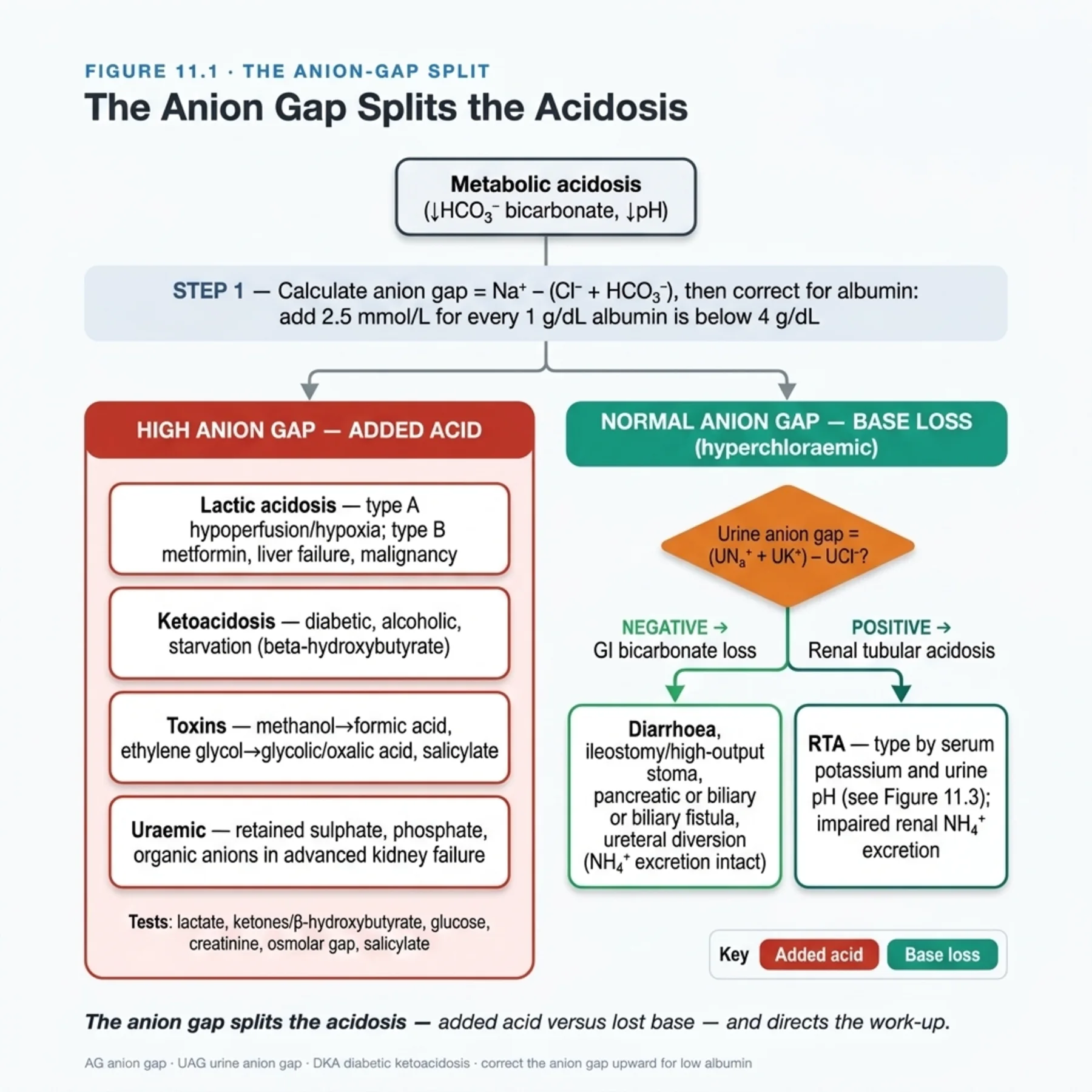
Metabolic acidosis is the acid-base disorder where the anion gap earns its keep. The same low bicarbonate can mean an acid was added or a base was lost, and the gap tells which — a distinction that then governs both the work-up and, crucially, whether to give bicarbonate at all. The chapter follows the method of the last: split by the gap, work up each branch, and treat the cause, giving bicarbonate only when the base is genuinely gone.
— The high-anion-gap causes
A high anion gap means an unmeasured acid anion has been added, consuming bicarbonate. The causes fall into recognisable groups. Lactic acidosis is the commonest in the acutely ill: type A from tissue hypoxia (shock, sepsis, ischaemia) and type B from impaired metabolism (metformin, liver failure, malignancy). Ketoacidosis comes in three forms — diabetic (insulin deficiency), alcoholic, and starvation. The toxic ingestions are a distinct, dangerous group: methanol (metabolised to formic acid, causing visual loss), ethylene glycol (metabolised to glycolic and oxalic acids, causing acute kidney injury and oxalate crystals), and salicylate, which characteristically produces a mixed disorder — a high-gap acidosis plus a respiratory alkalosis from direct respiratory-centre stimulation. Uraemic acidosis is the retained-acid acidosis of advanced CKD (the Volume 6 mineral-acid story). The work-up of a high-gap acidosis therefore measures lactate, ketones, glucose, renal function, and — when an ingestion is possible — the osmolar gap and a salicylate level.
— The toxic alcohols and the osmolar gap
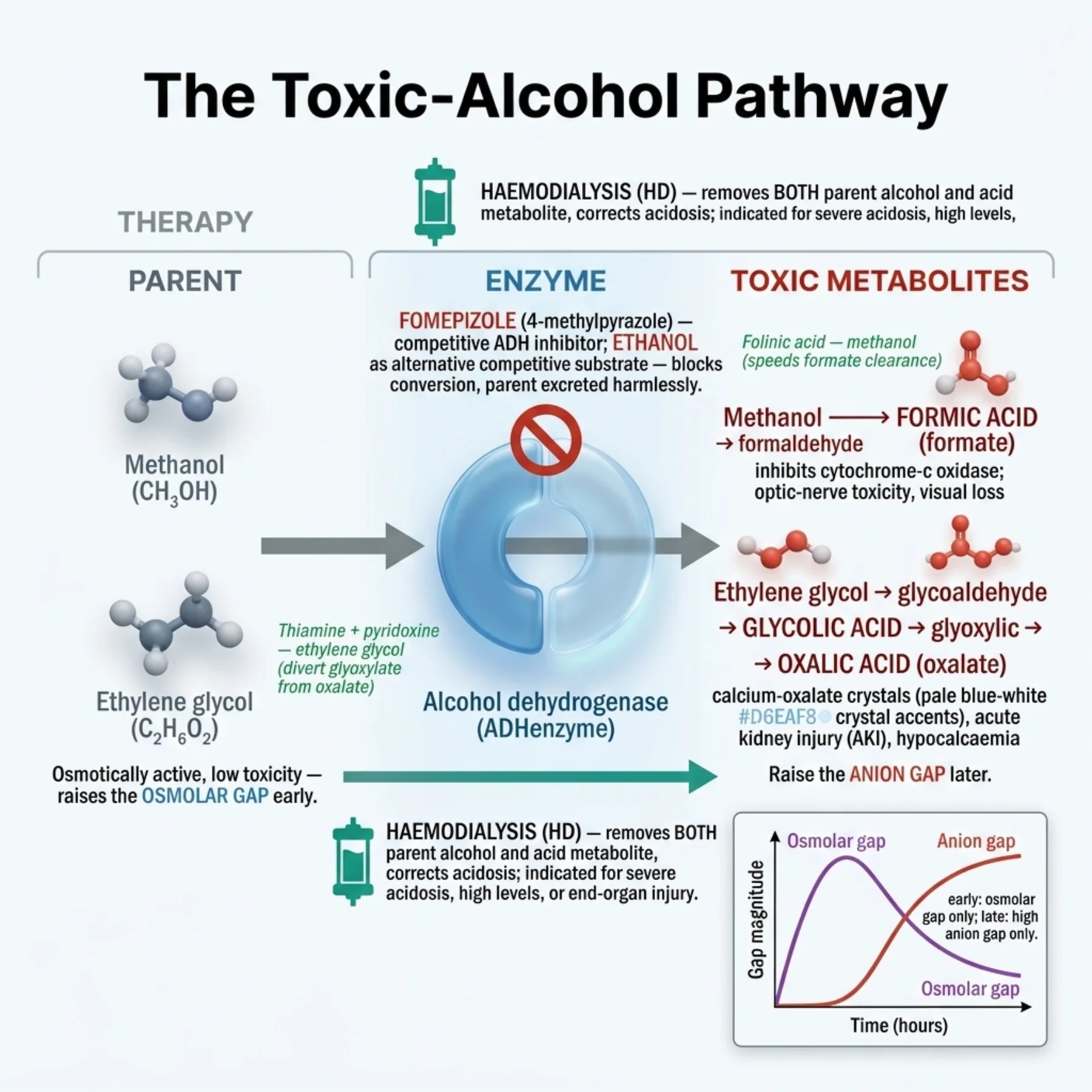
The toxic alcohols deserve emphasis because they are lethal and treatable, and because they showcase the osmolar gap from the opening chapter. Methanol and ethylene glycol are themselves osmotically active but relatively non-toxic; it is their metabolism by alcohol dehydrogenase into toxic acids (formic acid, glycolic and oxalic acids) that causes the harm. Early on, the parent alcohol raises the osmolar gap (measured minus calculated osmolality) before much acid has formed, so a wide osmolar gap with an evolving high-anion-gap acidosis is the signature. The treatment exploits the metabolic pathway: fomepizole inhibits alcohol dehydrogenase, blocking the conversion to the toxic acids and buying time, and dialysis removes both the parent alcohol and the toxic metabolites — with bicarbonate as adjunct. Recognising the osmolar-gap-plus-acidosis pattern and acting on it early prevents the blindness, renal failure, and death these poisonings cause.
— The normal-anion-gap causes and the urine anion gap
A normal anion gap means bicarbonate has been lost (or chloride gained) without an added acid — a hyperchloraemic acidosis. The two broad sources are the gut and the kidney. Gastrointestinal bicarbonate loss, chiefly from diarrhoea, is the commonest cause overall. Renal loss is the renal tubular acidoses. Distinguishing gut from kidney is the job of the urine anion gap (sodium plus potassium minus chloride), which is an indirect measure of urinary ammonium: a negative urine anion gap means high ammonium excretion — the kidney is appropriately excreting acid, so the lost bicarbonate is from the gut; a positive urine anion gap means low ammonium — the kidney is failing to excrete acid, so the problem is renal (a renal tubular acidosis). This single calculation cleanly separates the diarrhoeal patient (negative) from the renal tubular acidosis patient (positive), and is the key test in normal-gap acidosis.
— The renal tubular acidoses
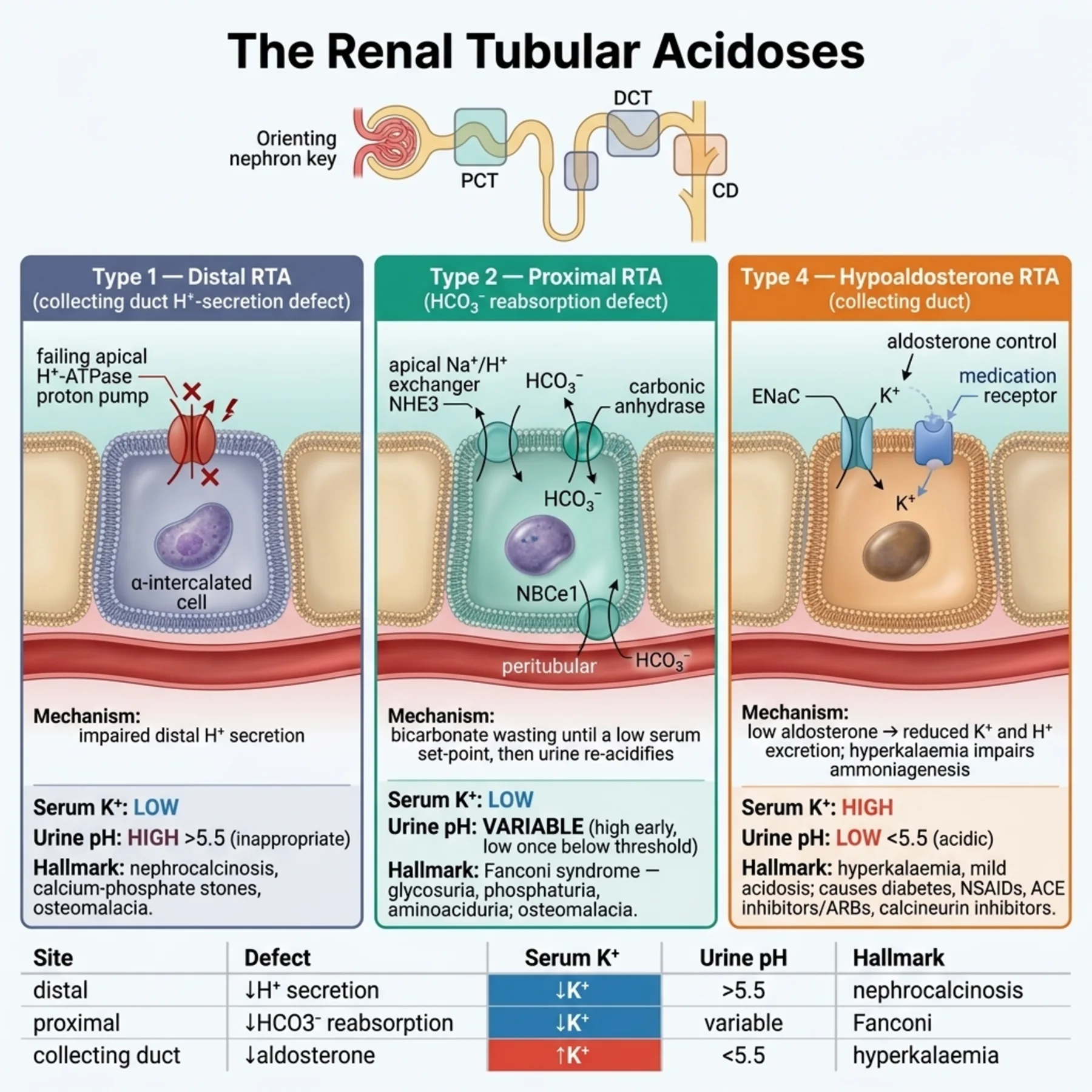
The renal tubular acidoses are best held apart by lesion, potassium, and urine pH. Type 1 (distal) is a failure of distal hydrogen-ion secretion, so the kidney cannot acidify the urine (urine pH stays above 5.5 despite acidaemia); it causes hypokalaemia and nephrocalcinosis or stones, and arises from autoimmune disease (Sjögren), drugs (amphotericin), and genetic defects. Type 2 (proximal) is a failure of proximal bicarbonate reabsorption, so bicarbonate is wasted until the serum level falls to a new low threshold; it causes hypokalaemia and is often part of Fanconi syndrome (glycosuria, phosphaturia, aminoaciduria), from myeloma, drugs (acetazolamide, tenofovir), and cystinosis. Type 4 is hypoaldosteronism — aldosterone deficiency or resistance — and is distinctive for causing hyperkalaemia with a mild acidosis, from diabetic hyporeninaemic hypoaldosteronism, drugs (RAAS blockers, potassium-sparing diuretics, trimethoprim, NSAIDs), and adrenal insufficiency. The potassium is the quickest discriminator: low in types 1 and 2, high in type 4.
— Treat the cause first
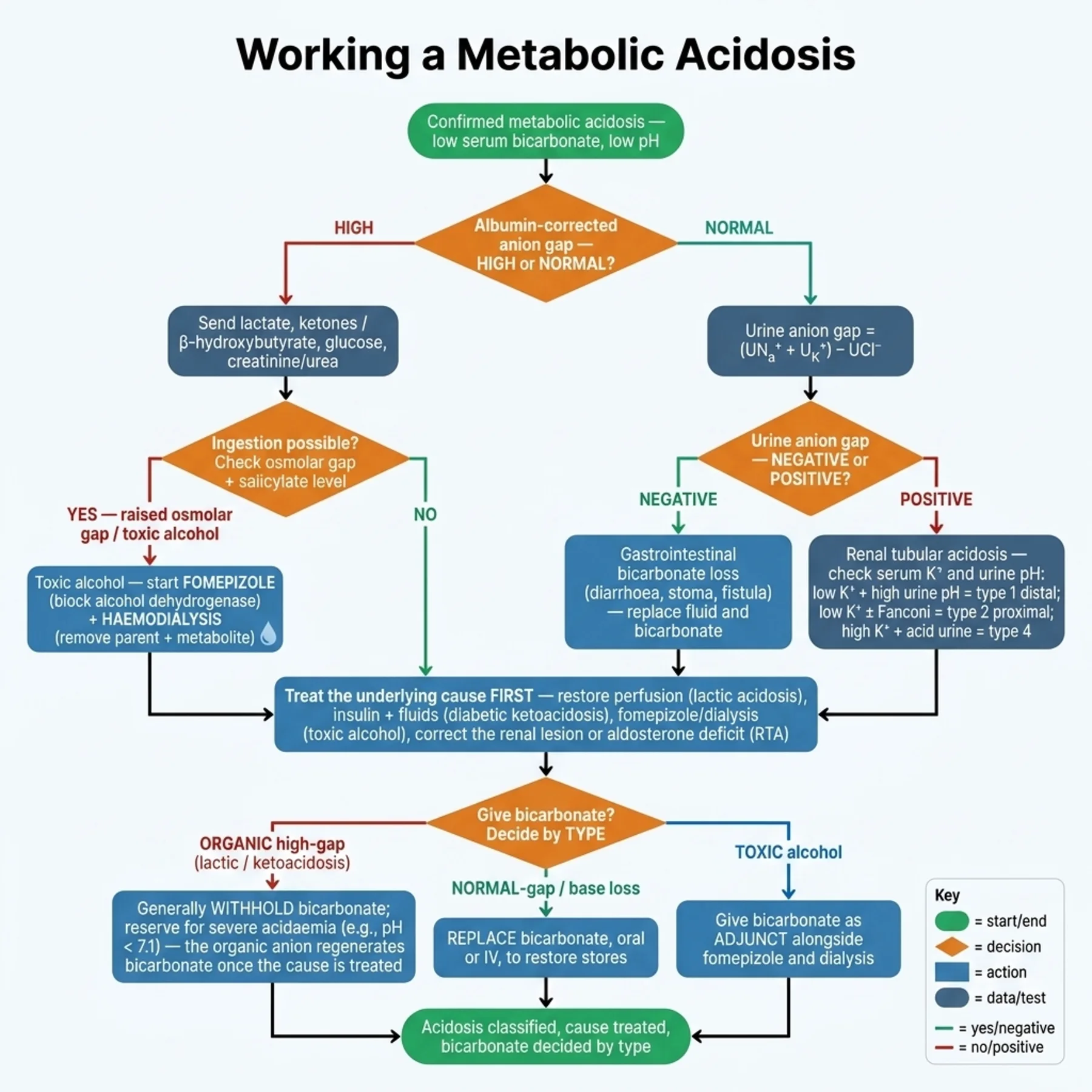
Across every metabolic acidosis, the priority is to treat the underlying cause, because that is what actually resolves the acidosis. Lactic acidosis is treated by restoring perfusion and oxygen delivery and removing the offending drug — the acidosis clears as the lactate is metabolised. Diabetic ketoacidosis is treated with fluids, insulin, and potassium attention (as the potassium chapter and the emergencies chapter detail) — the ketones clear with insulin. Toxic alcohols are treated with fomepizole and dialysis. Uraemic and renal tubular acidoses are treated by addressing the renal lesion and replacing base. Bicarbonate, where used, is an adjunct to cause-directed treatment, never a substitute for it; pouring bicarbonate into an untreated lactic acidosis without restoring perfusion does not help and may harm. The cause is the lever; bicarbonate is, at most, a temporising measure in specific situations.
— The bicarbonate question, decided by type
Whether to give bicarbonate is the chapter's central therapeutic decision, and it turns entirely on the type of acidosis. In an organic high-anion-gap acidosis — lactic acidosis, ketoacidosis — bicarbonate is generally not beneficial, for a mechanistic reason: the organic anion (lactate, ketoacids) is itself metabolised back to bicarbonate once the underlying cause is treated, so the body regenerates its own base, and giving exogenous bicarbonate risks an overshoot alkalosis as the anions are later metabolised, along with sodium and volume loading, hypocalcaemia, hypokalaemia, and a paradoxical worsening of intracellular and cerebrospinal-fluid acidosis. Bicarbonate is therefore reserved for severe acidaemia (a pH below roughly 7.1) in these states, and even then its benefit is debated — a major trial found no overall benefit, with a possible signal in the acute-kidney-injury subgroup. In a normal-anion-gap acidosis, the situation is opposite: the bicarbonate has actually been lost (from the gut or the kidney) and there is no organic anion to regenerate it, so replacing bicarbonate is appropriate and is the mainstay of treating renal tubular acidosis and chronic CKD acidosis. The principle is clean: replace base when it is truly lost (normal-gap), treat the cause when the base will return (organic high-gap).
— Putting it together
Metabolic acidosis is, in the end, a two-question disorder. First, added acid or lost base? — answered by the anion gap, with the osmolar gap and the urine anion gap as the second-line discriminators (toxic alcohols, gut versus kidney). Second, will the base come back? — answered by the type, and deciding the bicarbonate question. The high-gap causes are worked up by their markers (lactate, ketones, osmolar gap, salicylate) and treated by their causes, with bicarbonate generally withheld because the anions regenerate base. The normal-gap causes are localised by the urine anion gap and subclassified (the renal tubular acidoses by potassium and urine pH) and treated by replacing the lost base. Held this way — gap first, then cause, then the type-specific bicarbonate decision — the bewildering list of acidoses becomes an orderly, two-branch problem, built directly on the systematic method of the previous chapter.
| 04 | PHASE A · LEVEL 4 · ORIENTATION & KNOWLEDGE Reference Tables |
Table 11.1 — High-anion-gap causes
| Group | Detail |
| Lactic acidosis | Type A (hypoxia/shock/sepsis); type B (metformin, liver failure, malignancy) |
| Ketoacidosis | Diabetic, alcoholic, starvation |
| Toxic ingestions | Methanol (→ formic acid), ethylene glycol (→ oxalic/glycolic), salicylate (mixed), propylene glycol |
| Uraemic | Advanced CKD — retained acids (Volume 6) |
Table 11.2 — The toxic alcohols
| Feature | Detail |
| Mechanism | Parent alcohol metabolised by alcohol dehydrogenase to a toxic acid |
| Methanol | → formic acid — visual loss |
| Ethylene glycol | → glycolic/oxalic acid — AKI, oxalate crystals |
| Clue | Wide osmolar gap + evolving high-anion-gap acidosis |
| Treatment | Fomepizole (blocks ADH) + dialysis (± bicarbonate) |
Table 11.3 — Normal-anion-gap causes and the urine anion gap
| Item | Detail |
| Gastrointestinal | Diarrhoea (commonest), fistulae, ureterosigmoidostomy |
| Renal | Renal tubular acidosis; early CKD; carbonic anhydrase inhibitors |
| Urine anion gap | Na + K − Cl (an indirect measure of urinary ammonium) |
| Negative UAG | High ammonium — gastrointestinal loss (appropriate renal response) |
| Positive UAG | Low ammonium — renal (renal tubular acidosis) |
Table 11.4 — The renal tubular acidoses
| Type | Lesion | Potassium | Features / causes |
| Type 1 (distal) | Impaired distal H+ secretion | Low | Urine pH > 5.5; nephrocalcinosis; Sjögren, amphotericin |
| Type 2 (proximal) | Impaired HCO3 reabsorption | Low | Fanconi; myeloma, tenofovir, acetazolamide |
| Type 4 | Hypoaldosteronism | High | Mild acidosis; diabetes, RAAS blockers, trimethoprim |
Table 11.5 — The diagnostic work-up
| Step | Detail |
| Confirm + gap | Low HCO3, check compensation; anion gap (albumin-corrected) |
| High gap | Lactate, ketones, glucose, renal function; osmolar gap, salicylate if ingestion |
| Normal gap | Urine anion gap (GI vs renal); potassium; urine pH; Fanconi screen |
| Mixed | Delta ratio (Chapter 10) |
Table 11.6 — The bicarbonate decision
| Acidosis type | Bicarbonate |
| Organic high-gap (lactic, ketoacidosis) | Generally NOT beneficial — anions regenerate bicarbonate; reserve for severe pH (< ~7.1), debated |
| Normal-gap (base lost) | Replace bicarbonate (RTA, chronic CKD acidosis) |
| Toxic alcohols | Bicarbonate + fomepizole + dialysis |
| Principle | Replace base when truly lost; treat the cause when base will return |
| 05 | PHASE B · LEVEL 5 · VISUALISE & MAP Imaging & Flowchart Specifications |
| 06 | PHASE B · LEVEL 6 · VISUALISE & MAP Concept Maps |
Each chain runs from physiology to a named bedside action; read the arrows as “leads to.”
The anion-gap split. Low bicarbonate → anion gap high (added acid: lactate/ketones/toxins/uraemic) vs normal (base loss: GI vs renal) → ACTION: calculate the albumin-corrected gap to choose the branch and the work-up.
Organic acid regeneration. Organic anions (lactate, ketoacids) are metabolised back to bicarbonate when the cause is treated → the body regenerates its own base → ACTION: treat the cause and generally withhold bicarbonate in organic high-gap acidosis.
Toxic alcohols. Parent alcohol (raises osmolar gap) → alcohol dehydrogenase → toxic acid (raises anion gap, organ injury) → ACTION: recognise the osmolar-gap-plus-acidosis pattern and give fomepizole + dialysis.
Renal tubular acidoses. Distal H+ defect (type 1, low K, alkaline urine) / proximal HCO3 defect (type 2, low K, Fanconi) / hypoaldosteronism (type 4, high K) → ACTION: use potassium and urine pH to type the RTA and replace base.
Urine anion gap. Urinary ammonium (acid excretion) → negative UAG (high ammonium, GI loss) vs positive UAG (low ammonium, renal) → ACTION: use the urine anion gap to separate gut from kidney in normal-gap acidosis.
| 07 | PHASE B · LEVEL 7 · VISUALISE & MAP Decision Pathways |
| R1 | IF there is a metabolic acidosis, THEN calculate the albumin-corrected anion gap first — high-gap (added acid) versus normal-gap (lost base) directs everything. |
| R2 | IF the anion gap is high, THEN measure lactate, ketones, glucose, and renal function, and check the osmolar gap and salicylate if an ingestion is possible. |
| R3 | IF a wide osmolar gap accompanies a high-gap acidosis, THEN suspect a toxic alcohol and give fomepizole and dialysis. |
| R4 | IF the anion gap is normal, THEN calculate the urine anion gap — negative means gastrointestinal loss, positive means a renal tubular acidosis. |
| R5 | IF a renal tubular acidosis is present, THEN type it by potassium and urine pH — low potassium (types 1 and 2), high potassium (type 4). |
| R6 | IF treating any metabolic acidosis, THEN treat the underlying cause as the priority — bicarbonate is at most an adjunct. |
| R7 | IF the acidosis is an organic high-gap type (lactic, ketoacidosis), THEN generally withhold bicarbonate — the anions regenerate it — reserving it for severe acidaemia. |
| R8 | IF the acidosis is a normal-gap (base-loss) type, THEN replace bicarbonate — it has been lost and will not regenerate. |
| 08 | PHASE C · LEVEL 8 · CLINICAL REASONING Clinical Cases |
| CASE 1 | TREAT THE PERFUSION Bicarbonate won't fix it Lactic acidosis |
Presentation
A septic, hypotensive patient has a severe high-anion-gap metabolic acidosis with a high lactate. The team's first instinct is to give bicarbonate to correct the pH.
❖ Pause and reflect Will bicarbonate fix this lactic acidosis? |
Analysis
No — the acidosis is driven by tissue hypoperfusion (type A lactic acidosis), and the treatment is to restore perfusion and oxygen delivery (resuscitation, source control), after which the lactate is metabolised back to bicarbonate and the acidosis resolves on its own. Giving bicarbonate without treating the perfusion does not help and risks overshoot alkalosis, sodium and volume loading, and a paradoxical worsening of intracellular acidosis. Bicarbonate would be reserved, if at all, for severe acidaemia, and even then its benefit is debated.
Plan
Treat the cause — restore perfusion with resuscitation and source control — and let the lactate clear; reserve bicarbonate for severe acidaemia (pH below ~7.1), recognising its uncertain benefit. Do not substitute bicarbonate for treating the shock.
Teaching point
Lactic acidosis is treated by restoring perfusion — the lactate regenerates bicarbonate; bicarbonate doesn't fix it and may harm.
Cross-reference
Exercises rules R6 and R7; the organic-acid-regeneration concept map; Tables 11.1, 11.6.
| CASE 2 | THE OSMOLAR GAP Block and remove Toxic alcohol poisoning |
Presentation
A patient is found drowsy with a high-anion-gap metabolic acidosis and a markedly wide osmolar gap. A history of possible antifreeze ingestion emerges, and there is early acute kidney injury.
❖ Pause and reflect What does the osmolar gap plus acidosis indicate, and how is it treated? |
Analysis
This is toxic-alcohol poisoning, here ethylene glycol (antifreeze), which the kidney injury and the picture support. The wide osmolar gap reflects the parent alcohol, and the high anion gap reflects its metabolism to glycolic and oxalic acids (causing the AKI and oxalate crystals). The treatment exploits the pathway: fomepizole inhibits alcohol dehydrogenase to block further conversion to the toxic acids, and dialysis removes both the parent alcohol and the toxic metabolites — acting early prevents further organ damage.
Plan
Give fomepizole to block alcohol dehydrogenase and arrange dialysis to remove the alcohol and its metabolites, with bicarbonate as an adjunct and supportive care for the AKI. Recognise the osmolar-gap-plus-acidosis pattern as the trigger to act.
Teaching point
A wide osmolar gap with a high-anion-gap acidosis is toxic-alcohol poisoning — give fomepizole and dialyse.
Cross-reference
Exercises rule R3; the toxic-alcohol concept map; Figure 11.2; Tables 11.2; the osmolar gap in Chapter 1.
| CASE 3 | GUT OR KIDNEY? The urine anion gap Normal-anion-gap acidosis |
Presentation
Two patients have a normal-anion-gap (hyperchloraemic) metabolic acidosis. One has chronic diarrhoea; the other has no obvious gastrointestinal cause. The team must localise the bicarbonate loss.
❖ Pause and reflect How do you distinguish gastrointestinal from renal bicarbonate loss? |
Analysis
The urine anion gap distinguishes them. In the diarrhoeal patient, the kidney appropriately increases ammonium excretion to compensate, giving a negative urine anion gap (sodium plus potassium minus chloride). In the second patient, a positive urine anion gap would indicate low ammonium — the kidney failing to excrete acid — pointing to a renal tubular acidosis, which is then typed by the potassium (low in types 1 and 2, high in type 4) and the urine pH. The urine anion gap is the key test that separates gut from kidney.
Plan
Calculate the urine anion gap: a negative value confirms gastrointestinal loss (treat the diarrhoea, replace bicarbonate); a positive value indicates a renal tubular acidosis, which is then typed by potassium and urine pH and treated accordingly. Use the urine anion gap as the discriminator.
Teaching point
In normal-gap acidosis, the urine anion gap separates gut (negative) from kidney (positive); type the RTA by potassium and urine pH.
Cross-reference
Exercises rules R4 and R5; the urine-anion-gap and RTA concept maps; Figure 11.3; Tables 11.3, 11.4.
| CASE 4 | TO GIVE OR NOT TO GIVE Decide by type The bicarbonate question |
Presentation
Two patients have a metabolic acidosis: one with diabetic ketoacidosis and a low bicarbonate, the other with a chronic normal-anion-gap acidosis from a distal renal tubular acidosis. The team asks whether each should receive bicarbonate.
❖ Pause and reflect Should both receive bicarbonate, neither, or one? |
Analysis
They are opposite cases. In diabetic ketoacidosis (an organic high-gap acidosis), bicarbonate is generally not given: insulin and fluids treat the cause, and the ketoacids are metabolised back to bicarbonate, so exogenous bicarbonate risks overshoot and other harms and is reserved only for severe acidaemia. In the distal renal tubular acidosis (a normal-gap, base-loss acidosis), the bicarbonate has genuinely been lost and will not regenerate, so bicarbonate replacement is appropriate and is the mainstay of treatment. The same low bicarbonate, opposite decisions — decided entirely by type.
Plan
Treat the diabetic ketoacidosis with insulin, fluids, and potassium attention, withholding bicarbonate unless the acidaemia is severe; treat the renal tubular acidosis with oral bicarbonate replacement. Decide bicarbonate by the type of acidosis.
Teaching point
Decide bicarbonate by type: withhold in organic high-gap (the anions regenerate base), replace in normal-gap (the base is truly lost).
Cross-reference
Exercises rules R7 and R8; the organic-acid-regeneration concept map; Table 11.6; CKD acidosis in Volume 6.
| 09 | PHASE C · LEVEL 9 · CLINICAL REASONING Clinical Implications |
One triad per mechanism the narrative exposed: the physiology, why it matters, and the bedside move.
MECHANISM Added acid raises the anion gap while bicarbonate loss does not. |
WHY IT MATTERS This splits metabolic acidosis into high-gap and normal-gap, with different causes and treatments. |
ACTION Calculate the albumin-corrected anion gap first. |
MECHANISM Organic anions (lactate, ketoacids) are metabolised back to bicarbonate when the cause is treated. |
WHY IT MATTERS The body regenerates its own base, so exogenous bicarbonate is usually unnecessary and risks harm. |
ACTION Treat the cause and generally withhold bicarbonate in organic high-gap acidosis. |
MECHANISM Toxic alcohols are converted by alcohol dehydrogenase into toxic acids. |
WHY IT MATTERS The parent raises the osmolar gap early and the acid raises the anion gap and injures organs. |
ACTION Recognise the osmolar-gap-plus-acidosis pattern and give fomepizole and dialysis. |
MECHANISM Urinary ammonium excretion reflects the kidney's capacity to excrete acid. |
WHY IT MATTERS A normal-gap acidosis from the gut raises ammonium (negative urine anion gap), while a renal cause does not (positive). |
ACTION Use the urine anion gap to separate gut from kidney. |
MECHANISM In normal-gap acidosis the bicarbonate has been lost with no anion to regenerate it. |
WHY IT MATTERS Unlike organic acidosis, the base does not return on its own. |
ACTION Replace bicarbonate in normal-gap acidosis (renal tubular acidosis, chronic CKD). |
| 10 | PHASE C · LEVEL 10 · CLINICAL REASONING Clinical Pearls |
| Metabolic acidosis = low bicarbonate; the anion gap splits it. | High gap = added acid; normal gap = lost base. |
| HAGMA: lactate, ketoacidosis, toxins, uraemic. | Lactic: type A (hypoxia/shock) vs type B (metformin, liver, malignancy). |
| Toxic alcohols: osmolar gap + anion gap; methanol → visual loss, ethylene glycol → AKI/oxalate. | Toxic alcohols: fomepizole (blocks ADH) + dialysis. |
| Salicylate: mixed HAGMA + respiratory alkalosis. | NAGMA: GI loss (diarrhoea commonest) vs renal (RTA). |
| Urine anion gap: negative = GI (high ammonium); positive = renal (RTA). | RTA type 1 (distal): can't acidify urine (pH > 5.5), low K, nephrocalcinosis. |
| RTA type 2 (proximal): HCO3 wasting, low K, Fanconi. | RTA type 4 (hypoaldosteronism): HIGH K, mild acidosis. |
| Potassium discriminates: low (1/2) vs high (4). | Treat the CAUSE first — bicarbonate is at most an adjunct. |
| Organic HAGMA: generally withhold bicarbonate (anions regenerate base). | Reserve bicarbonate for severe acidaemia (pH < ~7.1) — benefit debated. |
| NAGMA (base lost): REPLACE bicarbonate (RTA, chronic CKD). | Principle: replace base when lost; treat the cause when base will return. |
| 11 | PHASE D · LEVEL 11 · SAFETY & EVIDENCE Red Flags & Never-Do |
Panel A — Red flags
| ▲ | A high-anion-gap acidosis with a wide osmolar gap — toxic alcohol; give fomepizole and dialyse urgently. |
| ▲ | Bicarbonate being poured into an untreated lactic acidosis — treat the perfusion; the lactate regenerates base. |
| ▲ | A high-gap acidosis with a respiratory alkalosis — think salicylate (a mixed picture). |
| ▲ | A normal-gap acidosis with hyperkalaemia — type 4 RTA (hypoaldosteronism). |
| ▲ | A normal-gap acidosis with a positive urine anion gap — a renal tubular acidosis, not gut loss. |
Panel B — Never do
| ✖ NEVER — substitute bicarbonate for treating the cause of an organic high-gap acidosis. |
| ✖ NEVER — miss a toxic alcohol — check the osmolar gap in an unexplained high-gap acidosis. |
| ✖ NEVER — localise a normal-gap acidosis without the urine anion gap. |
| ✖ NEVER — withhold bicarbonate in a normal-gap base-loss acidosis where it is the treatment. |
| 12 | PHASE D · LEVEL 12 · SAFETY & EVIDENCE Common Pitfalls |
Pitfall 1 — Bicarbonate for lactic acidosis
| ✖ | WRONG Giving bicarbonate to correct an untreated lactic acidosis. |
| ✓ | RIGHT Restoring perfusion and letting the lactate regenerate bicarbonate. |
| ✉ | WHY The organic anion regenerates base; bicarbonate risks overshoot and harm. |
Pitfall 2 — Missing the toxic alcohol
| ✖ | WRONG Investigating an unexplained high-gap acidosis without the osmolar gap. |
| ✓ | RIGHT Checking the osmolar gap and acting on toxic-alcohol suspicion. |
| ✉ | WHY The parent alcohol raises the osmolar gap before much acid forms. |
Pitfall 3 — Guessing the normal-gap source
| ✖ | WRONG Assuming a normal-gap acidosis is gut or kidney without testing. |
| ✓ | RIGHT Calculating the urine anion gap to localise it. |
| ✉ | WHY The urine anion gap (ammonium) cleanly separates gut from kidney. |
Pitfall 4 — Mistyping the RTA
| ✖ | WRONG Treating all renal tubular acidoses alike. |
| ✓ | RIGHT Typing by potassium and urine pH (low K types 1/2; high K type 4). |
| ✉ | WHY Type 4 is hyperkalaemic with different causes and management. |
Pitfall 5 — Withholding bicarbonate in base loss
| ✖ | WRONG Withholding bicarbonate in a renal tubular acidosis as if it were lactic acidosis. |
| ✓ | RIGHT Replacing bicarbonate, which is the treatment of base-loss acidosis. |
| ✉ | WHY The base has been lost and will not regenerate without replacement. |
| 13 | PHASE D · LEVEL 13 · SAFETY & EVIDENCE Evidence Grading |
GRADE A HIGH CONFIDENCE The effect is real and the estimate is stable. RCTs at low risk of bias; multiple concordant prospective cohorts; meta-analyses. |
GRADE B MODERATE CONFIDENCE The effect is likely real but may shift with new data. Observational studies, registries, mechanistic human studies. |
GRADE C LOW CONFIDENCE Rests on physiology, reasoning, or consensus rather than outcomes. Pathophysiological reasoning; extrapolation; consensus without outcomes. |
Graded statements (by evidence type)
| Statement | Grade | Basis (evidence type) |
| The anion gap distinguishes high-gap from normal-gap metabolic acidosis. | A | Established physiology |
| Organic anions regenerate bicarbonate when the cause is treated. | A | Established physiology |
| Fomepizole and dialysis treat toxic-alcohol poisoning. | A | Pharmacology and clinical data |
| The urine anion gap distinguishes GI from renal normal-gap acidosis. | A | Established physiology |
| The renal tubular acidoses differ by lesion, potassium, and urine pH. | A | Established physiology |
| Bicarbonate confers no clear overall benefit in severe metabolic acidaemia. | B | RCT (BICAR-ICU-type), with possible AKI-subgroup benefit |
| Bicarbonate replacement is appropriate in normal-gap (base-loss) acidosis. | A | Physiology and clinical consensus |
| 14 | PHASE E · LEVEL 14 · PATIENT DECISIONS Absolute Risk in Natural Frequency |
Natural-frequency estimates for orientation, from acidosis management; they vary with cause and severity. They convey the size of the decisions, expressed per 100 comparable patients.
| Per 100 patients… | Outcome | Roughly how many | See |
| Lactic acidosis with cause treated | Resolve the acidosis as lactate is metabolised | Most | L13 row 2 |
| Toxic-alcohol poisoning given fomepizole + dialysis early | Avoid death/organ injury | More than those treated late | L13 row 3 |
| Severe metabolic acidaemia given bicarbonate | Gain an overall outcome benefit | No clear benefit overall (possible AKI subgroup) | L13 row 6 |
| Normal-gap (RTA) acidosis given bicarbonate replacement | Correct the acidosis | Most | L13 row 7 |
★ How to read these Read these as orientation, not promises; outcomes depend on cause and severity. The stable signals: treating the cause resolves organic acidosis, early fomepizole-and-dialysis rescues toxic alcohols, bicarbonate's benefit in severe acidaemia is uncertain, and base replacement corrects base-loss acidosis. Communicate them as people out of 100, not as a hazard ratio. |
| 17 | PHASE F · LEVEL 17 · APPLY & TEST Documentation Templates |
Paste-ready notes. Tick the boxes that apply and delete the rest; make the gap split, the cause, and the bicarbonate-by-type decision explicit.
Template 1 — High-anion-gap acidosis work-up and treatment
Template 2 — Normal-anion-gap acidosis work-up
| 18 | PHASE F · LEVEL 18 · APPLY & TEST Cheat Sheet |
| Metabolic acidosis: anion gap splits it. | High gap = added acid; normal gap = lost base. |
| HAGMA: lactate, ketoacidosis, toxins, uraemic. | Toxic alcohols: osmolar gap + anion gap. |
| Methanol → visual loss; ethylene glycol → AKI/oxalate. | Toxic alcohols: fomepizole + dialysis. |
| Salicylate: HAGMA + respiratory alkalosis (mixed). | NAGMA: GI (diarrhoea) vs renal (RTA). |
| Urine anion gap: negative = GI; positive = renal. | RTA 1 (distal): pH > 5.5, low K, nephrocalcinosis. |
| RTA 2 (proximal): HCO3 wasting, low K, Fanconi. | RTA 4 (hypoaldosteronism): HIGH K, mild acidosis. |
| K discriminates: low (1/2) vs high (4). | Treat the CAUSE first. |
| Organic HAGMA: generally withhold bicarbonate (regenerates). | NAGMA (base lost): REPLACE bicarbonate. |
| 19 | PHASE F · LEVEL 19 · APPLY & TEST Flashcards |
| CARD 1 | Q. How does the anion gap split metabolic acidosis? A. A high anion gap means an added acid anion (high-gap acidosis: lactate, ketoacids, toxins, uraemic); a normal anion gap means bicarbonate has been lost or chloride gained (normal-gap, hyperchloraemic acidosis). DETAILED. The split directs the work-up and the bicarbonate decision. CLINICAL. Calculate the albumin-corrected anion gap first. |
| CARD 2 | Q. What are the high-anion-gap causes? A. Lactic acidosis (type A hypoxic, type B metabolic), ketoacidosis (diabetic, alcoholic, starvation), toxic ingestions (methanol, ethylene glycol, salicylate), and uraemic acidosis. DETAILED. The toxic alcohols also widen the osmolar gap. CLINICAL. Work up with lactate, ketones, osmolar gap, and salicylate. |
| CARD 3 | Q. How are toxic alcohols recognised and treated? A. By a wide osmolar gap (from the parent alcohol) plus an evolving high-anion-gap acidosis (from the toxic acid metabolite); treated with fomepizole to block alcohol dehydrogenase and dialysis to remove the alcohol and metabolites. DETAILED. Methanol causes visual loss; ethylene glycol causes AKI and oxalate crystals. CLINICAL. Give fomepizole and dialyse early. |
| CARD 4 | Q. How is the source of a normal-gap acidosis localised? A. With the urine anion gap (sodium plus potassium minus chloride): negative means high ammonium and gastrointestinal loss; positive means low ammonium and a renal tubular acidosis. DETAILED. It is an indirect measure of urinary ammonium. CLINICAL. Calculate the urine anion gap to separate gut from kidney. |
| CARD 5 | Q. How do the renal tubular acidoses differ? A. Type 1 (distal) cannot acidify the urine (pH over 5.5), with low potassium and nephrocalcinosis; type 2 (proximal) wastes bicarbonate, with low potassium and Fanconi; type 4 is hypoaldosteronism, with high potassium and a mild acidosis. DETAILED. Potassium is the quickest discriminator. CLINICAL. Type by potassium and urine pH. |
| CARD 6 | Q. Why is bicarbonate generally withheld in organic high-gap acidosis? A. The organic anion (lactate, ketoacids) is metabolised back to bicarbonate once the cause is treated, so the body regenerates its own base; exogenous bicarbonate risks overshoot alkalosis, volume load, and paradoxical acidosis. DETAILED. It is reserved for severe acidaemia, where benefit is debated. CLINICAL. Treat the cause; withhold bicarbonate in organic high-gap acidosis. |
| CARD 7 | Q. Why is bicarbonate replaced in normal-gap acidosis? A. Because the bicarbonate has genuinely been lost (from the gut or kidney) with no organic anion to regenerate it, so it must be replaced — the mainstay of treating renal tubular acidosis and chronic CKD acidosis. DETAILED. Unlike organic acidosis, the base will not return. CLINICAL. Replace bicarbonate in base-loss acidosis. |
| CARD 8 | Q. What is the unifying principle for bicarbonate in metabolic acidosis? A. Replace base when it is truly lost (normal-gap acidosis), and treat the cause when the base will return (organic high-gap acidosis). DETAILED. The same low bicarbonate can lead to opposite decisions. CLINICAL. Decide bicarbonate by the type of acidosis. |
| 20 | PHASE F · LEVEL 20 · APPLY & TEST One-Minute Preceptor |
| SCENE 1 | The intern reaching for bicarbonate |
GET A COMMITMENT. “You want to give bicarbonate for this septic lactic acidosis — why?”
PROBE FOR EVIDENCE. “To correct the pH” — ask: “What happens to the lactate when you restore perfusion, and what does it become?”
TEACH A GENERAL RULE. Organic acids like lactate regenerate bicarbonate once the cause is treated, so restoring perfusion fixes the acidosis — bicarbonate doesn't, and risks overshoot and paradoxical acidosis.
REINFORCE WHAT WAS RIGHT. Recognising the severe acidosis was correct.
CORRECT A MISTAKE. Treat the perfusion; reserve bicarbonate for severe acidaemia only.
| SCENE 2 | The resident guessing the normal-gap source |
GET A COMMITMENT. “You've assumed this normal-gap acidosis is from diarrhoea — how do you know?”
PROBE FOR EVIDENCE. “It's the commonest cause” — ask: “What does the urine anion gap show, and what would a positive value mean?”
TEACH A GENERAL RULE. The urine anion gap measures ammonium — negative means the kidney is excreting acid (gut loss), positive means it isn't (a renal tubular acidosis); calculate it before assuming.
REINFORCE WHAT WAS RIGHT. Considering diarrhoea was reasonable.
CORRECT A MISTAKE. Calculate the urine anion gap to confirm gut versus kidney.
| 22 | PHASE F · LEVEL 22 · APPLY & TEST Board-Style Questions |
| Q 01 | What does a high anion gap in metabolic acidosis indicate? |
| A | Bicarbonate loss |
| B | An added unmeasured acid anion |
| C | Chloride gain |
| D | A respiratory disorder |
Rationale A high gap means an added acid anion consuming bicarbonate (high-gap acidosis); bicarbonate loss gives a normal gap (Figure 11.1, rule R1). A and C are normal-gap; D is a different axis. |
| Q 02 | A drowsy patient has a high-anion-gap acidosis and a wide osmolar gap. The diagnosis and treatment are: |
| A | Lactic acidosis — bicarbonate |
| B | Toxic-alcohol poisoning — fomepizole and dialysis |
| C | Diabetic ketoacidosis — insulin only |
| D | Uraemic acidosis — binders |
Rationale The osmolar gap plus acidosis is toxic-alcohol poisoning, treated by blocking alcohol dehydrogenase and dialysing (case 2, Figure 11.2, rule R3). A, C, and D miss the pattern. |
| Q 03 | Why is bicarbonate generally withheld in lactic acidosis? |
| A | It is too expensive |
| B | The lactate is metabolised back to bicarbonate once perfusion is restored, and bicarbonate risks harm |
| C | It worsens the lactate |
| D | It is contraindicated in sepsis |
Rationale Organic anions regenerate bicarbonate when the cause is treated, so exogenous bicarbonate is usually unnecessary and risks overshoot (case 1, rule R7, Table 11.6). A, C, and D are incorrect. |
| Q 04 | How is gastrointestinal distinguished from renal bicarbonate loss in a normal-gap acidosis? |
| A | Serum chloride |
| B | The urine anion gap — negative (GI) versus positive (renal) |
| C | The serum bicarbonate |
| D | The osmolar gap |
Rationale The urine anion gap reflects ammonium: negative means the kidney is excreting acid (gut loss), positive means it is not (RTA) (case 3, Table 11.3, rule R4). A, C, and D do not localise it. |
| Q 05 | Which renal tubular acidosis is characterised by hyperkalaemia? |
| A | Type 1 (distal) |
| B | Type 4 (hypoaldosteronism) |
| C | Type 2 (proximal) |
| D | None |
Rationale Type 4 reflects hypoaldosteronism and causes hyperkalaemia with a mild acidosis; types 1 and 2 are hypokalaemic (Table 11.4, rule R5). A, C, and D are incorrect. |
| Q 06 | A patient has diabetic ketoacidosis with a low bicarbonate. Bicarbonate therapy should be: |
| A | Given routinely |
| B | Generally withheld — insulin and fluids treat the cause and the ketoacids regenerate bicarbonate |
| C | Given as the primary treatment |
| D | Replaced as in RTA |
Rationale DKA is an organic high-gap acidosis; the cause is treated and the anions regenerate base, so bicarbonate is reserved for severe acidaemia (case 4, rule R7). A, C, and D misapply it. |
| Q 07 | A patient with a distal renal tubular acidosis and a chronic normal-gap acidosis should receive: |
| A | No bicarbonate |
| B | Bicarbonate replacement — the base has been lost and won't regenerate |
| C | Fomepizole |
| D | Insulin |
Rationale Normal-gap base-loss acidosis is treated by replacing bicarbonate, the mainstay for RTA (case 4, rule R8, Table 11.6). A withholds the treatment; C and D are unrelated. |
| Q 08 | Salicylate poisoning characteristically causes: |
| A | A pure normal-gap acidosis |
| B | A mixed high-anion-gap acidosis with a respiratory alkalosis |
| C | A pure respiratory acidosis |
| D | A metabolic alkalosis |
Rationale Salicylate stimulates the respiratory centre (respiratory alkalosis) and produces a high-gap acidosis — a classic mixed disorder (Table 11.1). A, C, and D are incorrect. |
| Q 09 | The unifying principle for bicarbonate in metabolic acidosis is: |
| A | Always give it |
| B | Replace base when truly lost (normal-gap); treat the cause when base will return (organic high-gap) |
| C | Never give it |
| D | Give it only in sepsis |
Rationale The same low bicarbonate leads to opposite decisions depending on type (rule R8, Table 11.6, case 4). A, C, and D ignore the type-specific logic. |