Chapter Preamble
Signals declared
Sig-D — Diagnostic (primary). Recognise the immediately life-threatening disturbance and judge severity by the clinical state, not the number alone.
Sig-T — Therapeutic (strong). The rapid protocols — stabilise, correct or shift, remove — for the electrolyte and acid-base emergencies, with dialysis as the definitive backstop.
Levels populated and omitted
Populated (17): L1–L5, L7, L8, L10–L14, L17–L20, L22. The therapeutic signal fires the absolute-risk table (L14) and the protocol templates (L17); the diagnostic signal drives the tables, rules, cases, pitfalls, and board items.
L6 / L9 mechanism levels — omitted. No Sig-M; the mechanisms were built in the disorder chapters, and this is a protocol-and-action chapter.
L15 / L16 preference-sensitive map and SDM scripts — omitted. No Sig-E; emergency management is effective, protocol-driven care.
| 01 | PHASE A · LEVEL 1 · ORIENTATION & KNOWLEDGE Learning Objectives |
By the end of this chapter you should be able to:
Recognise the life-threatening electrolyte and acid-base emergencies and prioritise the immediate threat.
Apply the stabilise-correct-remove framework to electrolyte emergencies.
Manage severe hyperkalaemia rapidly, regardless of the ECG.
Treat severe symptomatic hyponatraemia and avoid over-correction.
Manage hypercalcaemic crisis, severe hypocalcaemia, and the magnesium emergencies.
Treat severe metabolic acidaemia by its cause, reserving bicarbonate appropriately.
Use dialysis as the definitive treatment for refractory or severe disturbances.
Monitor and re-measure during emergency correction, and treat the cause alongside.
| 02 | PHASE A · LEVEL 2 · ORIENTATION & KNOWLEDGE Executive Summary |
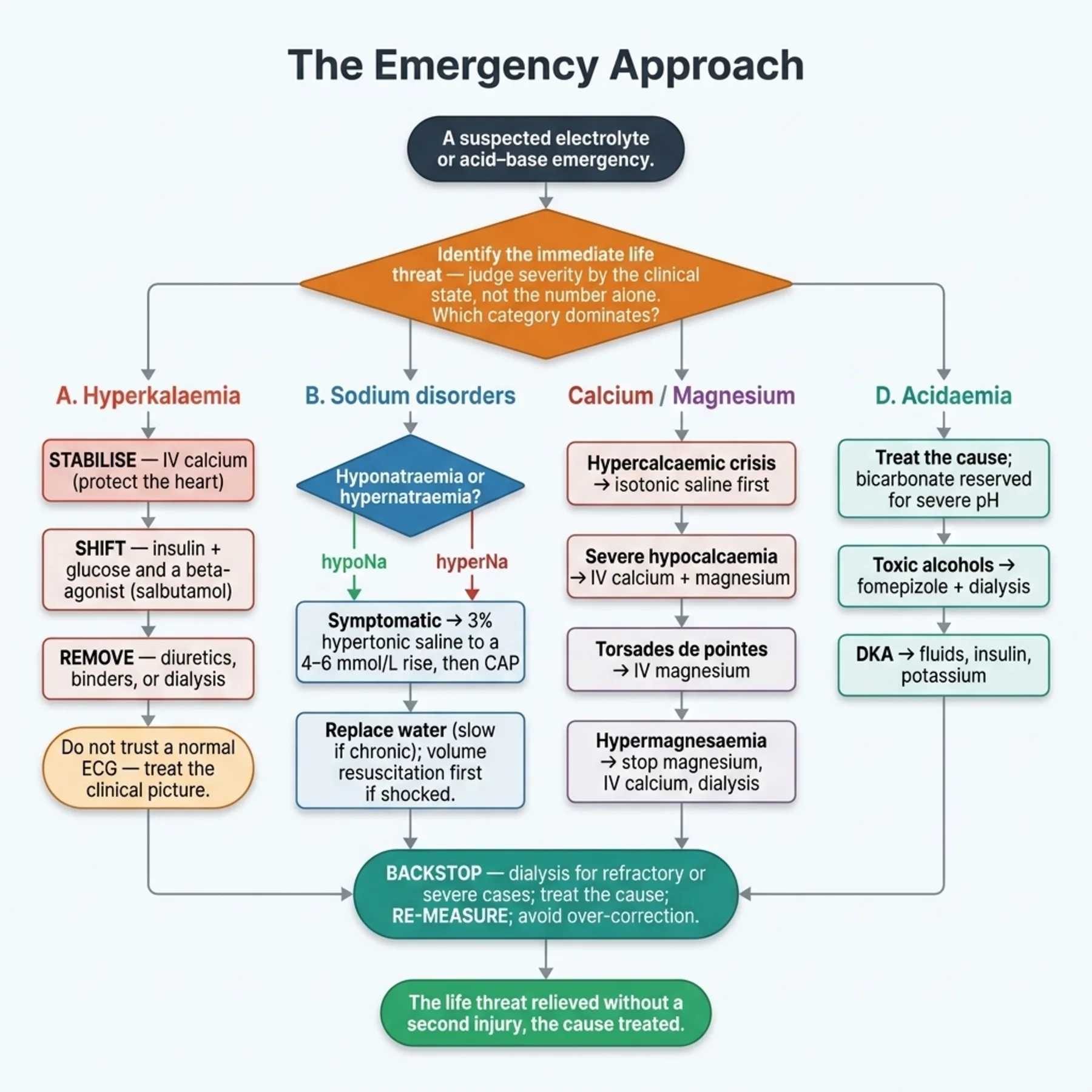
Electrolyte and acid-base emergencies are managed by identifying the immediately life-threatening disturbance and treating it first.
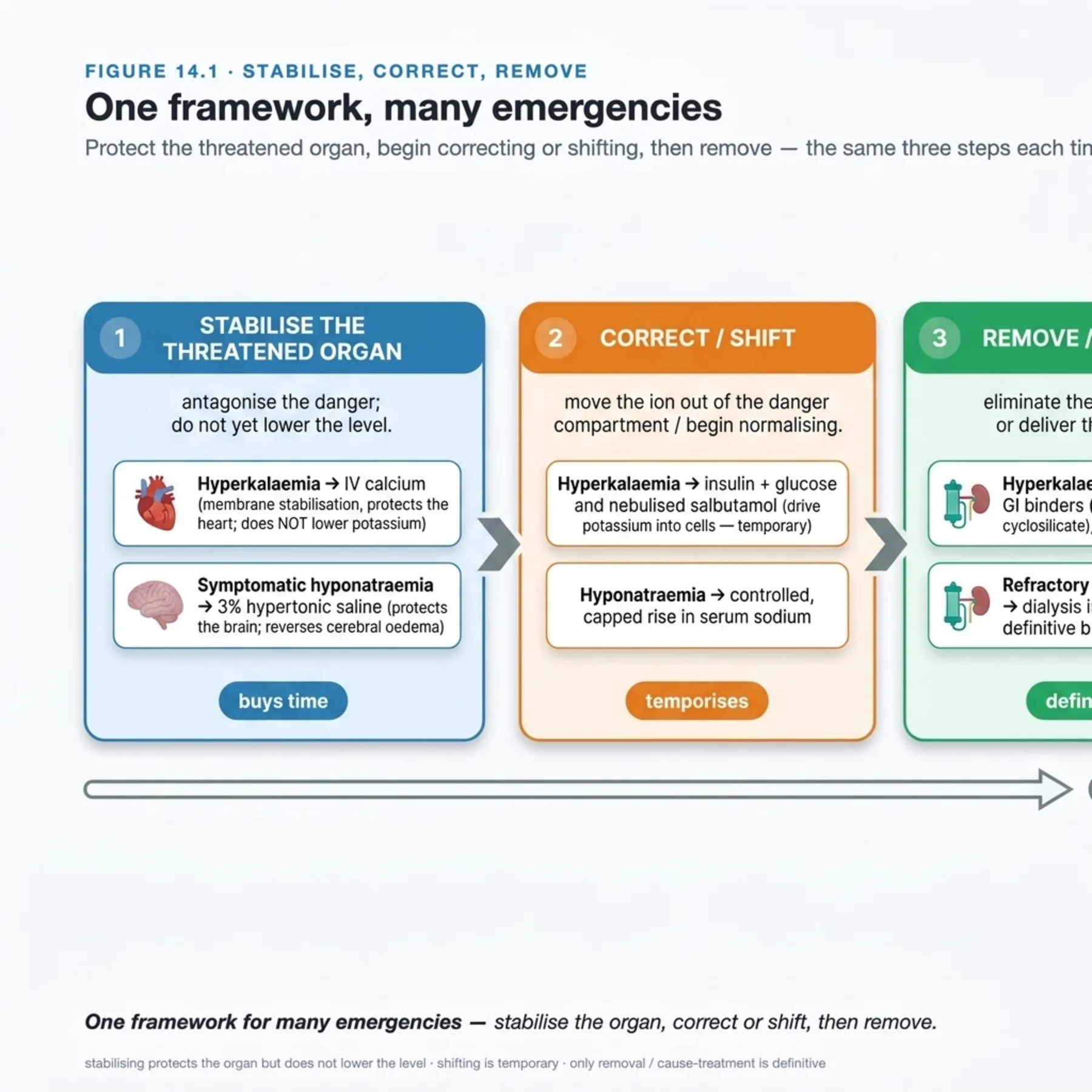
Many follow a common framework: stabilise the threatened organ, correct or shift the disturbance, and remove the excess or restore the deficit.
Severe hyperkalaemia is treated with calcium to stabilise the myocardium, insulin-glucose and a beta-agonist to shift, and diuretics, binders, or dialysis to remove — and the ECG must not be trusted to exclude danger.
Severe symptomatic hyponatraemia (seizures, coma) is treated with hypertonic saline to a small rise of about 4 to 6 mmol/L, then the correction is capped to avoid osmotic demyelination.
Severe hypernatraemia is corrected by replacing water — faster if acute, slowly if chronic to avoid cerebral oedema — with volume restored first when shocked.
Severe metabolic acidaemia is treated by its cause; bicarbonate is reserved for severe acidaemia and its benefit is debated, while toxic alcohols need fomepizole and dialysis and diabetic ketoacidosis needs fluids, insulin, and potassium attention.
Hypercalcaemic crisis is treated with intravenous saline first, then calcitonin and a bisphosphonate, with dialysis for severe disease in renal failure.
Severe hypocalcaemia (tetany, seizures, laryngospasm, long QT) is treated with intravenous calcium gluconate, and magnesium is replaced.
Severe hypomagnesaemia with torsades is treated with intravenous magnesium.
Hypermagnesaemia (renal failure plus a magnesium load) is treated by stopping the magnesium, giving calcium as an antagonist, and dialysing.
Dialysis is the definitive treatment for refractory or severe hyperkalaemia, severe acidaemia, hypermagnesaemia, and toxic alcohols.
Throughout, severity is judged by the clinical state, not the number alone, and the disturbance is re-measured frequently during correction.
Over-correction is avoided — osmotic demyelination in hyponatraemia, cerebral oedema in hypernatraemia, rebound in redistributive hypokalaemia.
The cause is treated alongside the emergency, because correcting the number without the cause is incomplete.
| 03 | PHASE A · LEVEL 3 · ORIENTATION & KNOWLEDGE Main Narrative |
Electrolyte and acid-base emergencies are where the calm, systematic methods of the preceding chapters must be executed fast and in the right order. A potassium of 7.5 with a widening QRS, a seizing hyponatraemic patient, a hypercalcaemic crisis — each is a sequence to be run, not a puzzle to be pondered. This chapter draws the acute protocols together: identify the immediate threat, act in the right order, treat the cause alongside, and avoid the over-correction that turns a rescue into a new injury.
— The framework: identify, then stabilise-correct-remove
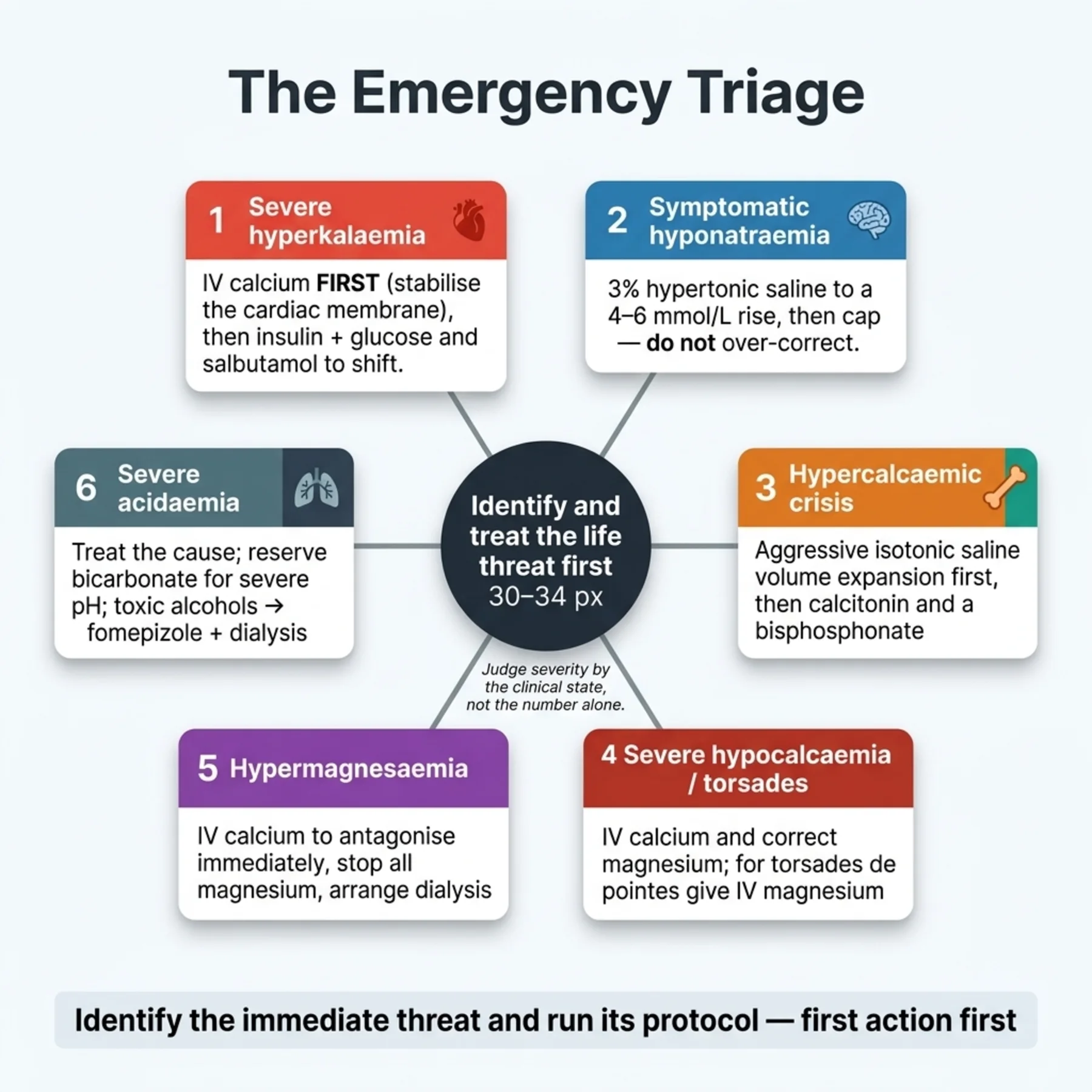
The first principle of any electrolyte or acid-base emergency is triage: identify the disturbance that is immediately life-threatening and treat it first, before completing a leisurely full analysis. Often a single, recurring framework applies, modelled on the hyperkalaemia emergency: stabilise the threatened organ (most often the heart), correct or shift the disturbance to lower the immediate danger, and then remove the excess or restore the deficit definitively. The order matters because the steps do different jobs — stabilising buys time, shifting temporises, and only removal (or restored physiology) is definitive — and confusing them leaves a 'treated' patient still in danger. Two further universal rules: treat the underlying cause alongside the number (correcting a potassium without stopping the drug that raised it is incomplete), and re-measure frequently, because the disturbance and the correction are both moving.
— The potassium and sodium emergencies
The two commonest lethal electrolyte emergencies are hyperkalaemia and symptomatic hyponatraemia, and each has its protocol from the earlier chapters. Severe hyperkalaemia — a high potassium with ECG changes, or a very high level — is managed in three prongs: intravenous calcium to stabilise the myocardium (immediate, not potassium-lowering, repeated if the ECG persists), insulin-glucose and a beta-agonist to shift potassium into cells, and diuretics, binders, or dialysis to remove it; and the cardinal warning is that the ECG is unreliable, so a normal ECG must not defer treatment. Severe symptomatic hyponatraemia — seizures or coma from cerebral oedema — is treated with hypertonic (3%) saline as a small bolus to raise the sodium just 4 to 6 mmol/L, relieving the oedema, after which the correction is capped (no more than about 8 mmol/L in 24 hours) to avoid osmotic demyelination, with re-lowering if overshoot occurs. Severe hypernatraemia is the mirror: replace the water deficit, faster if acute but slowly if chronic to avoid cerebral oedema, restoring volume first if the patient is shocked. These three protocols recur constantly in acute medicine and must be reflexive.
— The calcium and magnesium emergencies
The divalent-ion emergencies are less frequent but equally treatable. Hypercalcaemic crisis — severe symptomatic hypercalcaemia — is treated with intravenous saline first (the patient is volume-depleted), then calcitonin for a rapid bridging effect and a bisphosphonate for durable control, with dialysis reserved for severe hypercalcaemia in renal failure. Severe hypocalcaemia — tetany, seizures, laryngospasm, a prolonged QT — is treated with intravenous calcium gluconate, and the magnesium must be replaced (a low magnesium makes the hypocalcaemia refractory). Severe hypomagnesaemia, particularly with torsades de pointes, is treated with intravenous magnesium. And hypermagnesaemia — which requires renal failure plus a magnesium load and causes hyporeflexia, hypotension, and at high levels respiratory and cardiac depression — is treated by stopping the magnesium, giving intravenous calcium as a physiological antagonist, and dialysing in renal failure. Each is a short, definite sequence, and recognising the crisis is most of the battle.
— The acidaemia emergencies
Severe acidaemia is an emergency where the priority is the cause, not the number. In severe metabolic acidaemia, the cause is treated — perfusion restored in lactic acidosis, fluids and insulin and potassium attention in diabetic ketoacidosis, fomepizole and dialysis in toxic-alcohol poisoning — and bicarbonate is reserved for severe acidaemia (a pH below roughly 7.1), where even then its benefit is debated and it is at most an adjunct to treating the cause. Diabetic ketoacidosis deserves its own protocol within this: fluids to restore volume, insulin to switch off ketogenesis, and careful potassium management (the total-body potassium is depleted even when the serum is high, and it falls sharply with insulin), with bicarbonate generally not needed. Toxic alcohols are a true emergency — fomepizole to block the toxic metabolism and dialysis to remove the alcohol and metabolites, acting on the osmolar-gap-plus-acidosis pattern before the organ damage is done. Severe respiratory acidaemia is an emergency of ventilation, managed by supporting ventilation (non-invasive or invasive) and treating the cause.
— Dialysis as the definitive backstop
Running through the emergencies is dialysis as the definitive treatment when the kidney cannot do the job and the disturbance is severe or refractory. Dialysis removes potassium definitively in severe hyperkalaemia with renal failure; it removes magnesium in hypermagnesaemia; it removes toxic alcohols and their metabolites; it corrects severe acidaemia in renal failure; and it can manage refractory fluid and electrolyte derangements. The decision to dialyse acutely — covered in the AKI volume — is triggered by exactly these severe, refractory, or life-threatening electrolyte and acid-base emergencies (alongside refractory overload and uraemia). So while the pharmacological protocols (calcium, insulin, saline, bicarbonate) are the first response, dialysis is the backstop that definitively resolves the emergency when those measures are insufficient or the kidney cannot clear the disturbance. Knowing when to escalate to dialysis is part of every emergency protocol.
— Avoiding the second injury
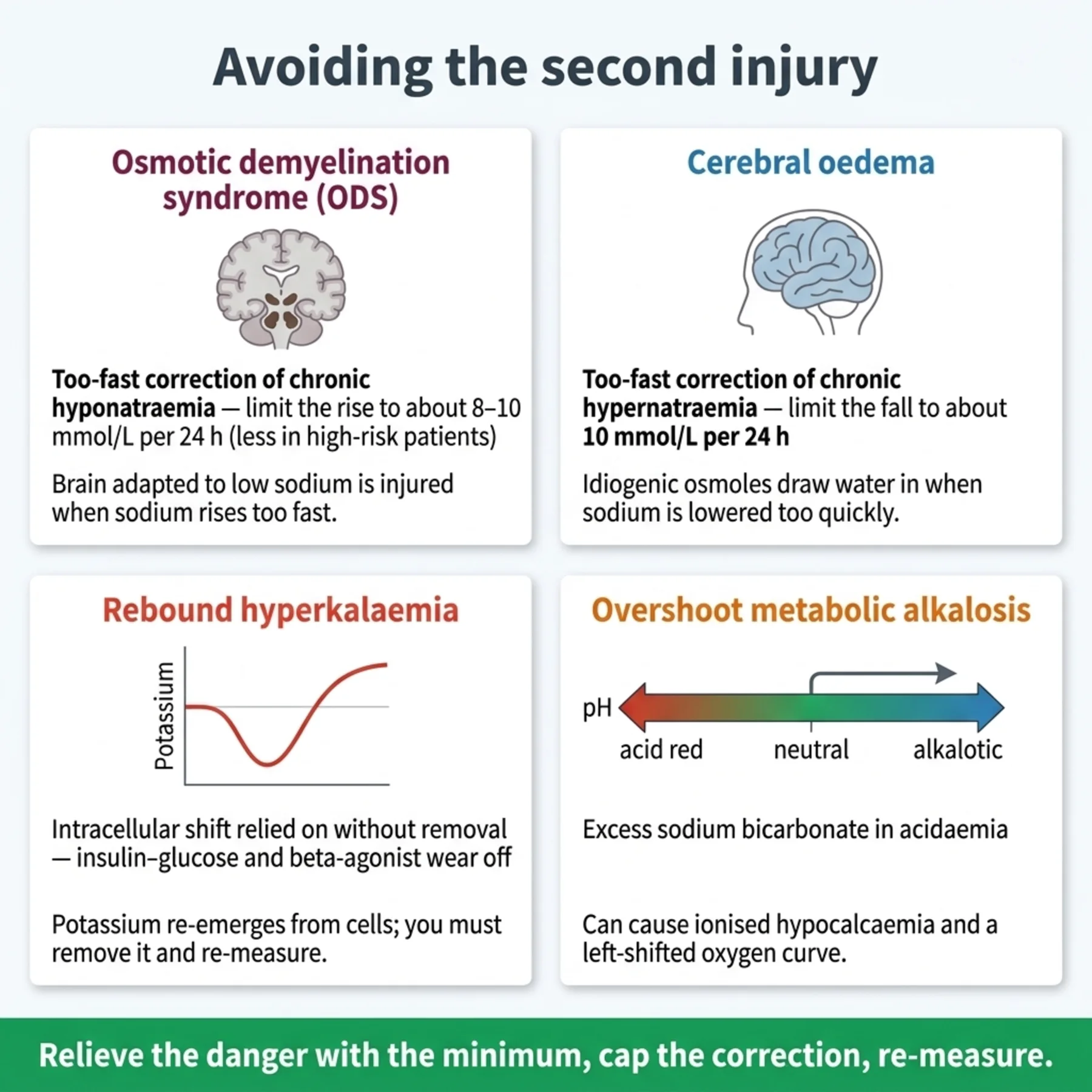
The final principle is that emergency correction can itself cause harm, and over-correction is the recurring danger. Correcting chronic hyponatraemia too fast causes osmotic demyelination; correcting chronic hypernatraemia too fast causes cerebral oedema; over-replacing redistributive hypokalaemia causes rebound hyperkalaemia; over-correcting an acidaemia with bicarbonate causes overshoot alkalosis. So the emergencies are managed with one eye on the immediate threat and one on the rate and endpoint of correction — relieving the danger with the minimum necessary intervention, capping the correction, and re-measuring frequently to catch overshoot. The discipline is to act fast on the life threat but not to overshoot the safe target, judging severity and progress by the clinical state and serial measurement rather than a single number. Treat the emergency, treat the cause, and do not create a second injury by correcting too far or too fast.
| 04 | PHASE A · LEVEL 4 · ORIENTATION & KNOWLEDGE Reference Tables |
Table 14.1 — The hyperkalaemia emergency
| Prong | Action |
| Stabilise | IV calcium — protects the myocardium (not potassium-lowering); repeat if ECG persists |
| Shift | Insulin + glucose (mainstay); beta-agonist; bicarbonate if acidotic |
| Remove | Diuretics (if urine), binders (SZC/patiromer), dialysis |
| Caveat | ECG unreliable — a normal ECG does NOT defer treatment (Chapter 8) |
Table 14.2 — The hyponatraemia / hypernatraemia emergencies
| Emergency | Action |
| Severe symptomatic hyponatraemia | 3% saline bolus → rise ~4–6 mmol/L (relieve oedema); cap correction (≤ ~8/24 h); re-lower if overshoot |
| Severe hypernatraemia | Replace water deficit — faster if acute, slow if chronic (cerebral oedema); volume first if shocked |
| Over-correction risks | ODS (hyponatraemia), cerebral oedema (hypernatraemia) |
Table 14.3 — The calcium and magnesium emergencies
| Emergency | Action |
| Hypercalcaemic crisis | Saline FIRST; calcitonin; bisphosphonate; dialysis (severe + renal failure) |
| Severe hypocalcaemia | IV calcium gluconate; replace magnesium |
| Severe hypomagnesaemia / torsades | IV magnesium |
| Hypermagnesaemia | Stop Mg; IV calcium (antagonist); dialysis |
Table 14.4 — The acidaemia emergencies
| Cause | Action |
| Severe metabolic acidaemia | Treat the cause; bicarbonate reserved for severe pH (< ~7.1), debated |
| Diabetic ketoacidosis | Fluids, insulin, potassium attention; bicarbonate generally not needed |
| Toxic alcohols | Fomepizole + dialysis |
| Severe respiratory acidaemia | Support ventilation (NIV/invasive); treat cause |
Table 14.5 — General principles
| Principle | Detail |
| Triage | Identify and treat the immediate life threat first |
| Framework | Stabilise → correct/shift → remove/definitive |
| Treat the cause | Alongside the number |
| Monitor | Re-measure frequently; cardiac monitoring as needed |
| Judge by | The clinical state, not the number alone |
Table 14.6 — Dialysis as the definitive backstop
| Emergency | Dialysis role |
| Severe/refractory hyperkalaemia (renal failure) | Definitive potassium removal |
| Hypermagnesaemia (renal failure) | Removes magnesium |
| Toxic alcohols | Removes alcohol and metabolites |
| Severe acidaemia (renal failure) | Corrects the acidaemia |
| Trigger | The severe/refractory electrolyte-acid-base emergencies (Volume 5) |
| 05 | PHASE B · LEVEL 5 · VISUALISE & MAP Imaging & Flowchart Specifications |
| 08 | PHASE C · LEVEL 8 · CLINICAL REASONING Clinical Cases |
| CASE 1 | POTASSIUM 7.5 Run the three prongs Severe hyperkalaemia |
Presentation
A patient with acute kidney injury has a potassium of 7.5 with peaked T waves and a broadening QRS. The team is deciding what to give and in what order.
❖ Pause and reflect What is the correct order of treatment? |
Analysis
This is the archetypal electrolyte emergency, run in three prongs. First, stabilise the myocardium with intravenous calcium — immediate protection, repeated if the ECG changes persist, though it does not lower the potassium. Second, shift potassium into cells with insulin-glucose and a beta-agonist to lower the level temporarily. Third, remove the potassium — and in acute kidney injury with a potassium of 7.5, dialysis is the definitive removal. The ECG changes confirm the emergency, but even without them this level would be treated; the ECG is unreliable and must not defer action.
Plan
Give intravenous calcium first to stabilise the heart, insulin-glucose and a beta-agonist to shift, and arrange dialysis to definitively remove the potassium in the setting of acute kidney injury. Treat the cause of the AKI and re-measure frequently.
Teaching point
Severe hyperkalaemia: calcium to stabilise, insulin-glucose/beta-agonist to shift, dialysis to remove — in that order, regardless of the ECG.
Cross-reference
Exercises the framework; Figures 14.1–14.2; Tables 14.1, 14.6; hyperkalaemia in Chapter 8.
| CASE 2 | SEIZING AND HYPONATRAEMIC Small rise, then cap Severe symptomatic hyponatraemia |
Presentation
A patient presents with a seizure and a sodium of 110. The team must act quickly but is worried about osmotic demyelination.
❖ Pause and reflect How do you relieve the cerebral oedema without causing demyelination? |
Analysis
The seizure signifies cerebral oedema, demanding urgent hypertonic (3%) saline — a small bolus to raise the sodium just 4 to 6 mmol/L, which relieves the oedema. The fear of demyelination is managed not by withholding treatment but by capping the total correction afterward (no more than about 8 mmol/L in 24 hours), with re-lowering using electrolyte-free water and desmopressin if the sodium overshoots. Relieve the immediate threat with a small rise, then protect against over-correction.
Plan
Give a 3% saline bolus to a 4–6 mmol/L rise to stop the seizure and relieve the oedema, then cap the 24-hour correction and monitor the sodium frequently, re-lowering if it overshoots. Treat the underlying cause of the hyponatraemia.
Teaching point
Severe symptomatic hyponatraemia: hypertonic saline for a small 4–6 mmol/L rise, then cap the correction to avoid demyelination.
Cross-reference
Exercises the framework; Table 14.2; the second-injury figure (14.3); hyponatraemia treatment in Chapter 5.
| CASE 3 | HYPERCALCAEMIC CRISIS Saline first Severe hypercalcaemia |
Presentation
A patient with malignancy presents confused and dehydrated with a corrected calcium of 3.6 mmol/L. A trainee proposes starting a bisphosphonate immediately as the first step.
❖ Pause and reflect Is a bisphosphonate the right first step in this crisis? |
Analysis
Not first. The patient is volume-depleted (the hypercalcaemia causes a nephrogenic diabetes insipidus and reduces intake), so the first step is intravenous saline to rehydrate and promote calciuresis, lowering the calcium quickly. Calcitonin can bridge with a rapid effect, and a bisphosphonate provides durable control over the next days — but it is slow and is not the immediate treatment. Starting with the bisphosphonate alone would leave the patient under-treated for the first critical days.
Plan
Give intravenous saline first to rehydrate and lower the calcium, add calcitonin for a rapid bridging effect and a bisphosphonate for durable control, and treat the malignancy; reserve dialysis for severe hypercalcaemia with renal failure.
Teaching point
Hypercalcaemic crisis: saline first (rehydrate and calciuresis), then calcitonin and a bisphosphonate — not the bisphosphonate alone.
Cross-reference
Exercises the framework; Table 14.3; hypercalcaemia in Chapter 9.
| CASE 4 | TWO EMERGENCIES AT ONCE Prioritise the life threat The combined emergency |
Presentation
A patient with a crush injury and rhabdomyolysis has acute kidney injury, a potassium of 7.2 with ECG changes, and a severe metabolic acidaemia. The team is unsure which problem to address first.
❖ Pause and reflect Which disturbance is the immediate life threat, and how do you proceed? |
Analysis
The immediate life threat is the hyperkalaemia with ECG changes, which can cause arrhythmia within minutes — so it is stabilised first with intravenous calcium, then shifted and removed. The acidaemia is managed alongside by treating the cause (the rhabdomyolysis and AKI), and dialysis is the definitive treatment that addresses the potassium, the acidaemia, and the renal failure together. Triage is the key: identify the most immediately dangerous disturbance, run its protocol first, and let dialysis resolve the combined picture.
Plan
Treat the hyperkalaemia first (calcium, then shift), manage the acidaemia by treating the rhabdomyolysis, and arrange urgent dialysis to address the potassium, acidaemia, and AKI together. Prioritise the immediate life threat, then the definitive treatment.
Teaching point
In a combined emergency, identify and treat the immediate life threat first (here, hyperkalaemia), with dialysis resolving the combined disturbance.
Cross-reference
Exercises the triage principle; Figure 14.2; Tables 14.5, 14.6; acute dialysis in Volume 5.
| 10 | PHASE C · LEVEL 10 · CLINICAL REASONING Clinical Pearls |
| Triage: identify and treat the immediate life threat first. | Common framework: stabilise → correct/shift → remove/definitive. |
| Judge severity by the clinical state, not the number alone. | Severe hyperkalaemia: calcium (stabilise), insulin-glucose/beta (shift), dialysis (remove). |
| Hyperkalaemia: a normal ECG does NOT defer treatment. | Severe symptomatic hyponatraemia: 3% saline to a 4–6 mmol/L rise, then cap. |
| Cap hyponatraemia correction (≤ ~8/24 h) — ODS risk; re-lower if overshoot. | Severe hypernatraemia: replace water (slow if chronic); volume first if shocked. |
| Hypercalcaemic crisis: SALINE FIRST, then calcitonin/bisphosphonate. | Severe hypocalcaemia: IV calcium gluconate + replace magnesium. |
| Torsades with low magnesium: IV magnesium. | Hypermagnesaemia: stop Mg, IV calcium (antagonist), dialysis. |
| Severe metabolic acidaemia: treat the cause; bicarbonate reserved (debated). | Toxic alcohols: fomepizole + dialysis; DKA: fluids/insulin/K. |
| Dialysis = definitive for refractory/severe (hyperK, acidaemia, hyperMg, toxic alcohols). | Treat the cause alongside; re-measure; avoid over-correction (the second injury). |
| 11 | PHASE D · LEVEL 11 · SAFETY & EVIDENCE Red Flags & Never-Do |
Panel A — Red flags
| ▲ | Peaked T waves or a widening QRS — give intravenous calcium immediately. |
| ▲ | A seizing or comatose hyponatraemic patient — cerebral oedema; give hypertonic saline. |
| ▲ | A confused, dehydrated patient with a very high calcium — hypercalcaemic crisis; saline first. |
| ▲ | Torsades with a low magnesium — give intravenous magnesium. |
| ▲ | Multiple emergencies at once — triage to the immediate life threat; consider dialysis to resolve the combined picture. |
Panel B — Never do
| ✖ NEVER — defer treatment of dangerous hyperkalaemia because the ECG looks normal. |
| ✖ NEVER — over-correct hyponatraemia or hypernatraemia — the second injury. |
| ✖ NEVER — give a bisphosphonate before saline in hypercalcaemic crisis. |
| ✖ NEVER — correct the number without treating the cause and re-measuring. |
| 12 | PHASE D · LEVEL 12 · SAFETY & EVIDENCE Common Pitfalls |
Pitfall 1 — Wrong order in hyperkalaemia
| ✖ | WRONG Shifting potassium with insulin while the heart is unstable. |
| ✓ | RIGHT Giving calcium first to stabilise, then shifting and removing. |
| ✉ | WHY Calcium protects the heart immediately; shifting only temporises. |
Pitfall 2 — Over-correcting sodium
| ✖ | WRONG Driving the sodium up (or down) rapidly to normalise it. |
| ✓ | RIGHT Relieving the immediate threat with a small change, then capping. |
| ✉ | WHY Over-correction causes demyelination or cerebral oedema. |
Pitfall 3 — Bisphosphonate first
| ✖ | WRONG Starting a bisphosphonate as the first step in hypercalcaemic crisis. |
| ✓ | RIGHT Giving saline first to rehydrate and promote calciuresis. |
| ✉ | WHY The patient is volume-depleted, and the bisphosphonate is slow. |
Pitfall 4 — Trusting the number alone
| ✖ | WRONG Grading an emergency by the laboratory value alone. |
| ✓ | RIGHT Judging severity by the clinical state and the trend. |
| ✉ | WHY The clinical state and rate of change determine the danger. |
Pitfall 5 — Forgetting the cause
| ✖ | WRONG Correcting the number and stopping there. |
| ✓ | RIGHT Treating the underlying cause alongside the emergency. |
| ✉ | WHY Correcting the number without the cause is incomplete and recurs. |
| 13 | PHASE D · LEVEL 13 · SAFETY & EVIDENCE Evidence Grading |
GRADE A HIGH CONFIDENCE The effect is real and the estimate is stable. RCTs at low risk of bias; multiple concordant prospective cohorts; meta-analyses. |
GRADE B MODERATE CONFIDENCE The effect is likely real but may shift with new data. Observational studies, registries, mechanistic human studies. |
GRADE C LOW CONFIDENCE Rests on physiology, reasoning, or consensus rather than outcomes. Pathophysiological reasoning; extrapolation; consensus without outcomes. |
Graded statements (by evidence type)
| Statement | Grade | Basis (evidence type) |
| Severe hyperkalaemia is managed by stabilise-shift-remove. | A | Physiology and consensus |
| The ECG is unreliable for grading hyperkalaemia severity. | B | Diagnostic-accuracy data |
| Severe symptomatic hyponatraemia needs hypertonic saline for a small rise. | A | Physiology and guidelines |
| Over-rapid correction of dysnatraemias causes demyelination or cerebral oedema. | A | Established physiology |
| Volume repletion is first-line in hypercalcaemic crisis. | A | Physiology and consensus |
| Dialysis definitively treats severe/refractory electrolyte-acid-base emergencies. | A | Physiology and clinical consensus |
| Intravenous magnesium treats torsades de pointes. | A | Clinical and electrophysiological data |
| 14 | PHASE E · LEVEL 14 · PATIENT DECISIONS Absolute Risk in Natural Frequency |
Natural-frequency estimates for orientation, from emergency management; they vary with severity. They convey the size of the decisions, expressed per 100 comparable patients.
| Per 100 patients… | Outcome | Roughly how many | See |
| Severe hyperkalaemia with the full protocol | Avoid arrhythmic death | More than those treated incompletely | L13 row 1 |
| Symptomatic hyponatraemia with prompt hypertonic saline | Survive the cerebral oedema | More than those under-treated | L13 row 3 |
| Dysnatraemias over-corrected | Suffer demyelination or cerebral oedema | A meaningful share — hence cap the rate | L13 row 4 |
| Severe/refractory emergencies given dialysis | Achieve definitive resolution | Most | L13 row 6 |
★ How to read these Read these as orientation, not promises; outcomes depend on severity and timeliness. The stable signals: the full protocols save lives in severe hyperkalaemia and symptomatic hyponatraemia, over-correction harms, and dialysis is definitive. Communicate them as people out of 100, not as a hazard ratio. |
| 17 | PHASE F · LEVEL 17 · APPLY & TEST Documentation Templates |
Paste-ready notes. Tick the boxes that apply and delete the rest; make the order, the cap, and the cause explicit.
Template 1 — Hyperkalaemia emergency protocol
Template 2 — Electrolyte/acid-base emergency checklist
| 18 | PHASE F · LEVEL 18 · APPLY & TEST Cheat Sheet |
| Triage: treat the immediate life threat first. | Framework: stabilise → correct/shift → remove/definitive. |
| Judge by clinical state, not the number. | Severe hyperK: calcium → insulin-glucose/beta → dialysis. |
| Normal ECG doesn't defer hyperK treatment. | Symptomatic hypoNa: 3% saline, 4–6 mmol/L rise, then cap. |
| Cap hypoNa correction (≤ ~8/24 h); re-lower if overshoot. | Severe hyperNa: replace water (slow if chronic); volume first if shocked. |
| Hypercalcaemic crisis: SALINE FIRST, then calcitonin/bisphosphonate. | Severe hypoCa: IV calcium + replace Mg. |
| Torsades + low Mg: IV magnesium. | HyperMg: stop Mg, IV calcium, dialysis. |
| Severe metabolic acidaemia: treat cause; bicarbonate reserved. | Toxic alcohols: fomepizole + dialysis; DKA: fluids/insulin/K. |
| Dialysis = definitive backstop. | Treat the cause; re-measure; avoid over-correction. |
| 19 | PHASE F · LEVEL 19 · APPLY & TEST Flashcards |
| CARD 1 | Q. What is the general framework for an electrolyte emergency? A. Identify and treat the immediate life threat first, then stabilise the threatened organ, correct or shift the disturbance, and remove the excess or restore the deficit — treating the cause alongside. DETAILED. Each step does a different job. CLINICAL. Triage, then stabilise-correct-remove. |
| CARD 2 | Q. How is severe hyperkalaemia managed? A. Intravenous calcium to stabilise the myocardium, insulin-glucose and a beta-agonist to shift potassium into cells, and diuretics, binders, or dialysis to remove it — regardless of the ECG, which is unreliable. DETAILED. Calcium protects but does not lower potassium; only removal is definitive. CLINICAL. Stabilise, shift, remove — don't trust a normal ECG. |
| CARD 3 | Q. How is severe symptomatic hyponatraemia treated? A. With hypertonic (3%) saline as a small bolus to raise the sodium just 4 to 6 mmol/L, relieving the cerebral oedema, after which the correction is capped to avoid osmotic demyelination, with re-lowering if it overshoots. DETAILED. Relieve the threat with a small rise, then protect against over-correction. CLINICAL. Hypertonic saline for a 4–6 mmol/L rise, then cap. |
| CARD 4 | Q. How is hypercalcaemic crisis treated? A. Intravenous saline first (the patient is volume-depleted), then calcitonin for a rapid bridging effect and a bisphosphonate for durable control, with dialysis for severe hypercalcaemia in renal failure. DETAILED. The bisphosphonate is slow and not the first step. CLINICAL. Saline first, then calcitonin and a bisphosphonate. |
| CARD 5 | Q. How are the magnesium emergencies treated? A. Severe hypomagnesaemia with torsades de pointes is treated with intravenous magnesium; hypermagnesaemia (renal failure plus a magnesium load) is treated by stopping the magnesium, giving intravenous calcium as an antagonist, and dialysing. DETAILED. Calcium antagonises magnesium's effects. CLINICAL. IV magnesium for torsades; stop Mg, calcium, and dialysis for hypermagnesaemia. |
| CARD 6 | Q. How is severe metabolic acidaemia managed in an emergency? A. By treating the cause — perfusion in lactic acidosis, fluids and insulin in diabetic ketoacidosis, fomepizole and dialysis in toxic alcohols — with bicarbonate reserved for severe acidaemia and its benefit debated. DETAILED. Bicarbonate is at most an adjunct. CLINICAL. Treat the cause; reserve bicarbonate. |
| CARD 7 | Q. What is the role of dialysis in these emergencies? A. It is the definitive treatment when the kidney cannot clear the disturbance and it is severe or refractory — removing potassium, magnesium, toxic alcohols, and acid — triggered by exactly these life-threatening emergencies. DETAILED. It resolves combined emergencies at once. CLINICAL. Escalate to dialysis for refractory or severe disturbances. |
| CARD 8 | Q. What is the recurring danger in emergency correction? A. Over-correction — osmotic demyelination from fast hyponatraemia correction, cerebral oedema from fast hypernatraemia correction, rebound hyperkalaemia from over-replaced shift, overshoot alkalosis from excess bicarbonate. DETAILED. Emergency correction can itself injure. CLINICAL. Relieve the threat with the minimum, cap the correction, and re-measure. |
| 20 | PHASE F · LEVEL 20 · APPLY & TEST One-Minute Preceptor |
| SCENE 1 | The intern shifting before stabilising |
GET A COMMITMENT. “You've given insulin-glucose for this potassium of 7.5 with a wide QRS — what's missing?”
PROBE FOR EVIDENCE. “That lowers the potassium” — ask: “What protects the heart right now, and what removes the potassium?”
TEACH A GENERAL RULE. Calcium stabilises the myocardium immediately, shifting only temporises, and dialysis removes — the emergency runs stabilise, shift, remove, in that order.
REINFORCE WHAT WAS RIGHT. Starting the shift was a correct component.
CORRECT A MISTAKE. Give calcium now and arrange definitive removal.
| SCENE 2 | The resident reaching for the bisphosphonate |
GET A COMMITMENT. “You want a bisphosphonate first for this hypercalcaemic crisis — why?”
PROBE FOR EVIDENCE. “It lowers calcium” — ask: “Is the patient volume-replete, and how fast does a bisphosphonate work?”
TEACH A GENERAL RULE. Hypercalcaemic patients are dehydrated, so saline comes first to rehydrate and promote calciuresis; the bisphosphonate is slow and follows.
REINFORCE WHAT WAS RIGHT. Recognising the crisis was correct.
CORRECT A MISTAKE. Give saline first, with calcitonin to bridge, then the bisphosphonate.
| 22 | PHASE F · LEVEL 22 · APPLY & TEST Board-Style Questions |
| Q 01 | The first principle in any electrolyte or acid-base emergency is to: |
| A | Complete a full analysis before acting |
| B | Identify and treat the immediate life threat first |
| C | Always give bicarbonate |
| D | Wait for repeat labs |
Rationale Triage to the immediate threat comes first, then the protocol (Figure 14.2, Table 14.5). A delays; C and D are wrong. |
| Q 02 | The correct order in severe hyperkalaemia with ECG changes is: |
| A | Shift, then stabilise |
| B | Stabilise (calcium), shift (insulin-glucose/beta), remove (dialysis) |
| C | Remove only |
| D | Bicarbonate alone |
Rationale Calcium stabilises first, shifting temporises, removal is definitive (case 1, Table 14.1). A inverts; C and D are incomplete. |
| Q 03 | Severe symptomatic hyponatraemia is treated with: |
| A | Slow fluid restriction |
| B | Hypertonic saline to a small 4–6 mmol/L rise, then capping the correction |
| C | Isotonic saline only |
| D | No treatment until chronic |
Rationale A small rise relieves the cerebral oedema, then the correction is capped to avoid demyelination (case 2, Table 14.2). A, C, and D are inadequate or unsafe. |
| Q 04 | The first step in hypercalcaemic crisis is: |
| A | A bisphosphonate |
| B | Intravenous saline to rehydrate and promote calciuresis |
| C | Dialysis |
| D | A loop diuretic |
Rationale The patient is volume-depleted, so saline comes first; the bisphosphonate is slow (case 3, Table 14.3). A, C, and D are not the first step. |
| Q 05 | Torsades de pointes with hypomagnesaemia is treated with: |
| A | Calcium |
| B | Intravenous magnesium |
| C | Potassium only |
| D | Bicarbonate |
Rationale Intravenous magnesium treats torsades (Table 14.3, L13 row 7). A, C, and D are not the treatment. |
| Q 06 | Severe hypermagnesaemia in renal failure is treated by: |
| A | Giving more magnesium |
| B | Stopping magnesium, giving intravenous calcium, and dialysing |
| C | Saline only |
| D | Insulin-glucose |
Rationale Stop the load, antagonise with calcium, and remove by dialysis (Table 14.3). A worsens it; C and D are not definitive. |
| Q 07 | In a crush-injury patient with hyperkalaemia (ECG changes), severe acidaemia, and AKI, you should: |
| A | Treat the acidaemia first |
| B | Treat the hyperkalaemia first (calcium, then shift), with dialysis to resolve the combined picture |
| C | Wait for dialysis only |
| D | Give bicarbonate alone |
Rationale The hyperkalaemia with ECG changes is the immediate threat; dialysis resolves the combined disturbance (case 4, Table 14.6). A, C, and D mis-prioritise. |
| Q 08 | What is the recurring danger of emergency correction? |
| A | Under-treatment only |
| B | Over-correction — demyelination, cerebral oedema, rebound, overshoot |
| C | There is no danger |
| D | Hypoglycaemia only |
Rationale Over-correction causes a second injury, so the correction is capped and re-measured (Figure 14.3, L9). A, C, and D miss it. |