Chapter Preamble
Signals declared
Sig-D — Diagnostic (primary). Match the fluid to the deficit — resuscitation, maintenance, or replacement — and recognise the iatrogenic harms fluids cause.
Sig-T — Therapeutic (strong). Prescribing fluid as a drug: type, rate, volume, and reassessment, across the five Rs.
Sig-V — Evidence-dense (strong). The balanced-versus-saline trials, the harm of starches, and the limits of albumin — graded and reflected on.
Levels populated and omitted
Populated (18): L1–L5, L7, L8, L10–L14, L17–L22. The therapeutic and evidence signals fire the absolute-risk table (L14), the templates (L17), and the reflective prompts (L21); the diagnostic signal drives the tables, rules, cases, pitfalls, and board items.
L6 / L9 mechanism levels — omitted. No Sig-M; the physiology of tonicity and distribution was built in Chapter 1, and this is a therapy and evidence chapter.
L15 / L16 preference-sensitive map and SDM scripts — omitted. No Sig-E; fluid prescribing is effective care — choosing the right fluid and dose is a clinical, not a values, decision.
| 01 | PHASE A · LEVEL 1 · ORIENTATION & KNOWLEDGE Learning Objectives |
By the end of this chapter you should be able to:
Describe the composition and use of the common crystalloids.
Explain why 0.9% saline causes hyperchloraemic acidosis and when a balanced solution is preferred.
State why 5% dextrose and hypotonic fluids are not resuscitation fluids.
Summarise the balanced-versus-saline trial evidence and its limits.
Explain why starches are avoided and where albumin has, and lacks, a role.
Prescribe fluid as a drug, using the five Rs.
Prescribe maintenance fluid safely, avoiding iatrogenic hyponatraemia.
Reassess and deprescribe fluid to avoid overload and electrolyte harm.
| 02 | PHASE A · LEVEL 2 · ORIENTATION & KNOWLEDGE Executive Summary |
Intravenous fluid is a drug, with indications, doses, and toxicities, and should be prescribed as deliberately as any other.
Crystalloids divide into isotonic resuscitation fluids — 0.9% saline and the balanced solutions — and hypotonic, free-water fluids such as 5% dextrose.
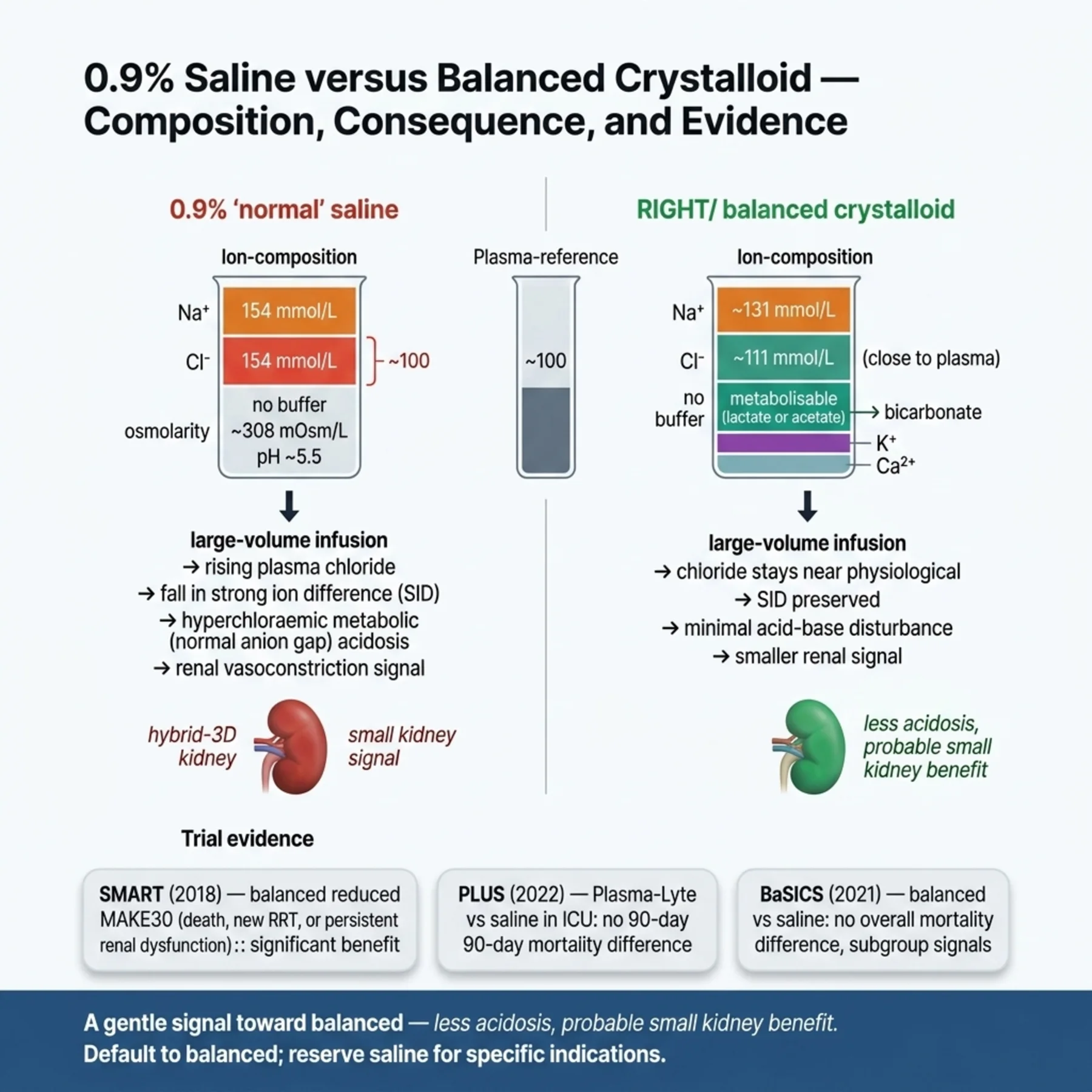
0.9% saline carries supraphysiologic chloride and, in large volumes, causes a hyperchloraemic metabolic acidosis.
Balanced solutions (Hartmann's, lactated Ringer's, Plasma-Lyte) have a more physiologic composition with a buffer and less chloride, and cause less acidosis.
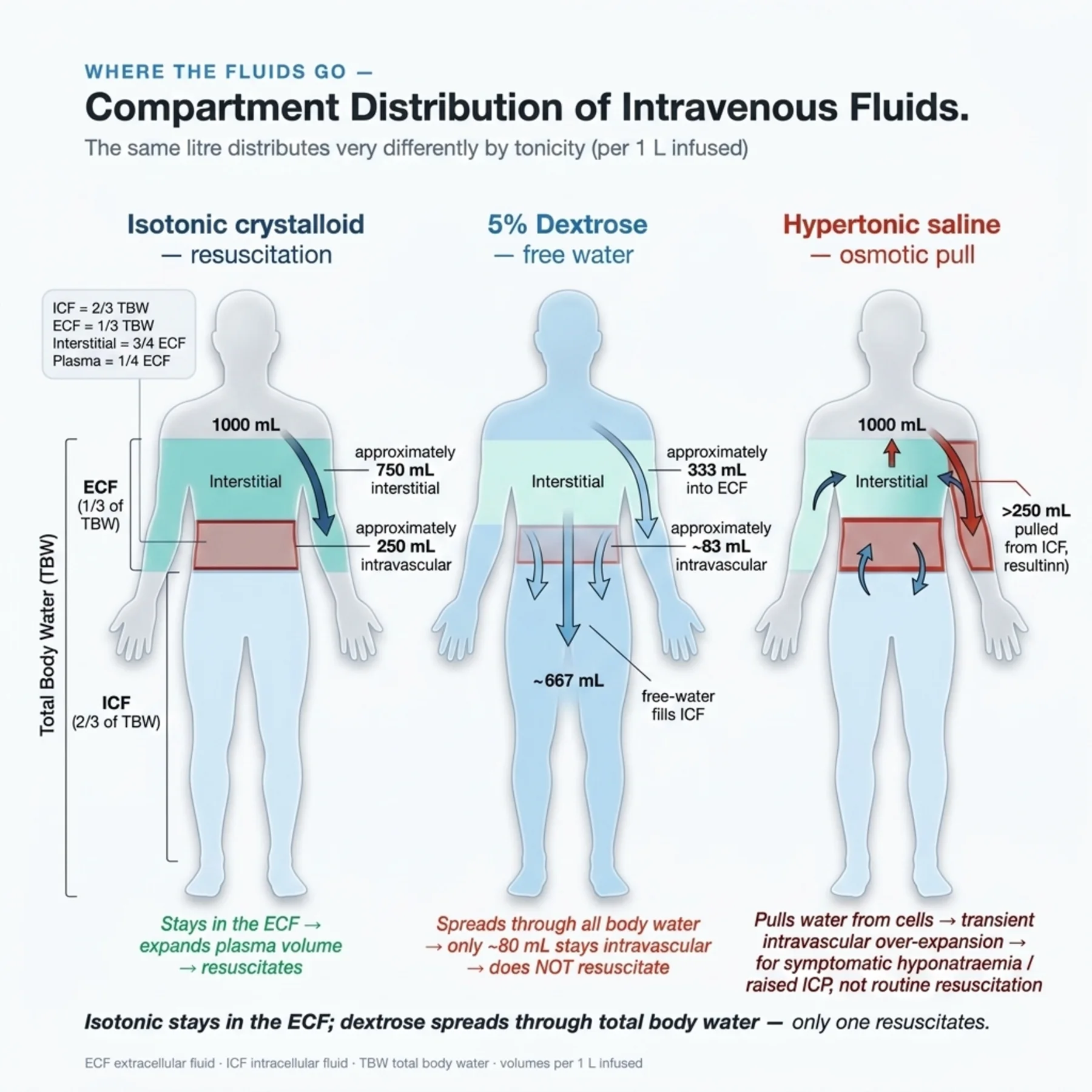
5% dextrose provides free water that distributes across total body water and is not a volume expander or resuscitation fluid.
Hypotonic maintenance fluids risk hyponatraemia, so isotonic maintenance is now preferred, especially in children.
Among colloids, albumin is no better than saline overall and is harmful in traumatic brain injury, with a role only in specific indications.
Hydroxyethyl starch increases acute kidney injury and mortality in the critically ill and is avoided.
The balanced-versus-saline trials show less hyperchloraemic acidosis and possibly fewer major adverse kidney events with balanced solutions, without a definitive mortality benefit.
A reasonable default is a balanced crystalloid, avoiding large-volume saline.
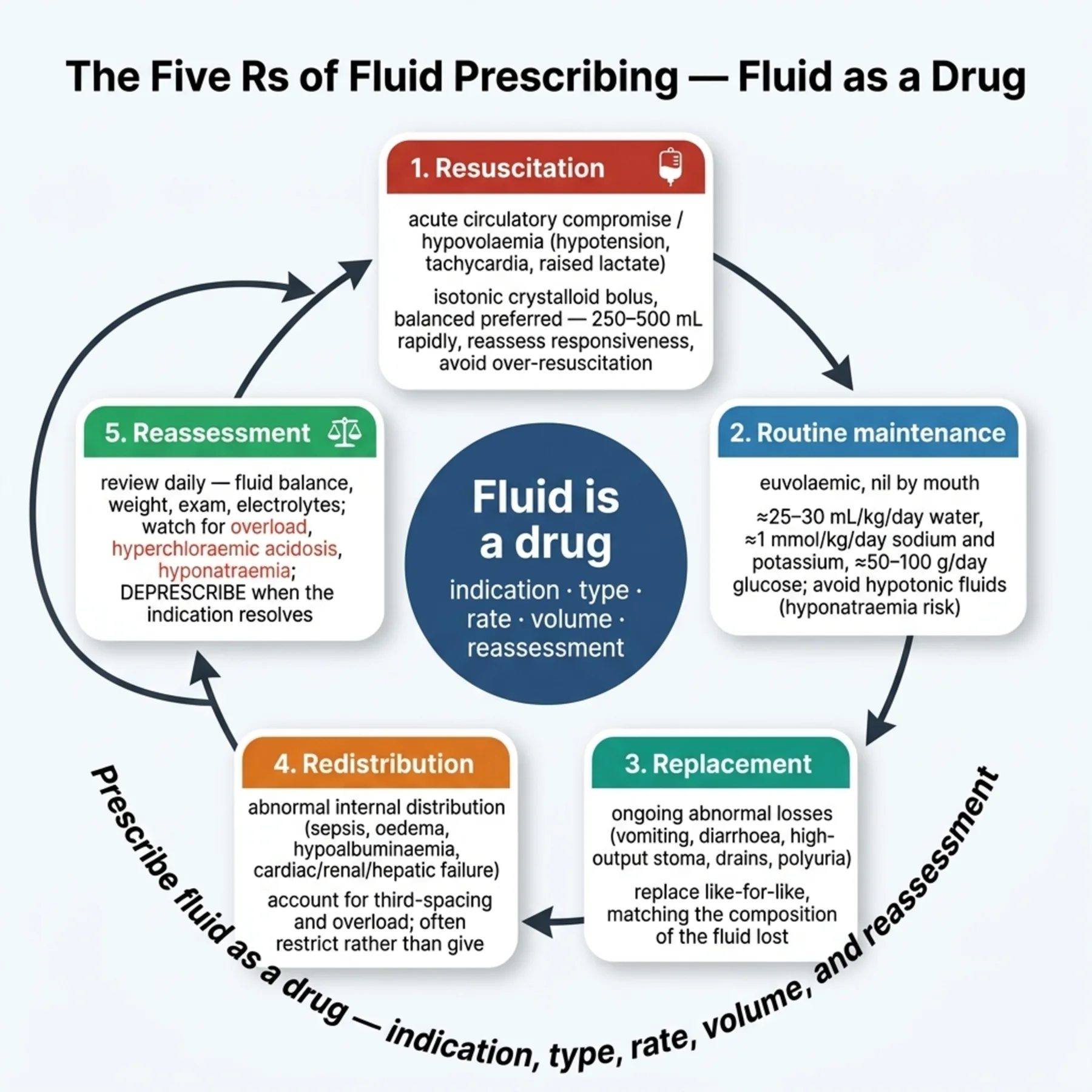
Fluid is prescribed across the five Rs: resuscitation, routine maintenance, replacement, redistribution, and reassessment.
Resuscitation uses isotonic crystalloid boluses with reassessment of responsiveness, avoiding over-resuscitation.
Maintenance provides the daily water, sodium, and potassium needs and no more.
Fluids are reassessed daily and deprescribed, because overload, hyperchloraemic acidosis, and hyponatraemia are common, harmful, and avoidable.
| 03 | PHASE A · LEVEL 3 · ORIENTATION & KNOWLEDGE Main Narrative |
Intravenous fluid is the most commonly prescribed drug in hospital and one of the least carefully prescribed. It has a composition, a dose, an indication, and a set of toxicities — hyperchloraemic acidosis, hyponatraemia, fluid overload — every bit as real as those of a cardiac drug, yet it is too often ordered reflexively, in the wrong type, at the wrong rate, without reassessment. This chapter treats fluid as the drug it is: the agents and their evidence, and the discipline of prescribing them.
— The crystalloids
Crystalloids are the workhorses. 0.9% saline, misleadingly called 'normal,' contains 154 mmol/L each of sodium and chloride — a chloride well above the plasma's, so that large volumes generate a hyperchloraemic metabolic acidosis. The balanced or buffered solutions — Hartmann's, lactated Ringer's, Plasma-Lyte — were designed to resemble plasma: lower chloride, a buffer (lactate, acetate, or gluconate) that is metabolised to bicarbonate, and small amounts of potassium and calcium, so they cause far less acidosis, at the cost of being slightly hypotonic. Both saline and the balanced solutions are isotonic enough to stay largely in the extracellular space and so serve as resuscitation fluids. 5% dextrose is different in kind: the dextrose is metabolised, leaving free water that distributes across total body water, so it expands the intravascular space barely at all — it is a free-water fluid for water deficits and a component of maintenance, not a resuscitation fluid, and giving it for shock is a classic error. Hypotonic maintenance fluids such as dextrose-saline sit between, and carry their own risk, discussed below.
— The colloids, and the rise and fall of starch
Colloids were promised to expand plasma volume more efficiently than crystalloids by holding water intravascularly with large molecules, but the evidence has been unkind. Albumin, the natural colloid, was tested head-to-head against saline in a large critical-care trial and proved no better overall for survival — and actively harmful in traumatic brain injury — so it has no general resuscitation role, retaining a place only in specific indications such as spontaneous bacterial peritonitis, hepatorenal syndrome, and large-volume paracentesis. The synthetic starches — hydroxyethyl starch — fared worse: dedicated trials in the critically ill and in sepsis showed increased acute kidney injury, more renal replacement therapy, and a mortality signal, leading to their withdrawal and contraindication in these populations. The lesson is that the theoretical efficiency of colloids did not translate into benefit and, for starch, translated into harm, so crystalloids remain the resuscitation fluid of choice and starch is avoided.
— Balanced versus saline: reading the trials
The most active fluid debate of recent years is balanced solutions versus saline, and it rewards careful reading. Mechanistically, the case against saline is the hyperchloraemic acidosis and a theoretical renal vasoconstriction from the chloride load. The large trials — in emergency-department and intensive-care populations — tell a nuanced story: one major intensive-care trial found a small reduction in a composite of major adverse kidney events with balanced solutions, while two subsequent large trials were neutral for mortality. Pooled, the evidence suggests balanced solutions cause less hyperchloraemic acidosis and probably do no harm, with at most a small kidney benefit, and no clear mortality advantage. The honest reading is a gentle signal toward balanced solutions rather than a dramatic one. The reasonable practical conclusion: use a balanced crystalloid as the default, particularly when large volumes are anticipated, and avoid large-volume saline — while recognising that saline remains appropriate in specific situations (such as hypochloraemic alkalosis or hyponatraemia where its higher sodium is useful).
— Fluid as a drug: the five Rs
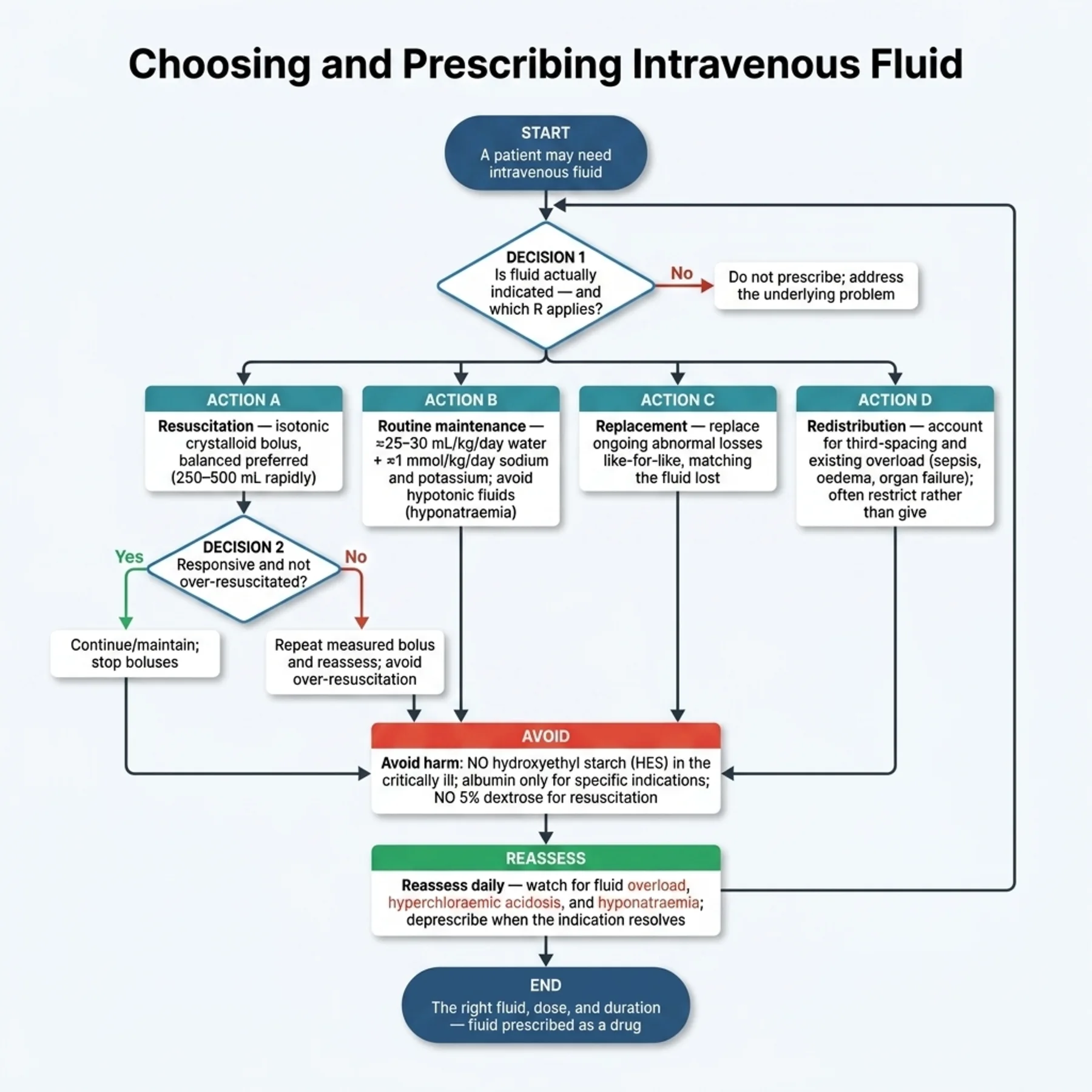
Good fluid prescribing follows a discipline often summarised as the five Rs. Resuscitation is the rapid replacement of intravascular volume in shock, with isotonic crystalloid boluses and reassessment of the response — guided by volume responsiveness, as the last chapter and the AKI volume insisted, and stopping before over-resuscitation, because fluid overload is itself a cause of death. Routine maintenance supplies the daily needs of a patient who cannot drink — water, sodium, potassium, and some glucose — and no more. Replacement matches ongoing abnormal losses (gastrointestinal, drains, fever) in volume and composition. Redistribution accounts for fluid shifts in conditions such as sepsis or hypoalbuminaemia. And reassessment — the most neglected R — means reviewing the fluid prescription daily, asking whether it is still needed, and deprescribing when it is not. Each prescription should specify the indication, the fluid, the rate, the volume, and the plan to reassess, exactly as a drug chart would.
— Maintenance fluids and iatrogenic hyponatraemia
Maintenance prescribing deserves its own warning because it causes a specific, common, and preventable harm. A reasonable maintenance regimen provides roughly 25 to 30 mL/kg/day of water and about 1 mmol/kg/day each of sodium and potassium, with glucose — and crucially, it should generally be isotonic. The historical practice of giving hypotonic maintenance fluids (dextrose-saline, 0.45% saline) delivers a large free-water load that, in the presence of the stress-driven ADH secretion ubiquitous in hospitalised and post-operative patients, causes hyponatraemia — sometimes fatal, especially in children, where deaths from hypotonic maintenance fluids led to the now-standard recommendation for isotonic maintenance. So maintenance fluid is not innocuous background therapy: prescribe it isotonic, in modest volume, and reassess it, rather than running hypotonic fluid that quietly drops the sodium.
— The toxicities, and deprescribing
Three iatrogenic harms recur and are worth naming as the toxicities of this drug. Fluid overload — from over-resuscitation or unreviewed maintenance — is associated with increased mortality in critically ill, septic, and acute-kidney-injury patients, and is among the commonest avoidable harms in hospital. Hyperchloraemic metabolic acidosis follows large-volume saline. And hyponatraemia follows hypotonic fluids. All three are prescribing harms, not diseases that befall the patient, and all three are prevented by the same discipline: the right fluid, the right dose, daily reassessment, and prompt deprescribing once the indication has passed. Treating fluid with the respect given to any drug with a narrow therapeutic margin — and a fatal overdose — is the central message.
— Where the evidence is firm, and where it is soft
The firm parts: starch harms the critically ill and is avoided; albumin confers no general resuscitation benefit and harms in traumatic brain injury; large-volume saline causes hyperchloraemic acidosis; and fluid overload is associated with worse outcomes. The softer part is the precise magnitude of benefit from balanced over saline — a small kidney signal in one trial, neutral mortality in others — which justifies a default toward balanced without overstating it. The resuscitation-strategy question (liberal versus restrictive) is still being worked out, with recent sepsis trials broadly neutral, reinforcing that fluid has toxicity at both ends. The disciplined position is to default to balanced crystalloid, avoid starch, reserve albumin for its indications, prescribe across the five Rs, give isotonic maintenance, and reassess relentlessly — confident in the harms to avoid even where the comparative benefits are modest.
| 04 | PHASE A · LEVEL 4 · ORIENTATION & KNOWLEDGE Reference Tables |
Table 2.1 — The common crystalloids
| Fluid | Key composition | Use |
| 0.9% saline | Na 154, Cl 154 (high Cl) | Resuscitation; large volumes → hyperchloraemic acidosis |
| Balanced (Hartmann's/Plasma-Lyte) | Lower Cl, a buffer, K/Ca | Resuscitation/maintenance — less acidosis |
| 5% dextrose | Free water (distributes TBW) | Free-water deficit/maintenance — NOT resuscitation |
| Hypotonic (dextrose-saline, 0.45%) | Low Na, free water | Maintenance — hyponatraemia risk |
Table 2.2 — The colloids
| Colloid | Evidence / role |
| Albumin | No general benefit over saline (SAFE); harm in TBI; specific indications only |
| Hydroxyethyl starch | ↑ AKI, RRT, mortality (6S, CHEST) — avoid in critically ill/sepsis |
| Gelatins / dextrans | Limited evidence; anaphylaxis/AKI concerns |
| Albumin's indications | SBP, hepatorenal syndrome, large-volume paracentesis |
Table 2.3 — The balanced-versus-saline evidence
| Trial / finding | Detail |
| SMART (ICU) | Small reduction in major adverse kidney events with balanced |
| SALT-ED (ED) | Fewer kidney events with balanced |
| PLUS / BaSICS | Neutral for mortality |
| Pooled reading | Less acidosis, probable small kidney benefit, no clear mortality gain |
| Practical default | Balanced crystalloid; avoid large-volume saline |
Table 2.4 — The five Rs of fluid prescribing
| R | Action |
| Resuscitation | Isotonic crystalloid boluses; reassess responsiveness; avoid over-resuscitation |
| Routine maintenance | Daily water/Na/K needs — isotonic, modest volume |
| Replacement | Match ongoing losses in volume and composition |
| Redistribution | Account for shifts (sepsis, hypoalbuminaemia) |
| Reassessment | Review daily; deprescribe when no longer needed |
Table 2.5 — Maintenance fluid prescribing
| Element | Detail |
| Water | ~25–30 mL/kg/day |
| Sodium / potassium | ~1 mmol/kg/day each |
| Tonicity | Isotonic preferred — hypotonic risks hyponatraemia |
| Children | Isotonic maintenance (hypotonic deaths) |
| Caveat | Reassess; don't run unreviewed maintenance |
Table 2.6 — Iatrogenic fluid harms
| Harm | Cause / prevention |
| Fluid overload | Over-resuscitation / unreviewed maintenance — ↑ mortality; reassess and deprescribe |
| Hyperchloraemic acidosis | Large-volume saline — use balanced |
| Hyponatraemia | Hypotonic fluids — use isotonic maintenance |
| Principle | All three are prescribing harms, not diseases — prevented by discipline |
| 05 | PHASE B · LEVEL 5 · VISUALISE & MAP Imaging & Flowchart Specifications |
| 08 | PHASE C · LEVEL 8 · CLINICAL REASONING Clinical Cases |
| CASE 1 | LITRES OF SALINE The chloride load Hyperchloraemic acidosis |
Presentation
A patient receives several litres of 0.9% saline for resuscitation and develops a normal-anion-gap metabolic acidosis with a rising chloride. The team is puzzled by the acidosis in a patient who is improving haemodynamically.
❖ Pause and reflect Where has this hyperchloraemic acidosis come from? |
Analysis
From the saline. 0.9% saline contains 154 mmol/L of chloride, well above plasma, so large volumes load the body with chloride and produce a hyperchloraemic, normal-anion-gap metabolic acidosis — an iatrogenic, prescribing-related acidosis, not a sign of deterioration. A balanced solution, with lower chloride and a buffer, would have avoided it, and the trials support balanced as the default when large volumes are anticipated.
Plan
Recognise the hyperchloraemic acidosis as saline-induced, switch ongoing resuscitation and maintenance to a balanced crystalloid, and reassess. Default to balanced solutions, especially for large-volume resuscitation.
Teaching point
Large-volume 0.9% saline causes hyperchloraemic metabolic acidosis — default to balanced crystalloids.
Cross-reference
Exercises rules R2 and R3; Figure 2.2; Tables 2.1, 2.3, and 2.6; acid-base in Chapter 11.
| CASE 2 | STARCH IN SEPSIS Theoretical efficiency, real harm Avoiding hydroxyethyl starch |
Presentation
A septic patient is given hydroxyethyl starch for volume expansion on the reasoning that a colloid will stay intravascular more efficiently than crystalloid. Over the next days the patient develops worsening acute kidney injury requiring renal replacement.
❖ Pause and reflect Was a starch colloid a safe choice in this septic patient? |
Analysis
No. Despite the theoretical efficiency, dedicated trials of hydroxyethyl starch in the critically ill and in sepsis showed increased acute kidney injury, more renal replacement therapy, and a mortality signal, leading to its contraindication in these populations. The worsening AKI requiring renal replacement is the documented harm. Crystalloid — balanced — is the resuscitation fluid of choice; starch should not have been used.
Plan
Stop the starch, resuscitate with balanced crystalloid guided by responsiveness, and manage the AKI. Avoid hydroxyethyl starch in the critically ill and septic entirely.
Teaching point
Hydroxyethyl starch increases AKI and mortality in the critically ill — avoid it; resuscitate with crystalloid.
Cross-reference
Exercises rule R4; Table 2.2; the L21 reflective prompts.
| CASE 3 | THE DROPPING SODIUM Hypotonic maintenance Iatrogenic hyponatraemia |
Presentation
A post-operative patient is placed on hypotonic dextrose-saline as maintenance fluid. Over two days the serum sodium falls progressively, and the patient becomes confused.
❖ Pause and reflect Why is the sodium falling on maintenance fluid? |
Analysis
The hypotonic maintenance fluid is the cause. It delivers a large free-water load, and in the post-operative state — where stress-driven ADH secretion is near-universal and retains that water — the sodium falls, producing the hyponatraemia and now confusion. This is a well-described, preventable, and occasionally fatal harm, and it is why isotonic maintenance is preferred, especially in children, in whom hypotonic-fluid deaths drove the change.
Plan
Stop the hypotonic fluid, switch to isotonic maintenance in modest volume, and manage the hyponatraemia (Chapter 5). Prescribe isotonic maintenance by default and reassess the sodium.
Teaching point
Hypotonic maintenance fluids cause hyponatraemia, especially post-operatively and in children — use isotonic maintenance.
Cross-reference
Exercises rules R5 and R6; Table 2.5; hyponatraemia in Chapters 4–5.
| CASE 4 | FLUID ON AUTOPILOT Reassess and deprescribe Fluid as a drug |
Presentation
A patient resuscitated for hypovolaemia three days ago remains on continuous maintenance fluid that no one has reviewed. He is now oedematous, gaining weight, and becoming breathless.
❖ Pause and reflect Should this fluid still be running, and what has it caused? |
Analysis
The fluid should have been stopped days ago. Maintenance fluid left running unreviewed after the resuscitation indication passed has produced fluid overload — oedema, weight gain, and now breathlessness — a common, avoidable, prescribing harm associated with worse outcomes. The neglected fifth R, reassessment, is the failure: fluid is a drug, and like any drug it must be reviewed and stopped when no longer needed.
Plan
Stop the maintenance fluid, manage the overload (Chapter 3), and institute daily fluid review. Treat every fluid prescription as a drug with a stop date and a reassessment plan.
Teaching point
Unreviewed fluid causes overload — reassess daily and deprescribe; fluid is a drug, not a default.
Cross-reference
Exercises rules R1 and R5; the five-Rs figure (2.3); Tables 2.4 and 2.6; volume overload in Chapter 3.
| 10 | PHASE C · LEVEL 10 · CLINICAL REASONING Clinical Pearls |
| Intravenous fluid is a drug — indication, type, rate, volume, reassessment. | 0.9% saline (Cl 154) → hyperchloraemic acidosis with large volumes. |
| Balanced solutions (Hartmann's/Plasma-Lyte): lower Cl + buffer → less acidosis. | 5% dextrose = free water (distributes TBW) — NOT a resuscitation fluid. |
| Hypotonic maintenance → hyponatraemia — use isotonic. | Albumin: no general benefit vs saline (SAFE); harm in TBI; specific indications only. |
| Albumin indications: SBP, hepatorenal syndrome, large-volume paracentesis. | Hydroxyethyl starch: ↑ AKI/RRT/mortality — avoid in critically ill/sepsis. |
| Balanced vs saline: less acidosis, small kidney signal, no clear mortality benefit. | Default to balanced; avoid large-volume saline. |
| Saline still useful in hypochloraemic alkalosis / where high Na helps. | Five Rs: resuscitation, maintenance, replacement, redistribution, reassessment. |
| Resuscitate with isotonic boluses + responsiveness; avoid over-resuscitation. | Maintenance ~25–30 mL/kg/day water, ~1 mmol/kg/day Na & K — isotonic. |
| Reassess daily and deprescribe — the most neglected R. | Fluid toxicities: overload, hyperchloraemic acidosis, hyponatraemia — all preventable. |
| 11 | PHASE D · LEVEL 11 · SAFETY & EVIDENCE Red Flags & Never-Do |
Panel A — Red flags
| ▲ | A normal-anion-gap acidosis with rising chloride after large-volume saline — hyperchloraemic acidosis; switch to balanced. |
| ▲ | Hydroxyethyl starch in a critically ill or septic patient — AKI/mortality risk; stop and use crystalloid. |
| ▲ | A falling sodium on hypotonic maintenance fluid — iatrogenic hyponatraemia; switch to isotonic. |
| ▲ | 5% dextrose ordered for resuscitation — it's free water, not a volume expander; use isotonic crystalloid. |
| ▲ | Maintenance fluid running unreviewed for days with weight gain — fluid overload; reassess and deprescribe. |
Panel B — Never do
| ✖ NEVER — use hydroxyethyl starch in the critically ill or septic. |
| ✖ NEVER — use 5% dextrose as a resuscitation fluid. |
| ✖ NEVER — run hypotonic maintenance fluid when isotonic is appropriate. |
| ✖ NEVER — leave fluid running without daily reassessment. |
| 12 | PHASE D · LEVEL 12 · SAFETY & EVIDENCE Common Pitfalls |
Pitfall 1 — Large-volume saline
| ✖ | WRONG Resuscitating with litres of 0.9% saline by default. |
| ✓ | RIGHT Defaulting to a balanced crystalloid for large volumes. |
| ✉ | WHY Saline's chloride load causes hyperchloraemic acidosis. |
Pitfall 2 — Colloid for efficiency
| ✖ | WRONG Choosing starch to expand plasma more 'efficiently.' |
| ✓ | RIGHT Resuscitating with crystalloid; avoiding starch. |
| ✉ | WHY Starch increases AKI and mortality in the critically ill. |
Pitfall 3 — Dextrose for shock
| ✖ | WRONG Giving 5% dextrose to resuscitate a hypotensive patient. |
| ✓ | RIGHT Using isotonic crystalloid for resuscitation. |
| ✉ | WHY Dextrose is free water that barely expands the intravascular space. |
Pitfall 4 — Hypotonic maintenance
| ✖ | WRONG Running hypotonic dextrose-saline as routine maintenance. |
| ✓ | RIGHT Prescribing isotonic maintenance, especially in children. |
| ✉ | WHY Hypotonic fluid plus stress ADH causes hyponatraemia. |
Pitfall 5 — Fluid on autopilot
| ✖ | WRONG Leaving maintenance fluid running unreviewed for days. |
| ✓ | RIGHT Reassessing daily and deprescribing when not needed. |
| ✉ | WHY Unreviewed fluid causes overload, which worsens outcomes. |
| 13 | PHASE D · LEVEL 13 · SAFETY & EVIDENCE Evidence Grading |
GRADE A HIGH CONFIDENCE The effect is real and the estimate is stable. RCTs at low risk of bias; multiple concordant prospective cohorts; meta-analyses. |
GRADE B MODERATE CONFIDENCE The effect is likely real but may shift with new data. Observational studies, registries, mechanistic human studies. |
GRADE C LOW CONFIDENCE Rests on physiology, reasoning, or consensus rather than outcomes. Pathophysiological reasoning; extrapolation; consensus without outcomes. |
Graded statements (by evidence type)
| Statement | Grade | Basis (evidence type) |
| Large-volume 0.9% saline causes hyperchloraemic metabolic acidosis. | A | Physiology and clinical data |
| Hydroxyethyl starch increases AKI and mortality in the critically ill. | A | RCTs (6S, CHEST) |
| Albumin confers no general resuscitation benefit and harms in TBI. | A | RCT (SAFE) |
| Balanced solutions reduce acidosis with at most a small kidney benefit. | B | RCTs (SMART, PLUS, BaSICS) |
| Hypotonic maintenance fluids cause hyponatraemia. | A | Physiology and clinical data |
| Fluid overload is associated with increased mortality. | B | Observational and trial data |
| Liberal vs restrictive resuscitation shows no clear difference in sepsis. | B | RCTs (CLASSIC, CLOVERS) |
| 14 | PHASE E · LEVEL 14 · PATIENT DECISIONS Absolute Risk in Natural Frequency |
Natural-frequency estimates for orientation, from the fluid trials; they vary with population and volume given. They convey the size of the fluid decisions, expressed per 100 comparable patients.
| Per 100 patients… | Outcome | Roughly how many | See |
| Given balanced vs saline | Avoid a major adverse kidney event | A small number more with balanced | L13 row 4 |
| Critically ill given starch vs crystalloid | Suffer AKI / need renal replacement | More with starch | L13 row 2 |
| With TBI given albumin vs saline | Die | More with albumin | L13 row 3 |
| Over-resuscitated to fluid overload | Have a worse outcome | More than the euvolaemic | L13 row 6 |
★ How to read these Read these as orientation, not promises; fluid outcomes vary with population and volume. The stable signals: starch harms, albumin harms in TBI, balanced has at most a small kidney edge, and overload worsens outcomes. Communicate them as people out of 100, not as a hazard ratio. |
| 17 | PHASE F · LEVEL 17 · APPLY & TEST Documentation Templates |
Paste-ready notes. Tick the boxes that apply and delete the rest; make the indication, fluid choice, and reassessment explicit — fluid is a drug.
Template 1 — Fluid prescription (any R)
Template 2 — Maintenance fluid prescription
| 18 | PHASE F · LEVEL 18 · APPLY & TEST Cheat Sheet |
| Fluid = a drug (indication/type/rate/volume/reassess). | 0.9% saline (Cl 154) → hyperchloraemic acidosis (large volumes). |
| Balanced (Hartmann's/Plasma-Lyte): less acidosis. | 5% dextrose = free water — NOT resuscitation. |
| Hypotonic maintenance → hyponatraemia — use isotonic. | Albumin: no general benefit; harm in TBI; specific indications. |
| Albumin: SBP, HRS, large-volume paracentesis. | HES (starch): ↑ AKI/mortality — AVOID (critically ill/sepsis). |
| Balanced vs saline: less acidosis, small kidney signal, neutral mortality. | Default balanced; avoid large-volume saline. |
| 5 Rs: resuscitation/maintenance/replacement/redistribution/reassessment. | Resuscitate: isotonic boluses + responsiveness; avoid over-resuscitation. |
| Maintenance ~25–30 mL/kg/day water, ~1 mmol/kg/day Na/K. | Reassess daily; deprescribe. |
| Toxicities: overload, hyperchloraemic acidosis, hyponatraemia. | All fluid harms are preventable by discipline. |
| 19 | PHASE F · LEVEL 19 · APPLY & TEST Flashcards |
| CARD 1 | Q. Why does 0.9% saline cause acidosis in large volumes? A. It contains 154 mmol/L of chloride, well above plasma, so large volumes load chloride and produce a hyperchloraemic, normal-anion-gap metabolic acidosis. DETAILED. Balanced solutions have lower chloride and a buffer. CLINICAL. Default to balanced crystalloids for large-volume resuscitation. |
| CARD 2 | Q. Why is 5% dextrose not a resuscitation fluid? A. The dextrose is metabolised, leaving free water that distributes across total body water, so it barely expands the intravascular space. DETAILED. It is for free-water deficits and maintenance, not volume. CLINICAL. Resuscitate with isotonic crystalloid, not dextrose. |
| CARD 3 | Q. What is the evidence on hydroxyethyl starch? A. Dedicated trials in the critically ill and septic showed increased acute kidney injury, more renal replacement therapy, and a mortality signal, leading to its contraindication. DETAILED. Its theoretical efficiency did not translate into benefit. CLINICAL. Avoid starch; resuscitate with crystalloid. |
| CARD 4 | Q. What is albumin's role? A. It is no better than saline overall for survival and is harmful in traumatic brain injury, with a role only in specific indications (SBP, hepatorenal syndrome, large-volume paracentesis). DETAILED. It is not a general resuscitation fluid. CLINICAL. Reserve albumin for its specific indications. |
| CARD 5 | Q. What do the balanced-versus-saline trials show? A. Balanced solutions cause less hyperchloraemic acidosis with at most a small reduction in major adverse kidney events, and no clear mortality benefit (SMART, PLUS, BaSICS). DETAILED. A gentle signal toward balanced, not a dramatic one. CLINICAL. Default to balanced; avoid large-volume saline. |
| CARD 6 | Q. What are the five Rs of fluid prescribing? A. Resuscitation, routine maintenance, replacement, redistribution, and reassessment — the framework for prescribing fluid as a drug. DETAILED. Reassessment is the most neglected. CLINICAL. Specify indication, type, rate, volume, and a reassessment plan. |
| CARD 7 | Q. Why do hypotonic maintenance fluids cause hyponatraemia? A. They deliver a large free-water load, and the stress-driven ADH secretion ubiquitous in hospitalised and post-operative patients retains that water, dropping the sodium. DETAILED. It is preventable and occasionally fatal, especially in children. CLINICAL. Prescribe isotonic maintenance and reassess the sodium. |
| CARD 8 | Q. What are the main iatrogenic harms of intravenous fluid? A. Fluid overload (from over-resuscitation or unreviewed maintenance), hyperchloraemic acidosis (large-volume saline), and hyponatraemia (hypotonic fluids). DETAILED. All are prescribing harms, not diseases. CLINICAL. Prevent them with the right fluid, dose, and daily reassessment. |
| 20 | PHASE F · LEVEL 20 · APPLY & TEST One-Minute Preceptor |
| SCENE 1 | The intern reaching for saline |
GET A COMMITMENT. “You're resuscitating with several litres of 0.9% saline — any concern?”
PROBE FOR EVIDENCE. “It's the standard fluid” — ask: “What does saline's chloride do in large volumes, and what do the trials favour?”
TEACH A GENERAL RULE. Large-volume saline causes hyperchloraemic acidosis, and the trials favour balanced solutions, so balanced is the default for large-volume resuscitation.
REINFORCE WHAT WAS RIGHT. Recognising the need to resuscitate was correct.
CORRECT A MISTAKE. Switch to a balanced crystalloid.
| SCENE 2 | The resident on hypotonic maintenance |
GET A COMMITMENT. “You've prescribed hypotonic dextrose-saline as maintenance — why?”
PROBE FOR EVIDENCE. “It's the usual maintenance fluid” — ask: “What happens to the sodium with a free-water load and post-operative ADH?”
TEACH A GENERAL RULE. Hypotonic maintenance plus stress ADH causes hyponatraemia, sometimes fatal, so isotonic maintenance is preferred, especially in children.
REINFORCE WHAT WAS RIGHT. Providing maintenance for a nil-by-mouth patient was appropriate.
CORRECT A MISTAKE. Switch to isotonic maintenance and monitor the sodium.
| 21 | PHASE F · LEVEL 21 · APPLY & TEST Reflective Prompts |
Genuine tensions this evidence leaves open; sit with them rather than resolving them too quickly.
Saline was the unquestioned default for a century before the chloride concern emerged. What does that say about how long a plausible-but-untested practice can persist unchallenged?
The balanced-versus-saline benefit is small and inconsistent across trials, yet the mechanistic case is appealing. How much should a tidy mechanism sway practice when the outcome data are modest?
Colloids promised efficiency and delivered harm. How do you stay sceptical of physiologically attractive interventions until the outcome trials report?
Fluid overload is a leading avoidable harm, yet fluid is ordered more casually than almost any drug. Why is it so hard to treat fluid with the discipline we give to medicines?
Restrictive and liberal resuscitation strategies are broadly neutral in trials. How do you act decisively at the bedside when the evidence says the extremes both have costs and the middle is uncertain?
| 22 | PHASE F · LEVEL 22 · APPLY & TEST Board-Style Questions |
| Q 01 | Why does large-volume 0.9% saline cause a metabolic acidosis? |
| A | It contains lactate |
| B | Its supraphysiologic chloride causes a hyperchloraemic, normal-anion-gap acidosis |
| C | It is hypotonic |
| D | It contains a buffer |
Rationale Saline's chloride (154 mmol/L) exceeds plasma, and large volumes produce hyperchloraemic acidosis (case 1, Table 2.1). A and D describe balanced solutions; C is incorrect. |
| Q 02 | Which fluid is NOT appropriate for resuscitation of a hypotensive patient? |
| A | Balanced crystalloid |
| B | 0.9% saline |
| C | 5% dextrose |
| D | Either crystalloid |
Rationale 5% dextrose is free water that distributes across total body water and barely expands the intravascular space (Figure 2.1, rule on dextrose). A, B, and D are isotonic resuscitation options. |
| Q 03 | What does the evidence show about hydroxyethyl starch in the critically ill? |
| A | It improves survival |
| B | It increases acute kidney injury and mortality and should be avoided |
| C | It is equivalent to crystalloid |
| D | It prevents AKI |
Rationale Trials (6S, CHEST) showed harm — more AKI, renal replacement, and mortality — leading to contraindication (case 2, Table 2.2). A, C, and D contradict the evidence. |
| Q 04 | What is albumin's place in resuscitation? |
| A | Superior to crystalloid for all patients |
| B | No general benefit over saline, harmful in TBI, with specific indications only |
| C | The first-line resuscitation fluid |
| D | Contraindicated entirely |
Rationale SAFE showed albumin is no better overall and harms in TBI, with a role only in specific indications (Table 2.2, L13 row 3). A and C overstate it; D is too absolute. |
| Q 05 | The balanced-versus-saline trials are best summarised as: |
| A | A large mortality benefit for balanced |
| B | Less acidosis and at most a small kidney benefit, without a clear mortality difference |
| C | Harm from balanced solutions |
| D | No difference of any kind |
Rationale SMART showed a small kidney-event reduction while PLUS/BaSICS were neutral for mortality (Table 2.3, L13 row 4). A overstates; C and D understate. |
| Q 06 | A post-operative patient on hypotonic dextrose-saline develops a falling sodium and confusion. The cause is: |
| A | Too much sodium |
| B | Iatrogenic hyponatraemia from the hypotonic fluid plus stress ADH |
| C | Dehydration |
| D | Hyperchloraemic acidosis |
Rationale Hypotonic maintenance delivers free water that ADH retains, dropping the sodium (case 3, Table 2.5). A is the opposite; C and D are wrong mechanisms. |
| Q 07 | What are the five Rs of fluid prescribing? |
| A | Rate, route, risk, review, repeat |
| B | Resuscitation, routine maintenance, replacement, redistribution, reassessment |
| C | Resuscitation, rate, replacement, review, restriction |
| D | Replacement, resuscitation, rest, review, rate |
Rationale The five Rs frame fluid as a drug: resuscitation, maintenance, replacement, redistribution, reassessment (Figure 2.3, Table 2.4). A, C, and D are incorrect. |
| Q 08 | Maintenance fluid left running unreviewed for days, with weight gain and breathlessness, has caused: |
| A | Hypovolaemia |
| B | Fluid overload — a preventable prescribing harm |
| C | Hypernatraemia |
| D | Hyperchloraemic acidosis |
Rationale Unreviewed fluid causes overload, associated with worse outcomes — the neglected fifth R (case 4, Table 2.6). A is the opposite; C and D are different harms. |
| Q 09 | Across 100 critically ill patients given starch versus crystalloid, the difference in kidney outcomes is: |
| A | Fewer kidney events with starch |
| B | More AKI and renal replacement with starch |
| C | No difference |
| D | Better kidney function with starch |
Rationale Starch increases AKI and renal replacement in the critically ill (L14, L13 row 2). A, C, and D contradict the trials. |