Chapter Preamble
Signals declared
Sig-D — Diagnostic (primary). Recognise the altered fluid, electrolyte, and acid-base handling of the failing and dialysed kidney, and interpret values with dialysis timing.
Sig-T — Therapeutic (strong). Manage the chronic disturbances and the dialysis prescription, and prevent the intradialytic complications.
Sig-M — Mechanistic (strong). How declining nephron mass loses regulatory capacity, the uraemic acidosis, isosthenuria, and the disequilibrium of rapid dialysis.
Levels populated and omitted
Populated (19): L1–L14, L17–L20, L22. The mechanistic signal fires the concept maps (L6) and triads (L9); the therapeutic signal fires the absolute-risk table (L14) and templates (L17); the diagnostic signal drives the tables, rules, cases, pitfalls, and board items.
L15 / L16 preference-sensitive map and SDM scripts — omitted. No Sig-E; managing these disturbances is effective care (the dialysis-versus-conservative choice lives in Volume 6).
L21 reflective prompts — omitted. No Sig-E/V; the chapter's tensions are worked through the cases and pitfalls.
| 01 | PHASE A · LEVEL 1 · ORIENTATION & KNOWLEDGE Learning Objectives |
By the end of this chapter you should be able to:
Explain how declining nephron mass loses fluid, electrolyte, and acid-base regulation.
Manage the volume, potassium, and acid-base disturbances of CKD.
Describe the uraemic metabolic acidosis and why bicarbonate is given.
Explain isosthenuria and why CKD predisposes to both hypo- and hypernatraemia.
Describe how disturbances accumulate between dialysis sessions and are corrected at dialysis.
Recognise and prevent the intradialytic complications — hypotension and dialysis disequilibrium.
Tailor the dialysate prescription to the patient.
Interpret electrolytes in dialysis patients with reference to timing.
| 02 | PHASE A · LEVEL 2 · ORIENTATION & KNOWLEDGE Executive Summary |
CKD progressively loses the kidney's capacity to regulate fluid, electrolytes, and acid-base, turning the disorders of this volume into chronic problems.
Adaptations keep balance until advanced CKD, when the disturbances emerge.
Impaired sodium excretion causes volume overload, hypertension, and oedema, managed with sodium restriction, high-dose loop diuretics, and ultrafiltration.
Impaired potassium excretion causes hyperkalaemia, especially in advanced or oliguric CKD and on RAAS blockers, managed with diet, binders, acidosis correction, and dialysis.
Impaired acid excretion causes a uraemic metabolic acidosis — initially normal-gap from reduced ammoniagenesis, later high-gap as anions are retained.
Bicarbonate is given to keep the serum bicarbonate at or above about 22, which also slows CKD progression.
The mineral-bone disorder — hyperphosphataemia, hypocalcaemia, secondary hyperparathyroidism — is managed with binders, vitamin D, and calcimimetics.
Water handling fails as isosthenuria — a fixed, near-isotonic urine — impairing both concentration and dilution, so CKD predisposes to both hyponatraemia and hypernatraemia.
In dialysis, disturbances accumulate between sessions — fluid gain, hyperkalaemia, acidosis — and are corrected at the session.
Intradialytic hypotension follows excessive or rapid ultrafiltration when the blood volume cannot refill.
Dialysis disequilibrium syndrome follows rapid removal of urea and osmolytes, creating an osmotic gradient and cerebral oedema, especially at the first dialysis with a high urea.
The dialysate prescription — potassium, calcium, bicarbonate, sodium — is tailored to the patient.
Electrolytes in dialysis patients swing with the cycle, so values are interpreted with reference to timing (pre- versus post-dialysis).
The unifying theme is that the failing kidney can no longer regulate the internal milieu, so the clinician and the dialysis machine must do it.
| 03 | PHASE A · LEVEL 3 · ORIENTATION & KNOWLEDGE Main Narrative |
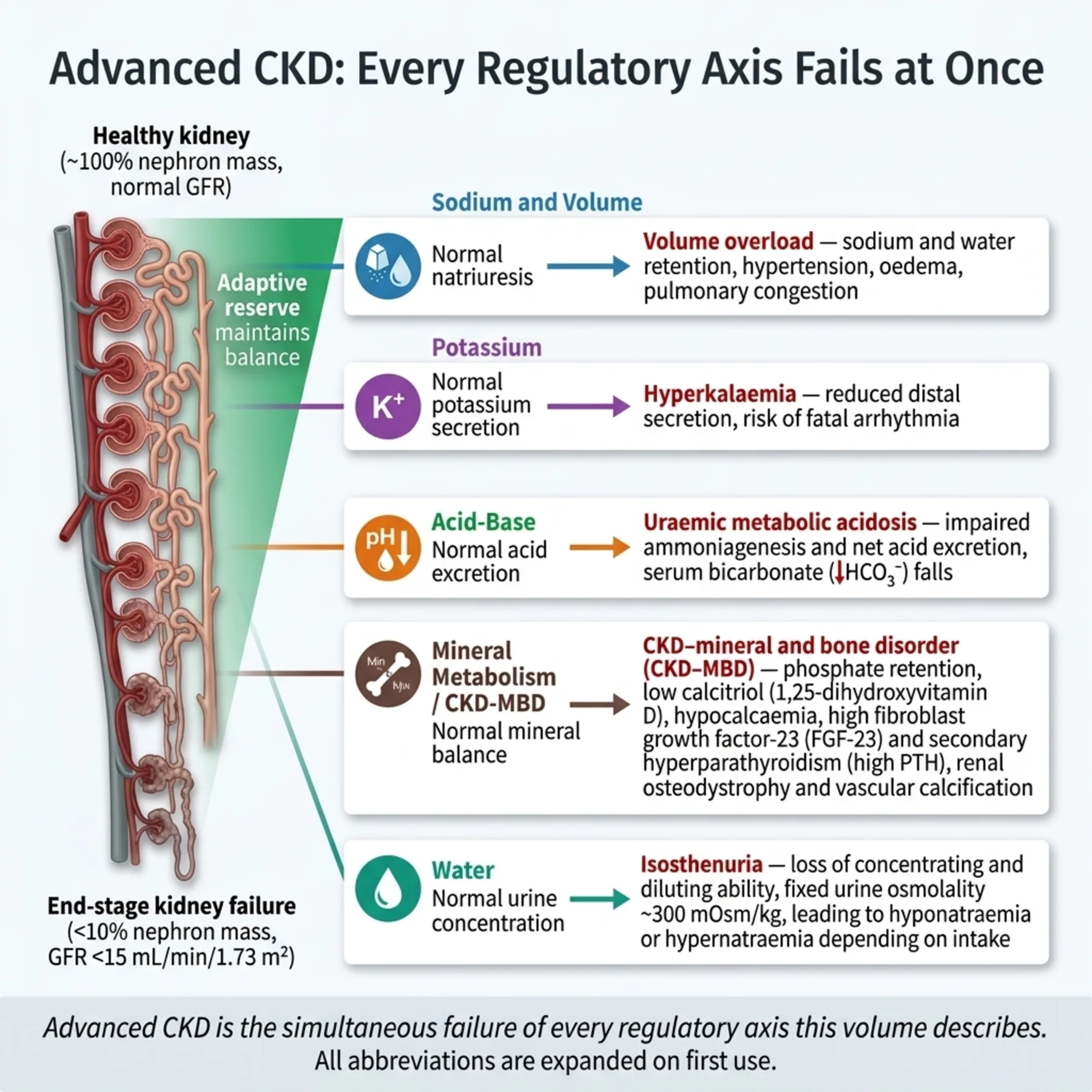
This volume has, chapter by chapter, described how the healthy kidney regulates the internal milieu. CKD is the story of that regulation failing. As nephron mass declines, the kidney loses, in turn, its control of sodium and volume, of potassium, of acid-base, of mineral metabolism, and of water — and the disorders that were acute problems in earlier chapters become chronic, coexisting burdens. In dialysis, the machine takes over the regulation intermittently, introducing its own rhythm of accumulation and correction, and its own complications. This chapter is where the whole volume meets the failing kidney.
— How CKD loses regulation
The kidney's regulatory capacity has reserve, so for much of CKD the remaining nephrons adapt to maintain balance — each surviving nephron excretes more sodium, potassium, and acid per unit — and the serum values stay near normal until the disease is advanced. As that reserve is exhausted (typically in the later stages), the disturbances emerge, and they emerge across all the axes at once because the same loss of nephron mass impairs every regulatory function. So the advanced-CKD patient develops volume overload, hyperkalaemia, metabolic acidosis, and the mineral-bone disorder together, and the dialysis patient lives with all of them between sessions. The framing for the chapter is that CKD is the chronic, simultaneous failure of the regulatory systems this volume has described — and management is the chronic substitution for each lost function.
— Sodium, potassium, and acid-base in CKD
Three of the axes dominate day-to-day CKD management. Sodium and volume: the failing kidney cannot excrete a sodium load, so volume overload, hypertension, and oedema develop, managed with dietary sodium restriction, high-dose loop diuretics (the dose escalates as GFR falls), and ultimately ultrafiltration on dialysis. Potassium: impaired excretion causes hyperkalaemia, particularly in advanced or oliguric disease and on the RAAS blockers that protect the kidney — managed with dietary restriction, the modern binders (which, as the hyperkalaemia chapter stressed, let RAAS blockade continue), correction of the acidosis, and dialysis. Acid-base: the failing kidney cannot excrete the daily acid load, producing a uraemic metabolic acidosis that is initially normal-anion-gap (from reduced ammoniagenesis) and becomes high-anion-gap as organic, phosphate, and sulfate anions are retained — treated with oral bicarbonate to keep the serum bicarbonate at or above about 22, which (as the CKD volume detailed) also slows the progression of the kidney disease itself. These three, plus the mineral-bone disorder, are the substance of chronic CKD electrolyte care.
— Mineral metabolism and water
Two further axes complete the CKD picture. The mineral-bone disorder — developed fully in the CKD volume — is the failure of phosphate, calcium, and PTH regulation: phosphate is retained (hyperphosphataemia), calcitriol falls and calcium drops (hypocalcaemia), FGF23 and PTH rise (secondary hyperparathyroidism), and the consequences span bone and vascular calcification; management is dietary phosphate restriction, binders, active vitamin D, and calcimimetics. Water handling fails in a characteristic way: the diseased kidney loses the ability to concentrate or dilute the urine, fixing the urine osmolality near that of plasma — isosthenuria. Because both concentration and dilution are impaired, the CKD patient is vulnerable to dysnatraemia in either direction: they cannot excrete a water load (predisposing to hyponatraemia) nor conserve water against a deficit (predisposing to hypernatraemia). And the failing kidney cannot excrete a magnesium load, so magnesium-containing laxatives and antacids risk hypermagnesaemia — the avoidable hazard met earlier. Every axis of this volume, in other words, is disordered in advanced CKD.
— The dialysis rhythm: accumulation and correction
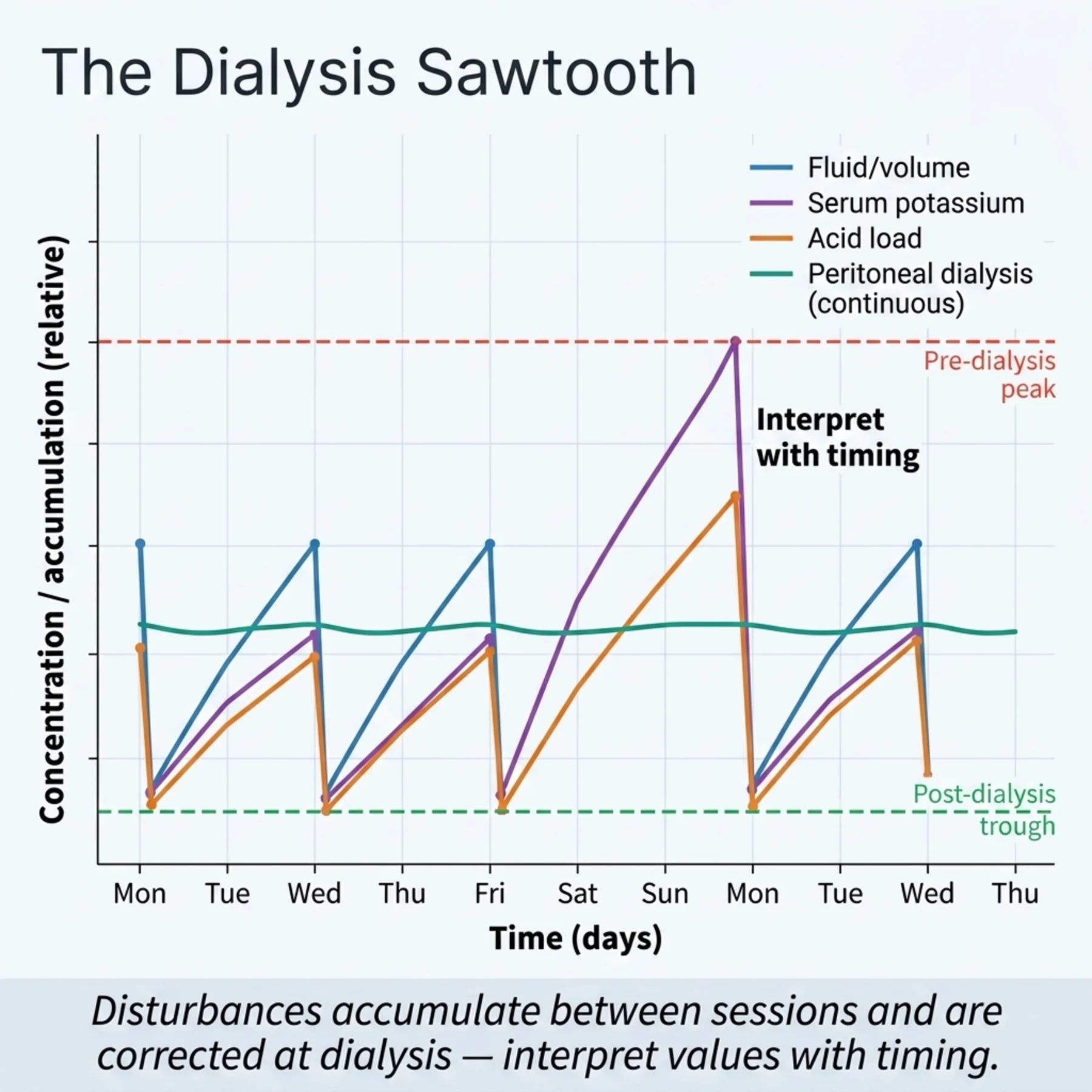
Dialysis changes the temporal pattern of these disturbances. Intermittent haemodialysis (typically thrice weekly) means the disturbances accumulate between sessions and are corrected at the session: over the interdialytic interval the patient gains fluid (the source of overload and interdialytic weight gain), the potassium rises (from diet and the lost excretion), and the acidosis re-accumulates — and the dialysis session removes the fluid, the potassium, and the acid, resetting the milieu. This sawtooth rhythm has a clinical consequence: the electrolytes of a haemodialysis patient swing with the cycle, so a value must be interpreted with reference to timing — a pre-dialysis potassium (the peak) differs from a post-dialysis one (the trough). Peritoneal dialysis, being continuous, gives a gentler, steadier correction without the same swings (at the cost of glucose absorption, protein loss, and peritonitis risk). Understanding the rhythm is essential to interpreting and managing the dialysis patient's chemistry.
— The intradialytic complications
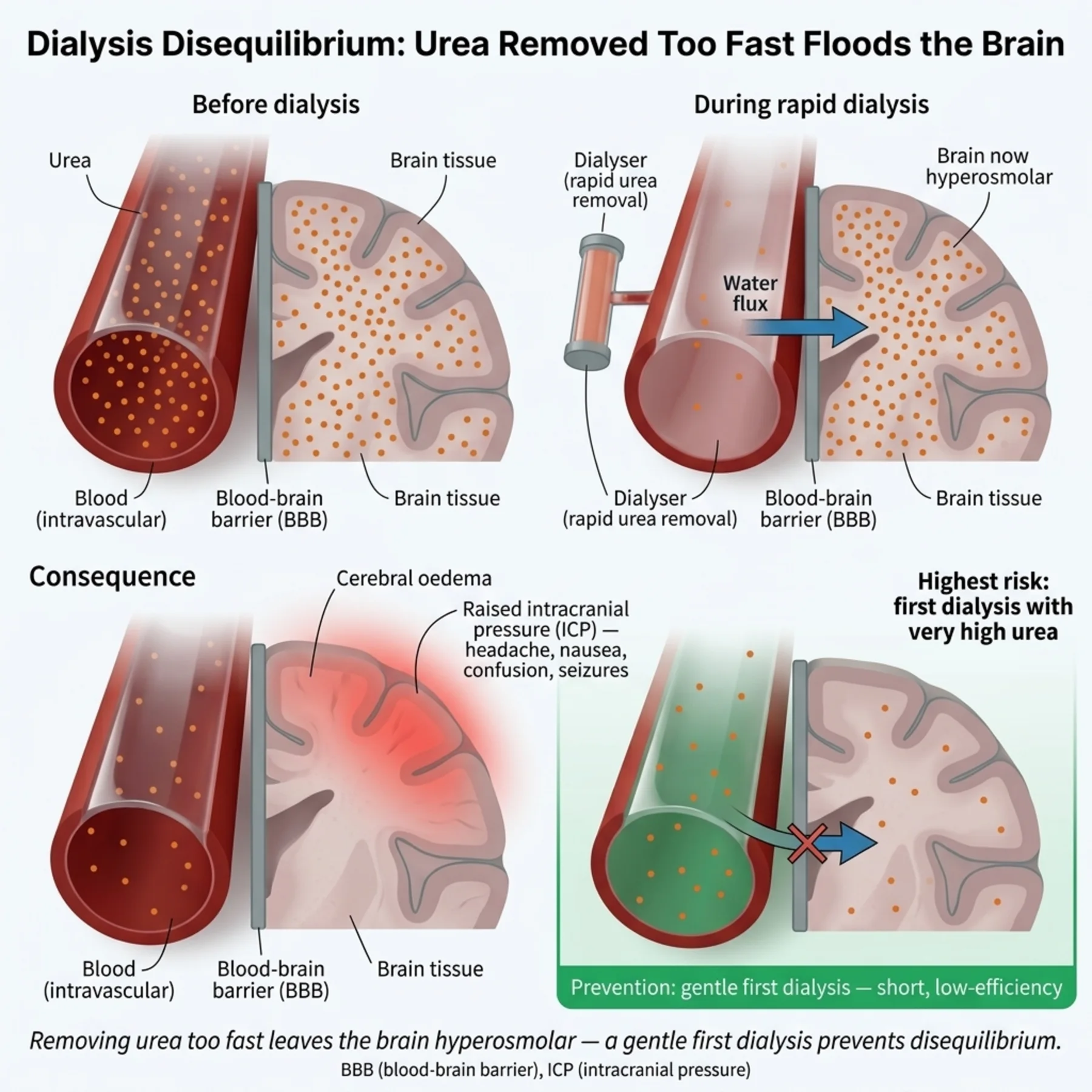
The dialysis session itself causes characteristic complications that the clinician must recognise and prevent. Intradialytic hypotension is the commonest: removing fluid by ultrafiltration faster than the intravascular space can refill from the interstitium drops the blood volume and the blood pressure — the same intravascular-versus-interstitial divergence met in the opening chapter — managed by limiting the ultrafiltration rate, achieving an accurate target weight, and other measures. Dialysis disequilibrium syndrome is the more dramatic: rapidly removing urea and other osmolytes from the blood leaves the brain transiently hyperosmolar relative to the plasma, drawing water in and causing cerebral oedema with headache, confusion, and (rarely) seizures — a particular risk at the very first dialysis in a patient with a very high urea, which is why initial dialysis is deliberately gentle (short, low-efficiency, with a modest urea reduction). Electrolyte shifts during dialysis (potassium, phosphate, calcium) depend on the dialysate composition. Recognising these complications and prescribing to prevent them — a gentle first dialysis, a controlled ultrafiltration rate — is core dialysis practice.
— The dialysate prescription, and the unifying theme
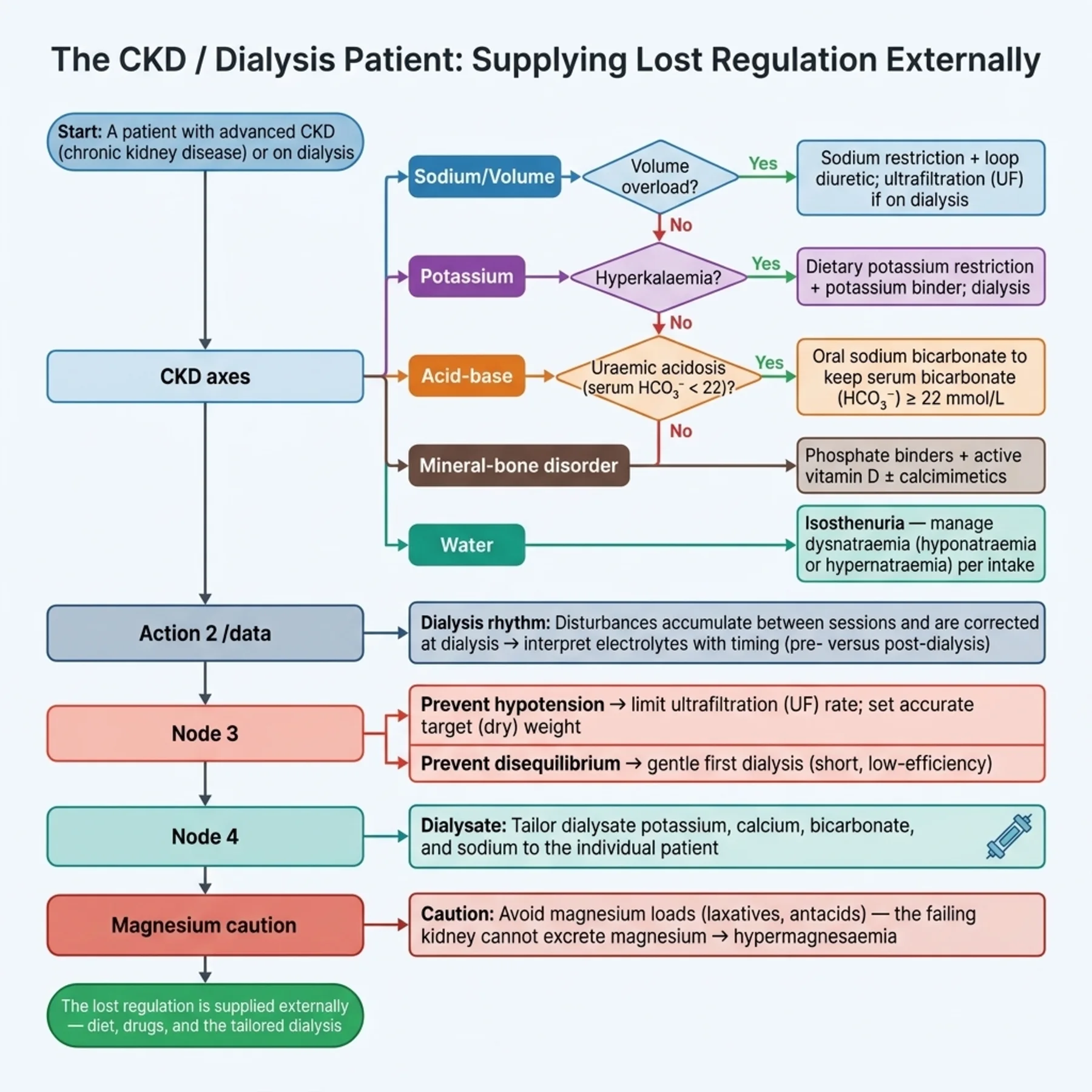
The dialysate is the tool by which the machine substitutes for the lost regulation, and its composition — potassium, calcium, bicarbonate, sodium — is tailored to the patient. A lower dialysate potassium removes more potassium (for the hyperkalaemic patient) but risks arrhythmia if too aggressive; the dialysate calcium and bicarbonate are set to manage the mineral-bone disorder and the acidosis; the dialysate sodium influences fluid and blood-pressure stability. The prescription is individualised and adjusted over time. Stepping back, the unifying theme of the chapter — and a fitting near-close to the volume — is that the failing kidney can no longer regulate the internal milieu that the healthy kidney maintains effortlessly, so the regulation must be supplied externally: by diet, by drugs (diuretics, binders, bicarbonate, vitamin D), and ultimately by the dialysis machine with its tailored dialysate and its careful rhythm. Every regulatory function this volume has described is, in advanced CKD, a function the clinician must now perform.
| 04 | PHASE A · LEVEL 4 · ORIENTATION & KNOWLEDGE Reference Tables |
Table 16.1 — The disturbances of CKD
| Axis | Disturbance | Management |
| Sodium / volume | Overload, hypertension, oedema | Na restriction, high-dose loop diuretics, ultrafiltration |
| Potassium | Hyperkalaemia | Diet, binders (enable RAAS), correct acidosis, dialysis |
| Acid-base | Uraemic acidosis (NAGMA → HAGMA) | Bicarbonate (keep ≥ ~22; slows CKD), dialysis |
| Mineral (MBD) | Hyperphosphataemia, hypocalcaemia, 2° HPT | Binders, vitamin D, calcimimetics (Volume 6) |
| Water | Isosthenuria — dysnatraemia either way | Manage per the sodium/water chapters |
Table 16.2 — The uraemic acidosis
| Stage | Detail |
| Early | Normal-anion-gap (reduced ammoniagenesis) |
| Later | High-anion-gap (retained organic/phosphate/sulfate anions) |
| Treatment | Oral bicarbonate to keep serum bicarbonate ≥ ~22 |
| Bonus | Correcting acidosis slows CKD progression (Volume 6) |
Table 16.3 — Water handling and isosthenuria
| Aspect | Detail |
| Isosthenuria | Fixed near-isotonic urine — impaired concentration AND dilution |
| Cannot excrete water load | Predisposes to hyponatraemia |
| Cannot conserve water | Predisposes to hypernatraemia |
| Magnesium | Cannot excrete a load — avoid Mg laxatives/antacids |
Table 16.4 — The dialysis rhythm
| Aspect | Detail |
| Interdialytic accumulation | Fluid gain, hyperkalaemia, acidosis re-accumulate |
| Dialysis correction | Removes fluid, potassium, and acid — resets the milieu |
| Timing matters | Pre-dialysis (peak) vs post-dialysis (trough) — interpret accordingly |
| Peritoneal dialysis | Continuous, gentler, no swings (glucose/protein/peritonitis trade-offs) |
Table 16.5 — Intradialytic complications
| Complication | Detail |
| Intradialytic hypotension | Ultrafiltration faster than intravascular refill — limit UF rate, accurate target weight |
| Dialysis disequilibrium | Rapid urea/osmolyte removal → cerebral oedema (esp first dialysis, high urea) |
| Prevention of disequilibrium | Gentle first dialysis — short, low-efficiency, modest urea reduction |
| Electrolyte shifts | Potassium, phosphate, calcium — depend on dialysate composition |
Table 16.6 — The dialysate prescription
| Component | Tailored to |
| Potassium | Lower dialysate K removes more (hyperkalaemia) — but arrhythmia risk if too aggressive |
| Calcium | Manage the mineral-bone disorder |
| Bicarbonate | Correct the acidosis |
| Sodium | Fluid and blood-pressure stability |
| 05 | PHASE B · LEVEL 5 · VISUALISE & MAP Imaging & Flowchart Specifications |
| 06 | PHASE B · LEVEL 6 · VISUALISE & MAP Concept Maps |
Each chain runs from physiology to a named bedside action; read the arrows as “leads to.”
CKD loses regulation. Declining nephron mass → adaptive reserve maintains balance → reserve exhausted (advanced CKD) → every axis fails at once → ACTION: substitute externally for each lost function (diet, drugs, dialysis).
Uraemic acidosis. Impaired acid excretion → reduced ammoniagenesis (early NAGMA) → retained anions (later HAGMA) → ACTION: give bicarbonate to keep ≥ 22 — it also slows CKD progression.
Hyperkalaemia in CKD. Impaired potassium excretion (worse with RAAS blockers, oliguria) → hyperkalaemia → ACTION: diet, binders (to keep RAAS going), correct acidosis, dialysis.
Isosthenuria. Fixed near-isotonic urine → cannot excrete a water load (hyponatraemia) nor conserve water (hypernatraemia) → ACTION: watch for dysnatraemia in either direction.
Dialysis rhythm + disequilibrium. Disturbances accumulate interdialytically, corrected at the session (swings) → rapid urea removal can cause cerebral oedema → ACTION: interpret with timing, and give a gentle first dialysis.
| 07 | PHASE B · LEVEL 7 · VISUALISE & MAP Decision Pathways |
| R1 | IF a patient has advanced CKD, THEN expect disordered regulation across every axis — volume, potassium, acid-base, mineral, water — and substitute for each. |
| R2 | IF there is a uraemic metabolic acidosis, THEN give bicarbonate to keep the serum bicarbonate at or above about 22 — which also slows CKD progression. |
| R3 | IF a CKD patient is hyperkalaemic on RAAS blockade, THEN use diet, binders, and acidosis correction to continue the protective drug rather than stopping it. |
| R4 | IF a CKD patient has a dysnatraemia, THEN remember isosthenuria predisposes to both hypo- and hypernatraemia. |
| R5 | IF interpreting electrolytes in a dialysis patient, THEN account for the timing relative to the last session (pre-dialysis peak vs post-dialysis trough). |
| R6 | IF a patient is starting dialysis with a very high urea, THEN give a gentle first dialysis to prevent disequilibrium syndrome. |
| R7 | IF intradialytic hypotension occurs, THEN limit the ultrafiltration rate and reassess the target weight — the blood volume cannot refill fast enough. |
| R8 | IF prescribing dialysis, THEN tailor the dialysate potassium, calcium, bicarbonate, and sodium to the patient; and avoid magnesium loads in CKD. |
| 08 | PHASE C · LEVEL 8 · CLINICAL REASONING Clinical Cases |
| CASE 1 | THE CHRONIC ACIDOSIS Bicarbonate that protects Uraemic metabolic acidosis |
Presentation
A patient with advanced CKD has a chronic metabolic acidosis with a serum bicarbonate of 17. The team wonders whether to treat it, given the patient is asymptomatic.
❖ Pause and reflect Should this asymptomatic chronic acidosis be treated? |
Analysis
Yes. The uraemic acidosis of CKD reflects the failing kidney's inability to excrete the daily acid load, and correcting it with oral bicarbonate to keep the serum bicarbonate at or above about 22 is beneficial beyond symptom relief — it reduces the catabolic and bone effects of chronic acidosis and, as the CKD volume detailed, slows the progression of the kidney disease itself. So this is treated despite the absence of symptoms, with bicarbonate replacement (the base is genuinely lost, as the metabolic-acidosis chapter explained for normal-gap acidosis).
Plan
Give oral bicarbonate to raise and maintain the serum bicarbonate at or above about 22, for its metabolic, bone, and CKD-progression benefits, and monitor. Treat the chronic acidosis even when asymptomatic.
Teaching point
Treat the uraemic acidosis with bicarbonate (keep ≥ ~22) — it slows CKD progression, not just relieves symptoms.
Cross-reference
Exercises rule R2; the uraemic-acidosis concept map; Table 16.2; CKD acidosis in Volume 6 and base-loss treatment in Chapter 11.
| CASE 2 | TIMING IS EVERYTHING Pre or post? Interpreting dialysis electrolytes |
Presentation
A haemodialysis patient has a potassium of 6.0 on a sample, and the team is alarmed. It then emerges the sample was drawn just before a dialysis session, at the end of the long interdialytic interval.
❖ Pause and reflect How does the timing of the sample change its interpretation? |
Analysis
The timing reframes it. In a haemodialysis patient, the potassium follows a sawtooth: it rises through the interdialytic interval (from diet and lost excretion) and falls sharply at the session. A pre-dialysis potassium of 6.0 — the peak, at the end of the long interval — is the expected high point and will be corrected by the imminent dialysis, quite different from a post-dialysis 6.0 (which would be alarming, indicating inadequate removal). The same number means different things depending on the timing, so dialysis electrolytes must always be interpreted with reference to the cycle.
Plan
Interpret the potassium in the context of the dialysis timing: a pre-dialysis peak that the imminent session will correct, rather than a post-dialysis value indicating inadequate removal. Always note the timing relative to dialysis when reading the chemistry.
Teaching point
Dialysis electrolytes swing with the cycle — interpret a value with reference to its timing (pre-dialysis peak vs post-dialysis trough).
Cross-reference
Exercises rule R5; the dialysis-rhythm concept map; Figure 16.2; Table 16.4.
| CASE 3 | THE FIRST DIALYSIS Go gently Dialysis disequilibrium syndrome |
Presentation
A patient presenting with a very high urea is started on an aggressive first haemodialysis session to clear it quickly. Toward the end of the session the patient develops headache and confusion.
❖ Pause and reflect Why did aggressive first dialysis cause headache and confusion? |
Analysis
This is dialysis disequilibrium syndrome. Rapidly removing urea (and other osmolytes) from the blood lowered the plasma osmolality faster than the brain could equilibrate, leaving the brain transiently hyperosmolar relative to the plasma; water moved into the brain, causing cerebral oedema with the headache and confusion. The risk is highest at the very first dialysis in a patient with a very high urea — exactly this scenario. It is prevented by a deliberately gentle first dialysis: short, low-efficiency, with only a modest reduction in urea.
Plan
Stop or slow the aggressive dialysis, manage the cerebral symptoms, and for future initiation use a gentle first dialysis — short duration, low efficiency, modest urea reduction — to prevent disequilibrium. Never clear a very high urea aggressively on the first session.
Teaching point
Dialysis disequilibrium follows rapid urea removal (esp the first dialysis, high urea) — prevent it with a gentle first session.
Cross-reference
Exercises rule R6; the disequilibrium concept map; Figure 16.3; Table 16.5; osmotic shifts in Chapter 1.
| CASE 4 | CRASHING ON THE MACHINE Slow the ultrafiltration Intradialytic hypotension |
Presentation
A haemodialysis patient with a large interdialytic weight gain is dialysed with a high ultrafiltration rate to remove all the fluid in one session, and becomes hypotensive and symptomatic mid-session.
❖ Pause and reflect Why did the patient become hypotensive during ultrafiltration? |
Analysis
This is intradialytic hypotension from too-rapid ultrafiltration. Removing fluid from the blood faster than the intravascular space can refill from the interstitium drops the circulating blood volume and the blood pressure — the intravascular-versus-interstitial divergence of the opening chapter, now on the dialysis machine. Trying to remove a large fluid gain in a single session forces an ultrafiltration rate the refill cannot match. The management is to limit the ultrafiltration rate, reassess the target weight, and spread the fluid removal appropriately.
Plan
Reduce the ultrafiltration rate, give measures to support the blood pressure, reassess the target weight, and remove the excess fluid more gradually (across sessions if needed). Limit the ultrafiltration rate to what the intravascular space can tolerate.
Teaching point
Intradialytic hypotension follows ultrafiltration faster than intravascular refill — limit the UF rate and reassess the target weight.
Cross-reference
Exercises rule R7; Table 16.5; intravascular-versus-interstitial divergence in Chapter 1.
| 09 | PHASE C · LEVEL 9 · CLINICAL REASONING Clinical Implications |
One triad per mechanism the narrative exposed: the physiology, why it matters, and the bedside move.
MECHANISM Declining nephron mass loses the regulation of every axis at once. |
WHY IT MATTERS Advanced CKD presents with volume, potassium, acid-base, and mineral disturbances together. |
ACTION Substitute externally for each lost function — diet, drugs, and dialysis. |
MECHANISM The failing kidney cannot excrete the daily acid load, producing a uraemic acidosis. |
WHY IT MATTERS Chronic acidosis harms bone and muscle and accelerates CKD progression. |
ACTION Give bicarbonate to keep the serum bicarbonate at or above about 22. |
MECHANISM The diseased kidney fixes the urine osmolality near plasma (isosthenuria). |
WHY IT MATTERS It can neither excrete a water load nor conserve water, so dysnatraemia can go either way. |
ACTION Watch for both hyponatraemia and hypernatraemia in CKD. |
MECHANISM Intermittent dialysis lets disturbances accumulate between sessions and corrects them at the session. |
WHY IT MATTERS The electrolytes swing with the cycle, so a value's meaning depends on timing. |
ACTION Interpret dialysis electrolytes with reference to the pre- or post-dialysis timing. |
MECHANISM Rapid urea removal leaves the brain transiently hyperosmolar relative to the plasma. |
WHY IT MATTERS Water moves into the brain, causing the cerebral oedema of disequilibrium syndrome. |
ACTION Give a gentle first dialysis when the urea is very high. |
| 10 | PHASE C · LEVEL 10 · CLINICAL REASONING Clinical Pearls |
| CKD progressively loses regulation of every axis — the volume's disorders become chronic. | Adaptive reserve maintains balance until advanced CKD. |
| Sodium/volume: overload — restriction, high-dose loop diuretics, ultrafiltration. | Potassium: hyperkalaemia — diet, binders (enable RAAS), correct acidosis, dialysis. |
| Uraemic acidosis: early NAGMA → later HAGMA. | Bicarbonate to keep ≥ ~22 — slows CKD progression. |
| CKD-MBD: hyperphosphataemia, hypocalcaemia, 2° HPT — binders, vit D, calcimimetics. | Isosthenuria: fixed urine osmolality — impaired concentration AND dilution. |
| CKD predisposes to BOTH hyponatraemia and hypernatraemia. | Avoid magnesium loads in CKD (hypermagnesaemia). |
| Dialysis: disturbances accumulate interdialytically, corrected at the session. | Interpret dialysis electrolytes with TIMING (pre-peak vs post-trough). |
| Intradialytic hypotension: UF faster than intravascular refill — limit UF rate. | Dialysis disequilibrium: rapid urea removal → cerebral oedema (first dialysis, high urea). |
| Prevent disequilibrium: gentle first dialysis (short, low-efficiency). | Tailor the dialysate (K, Ca, bicarbonate, sodium) to the patient. |
| 11 | PHASE D · LEVEL 11 · SAFETY & EVIDENCE Red Flags & Never-Do |
Panel A — Red flags
| ▲ | Headache and confusion during a first aggressive dialysis with a high urea — disequilibrium syndrome; go gently. |
| ▲ | Hypotension during high-rate ultrafiltration — the blood volume can't refill; limit the UF rate. |
| ▲ | A chronic CKD acidosis left untreated — bicarbonate slows progression; treat to ≥ ~22. |
| ▲ | RAAS blockade stopped for CKD hyperkalaemia — use binders to continue the protective drug. |
| ▲ | A magnesium-containing laxative in CKD — hypermagnesaemia risk; avoid. |
Panel B — Never do
| ✖ NEVER — clear a very high urea aggressively on the first dialysis. |
| ✖ NEVER — remove a large fluid gain with an ultrafiltration rate the patient cannot tolerate. |
| ✖ NEVER — interpret a dialysis patient's electrolytes without noting the timing. |
| ✖ NEVER — leave a uraemic acidosis untreated when bicarbonate would slow progression. |
| 12 | PHASE D · LEVEL 12 · SAFETY & EVIDENCE Common Pitfalls |
Pitfall 1 — Ignoring the acidosis
| ✖ | WRONG Leaving a chronic CKD acidosis untreated because it is asymptomatic. |
| ✓ | RIGHT Giving bicarbonate to keep the serum bicarbonate ≥ ~22. |
| ✉ | WHY Correcting the acidosis slows CKD progression and protects bone and muscle. |
Pitfall 2 — Misreading the timing
| ✖ | WRONG Alarming at a pre-dialysis potassium peak as if it were a steady value. |
| ✓ | RIGHT Interpreting it as the expected peak the imminent session will correct. |
| ✉ | WHY Dialysis electrolytes swing with the cycle. |
Pitfall 3 — Aggressive first dialysis
| ✖ | WRONG Clearing a very high urea fast on the first session. |
| ✓ | RIGHT Giving a gentle first dialysis (short, low-efficiency). |
| ✉ | WHY Rapid urea removal causes disequilibrium and cerebral oedema. |
Pitfall 4 — Too-rapid ultrafiltration
| ✖ | WRONG Removing a large fluid gain at a high ultrafiltration rate in one session. |
| ✓ | RIGHT Limiting the UF rate and spreading the removal. |
| ✉ | WHY The intravascular space cannot refill fast enough — hypotension. |
Pitfall 5 — Stopping the protective drug
| ✖ | WRONG Stopping RAAS blockade for CKD hyperkalaemia. |
| ✓ | RIGHT Using diet, binders, and acidosis correction to continue it. |
| ✉ | WHY Withdrawal forfeits kidney and cardiovascular protection. |
| 13 | PHASE D · LEVEL 13 · SAFETY & EVIDENCE Evidence Grading |
GRADE A HIGH CONFIDENCE The effect is real and the estimate is stable. RCTs at low risk of bias; multiple concordant prospective cohorts; meta-analyses. |
GRADE B MODERATE CONFIDENCE The effect is likely real but may shift with new data. Observational studies, registries, mechanistic human studies. |
GRADE C LOW CONFIDENCE Rests on physiology, reasoning, or consensus rather than outcomes. Pathophysiological reasoning; extrapolation; consensus without outcomes. |
Graded statements (by evidence type)
| Statement | Grade | Basis (evidence type) |
| CKD progressively impairs regulation of every fluid/electrolyte/acid-base axis. | A | Established physiology |
| Correcting the uraemic acidosis slows CKD progression. | B | RCTs and clinical data (Volume 6) |
| Isosthenuria predisposes to both hypo- and hypernatraemia. | A | Established physiology |
| Dialysis disequilibrium follows rapid osmolyte removal. | A | Established physiology and clinical observation |
| Intradialytic hypotension follows ultrafiltration outpacing refill. | A | Established physiology |
| A gentle first dialysis prevents disequilibrium syndrome. | B | Clinical consensus |
| Binders allow RAAS blockade to continue in CKD hyperkalaemia. | A | RCTs |
| 14 | PHASE E · LEVEL 14 · PATIENT DECISIONS Absolute Risk in Natural Frequency |
Natural-frequency estimates for orientation, from CKD and dialysis care; they vary with stage and prescription. They convey the size of the decisions, expressed per 100 comparable patients.
| Per 100 patients… | Outcome | Roughly how many | See |
| CKD acidosis treated with bicarbonate | Slow their CKD progression | More than the untreated | L13 row 2 |
| CKD hyperkalaemia given a binder | Continue RAAS blockade | Many more than without a binder | L13 row 7 |
| First dialysis done gently vs aggressively | Avoid disequilibrium | More with the gentle approach | L13 row 6 |
| High interdialytic gain removed too fast | Suffer intradialytic hypotension | More than with a limited UF rate | L13 row 5 |
★ How to read these Read these as orientation, not promises; outcomes depend on stage and prescription. The stable signals: bicarbonate slows CKD, binders keep patients on protective drugs, and gentle dialysis prevents disequilibrium and hypotension. Communicate them as people out of 100, not as a hazard ratio. |
| 17 | PHASE F · LEVEL 17 · APPLY & TEST Documentation Templates |
Paste-ready notes. Tick the boxes that apply and delete the rest; make the multi-axis management and the dialysis cautions explicit.
Template 1 — CKD electrolyte/acid-base management
Template 2 — Dialysis prescription & intradialytic
| 18 | PHASE F · LEVEL 18 · APPLY & TEST Cheat Sheet |
| CKD loses regulation of every axis — chronic disorders. | Reserve maintains balance until advanced. |
| Volume: overload — restriction, high-dose loop, ultrafiltration. | Potassium: hyperkalaemia — diet, binders, correct acidosis, dialysis. |
| Uraemic acidosis: NAGMA → HAGMA. | Bicarbonate ≥ ~22 — slows CKD progression. |
| CKD-MBD: hyperphosphataemia, hypocalcaemia, 2° HPT. | Isosthenuria — fixed urine osmolality. |
| CKD predisposes to BOTH hypo- and hypernatraemia. | Avoid magnesium loads (hypermagnesaemia). |
| Dialysis: accumulate interdialytically, correct at session. | Interpret electrolytes with TIMING (pre/post). |
| Intradialytic hypotension: limit UF rate. | Disequilibrium: rapid urea removal → cerebral oedema. |
| Gentle first dialysis prevents disequilibrium. | Tailor dialysate (K/Ca/bicarbonate/sodium). |
| 19 | PHASE F · LEVEL 19 · APPLY & TEST Flashcards |
| CARD 1 | Q. How does CKD affect fluid, electrolyte, and acid-base regulation? A. It progressively loses the kidney's capacity to regulate every axis — sodium and volume, potassium, acid-base, mineral metabolism, and water — with adaptive reserve maintaining balance until advanced CKD, when the disturbances emerge together. DETAILED. The acute disorders of this volume become chronic burdens. CLINICAL. Substitute externally for each lost function. |
| CARD 2 | Q. What is the uraemic metabolic acidosis, and why treat it? A. The failing kidney cannot excrete the daily acid load, causing an acidosis that is early normal-gap (reduced ammoniagenesis) and later high-gap (retained anions); it is treated with bicarbonate to keep the serum bicarbonate at or above about 22, which also slows CKD progression. DETAILED. Chronic acidosis harms bone and muscle. CLINICAL. Give bicarbonate to keep the level ≥ ~22. |
| CARD 3 | Q. What is isosthenuria and its consequence? A. The diseased kidney fixes the urine osmolality near that of plasma, losing the ability to either concentrate or dilute, so it cannot excrete a water load (predisposing to hyponatraemia) nor conserve water (predisposing to hypernatraemia). DETAILED. Dysnatraemia can go either way in CKD. CLINICAL. Watch for both hypo- and hypernatraemia. |
| CARD 4 | Q. How does the dialysis cycle affect electrolytes? A. Disturbances (fluid, potassium, acidosis) accumulate between sessions and are corrected at the session, so the electrolytes swing in a sawtooth — a value's meaning depends on whether it is pre-dialysis (peak) or post-dialysis (trough). DETAILED. Peritoneal dialysis is continuous and steadier. CLINICAL. Interpret dialysis electrolytes with reference to timing. |
| CARD 5 | Q. What is dialysis disequilibrium syndrome? A. Rapid removal of urea and osmolytes lowers the plasma osmolality faster than the brain equilibrates, leaving the brain transiently hyperosmolar so water moves in, causing cerebral oedema — highest risk at the first dialysis with a very high urea. DETAILED. It presents with headache, confusion, and rarely seizures. CLINICAL. Prevent it with a gentle first dialysis. |
| CARD 6 | Q. What causes intradialytic hypotension? A. Removing fluid by ultrafiltration faster than the intravascular space can refill from the interstitium drops the blood volume and blood pressure — the intravascular-versus-interstitial divergence on the dialysis machine. DETAILED. Trying to remove a large fluid gain too fast precipitates it. CLINICAL. Limit the ultrafiltration rate and reassess the target weight. |
| CARD 7 | Q. How is CKD hyperkalaemia managed without stopping RAAS blockade? A. With dietary potassium restriction, the modern binders, correction of the acidosis, and dialysis — the binders in particular let RAAS blockade continue at protective doses rather than being withdrawn. DETAILED. Hyperkalaemia is the commonest reason these drugs are stopped. CLINICAL. Bind the potassium to keep the protective drug going. |
| CARD 8 | Q. What is the unifying theme of CKD and dialysis disturbances? A. The failing kidney can no longer regulate the internal milieu, so the regulation must be supplied externally — by diet, drugs (diuretics, binders, bicarbonate, vitamin D), and the dialysis machine with its tailored dialysate. DETAILED. Every regulatory function this volume describes is now the clinician's. CLINICAL. Substitute deliberately for each lost regulatory function. |
| 20 | PHASE F · LEVEL 20 · APPLY & TEST One-Minute Preceptor |
| SCENE 1 | The intern alarmed by the potassium |
GET A COMMITMENT. “You're worried about this dialysis patient's potassium of 6.0 — what do you need to know first?”
PROBE FOR EVIDENCE. “It's high” — ask: “Was it drawn before or after dialysis, and what does the potassium do across the cycle?”
TEACH A GENERAL RULE. Dialysis electrolytes swing — a pre-dialysis peak the imminent session will correct is quite different from a post-dialysis value; always note the timing.
REINFORCE WHAT WAS RIGHT. Noticing the high potassium was appropriate.
CORRECT A MISTAKE. Check the timing — a pre-dialysis 6.0 is the expected peak.
| SCENE 2 | The resident rushing the first dialysis |
GET A COMMITMENT. “You want to clear this very high urea fast on the first dialysis — why?”
PROBE FOR EVIDENCE. “To bring the urea down quickly” — ask: “What happens to the brain if you remove urea faster than it can equilibrate?”
TEACH A GENERAL RULE. Rapid urea removal leaves the brain hyperosmolar and draws water in — disequilibrium syndrome; the first dialysis with a high urea must be gentle.
REINFORCE WHAT WAS RIGHT. Recognising the need to dialyse was correct.
CORRECT A MISTAKE. Use a short, low-efficiency first session with a modest urea reduction.
| 22 | PHASE F · LEVEL 22 · APPLY & TEST Board-Style Questions |
| Q 01 | How does advanced CKD affect fluid and electrolyte regulation? |
| A | It affects only potassium |
| B | It progressively loses regulation of every axis simultaneously |
| C | It improves regulation |
| D | It affects only acid-base |
Rationale Declining nephron mass impairs every regulatory function together (Figure 16.1, rule R1). A, C, and D are incorrect. |
| Q 02 | Why is a chronic uraemic acidosis treated with bicarbonate even when asymptomatic? |
| A | For symptoms only |
| B | It slows CKD progression and protects bone and muscle (keep ≥ ~22) |
| C | It has no benefit |
| D | To raise the potassium |
Rationale Correcting the acidosis slows progression and reduces catabolic and bone effects (case 1, Table 16.2, rule R2). A understates; C and D are wrong. |
| Q 03 | Isosthenuria in CKD predisposes the patient to: |
| A | Only hyponatraemia |
| B | Both hyponatraemia and hypernatraemia |
| C | Only hypernatraemia |
| D | Neither |
Rationale A fixed urine osmolality impairs both concentration and dilution, so dysnatraemia can go either way (Table 16.3, rule R4). A, C, and D are incomplete. |
| Q 04 | A haemodialysis patient's pre-dialysis potassium of 6.0 should be interpreted as: |
| A | A steady value |
| B | The expected interdialytic peak the imminent session will correct |
| C | An immediate emergency regardless of timing |
| D | A post-dialysis trough |
Rationale Potassium peaks pre-dialysis and falls at the session, so timing reframes it (case 2, Figure 16.2, rule R5). A ignores the cycle; C over-reacts; D is wrong timing. |
| Q 05 | Headache and confusion during an aggressive first dialysis with a high urea indicate: |
| A | Intradialytic hypotension |
| B | Dialysis disequilibrium syndrome |
| C | Hyperkalaemia |
| D | Hypercalcaemia |
Rationale Rapid urea removal causes cerebral oedema — disequilibrium syndrome (case 3, Figure 16.3, rule R6). A is a different complication; C and D are unrelated. |
| Q 06 | Intradialytic hypotension during ultrafiltration is caused by: |
| A | Too little fluid removal |
| B | Ultrafiltration faster than the intravascular space can refill |
| C | Hyperkalaemia |
| D | A high dialysate sodium |
Rationale Removing fluid faster than refill drops the blood volume — the intravascular-interstitial divergence (case 4, Table 16.5, rule R7). A, C, and D are incorrect. |
| Q 07 | How is dialysis disequilibrium syndrome prevented at the first session? |
| A | A high-efficiency long session |
| B | A gentle first dialysis (short, low-efficiency, modest urea reduction) |
| C | Giving more fluid |
| D | Raising the dialysate potassium |
Rationale A gentle first dialysis limits the rate of urea removal (case 3, Table 16.5, rule R6). A causes it; C and D are unrelated. |
| Q 08 | CKD hyperkalaemia on RAAS blockade is best managed by: |
| A | Stopping the RAAS blocker |
| B | Diet, binders, and acidosis correction to continue the protective drug |
| C | Ignoring it |
| D | Adding potassium |
Rationale Binders and the other measures let the protective drug continue (rule R3, L13 row 7). A forfeits benefit; C is unsafe; D is harmful. |
| Q 09 | The unifying theme of CKD and dialysis disturbances is that: |
| A | The kidney over-regulates |
| B | The failing kidney can no longer regulate the milieu, so it must be supplied externally |
| C | Only dialysis matters |
| D | Diet is irrelevant |
Rationale External substitution — diet, drugs, dialysis — replaces the lost regulation (rule R1, L9). A, C, and D are incorrect. |