Chapter Preamble
Signals declared
Sig-D — Diagnostic (primary). Find the cause of the water deficit, use the urine osmolality, and characterise diabetes insipidus.
Sig-T — Therapeutic (strong). Replacing the free-water deficit at a safe rate, restoring volume first when shocked, and treating diabetes insipidus.
Sig-M — Mechanistic (strong). The thirst–ADH defence that makes sustained hypernatraemia require impaired access, the basis of diabetes insipidus, and the cellular adaptation that mirrors the demyelination story.
Levels populated and omitted
Populated (19): L1–L14, L17–L20, L22. The mechanistic signal fires the concept maps (L6) and triads (L9); the therapeutic signal fires the absolute-risk table (L14) and templates (L17); the diagnostic signal drives the tables, rules, cases, pitfalls, and board items.
L15 / L16 preference-sensitive map and SDM scripts — omitted. No Sig-E; correcting hypernatraemia is effective care.
L21 reflective prompts — omitted. No Sig-E/V; the chapter's tension (the correction-rate mirror of demyelination) is worked through the cases and pitfalls.
| 01 | PHASE A · LEVEL 1 · ORIENTATION & KNOWLEDGE Learning Objectives |
By the end of this chapter you should be able to:
Explain why hypernatraemia is a water-deficit problem and why it requires impaired thirst or access to water.
Classify the causes — pure water loss, hypotonic fluid loss, and sodium gain.
Use the urine osmolality to localise the water loss as renal or extrarenal.
Distinguish central from nephrogenic diabetes insipidus and their causes.
Calculate and replace the free-water deficit, accounting for ongoing losses.
Correct chronic hypernatraemia slowly to avoid cerebral oedema, and restore volume first when shocked.
Treat central diabetes insipidus with desmopressin and nephrogenic with cause removal, thiazides, and amiloride.
Manage hypernatraemia from sodium gain.
| 02 | PHASE A · LEVEL 2 · ORIENTATION & KNOWLEDGE Executive Summary |
Hypernatraemia is a deficit of water relative to solute — a water problem, the mirror image of hyponatraemia, and always hypertonic.
The body defends against it powerfully through thirst and ADH, so sustained hypernatraemia requires impaired thirst or no access to water.
It is therefore largely a disorder of infants, the elderly, the neurologically impaired, and intubated or dependent patients who cannot drink to thirst.
The causes are pure water loss (insensible or renal), hypotonic fluid loss (gastrointestinal or renal), and, less often, sodium gain.
The urine osmolality localises the loss: a concentrated urine indicates extrarenal loss or low intake with appropriate renal conservation, while a dilute or submaximal urine indicates renal water loss.
Diabetes insipidus causes renal water loss and a dilute urine: central from ADH deficiency, nephrogenic from ADH resistance.
Lithium is the commonest acquired cause of nephrogenic diabetes insipidus; hypercalcaemia and hypokalaemia are others.
Central and nephrogenic diabetes insipidus are distinguished by the response to desmopressin after water deprivation.
Treatment is to address the cause and replace the free-water deficit, calculated from total body water and the sodium, plus ongoing losses.
The enteral route is preferred; intravenous replacement uses 5% dextrose or hypotonic saline.
Chronic hypernatraemia is corrected slowly — broadly no more than 10 to 12 mmol/L per day — because the brain has adapted and rapid correction causes cerebral oedema, the mirror of osmotic demyelination.
When the patient is volume-depleted and shocked, isotonic saline restores perfusion first, and the free water follows.
Central diabetes insipidus is treated with desmopressin; nephrogenic with cause removal, a low-salt and low-protein diet, a thiazide, and amiloride for lithium.
Hypernatraemia from sodium gain is treated by removing sodium with free water and a diuretic, or dialysis if severe.
| 03 | PHASE A · LEVEL 3 · ORIENTATION & KNOWLEDGE Main Narrative |
Hypernatraemia is hyponatraemia's mirror image: where the low sodium was too much water, the high sodium is too little. It is always hypertonic, because sodium is an effective osmole, and it shrinks cells just as hyponatraemia swells them. But the most important fact about it is defensive: the body fights hypernatraemia so effectively, through thirst and ADH, that a person who can sense thirst and reach water essentially cannot stay hypernatraemic. So hypernatraemia is, almost always, a failure of access — and that shapes both who gets it and how it is treated.
— Why it requires impaired access
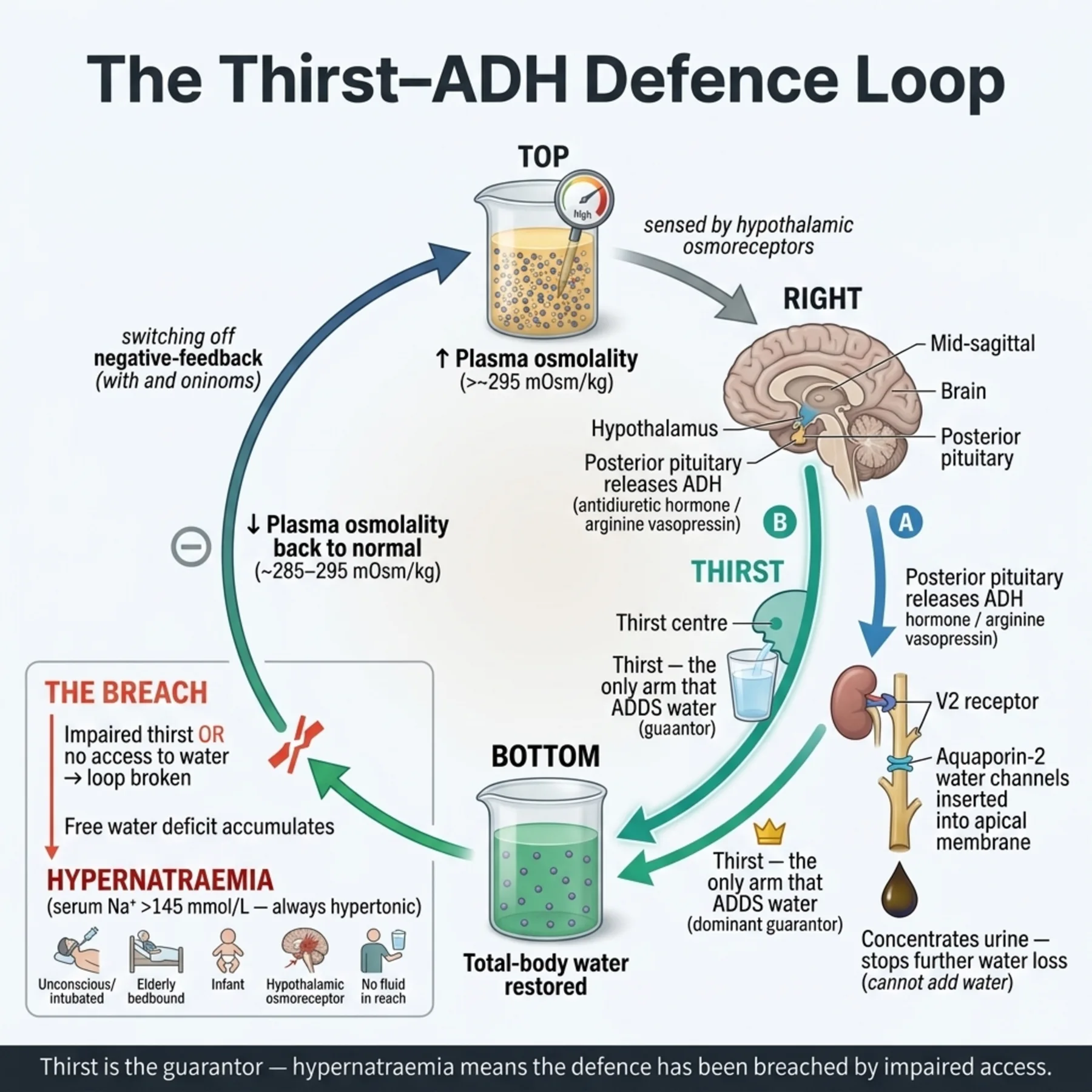
The defence against a rising osmolality has two arms. ADH is released, maximally concentrating the urine to conserve water; and thirst is stimulated, driving the person to drink. Of the two, thirst is the more powerful and the final guarantor — even a person with no ADH at all (complete diabetes insipidus) will not become hypernatraemic if thirst is intact and water is available, because they will simply drink the enormous volumes they lose. The corollary is decisive: sustained hypernatraemia requires that this defence be breached, which means either impaired thirst (hypodipsia, hypothalamic disease, depressed consciousness) or no access to water (infants, the frail elderly, the neurologically impaired, the intubated or sedated, the dependent). This is why hypernatraemia clusters in these populations and why, in a patient who develops it, the question is always not just 'what is losing water?' but 'why can't they drink to replace it?'
— The causes of water deficit
With the access factor understood, the water deficit itself has three mechanisms. Pure water loss — losing water with little solute — occurs insensibly (fever, burns, hyperventilation) and renally (diabetes insipidus, the failure to concentrate). Hypotonic fluid loss — losing a fluid that is dilute relative to plasma, so water is lost in excess of sodium — occurs from the gut (osmotic diarrhoea, vomiting) and the kidney (an osmotic diuresis from glucose, mannitol, or urea; loop diuretics; the post-obstructive or recovery diuresis). Sodium gain, the least common, comes from hypertonic saline or bicarbonate, salt poisoning, or mineralocorticoid excess. The clinical picture and the volume status help distinguish these — pure water loss leaves volume relatively preserved, hypotonic fluid loss depletes it, and sodium gain expands it — but in every case the permissive impaired access must also be present for hypernatraemia to persist.
— The urine osmolality and diabetes insipidus
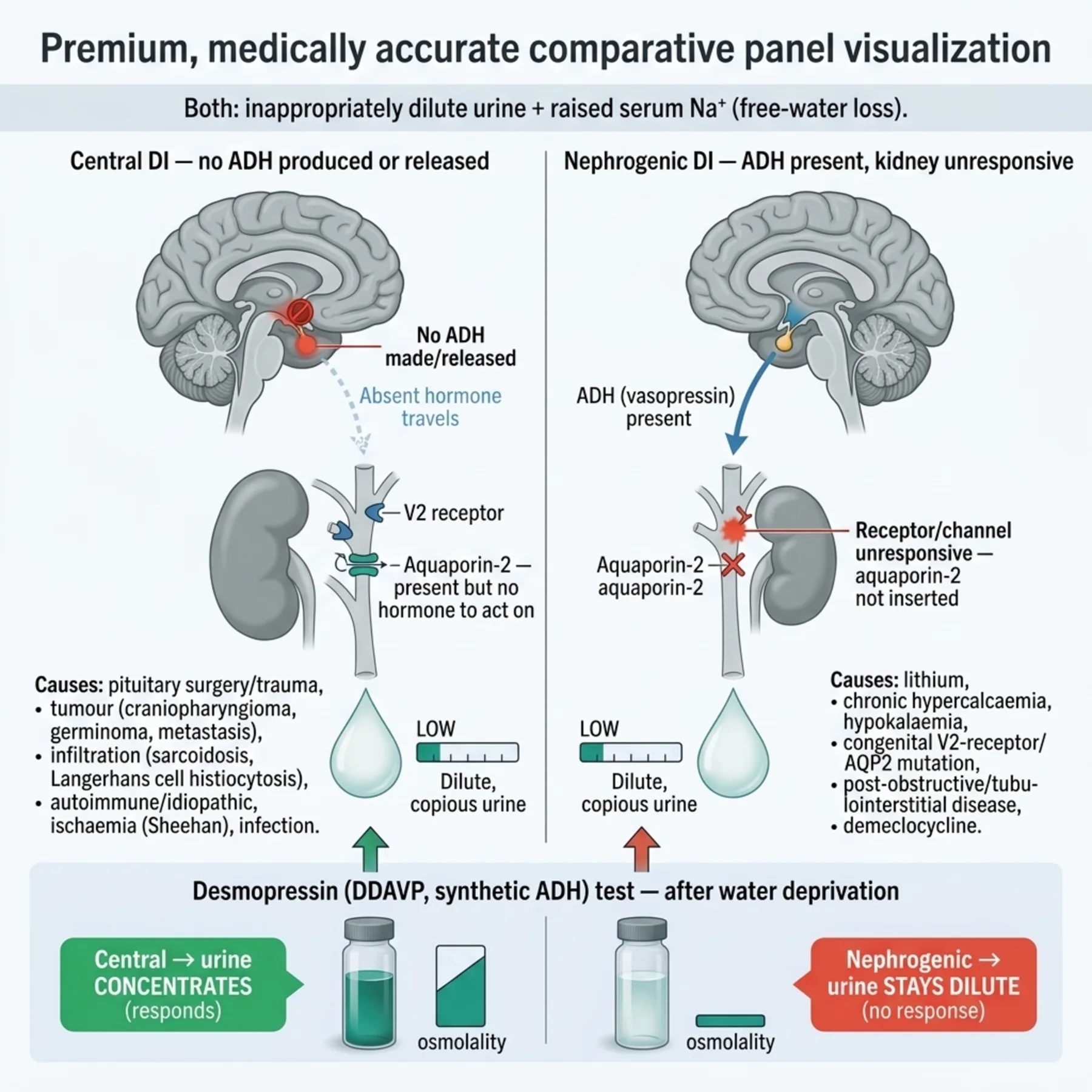
As with hyponatraemia, the urine osmolality is the pivotal test, here asking whether the kidney is conserving water appropriately. A concentrated urine — high osmolality, above roughly 700 to 800 — means the kidney is doing its job, so the water loss is extrarenal or intake is simply too low; the defence has been breached at the level of access, not the kidney. A dilute or submaximally concentrated urine in the face of hypertonicity is inappropriate and points to renal water loss. The two renal patterns are diabetes insipidus, where the urine is very dilute because the kidney cannot concentrate at all, and an osmotic diuresis, where the urine osmolality is intermediate (around 300) but the solute excretion is high. Diabetes insipidus then divides by mechanism: central, from ADH deficiency (pituitary or hypothalamic disease — tumour, surgery, trauma, infiltration, or idiopathic), and nephrogenic, from renal resistance to ADH (lithium, the commonest acquired cause; hypercalcaemia; hypokalaemia; congenital channel defects; chronic kidney disease). The two are separated by giving desmopressin after water deprivation: the central form concentrates the urine in response (the missing hormone is supplied), while the nephrogenic form does not (the kidney cannot respond).
— Replacing the deficit — and the rate that matters
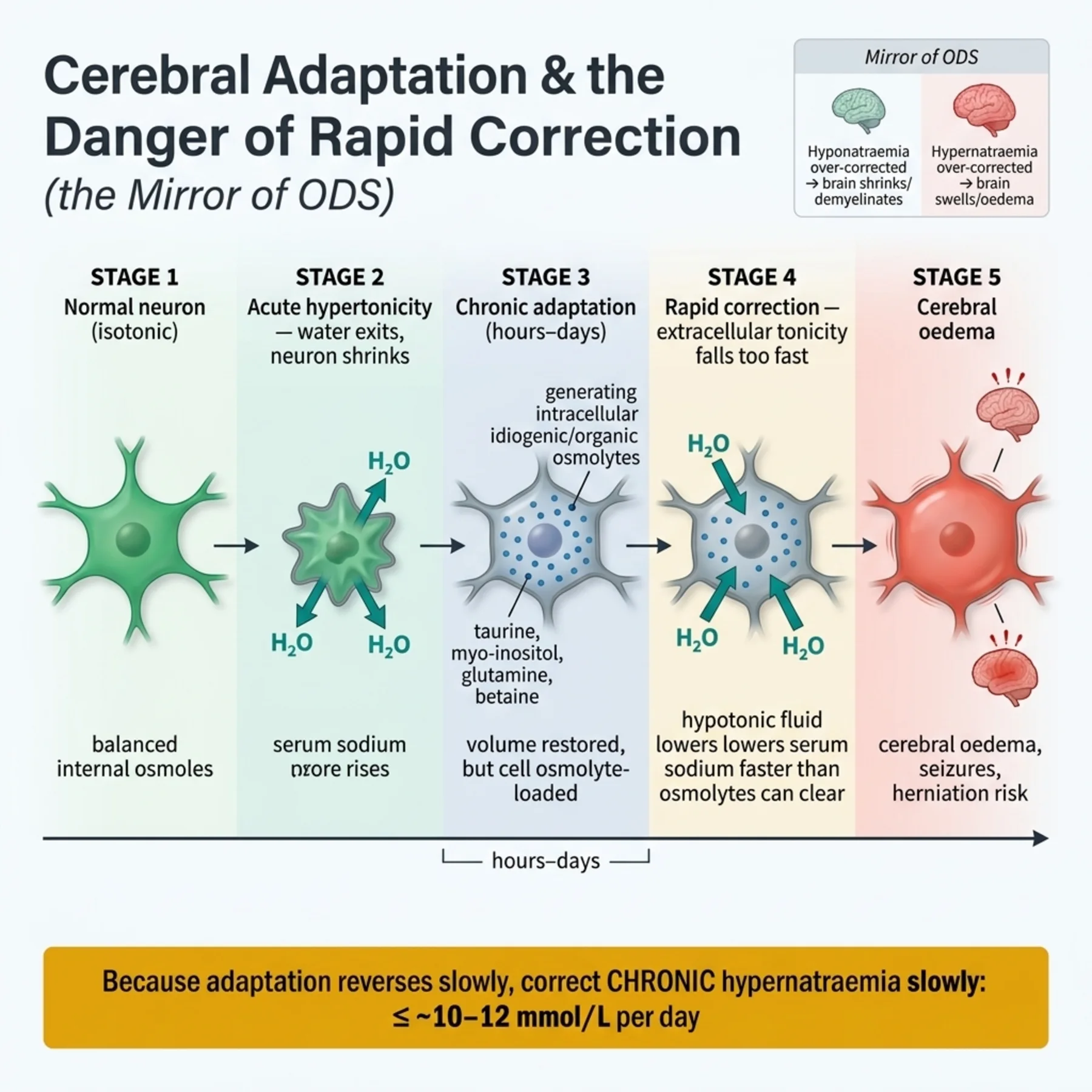
Treatment is to correct the cause and replace the missing water. The free-water deficit is estimated from total body water and the degree of hypernatraemia — total body water multiplied by the fractional excess of sodium over normal — and is replaced, by preference enterally, or intravenously with 5% dextrose or hypotonic saline, with ongoing losses added on top. But the rate is where harm is made or avoided, and it mirrors the demyelination story exactly. In chronic hypernatraemia the brain has adapted — over hours to days it generates organic osmolytes ('idiogenic osmoles') to draw water back in and restore its volume — so the adapted brain is now primed to over-absorb water. If the sodium is then lowered too fast, water floods the adapted cells and the brain swells, causing cerebral oedema and seizures — the precise mirror of the osmotic demyelination that follows over-rapid correction of hyponatraemia. So chronic hypernatraemia is corrected slowly, broadly no more than 10 to 12 mmol/L per day, while acute hypernatraemia (developed over hours, before adaptation) can be corrected faster. As with sodium in the other direction, the acuity governs the safe rate.
— Volume first when shocked
One ordering rule overrides the free-water logic. When hypernatraemia arises from hypotonic fluid loss severe enough to deplete the intravascular volume and compromise the circulation — a shocked, hypotensive patient — the priority is perfusion, not tonicity. Isotonic saline is given first to restore the circulating volume and organ perfusion, even though it is relatively hypotonic to the patient and will begin to lower the sodium, and only once the patient is haemodynamically stable does attention turn to replacing the remaining free-water deficit with hypotonic fluid. Volume before water, when the volume is the immediate threat: a patient is not helped by a perfectly planned water-deficit correction if they arrest from hypovolaemia first. This mirrors the resuscitation-before-refinement logic of the fluids and AKI chapters.
— Treating diabetes insipidus
Diabetes insipidus has type-specific treatment. Central diabetes insipidus is the missing hormone, so it is replaced — desmopressin (a vasopressin analogue) restores urinary concentration and controls the polyuria and water loss. Nephrogenic diabetes insipidus, where the kidney cannot respond to ADH, cannot be fixed by giving more, so the approach is different: remove the cause where possible (stop lithium, correct hypercalcaemia or hypokalaemia), and reduce the urine volume by other means. A low-salt and low-protein diet reduces the solute load that obligates water excretion. A thiazide diuretic, paradoxically, reduces urine output in nephrogenic diabetes insipidus: by inducing a mild volume depletion it enhances proximal sodium and water reabsorption, leaving less water to be lost distally. For lithium-induced disease, amiloride is useful because it blocks the epithelial sodium channel through which lithium enters the collecting-duct cells to cause its toxicity. These measures blunt the polyuria they cannot abolish.
— Sodium gain, and the unifying view
Hypernatraemia from sodium gain — hypertonic saline or bicarbonate, salt poisoning — is the one form not driven by water deficit, and it is treated by removing the excess sodium: free water to dilute it and a diuretic to excrete it, or dialysis if the gain is large or renal function poor. Stepping back, the whole chapter is the water axis worked in the opposite direction from the hyponatraemia chapters: hypernatraemia is too little water, defended by thirst and ADH, so it signals impaired access; it is diagnosed by finding the water loss and reading the urine osmolality (with diabetes insipidus the key renal cause); and it is treated by replacing the free-water deficit at a rate that respects cerebral adaptation — slowly when chronic — with volume restored first if the circulation is threatened. The symmetry with the sodium-concentration disorders of the preceding chapters is the point: both are water problems, read on the tonicity axis, with the brain's adaptation dictating the pace of safe correction in each direction.
| 04 | PHASE A · LEVEL 4 · ORIENTATION & KNOWLEDGE Reference Tables |
Table 6.1 — Causes of hypernatraemia
| Mechanism | Examples |
| Pure water loss | Insensible (fever, burns, hyperventilation); renal (diabetes insipidus) |
| Hypotonic fluid loss | GI (osmotic diarrhoea, vomiting); renal (osmotic diuresis, loop diuretics, post-obstructive) |
| Sodium gain | Hypertonic saline/bicarbonate, salt poisoning, mineralocorticoid excess |
| Permissive factor | Impaired thirst or no access to water — required for it to persist |
Table 6.2 — The thirst–ADH defence
| Arm | Detail |
| ADH | Released by rising osmolality → maximally concentrates the urine |
| Thirst | The more powerful arm — drives drinking to replace losses |
| Consequence | Intact thirst + water access → cannot stay hypernatraemic |
| So hypernatraemia means | Impaired thirst OR no access — infants, elderly, neuro-impaired, intubated |
Table 6.3 — Urine osmolality in hypernatraemia
| Urine osmolality | Interpretation |
| High (> ~700–800) | Appropriate concentration — extrarenal loss or low intake |
| Very dilute | Diabetes insipidus (cannot concentrate) |
| Intermediate (~300) with high solute | Osmotic diuresis (glucose, urea, mannitol) |
| Principle | A dilute/submaximal urine in hypertonicity is inappropriate — renal loss |
Table 6.4 — Diabetes insipidus: central versus nephrogenic
| Feature | Central | Nephrogenic |
| Defect | ADH deficiency | ADH resistance (renal) |
| Causes | Pituitary/hypothalamic (tumour, surgery, trauma, idiopathic) | Lithium, hypercalcaemia, hypokalaemia, congenital, CKD |
| Desmopressin response | Urine concentrates | Little/no concentration |
Table 6.5 — Treatment of hypernatraemia
| Element | Detail |
| Free-water deficit | ≈ total body water × (Na/140 − 1); add ongoing losses |
| Route | Enteral preferred; IV 5% dextrose or hypotonic saline |
| Rate (chronic) | Slow — ≤ ~10–12 mmol/L/day (cerebral oedema risk) |
| Rate (acute) | Faster correction is safe (brain not adapted) |
| If shocked | Isotonic saline FIRST (volume), then free water |
Table 6.6 — Treatment of diabetes insipidus
| Type | Treatment |
| Central | Desmopressin (replace the hormone) |
| Nephrogenic — cause | Remove cause (stop lithium; correct hypercalcaemia/hypokalaemia) |
| Nephrogenic — diet/diuretic | Low-salt/low-protein diet; thiazide (paradoxically reduces output) |
| Lithium-induced | Amiloride (blocks ENaC lithium entry) |
| Sodium-gain hypernatraemia | Remove sodium — free water + diuretic, or dialysis |
| 05 | PHASE B · LEVEL 5 · VISUALISE & MAP Imaging & Flowchart Specifications |
| 06 | PHASE B · LEVEL 6 · VISUALISE & MAP Concept Maps |
Each chain runs from physiology to a named bedside action; read the arrows as “leads to.”
Water deficit + the defence. Water loss (or sodium gain) → rising osmolality → thirst + ADH defend → sustained hypernatraemia only if thirst/access impaired → ACTION: always ask why the patient can't drink, not just what is losing water.
Loss types. Pure water loss (insensible, DI) / hypotonic fluid loss (GI, osmotic diuresis) / sodium gain → different volume status → ACTION: classify the loss and read the urine osmolality to localise it.
Diabetes insipidus. Central (no ADH) or nephrogenic (ADH resistance) → cannot concentrate → dilute urine, water loss → ACTION: separate with desmopressin; replace the hormone (central) or remove the cause and use thiazide/amiloride (nephrogenic).
Cellular adaptation. Hypertonicity → cells shrink → idiogenic osmoles generated over hours-days → adapted, osmolyte-loaded brain → rapid correction floods cells → cerebral oedema → ACTION: correct chronic hypernatraemia slowly (the mirror of ODS).
Volume before water. Hypotonic loss → intravascular depletion → shock → perfusion is the immediate threat → ACTION: give isotonic saline first to restore the circulation, then replace the free-water deficit.
| 07 | PHASE B · LEVEL 7 · VISUALISE & MAP Decision Pathways |
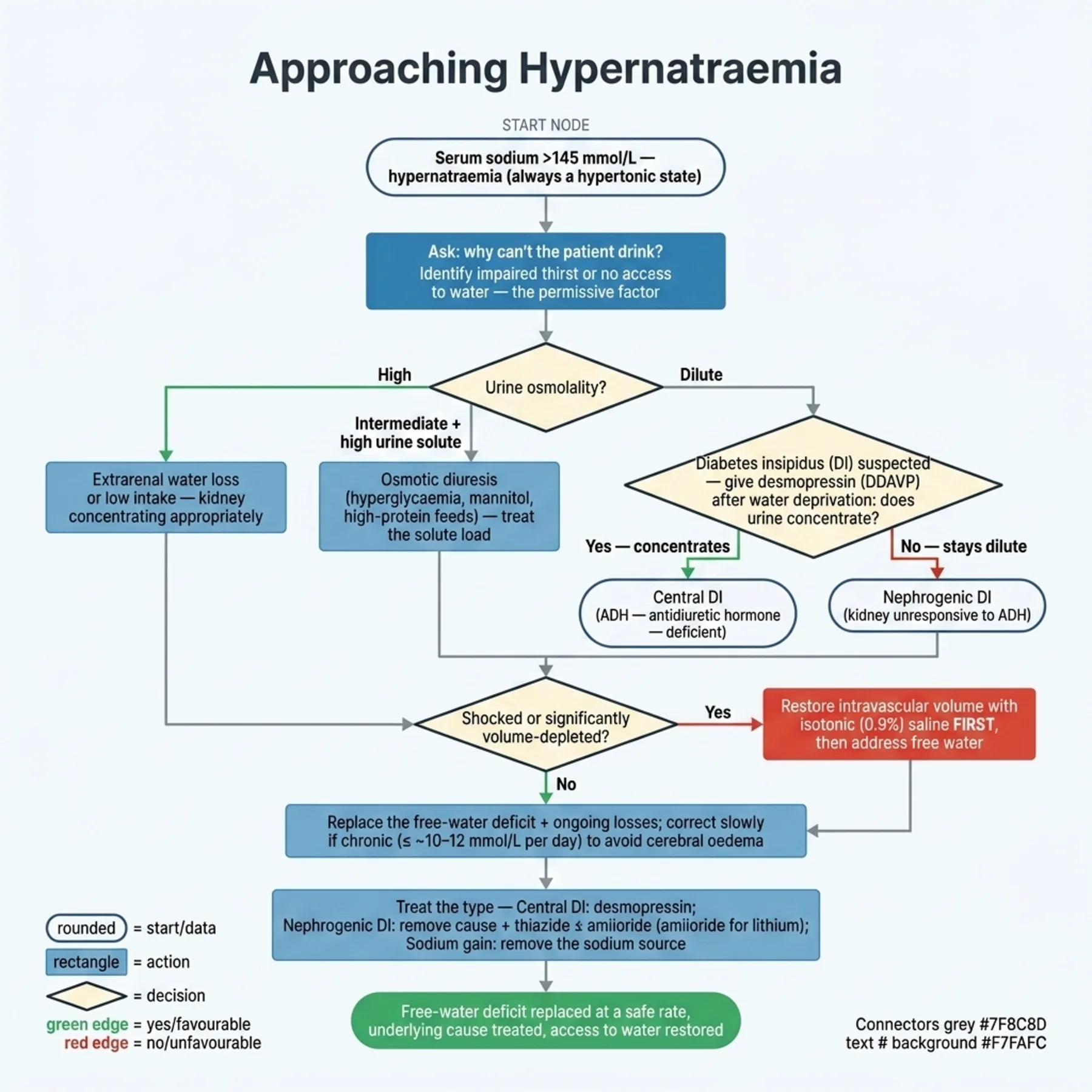
| R1 | IF a patient is hypernatraemic, THEN ask not only what is losing water but why the patient cannot drink — impaired thirst or access is required for it to persist. |
| R2 | IF localising the water loss, THEN use the urine osmolality — concentrated means extrarenal/low intake, dilute means renal (diabetes insipidus or osmotic diuresis). |
| R3 | IF diabetes insipidus is suspected, THEN distinguish central from nephrogenic by the response to desmopressin after water deprivation. |
| R4 | IF replacing water, THEN calculate the free-water deficit, prefer the enteral route, and add ongoing losses. |
| R5 | IF hypernatraemia is chronic, THEN correct slowly (≤ ~10–12 mmol/L/day) — the adapted brain swells if water is replaced too fast. |
| R6 | IF the patient is volume-depleted and shocked, THEN restore the circulation with isotonic saline FIRST, then replace the free-water deficit. |
| R7 | IF treating central diabetes insipidus, THEN give desmopressin; IF nephrogenic, THEN remove the cause and use a low-salt/low-protein diet, a thiazide, and amiloride for lithium. |
| R8 | IF hypernatraemia is from sodium gain, THEN remove the sodium with free water and a diuretic, or dialysis if severe. |
| 08 | PHASE C · LEVEL 8 · CLINICAL REASONING Clinical Cases |
| CASE 1 | COULDN'T REACH THE WATER Why can't they drink? Impaired access |
Presentation
A dependent elderly nursing-home resident with a recent febrile illness is found with a sodium of 162 and a concentrated urine. The team focuses on the fever as the cause of the water loss.
❖ Pause and reflect The fever explains water loss — but why did the hypernatraemia develop and persist? |
Analysis
The fever drove insensible water loss, but a person with intact thirst and water access would simply have drunk more and stayed normonatraemic. The hypernatraemia developed and persisted because she could not drink to replace the losses — dependent, perhaps with impaired thirst or simply unable to reach water. The concentrated urine confirms the kidney is conserving water appropriately, so the lesion is access, not renal. The fever is the loss; the impaired access is why it became hypernatraemia.
Plan
Replace the free-water deficit (enterally where possible) plus ongoing losses, correcting slowly as this is likely chronic, treat the febrile illness, and — critically — address access to water going forward. Recognise the impaired access as the permissive cause.
Teaching point
Hypernatraemia requires impaired thirst or access — always ask why the patient couldn't drink, not just what lost the water.
Cross-reference
Exercises rules R1, R4, R5; the defence concept map; Figure 6.1; Tables 6.2, 6.3.
| CASE 2 | POLYURIA AND DILUTE URINE Central or nephrogenic? Diabetes insipidus |
Presentation
A patient on long-term lithium has polyuria, polydipsia, a rising sodium, and a very dilute urine. A separate patient develops the same picture after pituitary surgery.
❖ Pause and reflect Both have diabetes insipidus — how do you tell central from nephrogenic, and why does it matter? |
Analysis
Both have diabetes insipidus — a dilute urine despite hypertonicity — but of different types. The lithium patient has nephrogenic diabetes insipidus (lithium is the commonest acquired cause, the kidney resisting ADH); the post-pituitary-surgery patient has central diabetes insipidus (ADH deficiency). Desmopressin after water deprivation separates them: the central form concentrates the urine (the missing hormone is replaced) while the nephrogenic does not (the kidney cannot respond). It matters because the treatments differ entirely.
Plan
Confirm the type with the desmopressin response. Treat the central patient with desmopressin; treat the lithium patient by reviewing the lithium, a low-salt/low-protein diet, a thiazide, and amiloride, with attention to water access and slow correction of the sodium.
Teaching point
Diabetes insipidus gives a dilute urine in hypertonicity — desmopressin distinguishes central (concentrates) from nephrogenic (does not), and lithium is the commonest acquired nephrogenic cause.
Cross-reference
Exercises rules R3 and R7; the DI concept map; Figure 6.2; Tables 6.4, 6.6.
| CASE 3 | CORRECTED TOO FAST The mirror of demyelination Cerebral oedema from rapid correction |
Presentation
A patient with chronic hypernatraemia (sodium 165 for several days) is given large volumes of 5% dextrose to normalise the sodium quickly. The sodium falls by 25 mmol/L in 24 hours, and the patient develops seizures.
❖ Pause and reflect Why did rapid correction cause seizures? |
Analysis
This is cerebral oedema from over-rapid correction of chronic hypernatraemia — the mirror of osmotic demyelination. Over days the brain adapted by generating idiogenic osmoles to draw water back and restore its volume; the adapted, osmolyte-loaded brain is now primed to over-absorb water, so lowering the sodium too fast floods the cells, swells the brain, and causes the seizures. Chronic hypernatraemia must be corrected slowly — broadly no more than 10 to 12 mmol/L per day — exactly because of this adaptation.
Plan
Slow the correction, manage the cerebral oedema and seizures, and re-target a fall of no more than about 10 to 12 mmol/L per day. For chronic hypernatraemia, replace the deficit gradually — the adapted brain dictates the pace.
Teaching point
Correct chronic hypernatraemia slowly — rapid correction of the adapted brain causes cerebral oedema, the mirror of osmotic demyelination.
Cross-reference
Exercises rule R5; the cellular-adaptation concept map; Figure 6.3; Table 6.5; the demyelination story in Chapter 5.
| CASE 4 | DRY AND SHOCKED Volume before water Hypotonic loss with hypovolaemia |
Presentation
A patient with profuse osmotic diarrhoea has a sodium of 158 and is hypotensive, tachycardic, and poorly perfused. The team plans to give 5% dextrose to correct the free-water deficit.
❖ Pause and reflect Should free water be the first fluid in a shocked hypernatraemic patient? |
Analysis
Not first. The hypotonic diarrhoeal loss has depleted the intravascular volume enough to cause shock, and perfusion is the immediate threat — 5% dextrose, distributing across total body water, would do little for the circulation and risks leaving the patient under-perfused. The priority is to restore volume with isotonic saline first; although it is relatively hypotonic to this patient and will begin to lower the sodium, it restores perfusion. Only once haemodynamically stable does attention turn to the remaining free-water deficit with hypotonic fluid.
Plan
Give isotonic saline first to restore the circulation, then, once stable, replace the remaining free-water deficit with hypotonic fluid at a safe rate, treating the diarrhoea. Volume before water when the circulation is threatened.
Teaching point
In shocked hypernatraemia from hypotonic loss, restore volume with isotonic saline first — then replace the free-water deficit.
Cross-reference
Exercises rule R6; the volume-before-water concept map; Table 6.5; resuscitation in Chapters 2–3.
| 09 | PHASE C · LEVEL 9 · CLINICAL REASONING Clinical Implications |
One triad per mechanism the narrative exposed: the physiology, why it matters, and the bedside move.
MECHANISM Thirst and ADH defend powerfully against a rising osmolality, with thirst the dominant arm. |
WHY IT MATTERS Sustained hypernatraemia therefore requires impaired thirst or no access to water. |
ACTION Always ask why the patient cannot drink, not just what is losing water. |
MECHANISM Water can be lost purely, as a hypotonic fluid, or sodium can be gained. |
WHY IT MATTERS The mechanism sets the volume status and the urine findings. |
ACTION Classify the loss and read the urine osmolality to localise it as renal or extrarenal. |
MECHANISM Diabetes insipidus is either ADH deficiency (central) or ADH resistance (nephrogenic). |
WHY IT MATTERS Both give a dilute urine, but they need opposite treatments. |
ACTION Separate them with the desmopressin response and treat the type. |
MECHANISM The brain adapts to chronic hypernatraemia by generating idiogenic osmoles. |
WHY IT MATTERS The adapted brain over-absorbs water, so rapid correction causes cerebral oedema. |
ACTION Correct chronic hypernatraemia slowly — the mirror of avoiding demyelination. |
MECHANISM Hypotonic fluid loss can deplete the intravascular volume enough to cause shock. |
WHY IT MATTERS Perfusion is then the immediate threat, not tonicity. |
ACTION Restore volume with isotonic saline first, then replace the free-water deficit. |
| 10 | PHASE C · LEVEL 10 · CLINICAL REASONING Clinical Pearls |
| Hypernatraemia = water deficit (a water problem), always hypertonic. | Thirst + ADH defend; thirst is the dominant arm. |
| Sustained hypernatraemia REQUIRES impaired thirst or no access. | Clusters in infants, elderly, neuro-impaired, intubated, dependent. |
| Causes: pure water loss, hypotonic fluid loss, sodium gain. | Urine osm high (> ~700) = extrarenal/low intake; dilute = renal loss. |
| Osmotic diuresis: intermediate urine osm (~300) with high solute. | Diabetes insipidus: central (ADH deficiency) vs nephrogenic (resistance). |
| Lithium = commonest acquired nephrogenic DI (also hyperCa, hypoK). | Desmopressin: central concentrates, nephrogenic doesn't. |
| Free-water deficit ≈ TBW × (Na/140 − 1); add ongoing losses. | Enteral route preferred; IV = 5% dextrose / hypotonic saline. |
| Chronic: correct slowly (≤ ~10–12 mmol/L/day) — cerebral oedema risk. | Rapid correction of chronic hypernatraemia = cerebral oedema (mirror of ODS). |
| Shocked? Isotonic saline FIRST (volume), then free water. | Central DI → desmopressin; nephrogenic → cause removal, thiazide, amiloride (lithium). |
| 11 | PHASE D · LEVEL 11 · SAFETY & EVIDENCE Red Flags & Never-Do |
Panel A — Red flags
| ▲ | Hypernatraemia in a dependent or neuro-impaired patient — impaired access; the question is why they can't drink. |
| ▲ | Polyuria with a very dilute urine despite hypertonicity — diabetes insipidus; characterise central vs nephrogenic. |
| ▲ | A sodium falling faster than ~10–12 mmol/L/day in chronic hypernatraemia — cerebral oedema risk; slow down. |
| ▲ | A shocked, hypernatraemic patient given only free water — restore volume with isotonic saline first. |
| ▲ | New nephrogenic diabetes insipidus on lithium — review the lithium; consider amiloride. |
Panel B — Never do
| ✖ NEVER — attribute hypernatraemia to water loss alone without finding why the patient cannot drink. |
| ✖ NEVER — correct chronic hypernatraemia rapidly — the adapted brain will swell. |
| ✖ NEVER — give free water as the first fluid to a shocked, volume-depleted patient. |
| ✖ NEVER — treat nephrogenic diabetes insipidus with more desmopressin expecting a response. |
| 12 | PHASE D · LEVEL 12 · SAFETY & EVIDENCE Common Pitfalls |
Pitfall 1 — Ignoring access
| ✖ | WRONG Attributing hypernatraemia to the water loss alone. |
| ✓ | RIGHT Identifying the impaired thirst or access that allowed it to persist. |
| ✉ | WHY Intact thirst and access prevent sustained hypernatraemia. |
Pitfall 2 — Correcting too fast
| ✖ | WRONG Rapidly normalising a chronic hypernatraemia with large free-water volumes. |
| ✓ | RIGHT Correcting slowly (≤ ~10–12 mmol/L/day). |
| ✉ | WHY The adapted brain over-absorbs water and swells. |
Pitfall 3 — Free water in shock
| ✖ | WRONG Giving 5% dextrose first to a shocked hypernatraemic patient. |
| ✓ | RIGHT Restoring volume with isotonic saline first, then free water. |
| ✉ | WHY Perfusion is the immediate threat; dextrose barely expands the circulation. |
Pitfall 4 — Misclassifying diabetes insipidus
| ✖ | WRONG Treating nephrogenic diabetes insipidus with desmopressin. |
| ✓ | RIGHT Distinguishing the type and treating nephrogenic with cause removal/thiazide/amiloride. |
| ✉ | WHY The nephrogenic kidney cannot respond to ADH. |
Pitfall 5 — Forgetting ongoing losses
| ✖ | WRONG Replacing only the calculated deficit and ignoring continuing losses. |
| ✓ | RIGHT Adding ongoing losses to the free-water deficit. |
| ✉ | WHY Continued losses perpetuate the deficit if not matched. |
| 13 | PHASE D · LEVEL 13 · SAFETY & EVIDENCE Evidence Grading |
GRADE A HIGH CONFIDENCE The effect is real and the estimate is stable. RCTs at low risk of bias; multiple concordant prospective cohorts; meta-analyses. |
GRADE B MODERATE CONFIDENCE The effect is likely real but may shift with new data. Observational studies, registries, mechanistic human studies. |
GRADE C LOW CONFIDENCE Rests on physiology, reasoning, or consensus rather than outcomes. Pathophysiological reasoning; extrapolation; consensus without outcomes. |
Graded statements (by evidence type)
| Statement | Grade | Basis (evidence type) |
| Hypernatraemia requires impaired thirst or water access to persist. | A | Established physiology |
| The urine osmolality localises water loss as renal or extrarenal. | A | Established physiology |
| Desmopressin distinguishes central from nephrogenic diabetes insipidus. | A | Established physiology and clinical testing |
| Lithium is the commonest acquired cause of nephrogenic diabetes insipidus. | A | Consistent clinical data |
| Rapid correction of chronic hypernatraemia causes cerebral oedema. | A | Established physiology and clinical data |
| Thiazides paradoxically reduce urine output in nephrogenic diabetes insipidus. | B | Mechanistic and clinical data |
| Volume restoration precedes free-water correction in shock. | A | Physiology and clinical consensus |
| 14 | PHASE E · LEVEL 14 · PATIENT DECISIONS Absolute Risk in Natural Frequency |
Natural-frequency estimates for orientation, from hypernatraemia management; they vary with cause and acuity. They convey the size of the decisions, expressed per 100 comparable patients.
| Per 100 patients… | Outcome | Roughly how many | See |
| Chronic hypernatraemia corrected too fast | Develop cerebral oedema/seizures | More than the slowly corrected | L13 row 5 |
| Central DI given desmopressin | Control polyuria and water loss | Most | L13 row 3 |
| Nephrogenic DI given a thiazide (± amiloride) | Achieve a meaningful fall in urine output | Many | L13 row 6 |
| Shocked hypernatraemia given isotonic saline first | Restore perfusion safely | Most | L13 row 7 |
★ How to read these Read these as orientation, not promises; outcomes depend on cause and acuity. The stable signals: fast correction of chronic hypernatraemia harms, desmopressin controls central DI, thiazides blunt nephrogenic DI, and volume comes before water in shock. Communicate them as people out of 100, not as a hazard ratio. |
| 17 | PHASE F · LEVEL 17 · APPLY & TEST Documentation Templates |
Paste-ready notes. Tick the boxes that apply and delete the rest; make the access question, the rate, and the volume-first rule explicit.
Template 1 — Hypernatraemia assessment and free-water replacement
Template 2 — Diabetes insipidus evaluation and treatment
| 18 | PHASE F · LEVEL 18 · APPLY & TEST Cheat Sheet |
| Hypernatraemia = water DEFICIT (always hypertonic). | Thirst + ADH defend; thirst dominant. |
| Sustained hypernatraemia REQUIRES impaired thirst/access. | Clusters: infants, elderly, neuro, intubated, dependent. |
| Causes: pure water loss / hypotonic fluid loss / sodium gain. | Urine osm > ~700 = extrarenal/low intake; dilute = renal. |
| Osmotic diuresis: urine osm ~300 + high solute. | DI: central (ADH deficiency) vs nephrogenic (resistance). |
| Lithium = commonest acquired nephrogenic DI. | Desmopressin: central concentrates, nephrogenic doesn't. |
| Free-water deficit ≈ TBW × (Na/140 − 1) + ongoing losses. | Enteral preferred; IV = D5W / hypotonic saline. |
| Chronic: correct slowly (≤ ~10–12/day) — cerebral oedema risk. | Shocked → isotonic saline FIRST, then free water. |
| Central DI → desmopressin. | Nephrogenic DI → remove cause, thiazide, amiloride (lithium). |
| 19 | PHASE F · LEVEL 19 · APPLY & TEST Flashcards |
| CARD 1 | Q. Why does sustained hypernatraemia require impaired thirst or access? A. Because thirst and ADH defend powerfully against a rising osmolality — thirst is the dominant arm — so a person who can sense thirst and reach water will drink and self-correct; only a breach of that defence allows hypernatraemia to persist. DETAILED. It clusters in infants, the elderly, the neuro-impaired, and dependent patients. CLINICAL. Always ask why the patient cannot drink. |
| CARD 2 | Q. What are the causes of hypernatraemia? A. Pure water loss (insensible, diabetes insipidus), hypotonic fluid loss (gastrointestinal, osmotic diuresis), and sodium gain (hypertonic saline, salt poisoning) — always with impaired access as the permissive factor. DETAILED. The mechanism sets the volume status. CLINICAL. Classify the loss and read the urine osmolality. |
| CARD 3 | Q. How does the urine osmolality localise the water loss? A. A concentrated urine (over ~700) means appropriate renal conservation — extrarenal loss or low intake; a dilute urine means renal water loss (diabetes insipidus); an intermediate osmolality with high solute means an osmotic diuresis. DETAILED. A dilute urine in hypertonicity is inappropriate. CLINICAL. Use it to separate renal from extrarenal loss. |
| CARD 4 | Q. How do central and nephrogenic diabetes insipidus differ? A. Central is ADH deficiency (pituitary/hypothalamic disease); nephrogenic is renal resistance to ADH (lithium, hypercalcaemia, hypokalaemia, congenital, CKD). After desmopressin, the central urine concentrates and the nephrogenic does not. DETAILED. Lithium is the commonest acquired nephrogenic cause. CLINICAL. Distinguish with desmopressin and treat the type. |
| CARD 5 | Q. How is the free-water deficit replaced? A. Estimate it from total body water times the fractional excess of sodium over normal, replace it preferentially enterally (or with 5% dextrose / hypotonic saline), and add ongoing losses. DETAILED. Continuing losses must be matched. CLINICAL. Replace the deficit plus ongoing losses. |
| CARD 6 | Q. Why must chronic hypernatraemia be corrected slowly? A. The brain adapts over hours to days by generating idiogenic osmoles to restore its volume; the adapted brain over-absorbs water, so rapid correction floods the cells and causes cerebral oedema — the mirror of osmotic demyelination. DETAILED. Acute hypernatraemia can be corrected faster. CLINICAL. Limit chronic correction to about 10–12 mmol/L per day. |
| CARD 7 | Q. When is volume restored before free water? A. When hypotonic fluid loss has depleted the intravascular volume enough to cause shock — perfusion is the immediate threat, so isotonic saline is given first, then the free-water deficit. DETAILED. Dextrose barely expands the circulation. CLINICAL. Volume before water when the circulation is threatened. |
| CARD 8 | Q. How is diabetes insipidus treated by type? A. Central: desmopressin (replace the hormone). Nephrogenic: remove the cause (stop lithium, correct hypercalcaemia/hypokalaemia), a low-salt/low-protein diet, a thiazide (paradoxically reduces output), and amiloride for lithium. DETAILED. The nephrogenic kidney cannot respond to more ADH. CLINICAL. Match the treatment to the type. |
| 20 | PHASE F · LEVEL 20 · APPLY & TEST One-Minute Preceptor |
| SCENE 1 | The intern blaming the fever |
GET A COMMITMENT. “You've put this sodium of 162 down to the fever — is that the whole story?”
PROBE FOR EVIDENCE. “The fever caused water loss” — ask: “Why didn't she just drink more and stay normal?”
TEACH A GENERAL RULE. Thirst and ADH defend so well that hypernatraemia needs impaired thirst or access — the fever is the loss, the inability to drink is why it became hypernatraemia.
REINFORCE WHAT WAS RIGHT. Identifying the water loss was correct.
CORRECT A MISTAKE. Replace water, correct slowly, and fix her access to water.
| SCENE 2 | The resident rushing the correction |
GET A COMMITMENT. “You're giving large volumes of dextrose to drop this chronic sodium of 165 fast — why?”
PROBE FOR EVIDENCE. “To normalise it quickly” — ask: “What has the brain done to adapt, and what happens if you add water fast?”
TEACH A GENERAL RULE. The adapted brain has generated osmolytes and over-absorbs water, so rapid correction causes cerebral oedema — the mirror of demyelination; correct chronic hypernatraemia slowly.
REINFORCE WHAT WAS RIGHT. Recognising the need to replace water was right.
CORRECT A MISTAKE. Limit the fall to about 10–12 mmol/L/day.
| 22 | PHASE F · LEVEL 22 · APPLY & TEST Board-Style Questions |
| Q 01 | Why does sustained hypernatraemia almost always require impaired thirst or water access? |
| A | ADH is the only defence |
| B | Thirst is a powerful defence — intact thirst and access prevent persistent hypernatraemia |
| C | The kidney cannot conserve water |
| D | Sodium gain is the usual cause |
Rationale Thirst is the dominant defence, so a person who can drink to thirst self-corrects; hypernatraemia persists only when that is breached (Figure 6.1, rule R1). A, C, and D are incorrect. |
| Q 02 | A hypernatraemic patient has a urine osmolality of 750. This indicates: |
| A | Diabetes insipidus |
| B | Appropriate renal water conservation — extrarenal loss or low intake |
| C | Osmotic diuresis |
| D | Sodium gain |
Rationale A concentrated urine means the kidney is conserving water appropriately, so the loss is extrarenal or intake is low (Table 6.3, rule R2). A and C give dilute/intermediate urine; D is unrelated. |
| Q 03 | How are central and nephrogenic diabetes insipidus distinguished? |
| A | By serum sodium |
| B | By the urine response to desmopressin after water deprivation |
| C | By urine output alone |
| D | They cannot be distinguished |
Rationale After desmopressin, the central urine concentrates (hormone replaced) while the nephrogenic does not (kidney unresponsive) (Figure 6.2, rule R3). A, C, and D do not separate them. |
| Q 04 | The commonest acquired cause of nephrogenic diabetes insipidus is: |
| A | Pituitary surgery |
| B | Lithium |
| C | Head trauma |
| D | SIADH |
Rationale Lithium is the commonest acquired nephrogenic cause; pituitary surgery and trauma cause central DI (Table 6.4, case 2). A and C are central; D is a different disorder. |
| Q 05 | Why must chronic hypernatraemia be corrected slowly? |
| A | To save fluid |
| B | The adapted brain over-absorbs water, so rapid correction causes cerebral oedema |
| C | It cannot be corrected at all |
| D | To raise the sodium further |
Rationale The brain generates idiogenic osmoles to adapt, so fast water replacement floods and swells it — the mirror of demyelination (Figure 6.3, rule R5, case 3). A, C, and D are wrong. |
| Q 06 | A shocked patient with a sodium of 158 from osmotic diarrhoea should first receive: |
| A | 5% dextrose |
| B | Isotonic saline to restore perfusion, then free water |
| C | Hypertonic saline |
| D | No fluid |
Rationale Perfusion is the immediate threat, so volume is restored with isotonic saline before the free-water deficit (case 4, rule R6). A barely expands the circulation; C and D are wrong. |
| Q 07 | Central diabetes insipidus is treated with: |
| A | A thiazide |
| B | Desmopressin |
| C | Amiloride |
| D | Fluid restriction |
Rationale Central DI is ADH deficiency, treated by replacing the hormone with desmopressin (Table 6.6, rule R7). A and C are nephrogenic measures; D is wrong. |
| Q 08 | Why does a thiazide reduce urine output in nephrogenic diabetes insipidus? |
| A | It replaces ADH |
| B | It induces mild volume depletion, enhancing proximal reabsorption and reducing distal water delivery |
| C | It blocks ENaC |
| D | It concentrates the urine directly |
Rationale The thiazide's mild volume depletion increases proximal sodium and water reabsorption, leaving less water to be lost distally (Table 6.6). A is false; C is amiloride; D is not the mechanism. |
| Q 09 | Across 100 chronically hypernatraemic patients corrected too rapidly versus slowly, the rapid group has: |
| A | Fewer complications |
| B | More cerebral oedema and seizures |
| C | No difference |
| D | Better outcomes |
Rationale Rapid correction of the adapted brain causes cerebral oedema (L14, L13 row 5). A, C, and D contradict the physiology. |