Chapter Preamble
Signals declared
Sig-D — Diagnostic (primary). Choose the first-line agent by the compelling indication and the patient's age and ethnicity, and recognise the class-specific adverse effects.
Sig-T — Therapeutic (strong). Initiate and monitor the first-line classes — RAAS blockers, calcium-channel blockers, thiazide-type diuretics — and know where beta-blockers fit.
Sig-M — Mechanistic (strong). How each class lowers blood pressure, the efferent dilation and renoprotection of RAAS blockade, and the functional creatinine rise.
Sig-V — Evidence-dense (strong). The trial evidence that the classes lower events similarly when blood pressure is equalised, the limits of beta-blockers, and the harm of dual RAAS blockade — graded and reflected on.
Levels populated and omitted
Populated (20): L1–L14, L17–L22. As a four-signal flagship it fires nearly everything — concept maps and triads (Sig-M), the absolute-risk table and templates (Sig-T), and the reflective prompts (Sig-V).
L15 / L16 preference-sensitive map and SDM scripts — omitted. No Sig-E; first-line drug selection is effective, evidence-driven care, with the preference-sensitive decisions reserved for the resistant-hypertension and elderly chapters.
| 01 | PHASE A · LEVEL 1 · ORIENTATION & KNOWLEDGE Learning Objectives |
By the end of this chapter you should be able to:
Describe the mechanism, benefits, and adverse effects of ACE inhibitors and ARBs.
Explain the efferent dilation, renoprotection, and functional creatinine rise of RAAS blockade.
Explain why ACE inhibitors and ARBs should not be combined.
Describe the calcium-channel blockers and thiazide-type diuretics and their adverse effects.
Explain why beta-blockers are not first-line for uncomplicated hypertension.
Choose a first-line agent by compelling indication and by age and ethnicity.
Summarise the evidence that the classes lower events similarly when blood pressure is equalised.
Initiate and monitor first-line therapy safely.
| 02 | PHASE A · LEVEL 2 · ORIENTATION & KNOWLEDGE Executive Summary |
Four classes are first-line for hypertension: thiazide-type diuretics, calcium-channel blockers, ACE inhibitors, and angiotensin-receptor blockers.
ACE inhibitors block the conversion of angiotensin I to II and reduce bradykinin breakdown, lowering blood pressure and protecting the kidney by reducing proteinuria; their adverse effects include cough, angioedema, hyperkalaemia, a functional rise in creatinine, and teratogenicity.
Angiotensin-receptor blockers block the AT1 receptor with similar efficacy and renoprotection but without the cough, and they too are teratogenic.
ACE inhibitors and ARBs should not be combined — the combination increases harm without benefit.
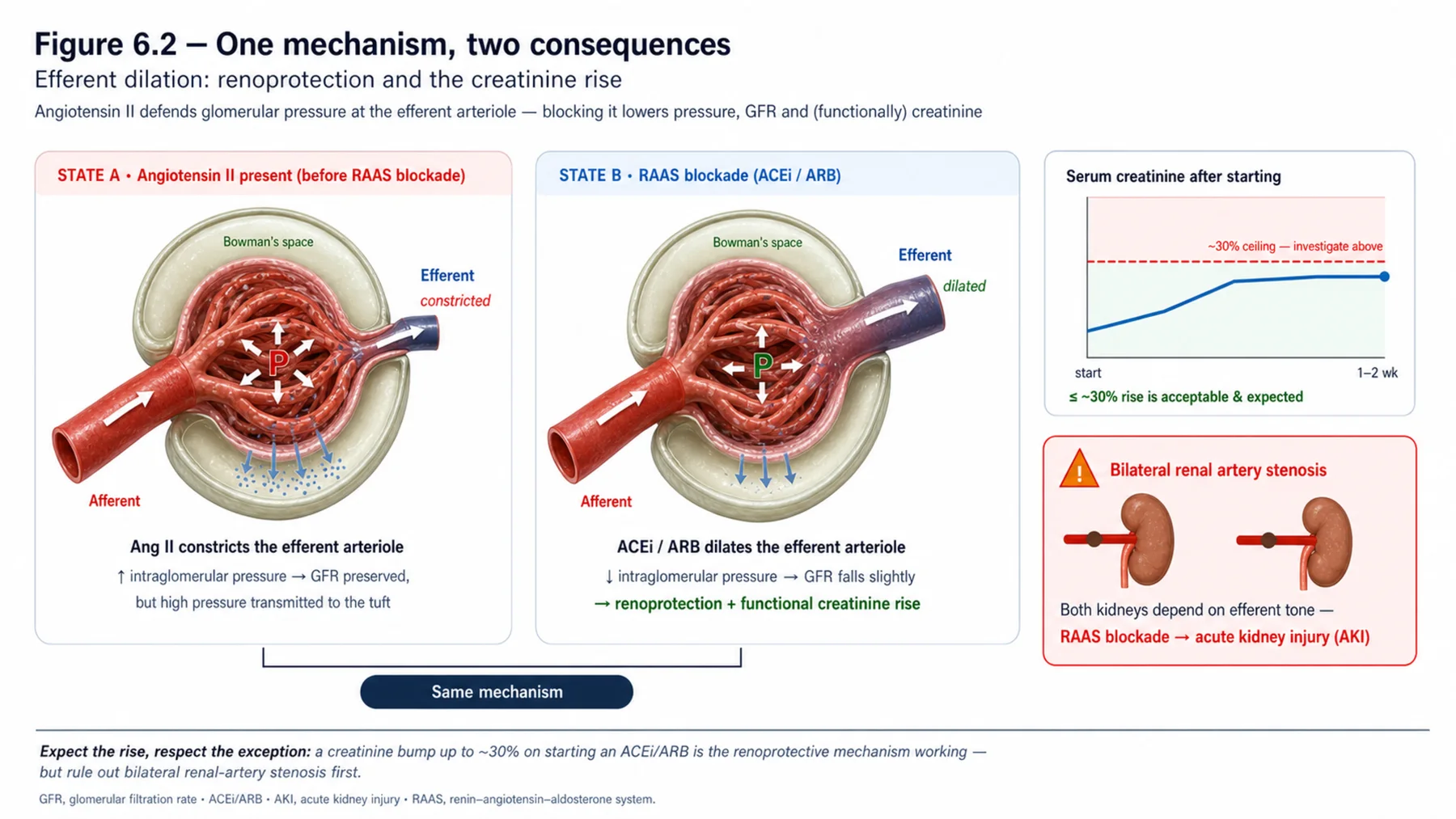
RAAS blockade dilates the efferent arteriole, lowering intraglomerular pressure (the basis of its renoprotection) but causing a functional rise in creatinine; a rise up to about 30% is acceptable, and the creatinine and potassium are checked shortly after starting.
Calcium-channel blockers vasodilate, lowering systemic vascular resistance, and are especially effective in older and black patients, with peripheral oedema as the main adverse effect.
Thiazide-type diuretics lower volume and then resistance; the thiazide-like agents chlorthalidone and indapamide are often preferred over hydrochlorothiazide, with hypokalaemia, hyponatraemia, and hyperuricaemia among their effects.
Beta-blockers are not first-line for uncomplicated hypertension — they protect against stroke less well than the other classes — but are used when there is a compelling indication such as heart failure, coronary disease, or arrhythmia.
The choice of first-line agent is directed by compelling indications: ACE inhibitors or ARBs for CKD, proteinuria, diabetes, and heart failure; calcium-channel blockers or diuretics for older and black patients.
A simple framework keys the choice to age and ethnicity, reflecting renin status.
The trial evidence shows that all four classes reduce cardiovascular events similarly when blood pressure is lowered equally, so the degree of blood-pressure reduction matters most.
Therapy is started at a standard dose, and most patients ultimately need combination treatment.
Pregnancy is a key exception — ACE inhibitors and ARBs are avoided.
| 03 | PHASE A · LEVEL 3 · ORIENTATION & KNOWLEDGE Main Narrative |
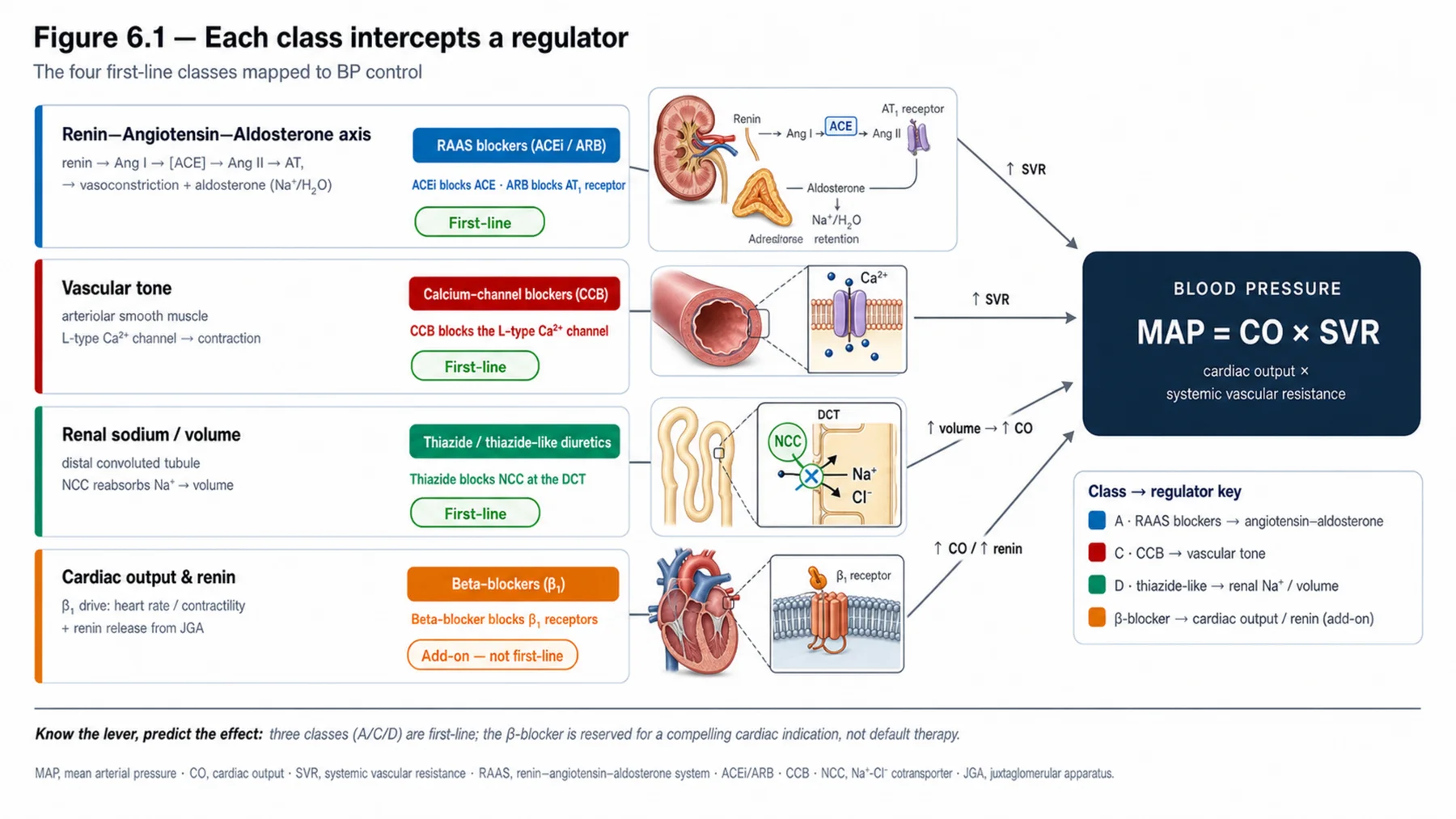
Four drug classes carry the burden of hypertension treatment: the RAAS blockers (ACE inhibitors and angiotensin-receptor blockers), the calcium-channel blockers, and the thiazide-type diuretics. Each acts on a regulator from the opening chapter, each has a place, and the choice between them is directed by the patient's compelling indications and their age and ethnicity. This flagship chapter sets out how each works, what each costs, what the evidence says, and how to choose — with beta-blockers in their proper, more limited place.
— RAAS blockade: ACE inhibitors and ARBs
The RAAS blockers are the most consequential class for the kidney patient. ACE inhibitors block the conversion of angiotensin I to angiotensin II, reducing vasoconstriction and aldosterone, and they also reduce the breakdown of bradykinin — which contributes both to their benefit and to their characteristic dry cough (and, rarely, angioedema). Beyond lowering blood pressure, they are renoprotective: by reducing proteinuria and intraglomerular pressure they slow the progression of proteinuric kidney disease, which is why they are first-line in CKD, diabetes, and heart failure. Their adverse effects — cough, angioedema, hyperkalaemia, a functional rise in creatinine, and teratogenicity — must be known. Angiotensin-receptor blockers block the AT1 receptor directly, achieving similar blood-pressure lowering and renoprotection without the bradykinin-mediated cough (and with less angioedema), and are the substitute when an ACE inhibitor is not tolerated; they are also teratogenic. One firm rule: ACE inhibitors and ARBs are not combined — the dual blockade increases hyperkalaemia, acute kidney injury, and hypotension without improving outcomes.
— The functional creatinine rise: a feature, not a failure
RAAS blockade produces a phenomenon that is widely misunderstood and worth dwelling on. Angiotensin II preferentially constricts the efferent (post-glomerular) arteriole to maintain intraglomerular pressure; blocking it dilates the efferent arteriole, which lowers the intraglomerular pressure — and this is precisely the mechanism of renoprotection (reducing the glomerular hypertension that damages the nephron). But lowering the intraglomerular pressure also lowers the filtration rate slightly, producing a small, functional rise in serum creatinine. This rise is expected, is not nephrotoxicity, and is in fact a marker that the drug is working as intended: a rise of up to about 30% from baseline is acceptable and the drug should be continued. Stopping the drug for a small expected rise forfeits the renoprotection. The creatinine and potassium are checked within a week or two of starting (or up-titrating); a rise greater than about 30%, or significant hyperkalaemia, prompts investigation — including for bilateral renal artery stenosis, in which the kidneys depend on angiotensin II and RAAS blockade can precipitate acute kidney injury. Distinguishing the acceptable functional rise from the dangerous one is a core skill.
— Calcium-channel blockers and thiazide-type diuretics
The other two first-line classes act on the determinants of blood pressure directly. The dihydropyridine calcium-channel blockers (amlodipine and others) cause peripheral vasodilation, lowering systemic vascular resistance; they are effective, well-tolerated, safe in CKD, and particularly effective in older and black patients, with peripheral oedema (and flushing, headache) the main adverse effect. The non-dihydropyridines (verapamil, diltiazem) act more on the heart and are not preferred for hypertension alone. The thiazide-type diuretics lower blood pressure first by natriuresis and volume reduction and then, with chronic use, by lowering vascular resistance; importantly, the thiazide-like agents — chlorthalidone and indapamide, which are longer-acting and more potent — are often preferred over hydrochlorothiazide on outcome grounds. Their adverse effects are metabolic: hypokalaemia, hyponatraemia, hyperuricaemia (and gout), and modest glucose and lipid effects, with hypercalcaemia. Each of these classes is a reasonable first-line choice, and each has the situations where it shines.
— Beta-blockers: not first-line for uncomplicated hypertension
Beta-blockers deserve a clear statement of their place, because it is commonly misunderstood. They lower blood pressure by reducing cardiac output and renin, but the evidence — from trials such as LIFE and ASCOT — shows that for uncomplicated hypertension they protect against stroke less well than the other classes, so they are not recommended as first-line for hypertension in the absence of another indication. This does not make them bad drugs; it places them. They remain first-choice agents when there is a compelling indication that they treat — heart failure with reduced ejection fraction, coronary artery disease and post-myocardial-infarction, certain arrhythmias — in which case they are used both for that indication and for the blood pressure. The common error is to reach for a beta-blocker as a first-line antihypertensive in an uncomplicated patient; the correct approach is to use one of the four first-line classes unless a beta-blocker indication is present. Beta-blockers are not first-line for hypertension alone, but are first-choice when their compelling indications coexist.
— Choosing the first-line agent
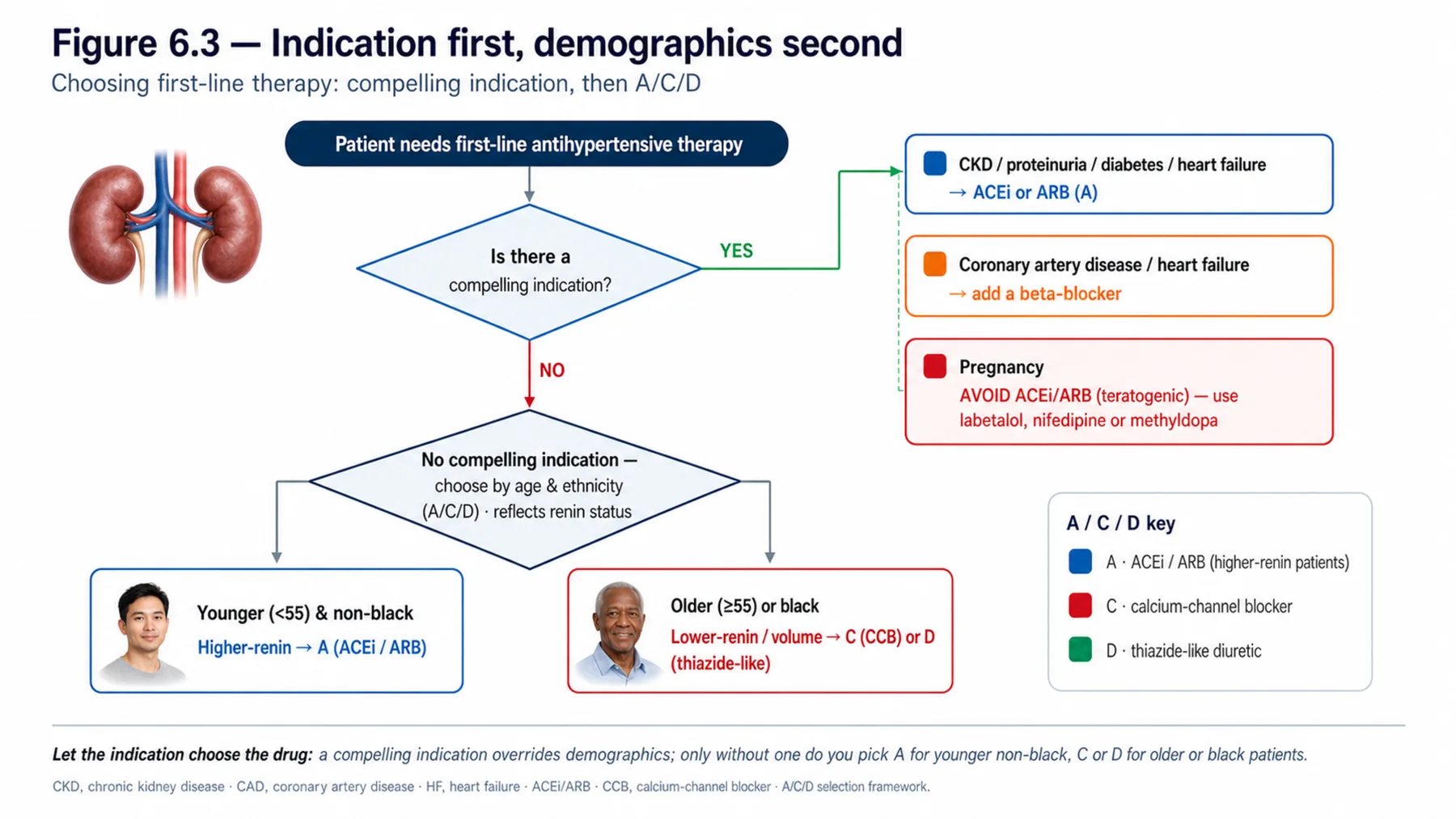
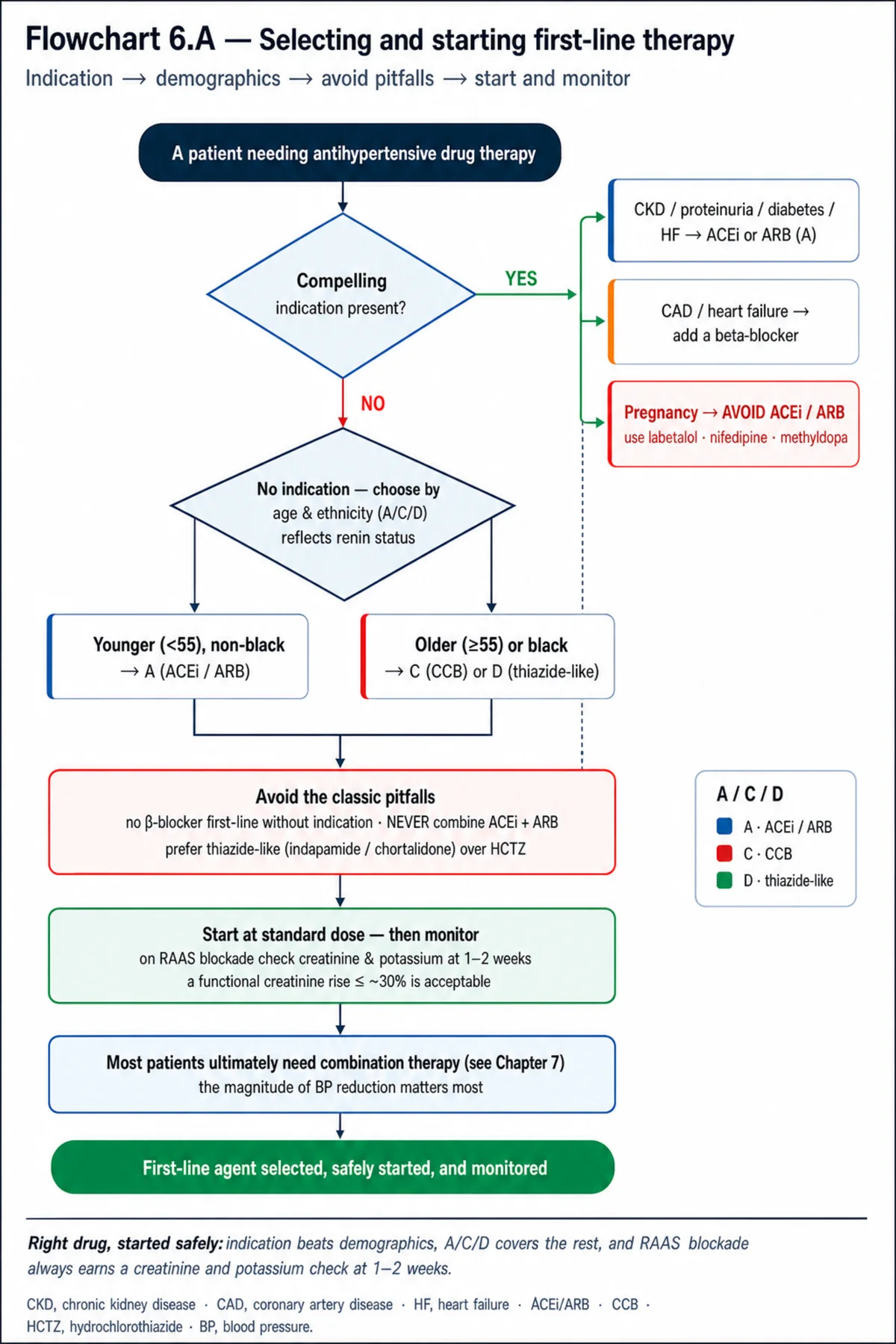
With four first-line classes of broadly similar blood-pressure-lowering efficacy, the choice is directed by two considerations. First, compelling indications, which often make the decision: an ACE inhibitor or ARB for the patient with CKD, proteinuria, diabetes, or heart failure (for the renoprotection and the disease-specific benefit); a beta-blocker (added) for coronary disease or heart failure; avoidance of ACE inhibitors and ARBs in pregnancy. Second, where no compelling indication dominates, age and ethnicity guide the choice, captured in a simple framework: a younger, non-black patient tends to have higher-renin hypertension and responds well to a RAAS blocker ('A'), while an older patient or a black patient of African or Caribbean ancestry tends to have lower-renin, more volume-dependent hypertension and responds better to a calcium-channel blocker ('C') or a thiazide-type diuretic ('D'). This age-and-ethnicity framework reflects the underlying renin physiology and predicts which class will work best as monotherapy. Therapy is started at a standard dose, taken once daily where possible, and — because most hypertension needs more than one drug — the choice anticipates the combinations of the next chapter.
— The evidence, and what it means
The large trials and meta-analyses converge on a clarifying conclusion: when blood pressure is lowered to the same degree, the four first-line classes reduce cardiovascular events similarly, so the magnitude of blood-pressure reduction matters more than the particular class chosen. The landmark comparison (ALLHAT) found broadly similar major cardiovascular outcomes across a diuretic, a calcium-channel blocker, and an ACE inhibitor, and subsequent meta-analyses confirmed that the benefit tracks the blood-pressure reduction. This is liberating: it means the clinician should choose a class the patient will tolerate and that suits their indications, get the blood pressure down, and not agonise over small differences between equally effective first-line agents. The exceptions — where a class is specifically favoured or avoided — are the compelling indications (RAAS blockade in proteinuric CKD), the beta-blocker's weaker stroke protection, the preference for thiazide-like over hydrochlorothiazide, and the harm of dual RAAS blockade. The disciplined position is therefore: choose by indication and by age and ethnicity, prefer thiazide-like diuretics, reserve beta-blockers for their indications, never combine an ACE inhibitor with an ARB, monitor the creatinine and potassium on RAAS blockade, and above all lower the blood pressure — because that is what delivers the benefit. The combinations and the stepwise escalation that most patients need follow in the next chapter.
| 04 | PHASE A · LEVEL 4 · ORIENTATION & KNOWLEDGE Reference Tables |
Table 6.1 — The first-line classes and their mechanisms
| Class | Mechanism | Notes |
| ACE inhibitor | ↓ angiotensin II, ↑ bradykinin | Renoprotective; cough, angioedema; teratogenic |
| ARB | AT1-receptor blockade | Similar efficacy/renoprotection; no cough; teratogenic |
| Calcium-channel blocker (DHP) | Vasodilation → ↓ SVR | Effective in older/black; peripheral oedema |
| Thiazide-type diuretic | ↓ volume, then ↓ SVR | Thiazide-like (chlorthalidone/indapamide) preferred |
Table 6.2 — RAAS blockade: benefits, effects, cautions
| Aspect | Detail |
| Benefit | BP lowering + renoprotection (reduce proteinuria, intraglomerular pressure) |
| Adverse effects | Cough (ACEi), angioedema, hyperkalaemia, functional Cr rise, teratogenic |
| Functional Cr rise | Efferent dilation → ↓ intraglomerular pressure; rise ≤ ~30% acceptable |
| Do NOT combine ACEi + ARB | Increased harm (hyperkalaemia, AKI, hypotension), no benefit (ONTARGET) |
Table 6.3 — Calcium-channel blockers and diuretics
| Agent | Detail |
| DHP CCB (amlodipine) | Vasodilation; effective in older/black; safe in CKD; peripheral oedema |
| Non-DHP (verapamil/diltiazem) | Cardiac (rate/contractility) — not preferred for HTN alone |
| Thiazide-like (chlorthalidone/indapamide) | Longer-acting, more potent — often preferred |
| Diuretic adverse effects | Hypokalaemia, hyponatraemia, hyperuricaemia/gout, glucose/lipid, hypercalcaemia |
Table 6.4 — Beta-blockers: place in therapy
| Point | Detail |
| Mechanism | ↓ cardiac output, ↓ renin |
| Not first-line | For uncomplicated hypertension (less stroke protection — LIFE, ASCOT) |
| First-choice when | Compelling indication: heart failure, CAD/post-MI, arrhythmia |
| Common error | Using as a first-line antihypertensive without an indication |
Table 6.5 — Choosing the first-line agent
| Situation | Choice |
| CKD / proteinuria / diabetes / HF | ACE inhibitor or ARB |
| CAD / heart failure | Add a beta-blocker (with RAAS blockade) |
| Younger, non-black (higher renin) | 'A' — ACE inhibitor or ARB |
| Older or black (lower renin) | 'C' — calcium-channel blocker (or 'D' — diuretic) |
| Pregnancy | Avoid ACE inhibitors and ARBs |
Table 6.6 — The evidence
| Finding | Detail |
| Classes similar | All four lower CV events similarly when BP is equalised (ALLHAT, meta-analyses) |
| BP reduction matters most | The degree of lowering, not the class, drives most of the benefit |
| Beta-blockers | Weaker stroke protection — not first-line uncomplicated |
| Dual RAAS blockade | Harmful (ONTARGET) — do not combine ACEi + ARB |
| 05 | PHASE B · LEVEL 5 · VISUALISE & MAP Imaging & Flowchart Specifications |
| 06 | PHASE B · LEVEL 6 · VISUALISE & MAP Concept Maps |
Each chain runs from mechanism to a named bedside action; read the arrows as “leads to.”
RAAS blockade. ACE inhibitor (↓ angiotensin II, ↑ bradykinin) or ARB (AT1 block) → ↓ vasoconstriction + ↓ aldosterone + efferent dilation → BP lowering + renoprotection → ACTION: first-line in CKD/proteinuria/diabetes/HF; monitor Cr/K; never combine ACEi + ARB.
Functional creatinine rise. Efferent dilation → ↓ intraglomerular pressure (renoprotection) → small filtration drop → functional Cr rise → ACTION: accept a rise ≤ ~30%; investigate a larger rise (bilateral RAS).
Calcium-channel blockers. Dihydropyridine → peripheral vasodilation → ↓ systemic vascular resistance → ACTION: effective in older/black patients; expect peripheral oedema.
Thiazide-type diuretics. Natriuresis/volume reduction → then ↓ SVR → BP lowering (thiazide-like more potent) → ACTION: prefer chlorthalidone/indapamide; watch potassium, sodium, urate.
Beta-blockers. ↓ cardiac output, ↓ renin → BP lowering but weaker stroke protection → ACTION: not first-line for uncomplicated HTN; use for a compelling indication.
| 07 | PHASE B · LEVEL 7 · VISUALISE & MAP Decision Pathways |
| R1 | IF a patient has CKD, proteinuria, diabetes, or heart failure, THEN choose an ACE inhibitor or ARB first-line for the renoprotection and disease-specific benefit. |
| R2 | IF starting RAAS blockade, THEN check creatinine and potassium within 1–2 weeks — a creatinine rise up to ~30% is acceptable and the drug continued. |
| R3 | IF the creatinine rises more than ~30% or hyperkalaemia develops on RAAS blockade, THEN investigate — including for bilateral renal artery stenosis. |
| R4 | IF an ACE inhibitor is not tolerated (cough), THEN switch to an ARB — but never combine the two. |
| R5 | IF the patient is older or of black African/Caribbean ancestry (lower renin), THEN prefer a calcium-channel blocker or thiazide-type diuretic first-line. |
| R6 | IF prescribing a thiazide, THEN prefer a thiazide-like agent (chlorthalidone or indapamide) over hydrochlorothiazide. |
| R7 | IF the patient has uncomplicated hypertension, THEN do not use a beta-blocker first-line — reserve it for a compelling indication. |
| R8 | IF choosing among the first-line classes, THEN remember they lower events similarly when BP is equalised — choose by indication and tolerability and prioritise lowering the pressure. |
| 08 | PHASE C · LEVEL 8 · CLINICAL REASONING Clinical Cases |
| CASE 1 | PROTECT THE KIDNEY RAAS blockade and the creatinine rise First-line in proteinuric CKD |
Presentation
A diabetic patient with CKD and albuminuria is started on an ACE inhibitor. Two weeks later the creatinine has risen by about 20%, and a clinician proposes stopping the drug for 'nephrotoxicity.'
❖ Pause and reflect Is the creatinine rise a reason to stop the ACE inhibitor? |
Analysis
No — this is the expected functional creatinine rise, not nephrotoxicity. The ACE inhibitor dilates the efferent arteriole, lowering the intraglomerular pressure — which is exactly the mechanism of its renoprotection — and this also lowers the filtration rate slightly, raising the creatinine. A rise of about 20% is well within the acceptable range (up to ~30%), and it signals that the drug is working as intended; stopping it would forfeit the renoprotection this proteinuric diabetic patient most needs. The correct response is to continue the drug and monitor, having checked the potassium too.
Plan
Continue the ACE inhibitor — the ~20% creatinine rise is acceptable and reflects renoprotective efferent dilation — and recheck the creatinine and potassium; investigate only if the rise exceeds ~30% or hyperkalaemia develops. Do not stop the drug for an expected functional rise.
Teaching point
RAAS blockade in proteinuric CKD is renoprotective — a functional creatinine rise up to ~30% is acceptable and the drug is continued, not stopped.
Cross-reference
Exercises rules R1 and R2; the RAAS-blockade and functional-creatinine concept maps; Figure 6.2; Tables 6.2, 6.5.
| CASE 2 | THE WRONG FIRST CHOICE Age and ethnicity Choosing by renin status |
Presentation
An older black patient with uncomplicated hypertension is started on an ACE inhibitor as monotherapy, with a disappointing blood-pressure response. The team is puzzled by the poor effect.
❖ Pause and reflect Why did the ACE inhibitor monotherapy work poorly here? |
Analysis
Because of the renin physiology behind the age-and-ethnicity framework. Older patients and black patients of African or Caribbean ancestry tend to have lower-renin, more volume-dependent hypertension, which responds less well to a RAAS blocker as monotherapy and better to a calcium-channel blocker or a thiazide-type diuretic. A younger, non-black patient (higher renin) would have responded better to the ACE inhibitor. In the absence of a compelling indication for RAAS blockade (no CKD/proteinuria/diabetes/heart failure here), this patient should have started on a calcium-channel blocker or diuretic — the 'C' or 'D' of the framework.
Plan
Switch to (or add) a calcium-channel blocker or thiazide-type diuretic, which suit this older black patient's lower-renin hypertension; reserve RAAS blockade for a compelling indication. Choose the first-line class by age and ethnicity when no compelling indication dominates.
Teaching point
Older and black patients (lower renin) respond better to a calcium-channel blocker or diuretic; younger non-black (higher renin) to a RAAS blocker — the A/C/D framework.
Cross-reference
Exercises rule R5; Figure 6.3; Table 6.5; renin physiology in Chapter 1.
| CASE 3 | THE REFLEX BETA-BLOCKER Place it correctly Beta-blockers in uncomplicated HTN |
Presentation
A patient with uncomplicated hypertension and no cardiac disease is started on a beta-blocker as first-line therapy, on the reasoning that 'it lowers blood pressure.'
❖ Pause and reflect Is a beta-blocker an appropriate first-line choice here? |
Analysis
No — beta-blockers are not first-line for uncomplicated hypertension. Although they lower blood pressure (by reducing cardiac output and renin), the evidence (LIFE, ASCOT) shows they protect against stroke less well than the other classes, so they are not recommended first-line in the absence of a compelling indication. This patient, with uncomplicated hypertension and no cardiac disease, has no beta-blocker indication and should receive one of the four first-line classes. Beta-blockers would be a first-choice agent if this patient had heart failure, coronary disease, or an arrhythmia — but those are absent.
Plan
Stop the beta-blocker and start a first-line class (chosen by age/ethnicity, as there is no compelling indication); reserve beta-blockers for patients with a compelling indication. Do not use a beta-blocker first-line for uncomplicated hypertension.
Teaching point
Beta-blockers are not first-line for uncomplicated hypertension (weaker stroke protection) — reserve them for compelling indications.
Cross-reference
Exercises rule R7; the beta-blocker concept map; Table 6.4.
| CASE 4 | DOUBLE RAAS BLOCKADE Don't combine them ACE inhibitor plus ARB |
Presentation
A patient with proteinuria on an ACE inhibitor still has residual proteinuria, and a clinician proposes adding an ARB to 'maximise RAAS blockade,' then notices the potassium rising and the creatinine climbing.
❖ Pause and reflect Should an ARB be added to the ACE inhibitor for more RAAS blockade? |
Analysis
No — ACE inhibitors and ARBs should not be combined. Dual RAAS blockade was tested (ONTARGET and others) and found to increase harm — hyperkalaemia, acute kidney injury, and hypotension — without improving cardiovascular or renal outcomes, which is exactly what the rising potassium and climbing creatinine here signal. The intuition to 'maximise RAAS blockade' is understandable but wrong; the combination is harmful. Residual proteinuria is better addressed by other means (optimising the single agent, adding a different class, or a mineralocorticoid antagonist or SGLT2 inhibitor where appropriate), not by stacking two RAAS blockers.
Plan
Stop the dual RAAS blockade, return to a single agent, and address residual proteinuria by other routes; recheck the potassium and creatinine. Never combine an ACE inhibitor with an ARB.
Teaching point
Never combine an ACE inhibitor with an ARB — dual RAAS blockade increases hyperkalaemia, AKI, and hypotension without benefit (ONTARGET).
Cross-reference
Exercises rule R4; the RAAS-blockade concept map; Tables 6.2, 6.6.
| 09 | PHASE C · LEVEL 9 · CLINICAL REASONING Clinical Implications |
One triad per mechanism the narrative exposed: the physiology, why it matters, and the bedside move.
MECHANISM RAAS blockers reduce angiotensin II and aldosterone and dilate the efferent arteriole. |
WHY IT MATTERS They lower blood pressure and protect the proteinuric kidney. |
ACTION Choose them first-line in CKD, proteinuria, diabetes, and heart failure. |
MECHANISM Efferent dilation lowers intraglomerular pressure, slightly reducing filtration. |
WHY IT MATTERS This produces an expected functional creatinine rise, not nephrotoxicity. |
ACTION Accept a rise up to ~30%; investigate a larger rise for bilateral renal artery stenosis. |
MECHANISM Calcium-channel blockers and thiazides act on vascular tone and volume. |
WHY IT MATTERS They are especially effective in older and black (lower-renin) patients. |
ACTION Prefer them first-line when no RAAS-blockade indication dominates. |
MECHANISM Beta-blockers lower blood pressure but protect against stroke less well. |
WHY IT MATTERS They are not first-line for uncomplicated hypertension. |
ACTION Reserve them for compelling indications (heart failure, coronary disease, arrhythmia). |
MECHANISM Dual RAAS blockade increases hyperkalaemia, AKI, and hypotension without benefit. |
WHY IT MATTERS Stacking an ACE inhibitor and an ARB harms the patient. |
ACTION Never combine an ACE inhibitor with an ARB. |
| 10 | PHASE C · LEVEL 10 · CLINICAL REASONING Clinical Pearls |
| Four first-line classes: thiazide-type diuretic, CCB, ACE inhibitor, ARB. | ACE inhibitor: ↓ angiotensin II, ↑ bradykinin (cough, angioedema). |
| ARB: AT1 block — similar efficacy/renoprotection, no cough. | RAAS blockers: renoprotective (reduce proteinuria) — first-line in CKD/proteinuria/diabetes/HF. |
| Functional Cr rise from efferent dilation — up to ~30% acceptable; continue the drug. | Check Cr and K within 1–2 weeks of starting RAAS blockade. |
| >30% Cr rise or hyperkalaemia → investigate (bilateral renal artery stenosis). | NEVER combine ACE inhibitor + ARB (harm — ONTARGET). |
| ACEi and ARB are teratogenic — avoid in pregnancy. | DHP CCB (amlodipine): vasodilation; effective in older/black; peripheral oedema. |
| Thiazide-like (chlorthalidone/indapamide) preferred over hydrochlorothiazide. | Diuretic effects: hypokalaemia, hyponatraemia, hyperuricaemia/gout, glucose. |
| Beta-blockers NOT first-line uncomplicated (less stroke protection — LIFE/ASCOT). | Beta-blockers first-choice with a compelling indication (HF, CAD, arrhythmia). |
| A/C/D: younger non-black → A (ACEi/ARB); older/black → C (CCB) or D (diuretic). | Classes lower events similarly when BP is equalised — the BP reduction matters most. |
| 11 | PHASE D · LEVEL 11 · SAFETY & EVIDENCE Red Flags & Never-Do |
Panel A — Red flags
| ▲ | A creatinine rise > ~30% or marked hyperkalaemia after starting RAAS blockade — investigate, including for bilateral renal artery stenosis. |
| ▲ | An ACE inhibitor and an ARB prescribed together — harmful dual blockade; stop one. |
| ▲ | An ACE inhibitor or ARB in pregnancy — teratogenic; switch to a pregnancy-safe agent. |
| ▲ | A beta-blocker as first-line for uncomplicated hypertension — weaker stroke protection; use a first-line class. |
| ▲ | Poor response to ACE-inhibitor monotherapy in an older or black patient — lower renin; prefer a CCB or diuretic. |
Panel B — Never do
| ✖ NEVER — combine an ACE inhibitor with an ARB. |
| ✖ NEVER — stop RAAS blockade for an expected functional creatinine rise up to ~30%. |
| ✖ NEVER — use a beta-blocker first-line for uncomplicated hypertension. |
| ✖ NEVER — use an ACE inhibitor or ARB in pregnancy. |
| 12 | PHASE D · LEVEL 12 · SAFETY & EVIDENCE Common Pitfalls |
Pitfall 1 — Stopping for the creatinine rise
| ✖ | WRONG Stopping the ACE inhibitor for an expected ~20% creatinine rise. |
| ✓ | RIGHT Continuing it — a rise up to ~30% is acceptable. |
| ✉ | WHY The rise reflects renoprotective efferent dilation, not nephrotoxicity. |
Pitfall 2 — Wrong class for the patient
| ✖ | WRONG ACE-inhibitor monotherapy in an older black patient. |
| ✓ | RIGHT A calcium-channel blocker or diuretic (lower-renin hypertension). |
| ✉ | WHY The A/C/D framework reflects renin status. |
Pitfall 3 — Reflex beta-blocker
| ✖ | WRONG Reaching for a beta-blocker first-line in uncomplicated hypertension. |
| ✓ | RIGHT Using a first-line class; reserving beta-blockers for indications. |
| ✉ | WHY Beta-blockers protect against stroke less well. |
Pitfall 4 — Dual RAAS blockade
| ✖ | WRONG Adding an ARB to an ACE inhibitor for more RAAS blockade. |
| ✓ | RIGHT Keeping a single RAAS blocker and addressing proteinuria otherwise. |
| ✉ | WHY Dual blockade increases harm without benefit. |
Pitfall 5 — Hydrochlorothiazide by default
| ✖ | WRONG Defaulting to hydrochlorothiazide. |
| ✓ | RIGHT Preferring a thiazide-like agent (chlorthalidone or indapamide). |
| ✉ | WHY Thiazide-like agents have better outcome evidence. |
| 13 | PHASE D · LEVEL 13 · SAFETY & EVIDENCE Evidence Grading |
GRADE A HIGH CONFIDENCE The effect is real and the estimate is stable. RCTs at low risk of bias; multiple concordant prospective cohorts; meta-analyses. |
GRADE B MODERATE CONFIDENCE The effect is likely real but may shift with new data. Observational studies, registries, mechanistic human studies. |
GRADE C LOW CONFIDENCE Rests on physiology, reasoning, or consensus rather than outcomes. Pathophysiological reasoning; extrapolation; consensus without outcomes. |
Graded statements (by evidence type)
| Statement | Grade | Basis (evidence type) |
| The four first-line classes lower CV events similarly when BP is equalised. | A | RCTs (ALLHAT) and meta-analyses |
| RAAS blockade is renoprotective in proteinuric kidney disease. | A | RCTs |
| A functional creatinine rise up to ~30% on RAAS blockade is acceptable. | A | Consensus and physiology |
| Dual ACE-inhibitor/ARB blockade increases harm without benefit. | A | RCT (ONTARGET) |
| Beta-blockers protect against stroke less well in uncomplicated HTN. | A | RCTs (LIFE, ASCOT) |
| Thiazide-like diuretics are preferred over hydrochlorothiazide. | B | Comparative outcome data |
| Calcium-channel blockers/diuretics suit older and black patients. | B | Trial and physiological data |
| 14 | PHASE E · LEVEL 14 · PATIENT DECISIONS Absolute Risk in Natural Frequency |
Natural-frequency estimates for orientation, from the antihypertensive trials; they vary with the population and baseline risk. They convey the size of the decisions, expressed per 100 comparable patients.
| Per 100 patients… | Outcome | Roughly how many | See |
| Treated to the same BP with any first-line class | Avoid cardiovascular events | Similar across classes | L13 row 1 |
| Proteinuric CKD given RAAS blockade | Slow progression / reduce proteinuria | More than without it | L13 row 2 |
| Given dual ACEi + ARB | Suffer hyperkalaemia/AKI/hypotension | More — hence don't combine | L13 row 4 |
| Uncomplicated HTN on a beta-blocker vs other classes | Avoid stroke | Fewer — hence not first-line | L13 row 5 |
★ How to read these Read these as orientation, not promises; outcomes vary with the population and baseline risk. The stable signals: the classes are similar when BP is equalised, RAAS blockade protects the proteinuric kidney, dual blockade harms, and beta-blockers protect against stroke less well. Communicate them as people out of 100, not as a hazard ratio. |
| 17 | PHASE F · LEVEL 17 · APPLY & TEST Documentation Templates |
Paste-ready notes. Tick the boxes that apply and delete the rest; make the indication-based choice and the monitoring explicit.
Template 1 — First-line agent selection
Template 2 — RAAS-blockade initiation and monitoring
| 18 | PHASE F · LEVEL 18 · APPLY & TEST Cheat Sheet |
| Four first-line: thiazide-like, CCB, ACEi, ARB. | ACEi: ↓ angiotensin II, ↑ bradykinin (cough/angioedema). |
| ARB: AT1 block — no cough; similar efficacy. | RAAS blockers renoprotective — first-line in CKD/proteinuria/diabetes/HF. |
| Functional Cr rise ≤ ~30% acceptable — continue the drug. | Check Cr/K in 1–2 weeks; >30% rise → investigate (bilateral RAS). |
| NEVER combine ACEi + ARB (ONTARGET harm). | ACEi/ARB teratogenic — avoid in pregnancy. |
| DHP CCB: vasodilation; older/black; peripheral oedema. | Thiazide-like (chlorthalidone/indapamide) > HCTZ. |
| Diuretic: hypoK, hypoNa, hyperuricaemia, glucose. | Beta-blockers NOT first-line uncomplicated (less stroke protection). |
| Beta-blockers first-choice with a compelling indication. | A/C/D: young non-black → A; older/black → C or D. |
| Classes similar when BP equalised — BP reduction matters most. | Most patients need combination (Chapter 7). |
| 19 | PHASE F · LEVEL 19 · APPLY & TEST Flashcards |
| CARD 1 | Q. How do ACE inhibitors and ARBs differ? A. ACE inhibitors block the conversion of angiotensin I to II and reduce bradykinin breakdown (causing cough and, rarely, angioedema); ARBs block the AT1 receptor directly, with similar efficacy and renoprotection but no cough. Both are teratogenic. DETAILED. They are not combined — dual blockade harms. CLINICAL. Use either first-line in CKD/proteinuria/diabetes/HF; switch to an ARB for ACE-inhibitor cough. |
| CARD 2 | Q. Why does RAAS blockade cause a functional creatinine rise? A. It dilates the efferent arteriole, lowering the intraglomerular pressure — the mechanism of its renoprotection — which slightly lowers the filtration rate and raises the creatinine. DETAILED. A rise up to ~30% is expected and acceptable. CLINICAL. Continue the drug for a rise ≤ ~30%; investigate a larger rise for bilateral renal artery stenosis. |
| CARD 3 | Q. Why must ACE inhibitors and ARBs not be combined? A. Dual RAAS blockade (tested in ONTARGET and others) increases hyperkalaemia, acute kidney injury, and hypotension without improving cardiovascular or renal outcomes. DETAILED. The intuition to 'maximise RAAS blockade' is wrong. CLINICAL. Use a single RAAS blocker; address residual proteinuria by other means. |
| CARD 4 | Q. What characterises the calcium-channel blockers and thiazides? A. Dihydropyridine calcium-channel blockers vasodilate (effective in older and black patients; peripheral oedema), and thiazide-type diuretics lower volume then resistance (thiazide-like chlorthalidone/indapamide preferred; metabolic adverse effects). DETAILED. Both suit lower-renin hypertension. CLINICAL. Prefer them first-line when no RAAS-blockade indication dominates. |
| CARD 5 | Q. Why are beta-blockers not first-line for uncomplicated hypertension? A. Although they lower blood pressure by reducing cardiac output and renin, trials (LIFE, ASCOT) show they protect against stroke less well than the other classes. DETAILED. They remain first-choice with a compelling indication. CLINICAL. Reserve beta-blockers for heart failure, coronary disease, or arrhythmia. |
| CARD 6 | Q. How is the first-line agent chosen? A. By compelling indication first (ACEi/ARB for CKD/proteinuria/diabetes/HF; beta-blocker for CAD/HF; avoid ACEi/ARB in pregnancy), then by age and ethnicity — younger non-black to a RAAS blocker, older or black to a calcium-channel blocker or diuretic. DETAILED. The age/ethnicity framework reflects renin status. CLINICAL. Choose by indication, then by age and ethnicity. |
| CARD 7 | Q. What does the comparative trial evidence show? A. When blood pressure is lowered to the same degree, the four first-line classes reduce cardiovascular events similarly (ALLHAT, meta-analyses), so the magnitude of blood-pressure reduction matters more than the class. DETAILED. The exceptions are the compelling indications and the beta-blocker's weaker stroke protection. CLINICAL. Choose a tolerated, indication-appropriate class and lower the pressure. |
| CARD 8 | Q. Which thiazide is preferred, and why? A. The thiazide-like agents chlorthalidone and indapamide are often preferred over hydrochlorothiazide because they are longer-acting, more potent, and supported by better outcome evidence. DETAILED. It is a small but meaningful choice. CLINICAL. Prefer a thiazide-like diuretic to hydrochlorothiazide. |
| 20 | PHASE F · LEVEL 20 · APPLY & TEST One-Minute Preceptor |
| SCENE 1 | The intern stopping the ACE inhibitor |
GET A COMMITMENT. “You want to stop this diabetic CKD patient's ACE inhibitor because the creatinine rose 20% — why?”
PROBE FOR EVIDENCE. “It looks nephrotoxic” — ask: “What does the ACE inhibitor do to the efferent arteriole, and what creatinine rise is acceptable?”
TEACH A GENERAL RULE. RAAS blockade dilates the efferent arteriole, lowering intraglomerular pressure — the renoprotective mechanism — so a functional creatinine rise up to ~30% is expected and the drug is continued.
REINFORCE WHAT WAS RIGHT. Checking the creatinine after starting was correct.
CORRECT A MISTAKE. Continue the drug; investigate only if the rise exceeds ~30% or potassium climbs.
| SCENE 2 | The resident stacking RAAS blockers |
GET A COMMITMENT. “You've added an ARB to the ACE inhibitor for residual proteinuria — what are you expecting?”
PROBE FOR EVIDENCE. “More RAAS blockade, more benefit” — ask: “What did the trials of dual blockade show, and what is the potassium doing?”
TEACH A GENERAL RULE. Dual RAAS blockade increases hyperkalaemia, AKI, and hypotension without benefit — never combine an ACE inhibitor with an ARB.
REINFORCE WHAT WAS RIGHT. Wanting to reduce proteinuria was the right goal.
CORRECT A MISTAKE. Stop the combination; address proteinuria by other means.
| 21 | PHASE F · LEVEL 21 · APPLY & TEST Reflective Prompts |
Genuine tensions this evidence leaves open; sit with them rather than resolving them too quickly.
The classes are largely interchangeable for cardiovascular benefit when blood pressure is equalised, yet we debate them endlessly. How much of antihypertensive prescribing is choosing the right drug versus simply getting the pressure down?
The renoprotective creatinine rise looks identical to nephrotoxicity at the bedside, and fear of the latter drives clinicians to stop the former. How do you teach the confidence to continue a drug that is 'raising the creatinine'?
The age-and-ethnicity framework is useful but uses race as a proxy for renin physiology. How do you apply a population-level heuristic to an individual without over-relying on a crude category?
Beta-blockers fell from first-line on stroke data, yet remain deeply embedded in practice. How long does it take, and what does it take, to unlearn a former first-line drug?
Dual RAAS blockade made perfect mechanistic sense and harmed patients. How should that temper our enthusiasm for mechanistically attractive combinations?
| 22 | PHASE F · LEVEL 22 · APPLY & TEST Board-Style Questions |
| Q 01 | A diabetic CKD patient's creatinine rises 20% two weeks after starting an ACE inhibitor. You should: |
| A | Stop the ACE inhibitor for nephrotoxicity |
| B | Continue it — a functional rise up to ~30% is acceptable |
| C | Halve the dose immediately |
| D | Add an ARB |
Rationale The rise reflects renoprotective efferent dilation and is acceptable up to ~30% (case 1, Figure 6.2, rule R2). A forfeits renoprotection; C is unnecessary; D is harmful. |
| Q 02 | Why does RAAS blockade raise the creatinine slightly? |
| A | It is directly nephrotoxic |
| B | Efferent arteriolar dilation lowers intraglomerular pressure and filtration |
| C | It causes volume depletion |
| D | It blocks tubular secretion |
Rationale Efferent dilation lowers intraglomerular pressure (the renoprotective mechanism), slightly reducing filtration (Figure 6.2, Table 6.2). A, C, and D are incorrect. |
| Q 03 | An older black patient with uncomplicated hypertension responds poorly to ACE-inhibitor monotherapy. The best class is: |
| A | A higher-dose ACE inhibitor |
| B | A calcium-channel blocker or thiazide-type diuretic |
| C | An ARB added to the ACE inhibitor |
| D | A beta-blocker |
Rationale Lower-renin hypertension responds better to a CCB or diuretic (case 2, Figure 6.3, rule R5). A is unlikely to help; C is harmful; D is not first-line. |
| Q 04 | Beta-blockers are not first-line for uncomplicated hypertension because: |
| A | They do not lower blood pressure |
| B | They protect against stroke less well than other classes |
| C | They cause hyperkalaemia |
| D | They are teratogenic |
Rationale Trials (LIFE, ASCOT) show weaker stroke protection (case 3, Table 6.4, rule R7). A is false; C and D describe RAAS blockers. |
| Q 05 | Combining an ACE inhibitor with an ARB: |
| A | Improves renal outcomes |
| B | Increases hyperkalaemia, AKI, and hypotension without benefit |
| C | Is recommended for proteinuria |
| D | Is safe if potassium is monitored |
Rationale Dual RAAS blockade is harmful without benefit (case 4, Table 6.6, rule R4). A, C, and D are incorrect. |
| Q 06 | Which thiazide is generally preferred for hypertension? |
| A | Hydrochlorothiazide |
| B | A thiazide-like agent (chlorthalidone or indapamide) |
| C | No diuretic |
| D | A loop diuretic |
Rationale Thiazide-like agents are longer-acting, more potent, and better supported (Table 6.3, rule R6). A is less preferred; C and D are not first-line for HTN. |
| Q 07 | When blood pressure is lowered equally, the four first-line classes: |
| A | Differ greatly in cardiovascular benefit |
| B | Reduce cardiovascular events similarly |
| C | Only the diuretic helps |
| D | Only RAAS blockers help |
Rationale ALLHAT and meta-analyses show similar event reduction when BP is equalised (Table 6.6, rule R8). A, C, and D are incorrect. |
| Q 08 | A first-line agent should be avoided in pregnancy if it is: |
| A | A calcium-channel blocker |
| B | An ACE inhibitor or ARB (teratogenic) |
| C | A thiazide alternative |
| D | Any antihypertensive |
Rationale ACE inhibitors and ARBs are teratogenic and avoided in pregnancy (Table 6.5, rule on pregnancy). A is used in pregnancy; C and D are wrong. |