Chapter Preamble
Signals declared
Sig-D — Diagnostic (primary). Recognise inadequate response and apparent resistance — adherence, white-coat effect, interfering substances — before escalating blindly.
Sig-T — Therapeutic (strong). Build rational combinations and single-pill regimens, escalate stepwise, and use initial combination therapy when indicated.
Sig-M — Mechanistic (strong). Why combining complementary classes is synergistic — the counter-regulation a single drug provokes, blocked by a second class.
Levels populated and omitted
Populated (19): L1–L14, L17–L20, L22. The mechanistic signal fires the concept maps (L6) and triads (L9); the therapeutic signal fires the absolute-risk table (L14) and templates (L17); the diagnostic signal drives the tables, rules, cases, pitfalls, and board items.
L15 / L16 preference-sensitive map and SDM scripts — omitted. No Sig-E; building a rational regimen is effective care, with the preference-sensitive decisions in the resistant-hypertension chapter.
L21 reflective prompts — omitted. No Sig-E/V; the chapter's tensions (clinical inertia) are worked through the cases and pitfalls.
| 01 | PHASE A · LEVEL 1 · ORIENTATION & KNOWLEDGE Learning Objectives |
By the end of this chapter you should be able to:
Explain why most hypertension requires more than one drug.
Explain how counter-regulation makes complementary combinations synergistic.
Identify the rational combinations — A+C, A+D, C+D — and the irrational ones to avoid.
Describe the stepwise A+C+D escalation.
Explain the value of single-pill combinations and when to start with combination therapy.
Titrate therapy to target and avoid clinical inertia.
Recognise apparent resistance and its reversible causes before escalating.
Explain how a RAAS blocker mitigates calcium-channel-blocker oedema.
| 02 | PHASE A · LEVEL 2 · ORIENTATION & KNOWLEDGE Executive Summary |
Most hypertension requires more than one drug — monotherapy controls only about half of patients.
Combining drugs of different mechanisms is synergistic, allowing lower doses and fewer dose-dependent adverse effects.
The reason is counter-regulation: a single drug provokes a compensatory response that limits it, which a complementary second class blocks.
A diuretic activates the RAAS, so adding a RAAS blocker (which counters that activation) is synergistic — the A+D combination.
A RAAS blocker plus a calcium-channel blocker (A+C) is complementary, and the RAAS blocker also reduces the peripheral oedema the calcium-channel blocker causes.
Rational combinations are A+C, A+D, and C+D; the irrational ones to avoid are an ACE inhibitor with an ARB, two drugs of the same class, and a beta-blocker with a non-dihydropyridine calcium-channel blocker.
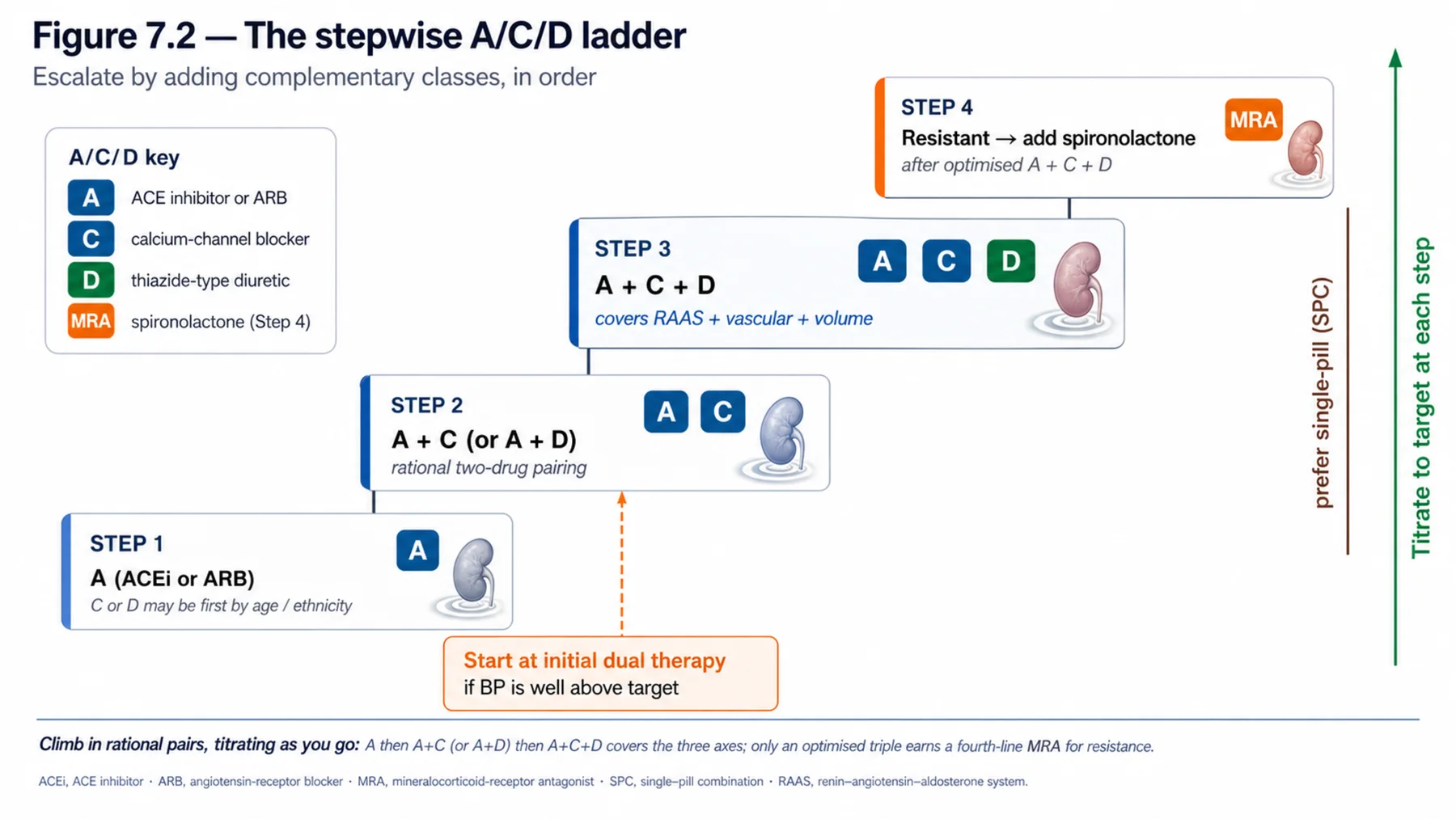
Stepwise escalation proceeds from a single agent (A, or C/D by age and ethnicity) to A+C, then to the three-drug A+C+D, which covers the RAAS, vascular, and volume mechanisms.
Step four — resistant hypertension — typically adds a mineralocorticoid antagonist and is the subject of a later chapter.
Single-pill (fixed-dose) combinations improve adherence and achieve control faster, and are preferred from the second step.
Initial combination therapy — starting with two drugs — is recommended for stage 2 hypertension or pressure well above target, for faster control.
Therapy is titrated to target over a few weeks, and clinical inertia — leaving a patient on submaximal therapy — is a major cause of poor control.
When the target is not reached on adequate combination therapy, apparent resistance is investigated — adherence, the white-coat effect, interfering substances, volume, and secondary causes — before labelling true resistance.
Rational combination and timely escalation are how most hypertension is actually controlled.
| 03 | PHASE A · LEVEL 3 · ORIENTATION & KNOWLEDGE Main Narrative |
One drug is rarely enough. Monotherapy controls only about half of hypertensive patients, so most need a combination — and the way drugs are combined is not arbitrary. Combining complementary classes is synergistic, blocks the compensatory responses that limit single agents, and (in a single pill) improves adherence. This chapter sets out why combinations work, which to use and which to avoid, how to escalate stepwise, and how to recognise when an inadequate response is apparent resistance rather than a need for yet another drug.
— Why combine: counter-regulation and synergy
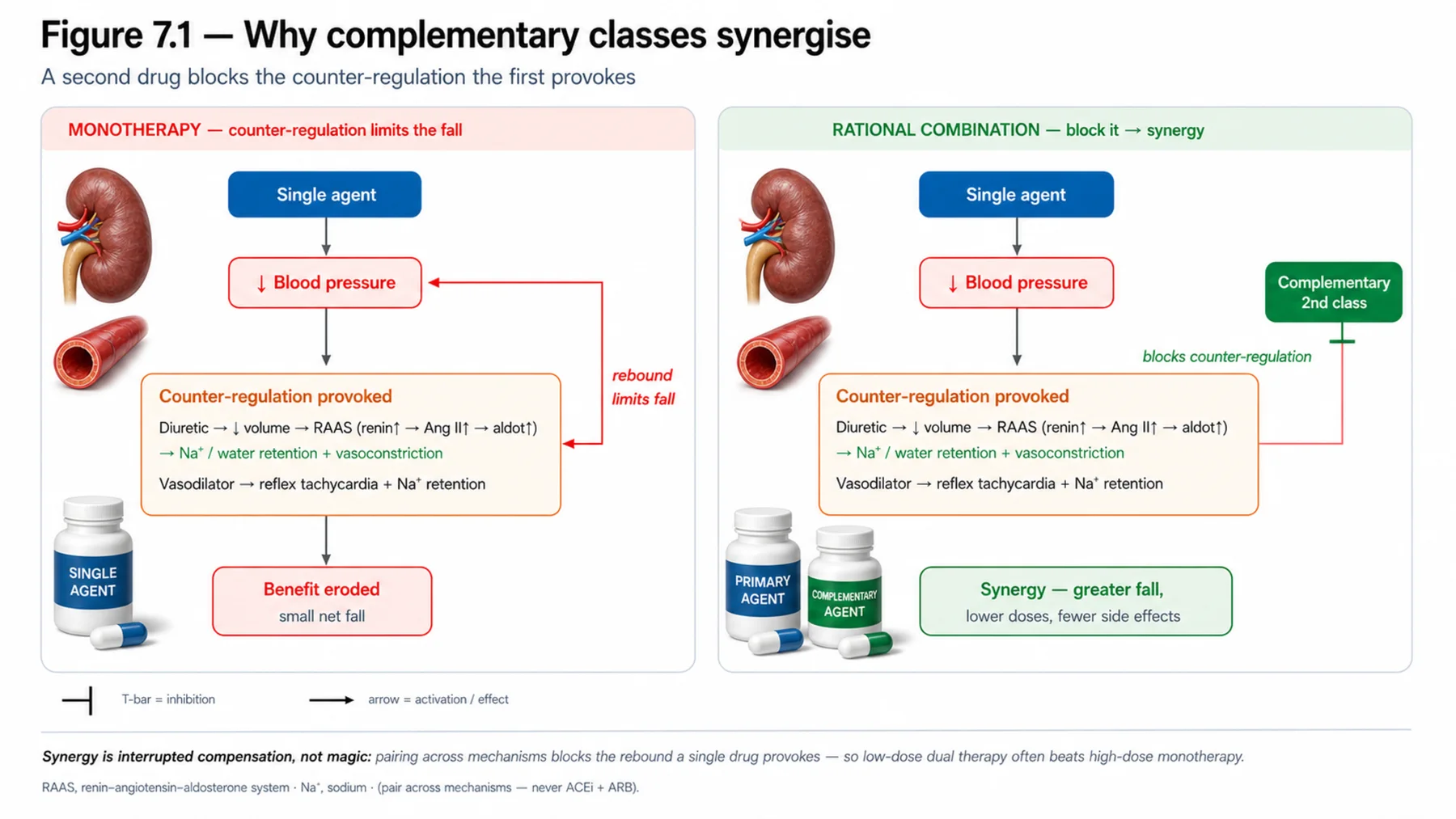
The mechanistic case for combination therapy is counter-regulation. The body defends its blood pressure, so a single drug that lowers it provokes a compensatory response that opposes the drug and limits its effect: a diuretic that lowers volume activates the RAAS (which retains sodium and constricts vessels), and a vasodilator that lowers resistance provokes a reflex tachycardia and sodium retention. Adding a second drug of a complementary class blocks the counter-regulation and so produces a synergistic effect — more than additive — while allowing each drug to be used at a lower, better-tolerated dose. This is why a low dose of two complementary drugs typically lowers blood pressure more, and with fewer dose-dependent side effects, than a high dose of one. Combination therapy is not just 'more drug'; it is the rational exploitation of complementary mechanisms to overcome the body's defence of its pressure.
— The rational combinations
Three combinations are rational and complementary. A RAAS blocker plus a diuretic (A+D) is synergistic because the diuretic activates the RAAS, which the RAAS blocker then counters — each addresses the other's counter-regulation. A RAAS blocker plus a calcium-channel blocker (A+C) combines two complementary mechanisms (the angiotensin-aldosterone axis and vascular tone), and has the additional benefit that the RAAS blocker's venodilation reduces the peripheral oedema the calcium-channel blocker causes — a side-effect mitigation as well as a blood-pressure synergy (and one major trial, ACCOMPLISH, favoured A+C over A+D for cardiovascular outcomes). A calcium-channel blocker plus a diuretic (C+D) is also rational. The triple combination A+C+D brings together all three mechanisms — RAAS, vascular tone, and volume — and is the standard three-drug regimen for hypertension not controlled on two. These rational combinations are the building blocks of stepwise care.
— The irrational combinations to avoid
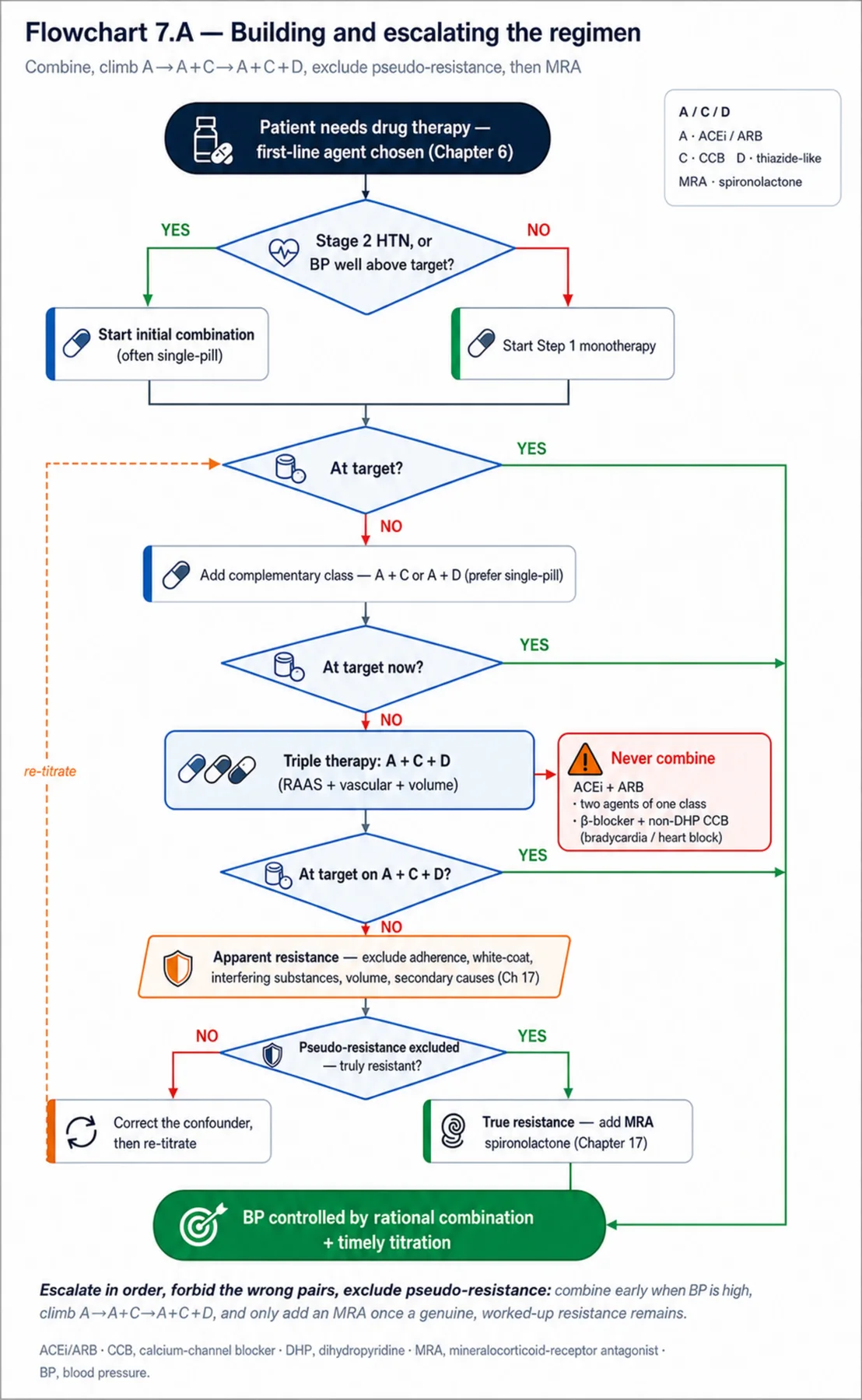
Some combinations should not be used. An ACE inhibitor with an ARB — dual RAAS blockade — increases harm (hyperkalaemia, acute kidney injury, hypotension) without benefit, as the previous chapter stressed, and is the classic combination to avoid. Two drugs of the same class (two RAAS blockers, two calcium-channel blockers) add toxicity without complementary benefit. And a beta-blocker with a non-dihydropyridine calcium-channel blocker (verapamil or diltiazem) is dangerous, because both slow the heart and impair conduction, risking bradycardia and heart block. Recognising the irrational combinations is as important as knowing the rational ones: the goal is complementary mechanisms, not redundant or antagonistic ones, and the common errors — stacking RAAS blockers, doubling within a class, or combining rate-slowing agents — are all failures of that principle.
— Stepwise escalation
Treatment escalates through a logical sequence, well captured by the A/C/D model. The first step is a single agent chosen by the previous chapter's logic — A (a RAAS blocker) for the younger, non-black patient, or C (a calcium-channel blocker) or D (a thiazide-type diuretic) for the older or black patient, or by compelling indication. The second step adds a complementary class — typically A+C (or A+D). The third step is the three-drug A+C+D, covering all the main mechanisms. The fourth step, for hypertension still uncontrolled on three drugs — resistant hypertension — typically adds a mineralocorticoid antagonist (spironolactone), and is developed fully in a later chapter. At each step, the regimen is built from the rational combinations, and the escalation continues until the target is reached. The key discipline is to keep moving up the steps until control is achieved, rather than stalling at an inadequate regimen.
— Single-pill combinations and initial combination therapy
Two practical refinements substantially improve outcomes. Single-pill (fixed-dose) combinations — two (or three) drugs in one tablet — improve adherence and persistence, reduce the pill burden, and achieve control faster than separate tablets; they are preferred once a patient is on two or more drugs, and increasingly are used to start treatment. And initial combination therapy — starting with two drugs rather than titrating up from one — is now recommended for patients with stage 2 hypertension or blood pressure well above target, because it achieves control faster and reduces the time spent at uncontrolled pressure; the two drugs are often given as a single pill from the outset. The shift from the old 'start one, titrate, then add' approach to 'start two (in one pill) when the pressure is well above target' reflects evidence that faster control improves outcomes and that adherence is better with fewer tablets. For most patients beyond the mildest hypertension, combination therapy — ideally in a single pill — is the modern default.
— Titration, clinical inertia, and apparent resistance
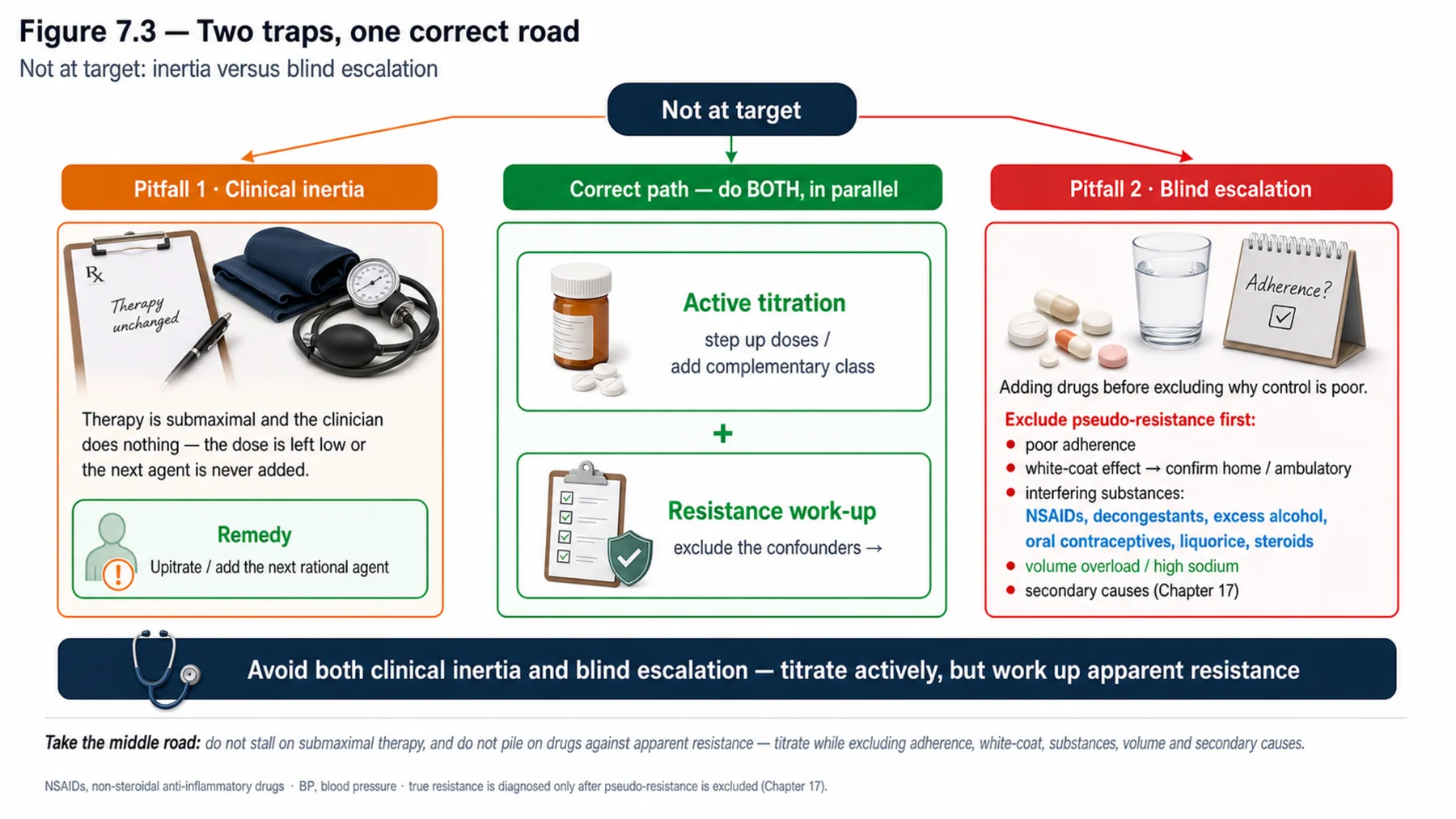
Getting to target requires active titration and the avoidance of two opposite failures. The first is clinical inertia — leaving a patient on submaximal therapy, an inadequate dose or too few drugs, without escalating — which is one of the commonest reasons hypertension stays uncontrolled; the remedy is to review every few weeks and uptitrate or add a drug until the target is reached, rather than accepting an inadequate response. The second failure is the opposite: escalating blindly when the apparent lack of response is not true drug failure. Before labelling a patient resistant and adding more drugs, the reversible causes of apparent resistance must be excluded — poor adherence (the commonest), a white-coat effect (the office reading exceeding the true pressure), measurement error, interfering substances (NSAIDs, decongestants, excess alcohol, certain other drugs), volume overload (under-diuresis, high salt), and undiagnosed secondary causes. Distinguishing true treatment resistance from these reversible causes — the detailed subject of the resistant-hypertension chapter — prevents both the under-treatment of clinical inertia and the over-treatment of escalating against an artefact. Rational combination, timely escalation, and the disciplined work-up of apparent resistance are, together, how most hypertension is actually brought to control.
| 04 | PHASE A · LEVEL 4 · ORIENTATION & KNOWLEDGE Reference Tables |
Table 7.1 — Why combination therapy
| Point | Detail |
| Need | Monotherapy controls ~half — most need ≥ 2 drugs |
| Synergy | Complementary mechanisms → more than additive; lower doses, fewer side effects |
| Counter-regulation | A single drug provokes a compensatory response; a second class blocks it |
| Example | Diuretic → RAAS activation; adding a RAAS blocker counters it |
Table 7.2 — The rational combinations
| Combination | Rationale |
| A + D (RAAS blocker + diuretic) | Diuretic activates RAAS — the blocker counters it |
| A + C (RAAS blocker + CCB) | Complementary mechanisms; RAAS blocker reduces CCB oedema (ACCOMPLISH favoured A+C) |
| C + D (CCB + diuretic) | Complementary — vascular tone + volume |
| A + C + D (triple) | Covers RAAS, vascular tone, and volume — the standard three-drug regimen |
Table 7.3 — Irrational combinations to avoid
| Avoid | Why |
| ACE inhibitor + ARB | Dual RAAS blockade — hyperkalaemia, AKI, hypotension, no benefit |
| Two drugs of the same class | Toxicity without complementary benefit |
| Beta-blocker + non-DHP CCB (verapamil/diltiazem) | Bradycardia, heart block |
| Principle | Combine complementary mechanisms, not redundant/antagonistic ones |
Table 7.4 — The stepwise A/C/D model
| Step | Regimen |
| Step 1 | A (younger non-black) or C/D (older or black) — or by compelling indication |
| Step 2 | A + C (or A + D) |
| Step 3 | A + C + D (triple — all main mechanisms) |
| Step 4 | Resistant — add a mineralocorticoid antagonist (spironolactone); see Chapter 17 |
Table 7.5 — Single-pill and initial combination
| Aspect | Detail |
| Single-pill combination | Improves adherence/persistence, faster control, fewer pills — preferred from step 2 |
| Initial combination therapy | Start with 2 drugs for stage 2 / BP well above target — faster control |
| Modern default | Combination (ideally single-pill) beyond the mildest hypertension |
| Titration | Review every few weeks; uptitrate to target |
Table 7.6 — Recognising inadequate response
| Cause | Detail |
| Clinical inertia | Leaving submaximal therapy — the commonest reason for poor control; uptitrate |
| Poor adherence | The commonest cause of apparent resistance — check before escalating |
| White-coat effect / measurement | Confirm out of office (Chapter 2) |
| Interfering substances / volume / secondary | NSAIDs, alcohol; under-diuresis/high salt; undiagnosed secondary cause (Chapter 17) |
| 05 | PHASE B · LEVEL 5 · VISUALISE & MAP Imaging & Flowchart Specifications |
| 06 | PHASE B · LEVEL 6 · VISUALISE & MAP Concept Maps |
Each chain runs from mechanism to a named bedside action; read the arrows as “leads to.”
Counter-regulation / synergy. A single drug → compensatory counter-regulation limits it → a complementary second class blocks the counter-regulation → synergy at lower doses → ACTION: combine complementary classes rather than maximising one.
A + D. Diuretic → volume loss → RAAS activation (limits it) → RAAS blocker counters → synergy → ACTION: pair a RAAS blocker with a diuretic.
A + C. CCB (vascular tone) + RAAS blocker (angiotensin-aldosterone) → complementary; RAAS blocker's venodilation reduces CCB oedema → ACTION: pair a RAAS blocker with a CCB (also mitigates oedema).
Irrational combinations. ACEi+ARB (dual blockade harm) / two same-class (toxicity) / beta-blocker + non-DHP CCB (bradycardia/block) → redundant or antagonistic → ACTION: avoid these; combine complementary mechanisms only.
Single-pill / adherence. Fewer tablets → better adherence and persistence → faster, more durable control → ACTION: use single-pill combinations from step 2 and to start in higher-stage hypertension.
| 07 | PHASE B · LEVEL 7 · VISUALISE & MAP Decision Pathways |
| R1 | IF monotherapy does not reach target, THEN add a complementary class rather than only maximising the first — combination is synergistic. |
| R2 | IF combining, THEN use a rational pairing — A+C, A+D, or C+D — building toward A+C+D. |
| R3 | IF a calcium-channel blocker causes peripheral oedema, THEN adding a RAAS blocker both lowers the pressure and reduces the oedema. |
| R4 | IF tempted by certain combinations, THEN avoid the irrational ones — ACE inhibitor with ARB, two of a class, beta-blocker with a non-dihydropyridine calcium-channel blocker. |
| R5 | IF a patient has stage 2 hypertension or pressure well above target, THEN start initial combination therapy (often a single pill) for faster control. |
| R6 | IF a patient is on two or more drugs, THEN prefer a single-pill combination to improve adherence. |
| R7 | IF a patient is not at target, THEN avoid clinical inertia — review every few weeks and uptitrate or add a drug until controlled. |
| R8 | IF the target is not reached on adequate combination, THEN exclude the reversible causes of apparent resistance — adherence, white-coat, interfering substances, volume, secondary causes — before labelling true resistance. |
| 08 | PHASE C · LEVEL 8 · CLINICAL REASONING Clinical Cases |
| CASE 1 | ONE ISN'T ENOUGH Add a complementary class Combination over maximisation |
Presentation
A patient on a maximal-dose ACE inhibitor remains above target. A clinician proposes pushing the dose even higher rather than adding a second drug.
❖ Pause and reflect Is maximising the single drug the best next step? |
Analysis
No — adding a complementary class is better than maximising one. The ACE inhibitor's effect is limited by counter-regulation, and pushing the dose higher yields diminishing returns while increasing dose-dependent side effects. Adding a complementary class — a calcium-channel blocker (A+C) or a diuretic (A+D) — produces a synergistic, more-than-additive fall in pressure at lower, better-tolerated doses of each, because the second drug blocks the counter-regulation the first provokes. This is the central rationale for combination therapy, and it is why guidelines move to a second drug rather than maximising the first.
Plan
Add a complementary class (a calcium-channel blocker or diuretic) rather than further maximising the ACE inhibitor, preferring a single-pill combination; this achieves more control with fewer side effects. Combine rather than maximise.
Teaching point
Adding a complementary class is synergistic and better tolerated than maximising a single drug — combine rather than push the dose.
Cross-reference
Exercises rules R1 and R2; the counter-regulation concept map; Figure 7.1; Tables 7.1, 7.2.
| CASE 2 | THE SWOLLEN ANKLES Synergy that mitigates a side effect A+C and CCB oedema |
Presentation
A patient on a calcium-channel blocker develops troublesome peripheral oedema and is still above target. A clinician considers stopping the calcium-channel blocker.
❖ Pause and reflect Is there a combination that both lowers the pressure further and reduces the oedema? |
Analysis
Yes — adding a RAAS blocker (the A+C combination). The calcium-channel blocker's peripheral oedema arises from its arteriolar (precapillary) vasodilation raising capillary pressure; a RAAS blocker, by also dilating the venous (postcapillary) side, lowers that capillary pressure and reduces the oedema — while simultaneously adding a complementary blood-pressure-lowering mechanism. So rather than stopping the effective calcium-channel blocker, adding a RAAS blocker both improves the blood pressure and mitigates the oedema. This is a neat example of a rational combination delivering synergy and side-effect mitigation at once.
Plan
Add a RAAS blocker to the calcium-channel blocker (the A+C combination), which lowers the pressure further and reduces the peripheral oedema, rather than stopping the calcium-channel blocker. Use A+C to gain synergy and mitigate the oedema.
Teaching point
Adding a RAAS blocker to a calcium-channel blocker (A+C) both lowers the pressure and reduces the calcium-channel-blocker oedema.
Cross-reference
Exercises rule R3; the A+C concept map; Table 7.2.
| CASE 3 | STUCK ON ONE PILL Clinical inertia Failure to escalate |
Presentation
A patient has been on the same single low-dose antihypertensive for a year, consistently above target at every visit, without any change to the regimen.
❖ Pause and reflect Why has this patient's hypertension remained uncontrolled for a year? |
Analysis
This is clinical inertia — the failure to escalate therapy in a patient who is persistently above target — and it is one of the commonest reasons hypertension stays uncontrolled. The patient has been left on submaximal monotherapy for a year despite repeated above-target readings, with no uptitration or addition of a second drug. The remedy is active titration: review every few weeks, and uptitrate or add a complementary class until the target is reached, rather than accepting the inadequate response visit after visit. (Adherence and the other causes of apparent resistance should also be checked, but a year of unchanged submaximal therapy is primarily inertia.)
Plan
Escalate therapy — uptitrate or add a complementary class — with regular review until the target is reached, checking adherence along the way; do not leave the patient on submaximal therapy. Treat clinical inertia by active titration.
Teaching point
Clinical inertia — leaving a patient on submaximal therapy — is a major cause of uncontrolled hypertension; titrate actively to target.
Cross-reference
Exercises rule R7; the inertia-vs-resistance figure (7.3); Table 7.6.
| CASE 4 | START WITH TWO Initial combination therapy Single-pill combination in stage 2 |
Presentation
A newly diagnosed patient has stage 2 hypertension with a blood pressure well above target. A trainee plans to start a single low-dose agent and titrate up slowly over months.
❖ Pause and reflect Is starting with a single agent the best approach for this stage 2 hypertension? |
Analysis
No — for stage 2 hypertension with the pressure well above target, initial combination therapy is recommended. Starting with two complementary drugs (often as a single pill) achieves control faster than titrating up from one, reducing the time the patient spends at an uncontrolled, higher-risk pressure, and the single pill improves adherence. The old approach of starting one drug and titrating slowly over months leaves the patient under-treated for too long when the pressure is markedly elevated. The modern default beyond mild hypertension is to start combination therapy, ideally in a single pill.
Plan
Start initial combination therapy with two complementary drugs (ideally a single-pill combination) given the stage 2 hypertension well above target, for faster control and better adherence, then titrate to target. Begin with two drugs when the pressure is well above target.
Teaching point
For stage 2 hypertension or pressure well above target, start initial combination therapy (often a single pill) for faster control.
Cross-reference
Exercises rules R5 and R6; the single-pill concept map; Table 7.5.
| 09 | PHASE C · LEVEL 9 · CLINICAL REASONING Clinical Implications |
One triad per mechanism the narrative exposed: the physiology, why it matters, and the bedside move.
MECHANISM A single antihypertensive provokes a counter-regulatory response that limits it. |
WHY IT MATTERS Maximising one drug yields diminishing returns and more side effects. |
ACTION Add a complementary class to block the counter-regulation — combine rather than maximise. |
MECHANISM A diuretic activates the RAAS, which a RAAS blocker counters. |
WHY IT MATTERS The A+D combination is therefore synergistic. |
ACTION Pair a RAAS blocker with a diuretic. |
MECHANISM A RAAS blocker's venodilation lowers the capillary pressure that causes calcium-channel-blocker oedema. |
WHY IT MATTERS The A+C combination both lowers pressure and reduces the oedema. |
ACTION Add a RAAS blocker to a calcium-channel blocker rather than stopping it for oedema. |
MECHANISM Some combinations are redundant or antagonistic rather than complementary. |
WHY IT MATTERS Dual RAAS blockade, same-class pairs, and beta-blocker plus non-dihydropyridine CCB cause harm. |
ACTION Combine complementary mechanisms only — avoid the irrational pairings. |
MECHANISM Fewer tablets improve adherence, and faster control reduces time at uncontrolled pressure. |
WHY IT MATTERS Single-pill and initial combination therapy translate into better outcomes. |
ACTION Use single-pill combinations, and start with two drugs when the pressure is well above target. |
| 10 | PHASE C · LEVEL 10 · CLINICAL REASONING Clinical Pearls |
| Monotherapy controls ~half — most need ≥ 2 drugs. | Combining complementary classes is synergistic (lower doses, fewer side effects). |
| Counter-regulation: a single drug provokes a response a second class blocks. | A+D: diuretic activates RAAS — the blocker counters it. |
| A+C: complementary; RAAS blocker reduces CCB oedema (ACCOMPLISH favoured A+C). | C+D: vascular tone + volume. |
| A+C+D: covers RAAS, vascular, and volume — standard triple. | Avoid ACEi+ARB (dual blockade harm). |
| Avoid two of the same class. | Avoid beta-blocker + non-DHP CCB (bradycardia/heart block). |
| Stepwise: A or C/D → A+C → A+C+D → step 4 (+ spironolactone). | Single-pill combinations improve adherence and speed control. |
| Initial combination therapy for stage 2 / BP well above target. | Titrate every few weeks to target — avoid clinical inertia. |
| Clinical inertia is a major cause of uncontrolled hypertension. | Before labelling resistant: check adherence, white-coat, substances, volume, secondary causes. |
| 11 | PHASE D · LEVEL 11 · SAFETY & EVIDENCE Red Flags & Never-Do |
Panel A — Red flags
| ▲ | A patient left on submaximal monotherapy while persistently above target — clinical inertia; escalate. |
| ▲ | An ACE inhibitor and ARB prescribed together — dual RAAS blockade; stop one. |
| ▲ | A beta-blocker with verapamil or diltiazem — bradycardia/heart-block risk; avoid. |
| ▲ | Troublesome calcium-channel-blocker oedema — add a RAAS blocker rather than stopping the CCB. |
| ▲ | Apparent resistance on 'three drugs' — check adherence, white-coat, NSAIDs, volume, secondary causes first. |
Panel B — Never do
| ✖ NEVER — maximise a single drug when a complementary combination would do more with fewer side effects. |
| ✖ NEVER — use an irrational combination (ACEi+ARB, same class, beta-blocker + non-DHP CCB). |
| ✖ NEVER — leave a patient on submaximal therapy while above target (clinical inertia). |
| ✖ NEVER — escalate blindly against apparent resistance without excluding its reversible causes. |
| 12 | PHASE D · LEVEL 12 · SAFETY & EVIDENCE Common Pitfalls |
Pitfall 1 — Maximising one drug
| ✖ | WRONG Pushing a single drug to maximal dose rather than combining. |
| ✓ | RIGHT Adding a complementary class. |
| ✉ | WHY Combination is synergistic with fewer dose-dependent side effects. |
Pitfall 2 — Stopping the CCB for oedema
| ✖ | WRONG Stopping a calcium-channel blocker because of peripheral oedema. |
| ✓ | RIGHT Adding a RAAS blocker (A+C) to reduce the oedema and the pressure. |
| ✉ | WHY RAAS-blocker venodilation lowers the capillary pressure causing the oedema. |
Pitfall 3 — Clinical inertia
| ✖ | WRONG Leaving a patient on submaximal therapy visit after visit. |
| ✓ | RIGHT Reviewing and uptitrating to target. |
| ✉ | WHY Inertia is a major cause of uncontrolled hypertension. |
Pitfall 4 — Irrational combination
| ✖ | WRONG Combining redundant or antagonistic drugs (ACEi+ARB, beta-blocker + non-DHP CCB). |
| ✓ | RIGHT Combining complementary mechanisms only. |
| ✉ | WHY Redundant/antagonistic combinations add harm without benefit. |
Pitfall 5 — Escalating against an artefact
| ✖ | WRONG Adding more drugs for apparent resistance without a work-up. |
| ✓ | RIGHT Excluding adherence, white-coat, substances, volume, and secondary causes first. |
| ✉ | WHY Most apparent resistance has a reversible cause. |
| 13 | PHASE D · LEVEL 13 · SAFETY & EVIDENCE Evidence Grading |
GRADE A HIGH CONFIDENCE The effect is real and the estimate is stable. RCTs at low risk of bias; multiple concordant prospective cohorts; meta-analyses. |
GRADE B MODERATE CONFIDENCE The effect is likely real but may shift with new data. Observational studies, registries, mechanistic human studies. |
GRADE C LOW CONFIDENCE Rests on physiology, reasoning, or consensus rather than outcomes. Pathophysiological reasoning; extrapolation; consensus without outcomes. |
Graded statements (by evidence type)
| Statement | Grade | Basis (evidence type) |
| Most hypertension requires more than one drug. | A | Trial and observational data |
| Combining complementary classes is synergistic. | A | Established pharmacology and trials |
| The A+C combination is effective and reduces CCB oedema. | A | RCTs (ACCOMPLISH) and pharmacology |
| Dual ACE-inhibitor/ARB blockade is harmful. | A | RCT (ONTARGET) |
| Single-pill combinations improve adherence and control. | A | Adherence and outcome studies |
| Initial combination therapy speeds control in higher-stage hypertension. | B | Trial and guideline consensus |
| Clinical inertia is a major cause of uncontrolled hypertension. | A | Observational data |
| 14 | PHASE E · LEVEL 14 · PATIENT DECISIONS Absolute Risk in Natural Frequency |
Natural-frequency estimates for orientation, from the combination-therapy literature; they vary with the population. They convey the size of the decisions, expressed per 100 comparable patients.
| Per 100 patients… | Outcome | Roughly how many | See |
| On monotherapy | Reach target | About half — most need combination | L13 row 1 |
| Given a low-dose complementary combination vs a maximised single drug | Reach target with fewer side effects | More with the combination | L13 row 2 |
| Given a single-pill vs separate tablets | Remain adherent and controlled | More with the single pill | L13 row 5 |
| Left on submaximal therapy (inertia) | Remain uncontrolled | More than the actively titrated | L13 row 7 |
★ How to read these Read these as orientation, not promises; the proportions vary with the population. The stable signals: monotherapy controls only about half, complementary combination outperforms a maximised single drug, single pills improve adherence, and inertia leaves patients uncontrolled. Communicate them as people out of 100, not as a hazard ratio. |
| 17 | PHASE F · LEVEL 17 · APPLY & TEST Documentation Templates |
Paste-ready notes. Tick the boxes that apply and delete the rest; make the rational combination and the titration plan explicit.
Template 1 — Stepwise escalation plan
Template 2 — Inadequate-response review
| 18 | PHASE F · LEVEL 18 · APPLY & TEST Cheat Sheet |
| Most HTN needs ≥ 2 drugs (monotherapy ~half). | Complementary combination = synergistic (lower doses, fewer SE). |
| Counter-regulation: a single drug provokes a response a second class blocks. | A+D: diuretic activates RAAS — blocker counters. |
| A+C: complementary; RAAS blocker reduces CCB oedema. | C+D: vascular + volume. |
| A+C+D: RAAS + vascular + volume (triple). | AVOID: ACEi+ARB; two of a class; beta-blocker + non-DHP CCB. |
| Steps: A or C/D → A+C → A+C+D → step 4 (+spironolactone). | Single-pill combinations → adherence + faster control. |
| Initial combination for stage 2 / BP well above target. | Titrate every few weeks to target. |
| Clinical inertia = major cause of poor control. | Not at target on adequate combination → work up apparent resistance. |
| Check adherence (commonest), white-coat, substances, volume, secondary. | True resistance → Chapter 17. |
| 19 | PHASE F · LEVEL 19 · APPLY & TEST Flashcards |
| CARD 1 | Q. Why does most hypertension require combination therapy? A. Because monotherapy controls only about half of patients, and combining complementary classes is synergistic — more than additive — allowing lower, better-tolerated doses of each. DETAILED. A single drug's effect is limited by counter-regulation. CLINICAL. Combine complementary classes rather than maximising one. |
| CARD 2 | Q. What is counter-regulation, and why does it matter? A. The compensatory response a single antihypertensive provokes that limits its effect — a diuretic activates the RAAS, a vasodilator causes reflex tachycardia and sodium retention; a complementary second class blocks the counter-regulation, producing synergy. DETAILED. It is the mechanistic basis for combining drugs. CLINICAL. Add a complementary class to overcome the counter-regulation. |
| CARD 3 | Q. What are the rational combinations? A. A+D (a RAAS blocker counters the RAAS activation a diuretic causes), A+C (complementary mechanisms, with the RAAS blocker reducing calcium-channel-blocker oedema), C+D, and the triple A+C+D covering RAAS, vascular tone, and volume. DETAILED. ACCOMPLISH favoured A+C over A+D for outcomes. CLINICAL. Build the regimen from these rational combinations. |
| CARD 4 | Q. Which combinations should be avoided? A. An ACE inhibitor with an ARB (dual RAAS blockade — harm without benefit), two drugs of the same class (toxicity without complementary benefit), and a beta-blocker with a non-dihydropyridine calcium-channel blocker (bradycardia and heart block). DETAILED. These are redundant or antagonistic rather than complementary. CLINICAL. Combine complementary mechanisms only. |
| CARD 5 | Q. How does a RAAS blocker help calcium-channel-blocker oedema? A. Calcium-channel-blocker oedema arises from arteriolar vasodilation raising capillary pressure; a RAAS blocker also dilates the venous side, lowering the capillary pressure and reducing the oedema — while adding a complementary blood-pressure-lowering mechanism. DETAILED. It is synergy plus side-effect mitigation. CLINICAL. Add a RAAS blocker rather than stopping the calcium-channel blocker. |
| CARD 6 | Q. What is the stepwise escalation? A. Step 1 a single agent (A, or C/D by age and ethnicity); step 2 A+C (or A+D); step 3 the triple A+C+D; step 4 (resistant) adding a mineralocorticoid antagonist — escalating through rational combinations to target. DETAILED. It builds from the rational combinations. CLINICAL. Escalate stepwise until the target is reached. |
| CARD 7 | Q. When are single-pill and initial combination therapy used? A. Single-pill (fixed-dose) combinations are preferred once a patient is on two or more drugs, improving adherence and speeding control; initial combination therapy (starting with two drugs, often a single pill) is recommended for stage 2 hypertension or pressure well above target. DETAILED. Faster control and better adherence improve outcomes. CLINICAL. Use single pills and start with two drugs when the pressure is well above target. |
| CARD 8 | Q. What is clinical inertia, and how is apparent resistance approached? A. Clinical inertia is leaving a patient on submaximal therapy without escalating — a major cause of poor control, remedied by active titration; apparent resistance is investigated by excluding poor adherence, the white-coat effect, interfering substances, volume, and secondary causes before labelling true resistance. DETAILED. Both under-treatment and blind escalation are errors. CLINICAL. Titrate actively, but work up apparent resistance before adding more drugs. |
| 20 | PHASE F · LEVEL 20 · APPLY & TEST One-Minute Preceptor |
| SCENE 1 | The intern maximising one drug |
GET A COMMITMENT. “You want to push this ACE inhibitor to maximal dose rather than add a second drug — why?”
PROBE FOR EVIDENCE. “More drug, more effect” — ask: “What limits a single drug's effect, and what does adding a complementary class do?”
TEACH A GENERAL RULE. A single drug provokes counter-regulation that limits it; a complementary class blocks that, giving synergy at lower, better-tolerated doses — combine rather than maximise.
REINFORCE WHAT WAS RIGHT. Recognising the inadequate response was correct.
CORRECT A MISTAKE. Add a complementary class (A+C or A+D), ideally as a single pill.
| SCENE 2 | The resident stuck on one pill |
GET A COMMITMENT. “This patient has been above target on the same low-dose pill for a year — what's gone wrong?”
PROBE FOR EVIDENCE. “They're on treatment” — ask: “Has the regimen ever been escalated, and what is clinical inertia?”
TEACH A GENERAL RULE. Leaving a patient on submaximal therapy while above target is clinical inertia — a major cause of uncontrolled hypertension; review and titrate to target.
REINFORCE WHAT WAS RIGHT. Noticing the persistent elevation was correct.
CORRECT A MISTAKE. Uptitrate or add a complementary class now, and review regularly.
| 22 | PHASE F · LEVEL 22 · APPLY & TEST Board-Style Questions |
| Q 01 | Why is combining complementary antihypertensive classes synergistic? |
| A | It doubles the dose |
| B | A second class blocks the counter-regulation a single drug provokes |
| C | It has no rationale |
| D | It only reduces side effects |
Rationale Counter-regulation limits a single drug; a complementary class blocks it, giving more-than-additive effect (case 1, Figure 7.1, rule R1). A, C, and D are incorrect. |
| Q 02 | Which combination is rational and reduces calcium-channel-blocker oedema? |
| A | ACE inhibitor + ARB |
| B | A RAAS blocker + a calcium-channel blocker (A+C) |
| C | Two calcium-channel blockers |
| D | Beta-blocker + verapamil |
Rationale A+C is complementary and the RAAS blocker's venodilation reduces the oedema (case 2, Table 7.2, rule R3). A, C, and D are irrational/harmful. |
| Q 03 | Which combination should be avoided? |
| A | A RAAS blocker + a diuretic |
| B | An ACE inhibitor + an ARB |
| C | A calcium-channel blocker + a diuretic |
| D | A RAAS blocker + a calcium-channel blocker |
Rationale Dual RAAS blockade is harmful without benefit (Table 7.3, rule R4). A, C, and D are rational combinations. |
| Q 04 | The standard three-drug regimen for hypertension is: |
| A | Two RAAS blockers + a diuretic |
| B | A+C+D (RAAS blocker + calcium-channel blocker + diuretic) |
| C | Three calcium-channel blockers |
| D | A beta-blocker + verapamil + a diuretic |
Rationale A+C+D covers the RAAS, vascular, and volume mechanisms (Table 7.4, Figure 7.2). A, C, and D are irrational. |
| Q 05 | For stage 2 hypertension with pressure well above target, the recommended start is: |
| A | A single low-dose agent titrated slowly |
| B | Initial combination therapy (often a single pill) |
| C | No drug therapy |
| D | A beta-blocker |
Rationale Initial combination therapy speeds control in higher-stage hypertension (case 4, Table 7.5, rule R5). A is too slow; C and D are inappropriate. |
| Q 06 | A patient left on submaximal monotherapy above target for a year illustrates: |
| A | True resistant hypertension |
| B | Clinical inertia |
| C | White-coat hypertension |
| D | Non-adherence only |
Rationale Failure to escalate persistently above-target therapy is clinical inertia (case 3, Table 7.6, rule R7). A, C, and D do not fit unchanged submaximal therapy. |
| Q 07 | The main advantage of single-pill combinations is: |
| A | Lower cost only |
| B | Improved adherence and faster control |
| C | More side effects |
| D | Avoiding titration |
Rationale Single-pill combinations improve adherence and speed control (Table 7.5, rule R6). A, C, and D are incorrect. |
| Q 08 | Before labelling a patient resistant on three drugs, you should first exclude: |
| A | Nothing — add a fourth drug |
| B | Poor adherence, white-coat effect, interfering substances, volume, and secondary causes |
| C | Only the white-coat effect |
| D | Only secondary causes |
Rationale The reversible causes of apparent resistance must be excluded before labelling true resistance (Table 7.6, rule R8; Chapter 17). A, C, and D are incomplete. |