Chapter Preamble
Signals declared
Sig-D — Diagnostic (primary). Recognise the clues that should trigger screening for a secondary cause, and target the screening tests to the clinical picture.
Sig-M — Mechanistic (strong). Why secondary hypertension matters — a correctable cause — and how each cause produces its characteristic clinical signature.
Levels populated and omitted
Populated (17): L1–L13, L18–L20, L22. The mechanistic signal fires the concept maps (L6) and triads (L9); the diagnostic signal drives the tables, rules, cases, pitfalls, and board items.
L14 absolute-risk — omitted. No Sig-T/E/V; this is a diagnostic-approach chapter, with the cause-specific treatment in the chapters that follow.
L15 / L16 preference-sensitive map and SDM scripts — omitted. No Sig-E; deciding whom to screen is a clinical, evidence-based judgement.
L17 documentation templates — omitted. No Sig-P/T; the management templates belong with the cause-specific chapters.
| 01 | PHASE A · LEVEL 1 · ORIENTATION & KNOWLEDGE Learning Objectives |
By the end of this chapter you should be able to:
Define secondary hypertension and explain why identifying it matters.
Recognise the clinical clues that should trigger screening for a secondary cause.
Explain why screening is targeted to the clues rather than universal.
List the major causes of secondary hypertension and their characteristic features.
Recognise that primary aldosteronism is common and does not require hypokalaemia.
Recognise the renovascular clues, including the rise in creatinine on RAAS blockade.
Recognise drug- and substance-induced hypertension as a reversible cause.
Select the appropriate screening test for the suspected cause.
| 02 | PHASE A · LEVEL 2 · ORIENTATION & KNOWLEDGE Executive Summary |
Secondary hypertension is hypertension with an identifiable, often correctable cause, accounting for roughly 5 to 15% of cases overall and a higher proportion of resistant, young, and severe hypertension.
Identifying it matters because the cause may be cured or specifically treated, and because it underlies much resistant hypertension.
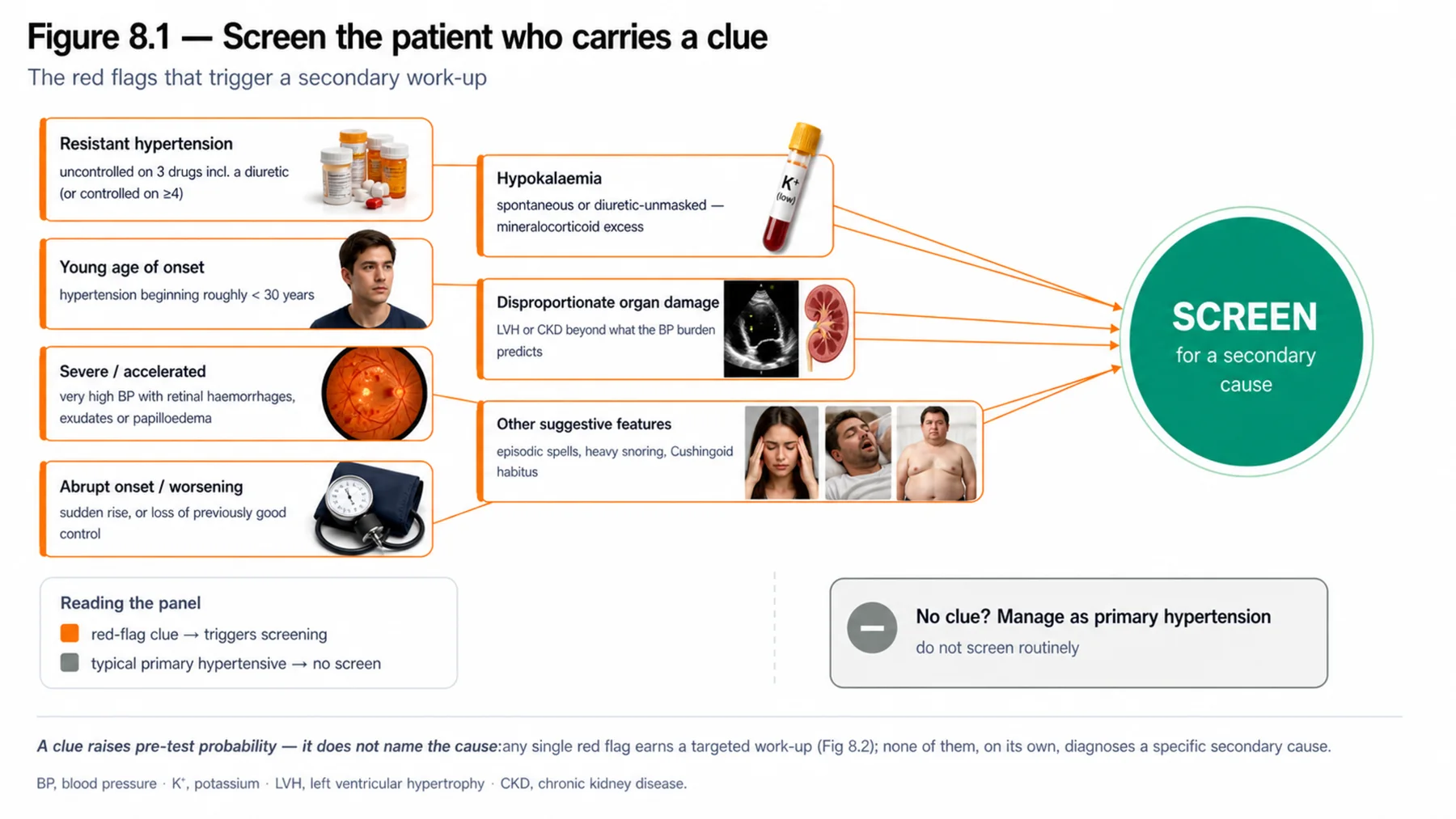
Screening is not universal but targeted to clinical clues: resistant hypertension, young onset, severe or accelerated hypertension, an abrupt onset or sudden worsening, hypokalaemia, and disproportionate target-organ damage.
Primary aldosteronism is the commonest endocrine cause and is frequently normokalaemic, so hypokalaemia is not required to suspect it; it is screened with the aldosterone-to-renin ratio.
Renovascular hypertension — atherosclerotic or fibromuscular — is suggested by an abdominal bruit, flash pulmonary oedema, a rise in creatinine on RAAS blockade, and asymmetric kidneys.
Renal parenchymal disease (CKD) is the commonest secondary cause overall, and obstructive sleep apnoea is a common, under-diagnosed contributor.
Other endocrine causes include phaeochromocytoma (episodic hypertension with the headache-palpitations-sweating triad), Cushing's syndrome, and thyroid disease.
Drug- and substance-induced hypertension — from NSAIDs, oral contraceptives, glucocorticoids, decongestants, stimulants, alcohol, and others — is a common and reversible cause that is easily overlooked.
Coarctation of the aorta (radio-femoral delay, an arm-leg blood-pressure differential) and the rare monogenic syndromes complete the differential.
Each cause produces a characteristic clinical signature that guides which screening test to choose.
The diagnostic approach is to let the clues raise suspicion, then test selectively for the suspected cause.
The cause-specific causes — renovascular, aldosteronism and endocrine, and the parenchymal, sleep-apnoea, drug, and monogenic causes — are developed in the chapters that follow.
This chapter is the framework for when to look and what to look for.
| 03 | PHASE A · LEVEL 3 · ORIENTATION & KNOWLEDGE Main Narrative |
Most hypertension is primary, but a meaningful minority — and a much larger fraction of the resistant, young, and severe — has an identifiable, often correctable cause. Finding that cause can cure the hypertension or direct a specific treatment, and missing it leaves a patient on lifelong drugs for a problem that could have been fixed. The art is knowing when to look: screening everyone is wasteful, but screening the right patients — those with the clues — is high-yield. This chapter is the framework for when to suspect, when to screen, and what the causes look like.
— Why it matters, and how common it is
Secondary hypertension — hypertension with an identifiable cause — accounts for roughly 5 to 15% of all hypertension, but the proportion is much higher in particular groups: in resistant hypertension it may approach a quarter or more, and it is overrepresented among the young and the severely hypertensive. It matters for three reasons. First, the cause may be curable (a stenosed renal artery, an aldosterone-producing adenoma, a phaeochromocytoma) or specifically treatable (treating sleep apnoea, stopping an offending drug), offering the chance to cure or substantially improve the hypertension rather than merely control it lifelong. Second, secondary causes underlie much resistant hypertension, so identifying them is central to managing the difficult case. Third, some causes carry specific risks (the catecholamine surges of phaeochromocytoma, the cardiovascular and metabolic effects of aldosterone excess) that targeted treatment addresses. The cost of looking is the cost of testing; the cost of not looking is a missed cure and unnecessary lifelong therapy.
— When to screen: the clues
Because secondary hypertension is the minority, screening every hypertensive patient for every cause would be wasteful and would generate false positives; the approach is instead targeted to clinical clues that raise the pre-test probability. The major triggers to screen are: resistant hypertension (uncontrolled despite three drugs including a diuretic, or controlled only on four or more); young onset (hypertension before about 30, especially without the usual risk factors); severe, accelerated, or malignant hypertension, or a hypertensive emergency; an abrupt onset or a sudden worsening of previously well-controlled hypertension; spontaneous or disproportionate hypokalaemia (suggesting aldosteronism); and target-organ damage out of proportion to the blood pressure or duration. Specific clinical features — an abdominal bruit, episodic symptoms, the stigmata of Cushing's — point to particular causes. When one or more of these clues is present, the probability of a secondary cause is high enough to justify screening; in their absence, in the typical middle-aged patient with primary hypertension, routine screening is not warranted.
— The major causes and their signatures
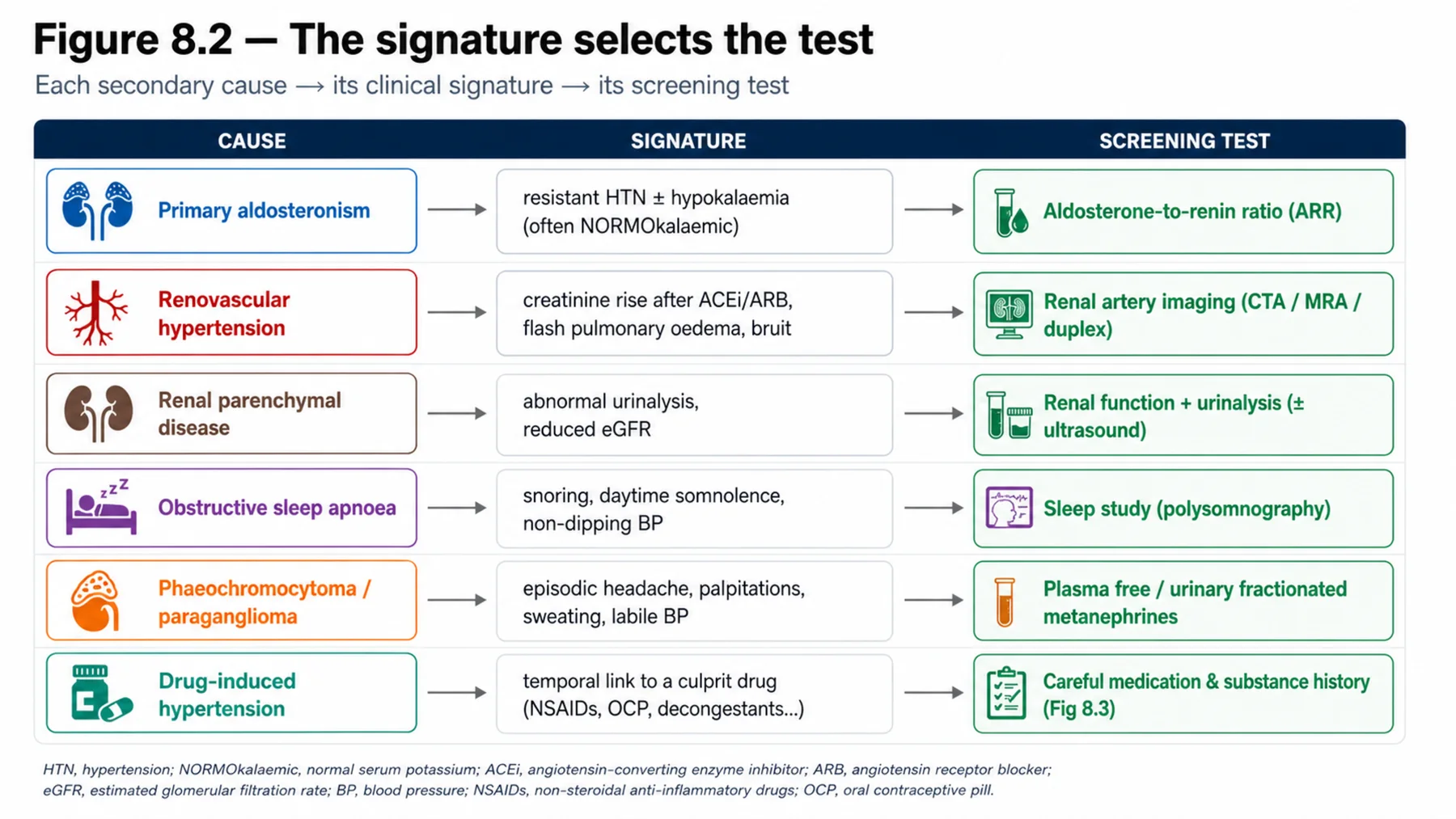
Each secondary cause produces a recognisable signature, and knowing them turns the clue into a targeted test. Primary aldosteronism is the commonest endocrine and identifiable cause, and a crucial point — developed in its own chapter — is that most cases are normokalaemic, so hypokalaemia is a clue but is not required to suspect or screen for it. Renovascular hypertension (atherosclerotic renal artery stenosis in older patients with vascular disease, fibromuscular dysplasia in younger women) is suggested by an abdominal bruit, recurrent flash pulmonary oedema, a significant rise in creatinine after starting a RAAS blocker, and asymmetric kidney size. Renal parenchymal disease — CKD of any cause — is the commonest secondary cause overall and is identified by the renal function and urinalysis. Obstructive sleep apnoea, common and under-diagnosed, is suggested by obesity, snoring, daytime sleepiness, and a non-dipping nocturnal pattern. Phaeochromocytoma announces itself with episodic hypertension and the classic triad of headache, palpitations, and sweating. Cushing's syndrome, thyroid disease, and hyperparathyroidism each have their own features. Coarctation of the aorta gives radio-femoral delay and an arm-leg blood-pressure differential in a young patient. And the monogenic hypertensions are rare. The signature directs the screening test.
— Drugs and substances: the reversible cause
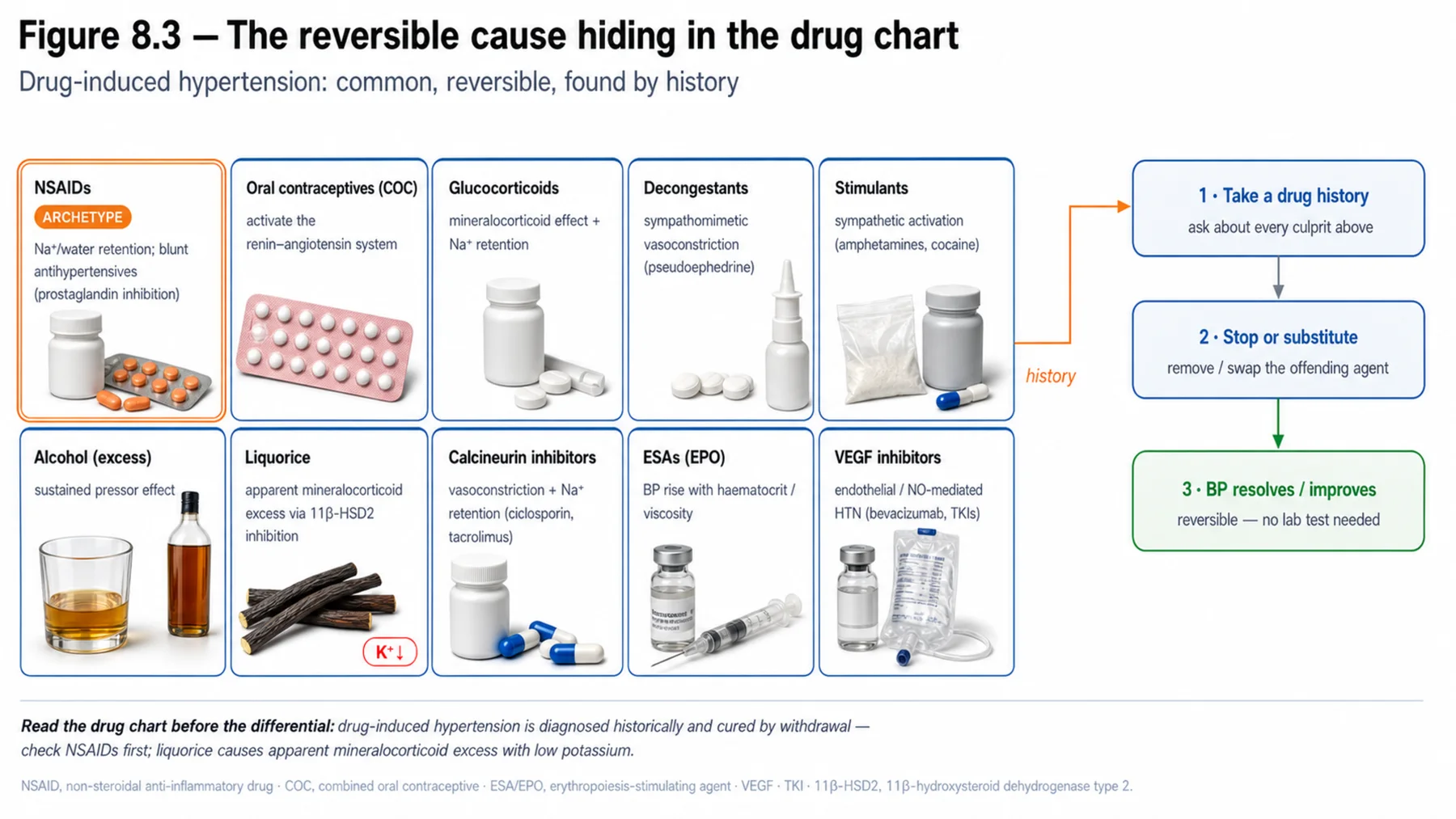
One category deserves emphasis because it is common, reversible, and easily overlooked: drug- and substance-induced hypertension. A wide range of agents raise blood pressure — NSAIDs (very common, through sodium retention and reduced renal prostaglandins), combined oral contraceptives, glucocorticoids and other steroids, sympathomimetic decongestants, stimulants and certain illicit drugs, excess alcohol, liquorice (mineralocorticoid effect), calcineurin inhibitors, erythropoietin, and the newer cancer therapies such as VEGF inhibitors. These should be sought by a careful medication and substance history in any hypertensive patient, and especially in resistant or new-onset hypertension, because stopping or substituting the offending agent can resolve the hypertension without further investigation or lifelong drugs. The NSAID is the archetype — ubiquitous, often unmentioned by the patient, and a frequent cause of both new and resistant hypertension. Drug-induced hypertension is the most easily corrected secondary cause, and the cheapest to find: it costs only a thorough history.
— The targeted diagnostic approach
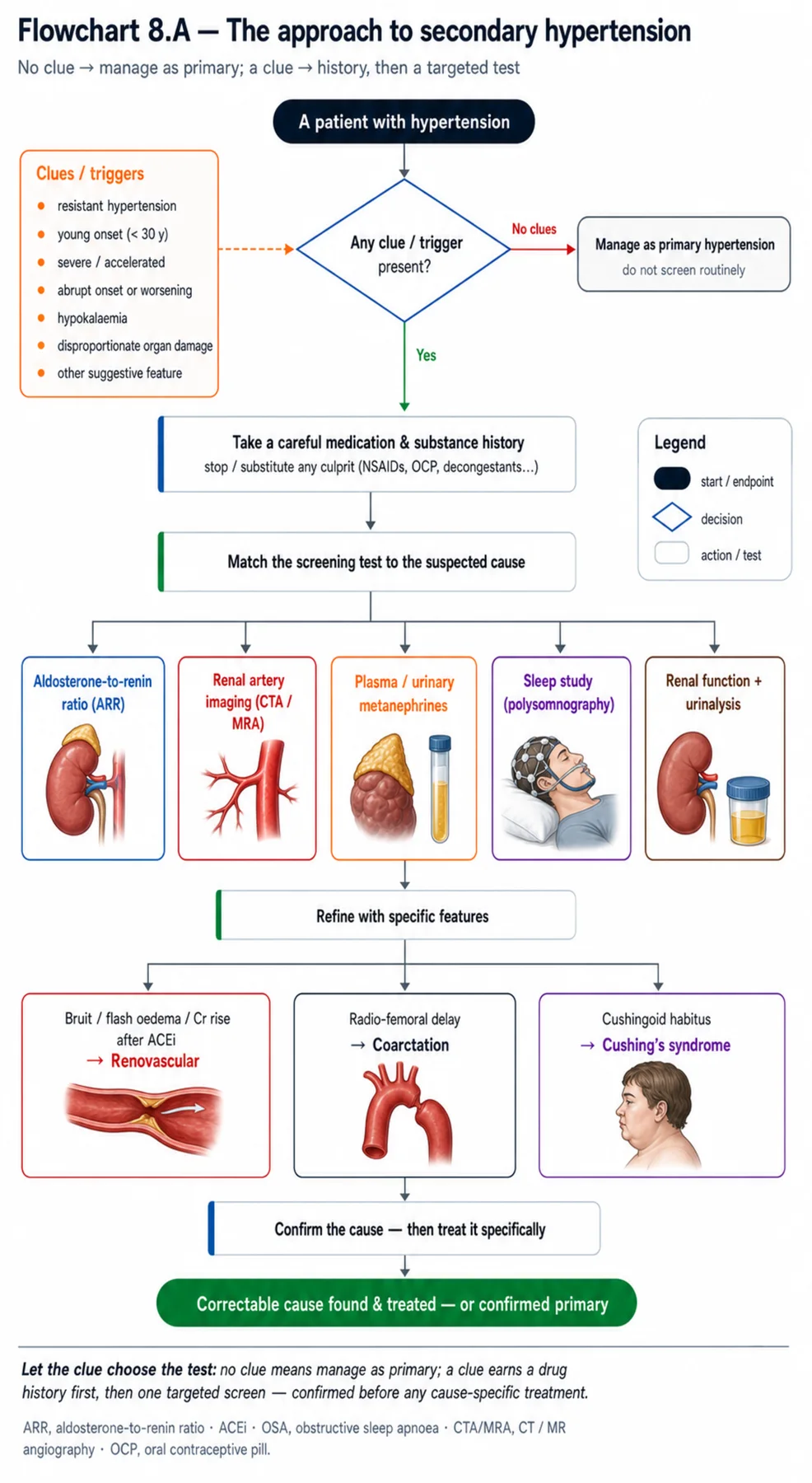
Putting it together, the approach to secondary hypertension is clue-driven and selective. The clinician first asks whether any of the screening triggers is present (resistant, young, severe, abrupt, hypokalaemic, disproportionate organ damage, or a suggestive feature); if so, the clinical picture points to the likely cause, and the appropriate screening test is chosen accordingly — the aldosterone-to-renin ratio for suspected aldosteronism, renal artery imaging for suspected renovascular disease, plasma or urine metanephrines for suspected phaeochromocytoma, a sleep study for suspected apnoea, and a careful drug history (with a low threshold to stop a suspect agent) throughout. Screening is targeted, not universal, because the pre-test probability matters: testing low-probability patients yields more false positives than true diagnoses. The disciplined position is therefore to screen selectively, guided by the clues, choosing the test that matches the suspected cause — and then to confirm and treat in the cause-specific way of the chapters that follow. The renovascular cause comes next, then aldosteronism and the endocrine causes, then the parenchymal, sleep-apnoea, drug, and monogenic causes, each with its own diagnosis and treatment built on this framework of when to look and what to look for.
| 04 | PHASE A · LEVEL 4 · ORIENTATION & KNOWLEDGE Reference Tables |
Table 8.1 — When to suspect/screen for secondary hypertension
| Clue | Detail |
| Resistant hypertension | Uncontrolled on ≥ 3 drugs (incl. a diuretic), or controlled on ≥ 4 |
| Young onset | Before ~30, especially without usual risk factors |
| Severe / accelerated / emergency | Malignant hypertension or a hypertensive emergency |
| Abrupt onset / sudden worsening | Of previously controlled hypertension |
| Hypokalaemia / disproportionate organ damage | Spontaneous hypokalaemia (aldosteronism); organ damage out of proportion |
Table 8.2 — The major causes and their signatures
| Cause | Signature |
| Primary aldosteronism | Commonest endocrine cause; often normokalaemic (Chapter 10) |
| Renovascular | Bruit, flash pulmonary oedema, Cr rise on RAAS blockade, asymmetric kidneys (Chapter 9) |
| Renal parenchymal (CKD) | Commonest secondary cause overall — renal function/urinalysis |
| Obstructive sleep apnoea | Obesity, snoring, daytime sleepiness, non-dipping |
| Phaeochromocytoma | Episodic HTN; headache, palpitations, sweating triad |
Table 8.3 — The screening tests
| Suspected cause | Screening test |
| Primary aldosteronism | Aldosterone-to-renin ratio |
| Renovascular | Renal artery imaging (duplex, CT/MR angiography) |
| Phaeochromocytoma | Plasma or 24-hour urinary metanephrines |
| Obstructive sleep apnoea | Sleep study |
| Drug-induced | A careful medication and substance history |
Table 8.4 — Renovascular and endocrine clues
| Cause | Clues |
| Atherosclerotic renal artery stenosis | Older, diffuse vascular disease, smoking |
| Fibromuscular dysplasia | Younger women |
| Renovascular (any) | Abdominal bruit, flash pulmonary oedema, Cr rise on ACEi/ARB, asymmetric kidneys |
| Cushing's / phaeochromocytoma / thyroid | Cushingoid features / paroxysms / thyroid signs |
Table 8.5 — Drug- and substance-induced hypertension
| Agent | Note |
| NSAIDs | Very common — sodium retention; new and resistant hypertension |
| Oral contraceptives / glucocorticoids | Hormonal causes |
| Decongestants / stimulants / alcohol | Sympathomimetic / dose-dependent |
| Liquorice / calcineurin inhibitors / EPO / VEGF inhibitors | Mineralocorticoid / drug-specific mechanisms |
Table 8.6 — The targeted approach
| Principle | Detail |
| Targeted, not universal | Screen when clues present — pre-test probability matters |
| Match the test to the cause | Aldosterone:renin, imaging, metanephrines, sleep study, drug history |
| Drug history always | The cheapest and most reversible cause |
| Then confirm and treat | Cause-specific, in the chapters that follow |
| 05 | PHASE B · LEVEL 5 · VISUALISE & MAP Imaging & Flowchart Specifications |
| 06 | PHASE B · LEVEL 6 · VISUALISE & MAP Concept Maps |
Each chain runs from clue to a named diagnostic action; read the arrows as “leads to.”
When to screen. A trigger (resistant, young, severe, abrupt, hypokalaemic, disproportionate organ damage) → raised pre-test probability → ACTION: screen selectively when the clues are present, not universally.
Primary aldosteronism. The commonest endocrine cause, often normokalaemic → hypokalaemia is a clue but not required → ACTION: screen with the aldosterone-to-renin ratio whenever a trigger is present (Chapter 10).
Renovascular. Renal artery stenosis → bruit, flash pulmonary oedema, creatinine rise on RAAS blockade, asymmetric kidneys → ACTION: suspect renovascular hypertension and image the renal arteries (Chapter 9).
Drug-induced. NSAIDs, oral contraceptives, decongestants, alcohol, etc. → reversible hypertension → ACTION: take a careful drug/substance history and stop or substitute the culprit — the cheapest correctable cause.
The targeted approach. Clue → likely cause → matched screening test → confirm → treat → ACTION: let the clinical signature select the test rather than screening everyone for everything.
| 07 | PHASE B · LEVEL 7 · VISUALISE & MAP Decision Pathways |
| R1 | IF a hypertensive patient has a screening trigger — resistant, young, severe, abrupt, hypokalaemic, or disproportionate organ damage — THEN screen for a secondary cause. |
| R2 | IF there are no clues in a typical middle-aged hypertensive, THEN do not screen routinely — the pre-test probability is low. |
| R3 | IF any hypertensive patient is assessed, THEN take a careful medication and substance history — drug-induced hypertension is common, reversible, and easily missed. |
| R4 | IF a secondary cause is suspected, THEN match the screening test to the suspected cause rather than testing for everything. |
| R5 | IF primary aldosteronism is considered, THEN screen with the aldosterone-to-renin ratio — do not require hypokalaemia, as most cases are normokalaemic. |
| R6 | IF there is a bruit, flash pulmonary oedema, a creatinine rise on RAAS blockade, or asymmetric kidneys, THEN suspect renovascular hypertension and image the renal arteries. |
| R7 | IF a young patient has radio-femoral delay or an arm-leg blood-pressure differential, THEN consider coarctation of the aorta. |
| R8 | IF a cause is found, THEN confirm and treat it specifically — a curable cause spares lifelong therapy. |
| 08 | PHASE C · LEVEL 8 · CLINICAL REASONING Clinical Cases |
| CASE 1 | RESISTANT AND LOW POTASSIUM Screen for aldosteronism The hypokalaemia clue |
Presentation
A patient with resistant hypertension (uncontrolled on three drugs including a diuretic) has spontaneous hypokalaemia. The team has not considered a secondary cause.
❖ Pause and reflect What secondary cause do the resistance and hypokalaemia suggest? |
Analysis
Primary aldosteronism. Two strong clues are present: resistant hypertension (a major trigger to screen for any secondary cause) and spontaneous hypokalaemia (classically associated with aldosterone excess). Aldosteronism is the commonest endocrine cause of secondary hypertension, and although most cases are actually normokalaemic, the presence of spontaneous hypokalaemia here makes it especially likely. The appropriate screening test is the aldosterone-to-renin ratio. Missing this would leave a potentially curable or specifically treatable cause undiagnosed and the patient on escalating drug therapy.
Plan
Screen for primary aldosteronism with the aldosterone-to-renin ratio, given the resistant hypertension and spontaneous hypokalaemia, and pursue the diagnosis (Chapter 10). Let the clues trigger targeted screening.
Teaching point
Resistant hypertension with spontaneous hypokalaemia points to primary aldosteronism — screen with the aldosterone-to-renin ratio.
Cross-reference
Exercises rules R1 and R5; the aldosteronism concept map; Figure 8.2; Tables 8.1, 8.3; aldosteronism in Chapter 10.
| CASE 2 | TOO YOUNG, TOO SUDDEN Young onset triggers the search Young-onset hypertension |
Presentation
A previously normotensive patient in their twenties develops significant hypertension with no family history, obesity, or other risk factors. A clinician plans simply to start an antihypertensive.
❖ Pause and reflect Should this young patient be screened for a secondary cause? |
Analysis
Yes — young onset is a key trigger to screen. Hypertension developing before about 30, especially without the usual risk factors (family history, obesity), has a substantially higher probability of a secondary, often correctable cause — renovascular disease (including fibromuscular dysplasia, classically in young women), aldosteronism, renal parenchymal disease, coarctation, or a monogenic syndrome. Simply starting a drug without investigation would risk missing a curable cause and committing a young person to lifelong therapy. The clinical picture should be examined for specific features (a bruit, radio-femoral delay) to direct the screening tests.
Plan
Screen for a secondary cause given the young onset — examine for specific features and target the tests (renal artery imaging, aldosterone-to-renin ratio, assessment for coarctation) accordingly — before settling on lifelong drug therapy. Treat young onset as a screening trigger.
Teaching point
Young-onset hypertension (before ~30, without risk factors) is a key trigger to screen for a secondary, often correctable cause.
Cross-reference
Exercises rules R1 and R7; the when-to-screen concept map; Figure 8.1; Tables 8.1, 8.4; renovascular in Chapter 9.
| CASE 3 | THE FORGOTTEN TABLETS Take the drug history Drug-induced hypertension |
Presentation
A patient with new, difficult-to-control hypertension is found, on careful questioning, to be taking regular over-the-counter NSAIDs for chronic joint pain — not previously mentioned. Extensive secondary screening had been planned.
❖ Pause and reflect What is the likely cause, and what is the simplest correction? |
Analysis
Drug-induced hypertension from the NSAIDs — the most easily missed and most easily corrected secondary cause. NSAIDs raise blood pressure (and impair antihypertensive efficacy) through sodium retention and reduced renal prostaglandins, and are a very common cause of both new and resistant hypertension; patients often do not mention over-the-counter medications. A careful medication and substance history found the culprit, and stopping or substituting the NSAID may resolve the hypertension without the planned extensive (and costly) investigation. This is why a thorough drug history is part of the assessment of every hypertensive patient.
Plan
Stop or substitute the NSAID (with an alternative analgesic strategy) and reassess the blood pressure before pursuing extensive secondary screening; the hypertension may resolve. Always take a careful drug history — it is the cheapest correctable cause.
Teaching point
Drug-induced hypertension (especially NSAIDs) is common, reversible, and easily missed — a careful drug history can spare extensive investigation.
Cross-reference
Exercises rule R3; the drug-induced concept map; Figure 8.3; Tables 8.5, 8.6; drug-induced hypertension in Chapter 11.
| CASE 4 | DON'T SCREEN EVERYONE Targeted, not universal Clue-driven screening |
Presentation
An enthusiastic trainee proposes an exhaustive secondary-hypertension work-up — aldosterone-to-renin ratio, renal artery imaging, metanephrines, and more — for a typical middle-aged patient with mild primary hypertension and no clues.
❖ Pause and reflect Should every hypertensive patient receive an exhaustive secondary work-up? |
Analysis
No — screening is targeted, not universal. In a typical middle-aged patient with mild primary hypertension and none of the screening triggers, the pre-test probability of a secondary cause is low, so an exhaustive work-up would yield more false positives (leading to further unnecessary testing and anxiety) than true diagnoses, and would waste resources. Secondary screening is reserved for patients with the clues — resistant, young, severe, abrupt, hypokalaemic, or disproportionate organ damage — in whom the pre-test probability is high enough to justify it. A careful drug history, however, should be taken in everyone.
Plan
Do not perform an exhaustive secondary work-up in this clue-free patient; manage as primary hypertension, taking a careful drug history, and screen only if a trigger emerges. Screen selectively, guided by the clues and the pre-test probability.
Teaching point
Secondary screening is targeted to the clues, not universal — testing low-probability patients yields more false positives than diagnoses.
Cross-reference
Exercises rules R2 and R4; the targeted-approach concept map; Table 8.6.
| 09 | PHASE C · LEVEL 9 · CLINICAL REASONING Clinical Implications |
One triad per mechanism the narrative exposed: the physiology, why it matters, and the diagnostic action.
MECHANISM Secondary hypertension has an identifiable, often correctable cause and is overrepresented in resistant, young, and severe hypertension. |
WHY IT MATTERS Finding it can cure the hypertension or direct specific treatment. |
ACTION Screen the high-probability groups, where the yield is high. |
MECHANISM Specific clinical clues raise the pre-test probability of a secondary cause. |
WHY IT MATTERS Screening low-probability patients yields more false positives than diagnoses. |
ACTION Screen selectively when a clue is present, not universally. |
MECHANISM Primary aldosteronism is common and most cases are normokalaemic. |
WHY IT MATTERS Requiring hypokalaemia to suspect it misses the majority. |
ACTION Screen with the aldosterone-to-renin ratio whenever a trigger is present. |
MECHANISM Renal artery stenosis produces a bruit, flash pulmonary oedema, and a creatinine rise on RAAS blockade. |
WHY IT MATTERS These signatures point to a treatable renovascular cause. |
ACTION Suspect renovascular hypertension on these clues and image the renal arteries. |
MECHANISM Many drugs and substances raise blood pressure reversibly. |
WHY IT MATTERS Drug-induced hypertension is common, easily overlooked, and the cheapest to correct. |
ACTION Take a careful drug history in every hypertensive patient. |
| 10 | PHASE C · LEVEL 10 · CLINICAL REASONING Clinical Pearls |
| Secondary hypertension = an identifiable, often correctable cause (~5–15%). | Higher in resistant, young, and severe hypertension. |
| Screen when clues are present — not universally. | Triggers: resistant, young onset, severe/accelerated, abrupt, hypokalaemia, disproportionate organ damage. |
| Primary aldosteronism: commonest endocrine cause — often NORMOKALAEMIC. | Don't require hypokalaemia to screen for aldosteronism (aldosterone:renin ratio). |
| Renovascular: bruit, flash pulmonary oedema, Cr rise on ACEi/ARB, asymmetric kidneys. | Atherosclerotic RAS (older) vs fibromuscular dysplasia (younger women). |
| Renal parenchymal disease (CKD) = commonest secondary cause overall. | OSA: common, underdiagnosed — obesity, snoring, non-dipping. |
| Phaeochromocytoma: episodic HTN; headache/palpitations/sweating triad; metanephrines. | Coarctation: radio-femoral delay, arm-leg BP differential (young). |
| Drug-induced: NSAIDs, OCP, steroids, decongestants, alcohol, liquorice — reversible. | Take a careful drug history in EVERY hypertensive patient. |
| Match the screening test to the suspected cause. | Find a curable cause → spare lifelong therapy. |
| 11 | PHASE D · LEVEL 11 · SAFETY & EVIDENCE Red Flags & Never-Do |
Panel A — Red flags
| ▲ | Resistant hypertension — a major trigger to screen for a secondary cause. |
| ▲ | Hypertension before ~30 without risk factors — screen for a secondary, often correctable cause. |
| ▲ | Spontaneous hypokalaemia — screen for primary aldosteronism (but don't require it). |
| ▲ | A creatinine rise on starting a RAAS blocker — suspect bilateral renovascular disease. |
| ▲ | New or resistant hypertension — take a careful drug history (NSAIDs, decongestants, OCP). |
Panel B — Never do
| ✖ NEVER — screen every hypertensive patient exhaustively for every secondary cause. |
| ✖ NEVER — require hypokalaemia before screening for primary aldosteronism. |
| ✖ NEVER — omit the drug and substance history in a hypertensive patient. |
| ✖ NEVER — commit a young patient to lifelong therapy without considering a secondary cause. |
| 12 | PHASE D · LEVEL 12 · SAFETY & EVIDENCE Common Pitfalls |
Pitfall 1 — Universal screening
| ✖ | WRONG Screening every hypertensive patient for every secondary cause. |
| ✓ | RIGHT Screening selectively when the clues are present. |
| ✉ | WHY Low pre-test probability yields more false positives than diagnoses. |
Pitfall 2 — Requiring hypokalaemia
| ✖ | WRONG Excluding aldosteronism because the potassium is normal. |
| ✓ | RIGHT Screening with the aldosterone-to-renin ratio regardless. |
| ✉ | WHY Most cases of primary aldosteronism are normokalaemic. |
Pitfall 3 — Skipping the drug history
| ✖ | WRONG Pursuing extensive screening without a drug history. |
| ✓ | RIGHT Taking a careful medication/substance history first. |
| ✉ | WHY Drug-induced hypertension is common, reversible, and cheap to find. |
Pitfall 4 — Ignoring young onset
| ✖ | WRONG Starting lifelong drugs in a young hypertensive without investigation. |
| ✓ | RIGHT Screening for a secondary cause given the young onset. |
| ✉ | WHY Young onset has a high probability of a correctable cause. |
Pitfall 5 — Wrong test for the picture
| ✖ | WRONG Ordering a blanket panel regardless of the clinical picture. |
| ✓ | RIGHT Matching the screening test to the suspected cause. |
| ✉ | WHY The signature directs the appropriate test. |
| 13 | PHASE D · LEVEL 13 · SAFETY & EVIDENCE Evidence Grading |
GRADE A HIGH CONFIDENCE The effect is real and the estimate is stable. RCTs at low risk of bias; multiple concordant prospective cohorts; meta-analyses. |
GRADE B MODERATE CONFIDENCE The effect is likely real but may shift with new data. Observational studies, registries, mechanistic human studies. |
GRADE C LOW CONFIDENCE Rests on physiology, reasoning, or consensus rather than outcomes. Pathophysiological reasoning; extrapolation; consensus without outcomes. |
Graded statements (by evidence type)
| Statement | Grade | Basis (evidence type) |
| Secondary hypertension is overrepresented in resistant, young, and severe disease. | A | Epidemiological data |
| Targeted, clue-driven screening is more appropriate than universal screening. | A | Diagnostic-yield and guideline data |
| Primary aldosteronism is common and frequently normokalaemic. | A | Prevalence studies |
| Renovascular hypertension produces characteristic clinical clues. | A | Clinical and imaging data |
| Drug- and substance-induced hypertension is common and reversible. | A | Clinical data |
| A curable secondary cause can spare lifelong therapy. | A | Clinical outcome data |
| The clinical signature should select the screening test. | A | Diagnostic reasoning |
| 18 | PHASE F · LEVEL 18 · APPLY & TEST Cheat Sheet |
| Secondary HTN = identifiable, often correctable cause (~5–15%). | Higher in resistant/young/severe. |
| Screen when clues present — NOT universally. | Triggers: resistant, young, severe/accelerated, abrupt, hypokalaemia, disproportionate organ damage. |
| Primary aldosteronism: commonest endocrine — often normokalaemic. | Aldosteronism screen: aldosterone-to-renin ratio (don't need hypoK). |
| Renovascular: bruit, flash oedema, Cr rise on ACEi/ARB, asymmetric kidneys. | Atherosclerotic RAS (older) vs FMD (young women). |
| Renal parenchymal (CKD) = commonest secondary overall. | OSA: obesity, snoring, non-dipping — sleep study. |
| Phaeo: episodic HTN; headache/palpitations/sweating; metanephrines. | Coarctation: radio-femoral delay, arm-leg BP gradient. |
| Drug-induced: NSAIDs, OCP, steroids, decongestants, alcohol, liquorice. | Drug history in EVERYONE. |
| Match the test to the suspected cause. | Curable cause → spare lifelong therapy. |
| 19 | PHASE F · LEVEL 19 · APPLY & TEST Flashcards |
| CARD 1 | Q. What is secondary hypertension and why does it matter? A. Hypertension with an identifiable, often correctable cause — about 5 to 15% overall, more in resistant, young, and severe disease — that matters because the cause may be cured or specifically treated and because it underlies much resistant hypertension. DETAILED. Finding it can spare lifelong therapy. CLINICAL. Screen the high-probability groups. |
| CARD 2 | Q. When should secondary hypertension be screened for? A. When a clue raises the pre-test probability: resistant hypertension, young onset, severe or accelerated hypertension, an abrupt onset or worsening, hypokalaemia, or disproportionate target-organ damage — and on suggestive clinical features. DETAILED. Screening is targeted, not universal. CLINICAL. Screen selectively when a trigger is present. |
| CARD 3 | Q. Why is a normal potassium not enough to exclude primary aldosteronism? A. Because most cases of primary aldosteronism — the commonest endocrine cause — are normokalaemic; hypokalaemia is a clue but is not required, so screening with the aldosterone-to-renin ratio should not be withheld for a normal potassium. DETAILED. Requiring hypokalaemia misses the majority. CLINICAL. Screen with the aldosterone-to-renin ratio regardless of the potassium. |
| CARD 4 | Q. What are the clues to renovascular hypertension? A. An abdominal bruit, recurrent flash pulmonary oedema, a significant rise in creatinine after starting a RAAS blocker, and asymmetric kidney size — atherosclerotic in older patients with vascular disease, fibromuscular dysplasia in younger women. DETAILED. These signatures point to a treatable renovascular cause. CLINICAL. Suspect it on these clues and image the renal arteries. |
| CARD 5 | Q. Why is the drug history so important in hypertension? A. Because drug- and substance-induced hypertension — from NSAIDs, oral contraceptives, glucocorticoids, decongestants, stimulants, alcohol, liquorice, and others — is common, reversible, and easily overlooked, and a careful history can resolve the hypertension without further investigation. DETAILED. The NSAID is the archetype, often unmentioned. CLINICAL. Take a careful drug history in every hypertensive patient. |
| CARD 6 | Q. How does phaeochromocytoma present, and how is it screened? A. With episodic (paroxysmal) hypertension and the classic triad of headache, palpitations, and sweating; it is screened with plasma or 24-hour urinary metanephrines. DETAILED. It carries the specific risk of catecholamine surges. CLINICAL. Screen with metanephrines when paroxysmal features are present. |
| CARD 7 | Q. What is the renal parenchymal and sleep-apnoea contribution? A. Renal parenchymal disease (CKD) is the commonest secondary cause overall, identified by renal function and urinalysis; obstructive sleep apnoea is a common, under-diagnosed contributor suggested by obesity, snoring, daytime sleepiness, and a non-dipping nocturnal pattern. DETAILED. Both are frequently present and addressable. CLINICAL. Assess renal function and consider a sleep study. |
| CARD 8 | Q. What is the overall diagnostic approach to secondary hypertension? A. Clue-driven and selective: let the screening triggers raise suspicion, let the clinical signature point to the likely cause, and choose the matched screening test — with a careful drug history throughout — rather than screening everyone for everything. DETAILED. Pre-test probability matters. CLINICAL. Screen selectively and match the test to the suspected cause. |
| 20 | PHASE F · LEVEL 20 · APPLY & TEST One-Minute Preceptor |
| SCENE 1 | The intern who skips the drug history |
GET A COMMITMENT. “You want an extensive secondary work-up for this new resistant hypertension — what have you asked about first?”
PROBE FOR EVIDENCE. “The blood pressure is high” — ask: “What over-the-counter or other medications is the patient taking?”
TEACH A GENERAL RULE. Drug-induced hypertension — NSAIDs especially — is common, reversible, and easily missed, so a careful drug history comes before extensive screening.
REINFORCE WHAT WAS RIGHT. Recognising the resistance as a trigger was correct.
CORRECT A MISTAKE. Take a thorough drug history and stop a culprit before the costly work-up.
| SCENE 2 | The resident who needs the potassium low |
GET A COMMITMENT. “You're not screening for aldosteronism because the potassium is normal — why?”
PROBE FOR EVIDENCE. “Aldosteronism causes hypokalaemia” — ask: “What fraction of primary aldosteronism is actually normokalaemic?”
TEACH A GENERAL RULE. Most primary aldosteronism is normokalaemic, so a normal potassium does not exclude it — screen with the aldosterone-to-renin ratio when a trigger is present.
REINFORCE WHAT WAS RIGHT. Knowing hypokalaemia is associated was correct.
CORRECT A MISTAKE. Screen with the aldosterone-to-renin ratio regardless of the potassium.
| 22 | PHASE F · LEVEL 22 · APPLY & TEST Board-Style Questions |
| Q 01 | Which feature should trigger screening for a secondary cause of hypertension? |
| A | Typical middle-aged onset with a family history |
| B | Resistant hypertension or young onset |
| C | Mild stage 1 hypertension |
| D | An obese patient with sleep complaints alone? no — controlled BP |
Rationale Resistant hypertension and young onset are key screening triggers (Figure 8.1, Table 8.1, rule R1). A is typical primary; C is low-probability. |
| Q 02 | Why is screening for secondary hypertension targeted rather than universal? |
| A | Testing is harmful |
| B | Low pre-test probability yields more false positives than true diagnoses |
| C | Secondary causes are untreatable |
| D | Guidelines forbid it |
Rationale Screening low-probability patients generates false positives; screen when clues raise the probability (case 4, Table 8.6, rule R2). A, C, and D are incorrect. |
| Q 03 | A normal serum potassium in a patient with resistant hypertension: |
| A | Excludes primary aldosteronism |
| B | Does not exclude primary aldosteronism — most cases are normokalaemic |
| C | Means no screening is needed |
| D | Confirms primary hypertension |
Rationale Most primary aldosteronism is normokalaemic, so a normal potassium does not exclude it (case 1, rule R5). A, C, and D are wrong. |
| Q 04 | Which clue points to renovascular hypertension? |
| A | A normal creatinine on RAAS blockade |
| B | An abdominal bruit, flash pulmonary oedema, or a creatinine rise on a RAAS blocker |
| C | A normal renal ultrasound |
| D | Low aldosterone |
Rationale These are the classic renovascular clues (Table 8.4, rule R6). A is reassuring; C and D do not point to renovascular disease. |
| Q 05 | The commonest secondary cause of hypertension overall is: |
| A | Phaeochromocytoma |
| B | Renal parenchymal disease (CKD) |
| C | Coarctation |
| D | Cushing's syndrome |
Rationale Renal parenchymal disease is the commonest secondary cause overall (Table 8.2). A, C, and D are less common. |
| Q 06 | A young patient with hypertension and radio-femoral delay should be evaluated for: |
| A | Phaeochromocytoma |
| B | Coarctation of the aorta |
| C | Sleep apnoea |
| D | Hypothyroidism |
Rationale Radio-femoral delay and an arm-leg blood-pressure differential suggest coarctation (Table 8.2, rule R7). A, C, and D do not cause this sign. |
| Q 07 | The most easily missed and most easily corrected secondary cause is: |
| A | Renovascular disease |
| B | Drug- or substance-induced hypertension (e.g. NSAIDs) |
| C | Phaeochromocytoma |
| D | Coarctation |
Rationale Drug-induced hypertension is common, reversible, and found by a careful history (case 3, Figure 8.3, rule R3). A, C, and D require imaging or biochemical work-up. |
| Q 08 | The screening test for suspected primary aldosteronism is: |
| A | Renal artery imaging |
| B | The aldosterone-to-renin ratio |
| C | Plasma metanephrines |
| D | A sleep study |
Rationale The aldosterone-to-renin ratio screens for primary aldosteronism (Table 8.3, rule R5). A is for renovascular disease, C for phaeochromocytoma, D for sleep apnoea. |