Chapter Preamble
Signals declared
Sig-D — Diagnostic (primary). Recognise hypertensive nephrosclerosis clinically, distinguish benign from malignant, and separate it from other causes of CKD.
Sig-T — Therapeutic (strong). Protect the kidney with blood-pressure control, RAAS blockade where proteinuric, and the CKD management package.
Sig-M — Mechanistic (strong). How chronic hypertension damages the renal vasculature, the failure of autoregulation that transmits pressure to the glomerulus, and the APOL1 contribution.
Levels populated and omitted
Populated (19): L1–L14, L17–L20, L22. The mechanistic signal fires the concept maps (L6) and triads (L9); the therapeutic signal fires the absolute-risk table (L14) and templates (L17); the diagnostic signal drives the tables, rules, cases, pitfalls, and board items.
L15 / L16 preference-sensitive map and SDM scripts — omitted. No Sig-E; protecting the kidney from hypertension is effective care (the BP-target debate lives in the CKD chapter).
L21 reflective prompts — omitted. No Sig-E/V; the chapter's tensions (the APOL1 reframing of 'hypertensive' nephropathy) are worked through the cases and pitfalls.
| 01 | PHASE A · LEVEL 1 · ORIENTATION & KNOWLEDGE Learning Objectives |
By the end of this chapter you should be able to:
Explain how chronic hypertension damages the kidney to cause nephrosclerosis.
Distinguish benign from malignant nephrosclerosis by their histology and course.
Explain renal autoregulation and how its failure transmits pressure to the glomerulus.
Describe the ischaemic and hyperfiltration routes of glomerular injury.
Recognise the APOL1 contribution to hypertension-attributed kidney disease.
Recognise hypertensive nephrosclerosis clinically and distinguish it from other CKD.
Protect the kidney with blood-pressure control and RAAS blockade where appropriate.
Explain the cause-and-victim cycle of hypertension and kidney disease.
| 02 | PHASE A · LEVEL 2 · ORIENTATION & KNOWLEDGE Executive Summary |
Hypertensive nephrosclerosis is the kidney damage caused by chronic hypertension — the kidney as victim — and is a leading cause of end-stage kidney disease.
Chronic hypertension damages the renal microvasculature, causing ischaemic injury, glomerulosclerosis, and tubulointerstitial fibrosis, and a progressive decline in function.
Benign nephrosclerosis is the gradual form, with hyaline arteriolosclerosis and glomerular sclerosis, presenting as slowly progressive CKD with modest proteinuria and a bland urine.
Malignant (accelerated) nephrosclerosis accompanies severe hypertension, with fibrinoid necrosis and a thrombotic microangiopathy, causing acute kidney injury — the renal face of the hypertensive emergency.
Renal autoregulation normally constricts the afferent arteriole to protect the glomerulus from systemic pressure.
When autoregulation fails or is exhausted — in severe or chronic hypertension, CKD, or diabetes — the systemic pressure transmits to the glomerulus, causing glomerular hypertension and injury.
Glomerular injury arises by two routes — ischaemia from vascular narrowing and hyperfiltration from transmitted pressure — both ending in glomerulosclerosis.
APOL1 high-risk variants, in people of African ancestry, markedly increase the risk of hypertension-attributed kidney disease, so much of what was called hypertensive nephrosclerosis in Black patients is an APOL1 nephropathy.
The diagnosis is usually clinical and presumptive — long-standing hypertension, slowly progressive CKD, modest proteinuria, a bland sediment, and other target-organ damage — with biopsy reserved for atypical features.
Heavy proteinuria or an active sediment points instead to glomerular disease.
The central protective treatment is blood-pressure control, which slows progression.
RAAS blockade is added where there is proteinuria, lowering the intraglomerular pressure that drives injury.
Controlling the hypertension protects the kidney and interrupts the cause-and-victim cycle in which each worsens the other.
| 03 | PHASE A · LEVEL 3 · ORIENTATION & KNOWLEDGE Main Narrative |
The opening chapter called the kidney both a cause and a victim of hypertension. The secondary-hypertension chapters explored the kidney as cause; this one turns to the kidney as victim — hypertensive nephrosclerosis, the chronic kidney damage that hypertension inflicts, and a leading cause of kidney failure. Understanding how the pressure damages the kidney, and why blood-pressure control protects it, completes the bidirectional relationship and motivates the protective management that follows.
— How hypertension damages the kidney
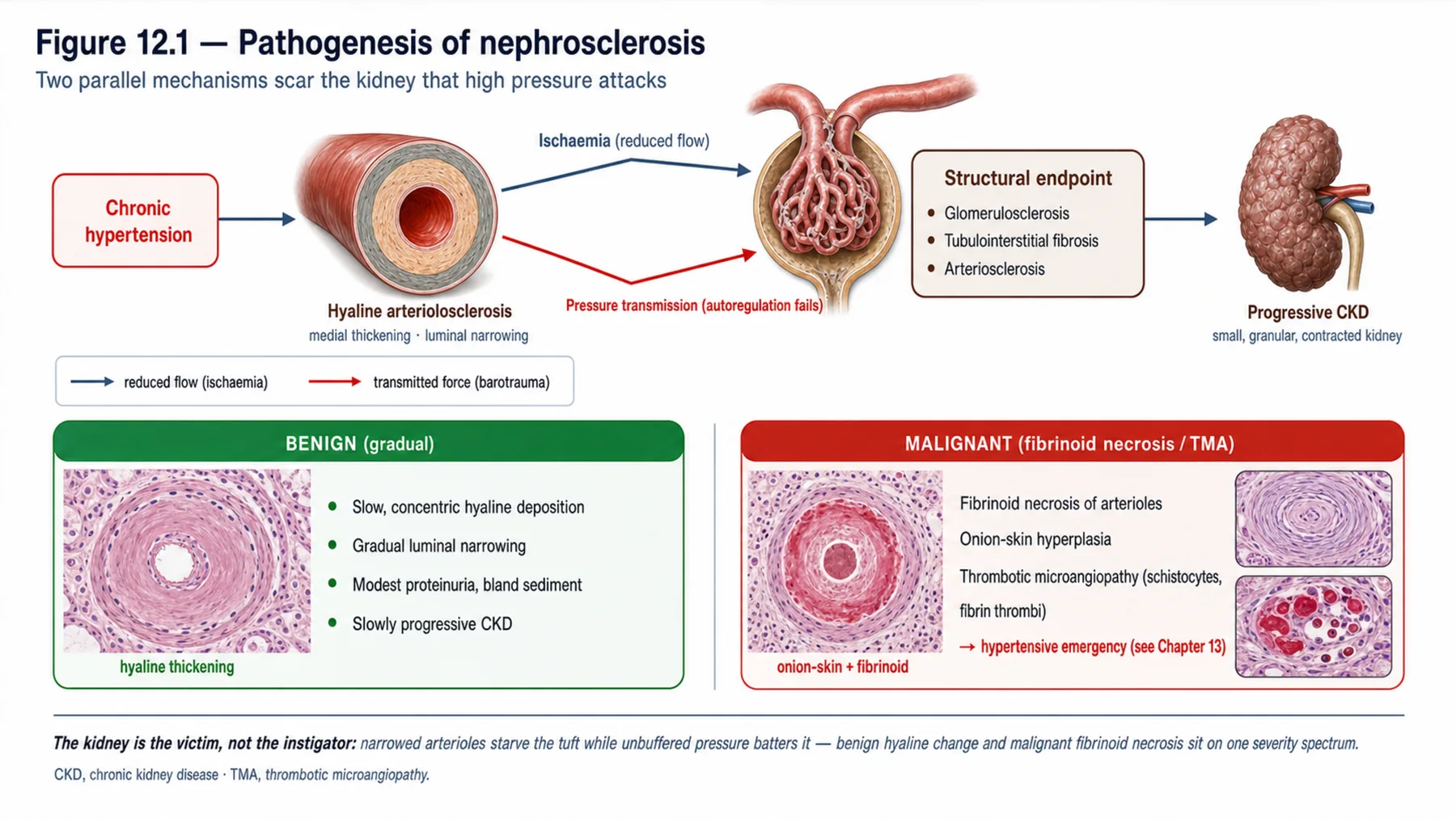
Chronic hypertension damages the kidney chiefly through its small vessels. The sustained high pressure injures the renal arterioles and small arteries, thickening and narrowing them, which both restricts blood flow (causing ischaemic injury downstream) and, where it fails to protect the glomerulus, transmits pressure into it. The result, over years, is hypertensive nephrosclerosis: a combination of arteriolosclerosis (the damaged vessels), glomerulosclerosis (scarred glomeruli), and tubulointerstitial fibrosis (scarred tubules and interstitium), producing a kidney that slowly loses function. This is the histological and functional signature of the kidney as victim, and — because hypertension is so common — it is one of the leading causes of end-stage kidney disease worldwide, second only to diabetes in many populations and especially prominent in Black populations. The damage is the chronic, low-grade counterpart to the acute injury of malignant hypertension.
— Benign and malignant nephrosclerosis
Nephrosclerosis comes in two forms paralleling the severity of the hypertension. Benign nephrosclerosis is the common, chronic form: the arterioles show hyaline arteriolosclerosis (a glassy thickening of the afferent arteriole) and the small arteries show intimal thickening, with global glomerulosclerosis and tubular atrophy, producing a slowly progressive CKD over years. Malignant (or accelerated) nephrosclerosis accompanies malignant or severely accelerated hypertension: the arterioles show fibrinoid necrosis and a hyperplastic 'onion-skin' thickening, with a thrombotic microangiopathy, producing acute or rapidly progressive kidney injury rather than the slow decline of the benign form. This malignant form is the renal manifestation of the hypertensive emergency (the next chapter) and demands urgent, controlled blood-pressure reduction to halt the ongoing injury. The distinction matters because the benign form is managed as chronic CKD with blood-pressure control, while the malignant form is a medical emergency.
— Autoregulation and the transmission of pressure
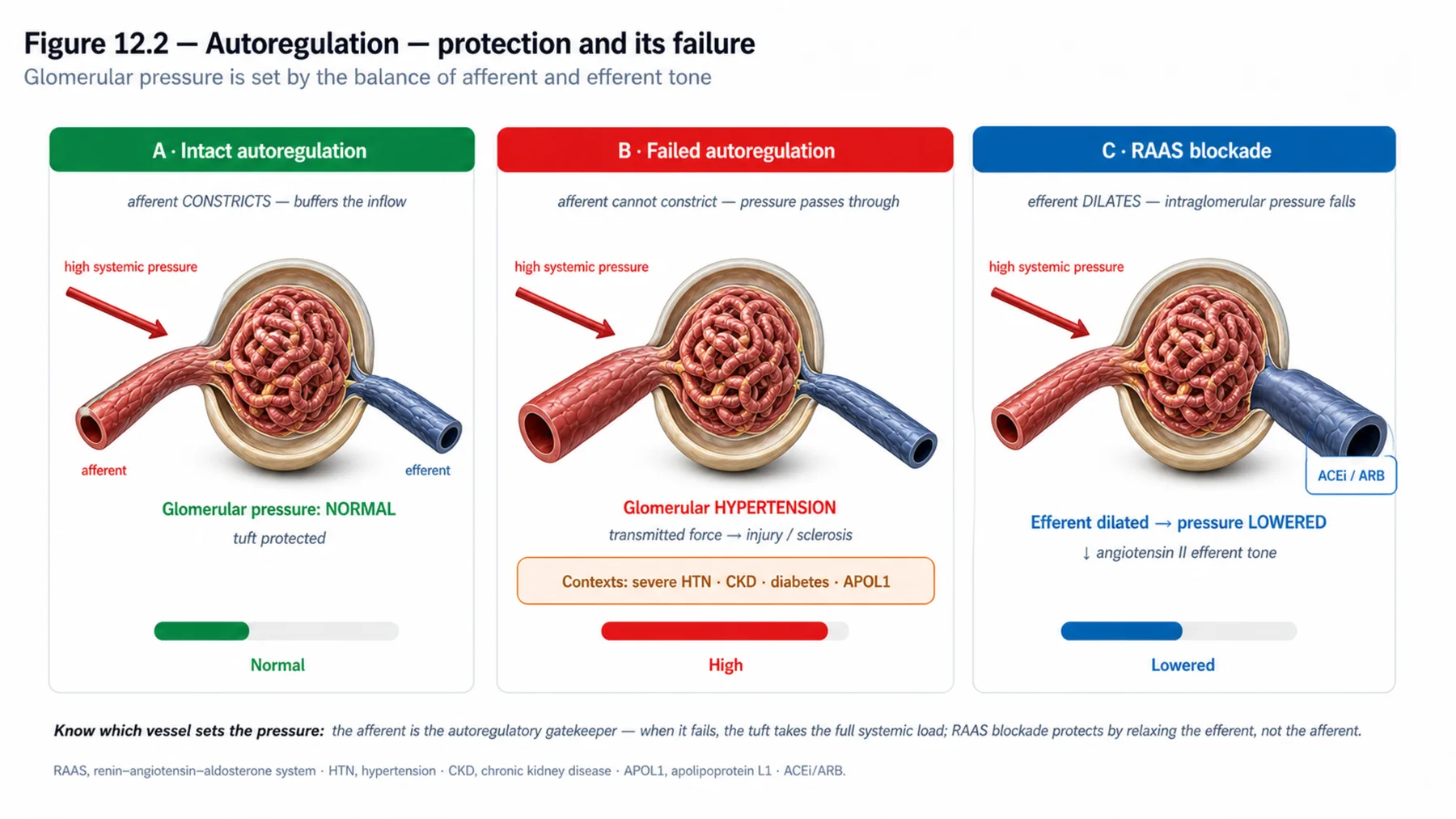
The key mechanism that determines whether systemic pressure damages the glomerulus is renal autoregulation. Normally, the afferent arteriole constricts in response to a rising systemic pressure (through myogenic and tubuloglomerular feedback mechanisms), keeping the glomerular pressure and filtration relatively constant across a range of systemic pressures — it is the glomerulus's protection against the systemic blood pressure. When autoregulation is intact, even fairly high systemic pressures are buffered at the glomerulus. But when autoregulation fails or is exhausted — by severe hypertension overwhelming it, or by the loss of the protective afferent constriction that occurs in CKD, diabetes, and (importantly) in those with APOL1 risk variants — the systemic pressure is transmitted into the glomerulus, causing glomerular hypertension. This transmitted pressure is itself injurious, driving glomerulosclerosis. So the same systemic pressure may be harmless to a kidney with intact autoregulation and harmful to one without it, which explains why kidneys with pre-existing disease (or genetic susceptibility) are so much more vulnerable to hypertensive injury — and why lowering the systemic pressure protects them.
— Two routes of glomerular injury
Hypertensive glomerular injury occurs by two routes, and recognising both clarifies the treatment. The first is ischaemic: the narrowing and sclerosis of the pre-glomerular vessels reduce blood flow to the glomerulus, causing ischaemic shrinkage and global sclerosis. The second is hyperfiltration/glomerular hypertension: where autoregulation fails and systemic pressure is transmitted into the glomerulus, the resulting glomerular hypertension and hyperfiltration damage the glomerular capillaries, causing a different pattern of injury (often with some proteinuria, and at the severe end resembling focal segmental glomerulosclerosis). Both routes converge on glomerulosclerosis and progressive function loss, but the second — the transmitted glomerular hypertension — is the one most amenable to a specific intervention: RAAS blockade dilates the efferent arteriole, lowering the intraglomerular pressure (the renoprotective mechanism from the pharmacotherapy chapter), which is why RAAS blockade is renoprotective in proteinuric hypertensive kidney disease. The two routes also explain the clinical picture, with the ischaemic route giving bland, low-proteinuria CKD and the hyperfiltration route adding proteinuria.
— APOL1 and the high-risk groups
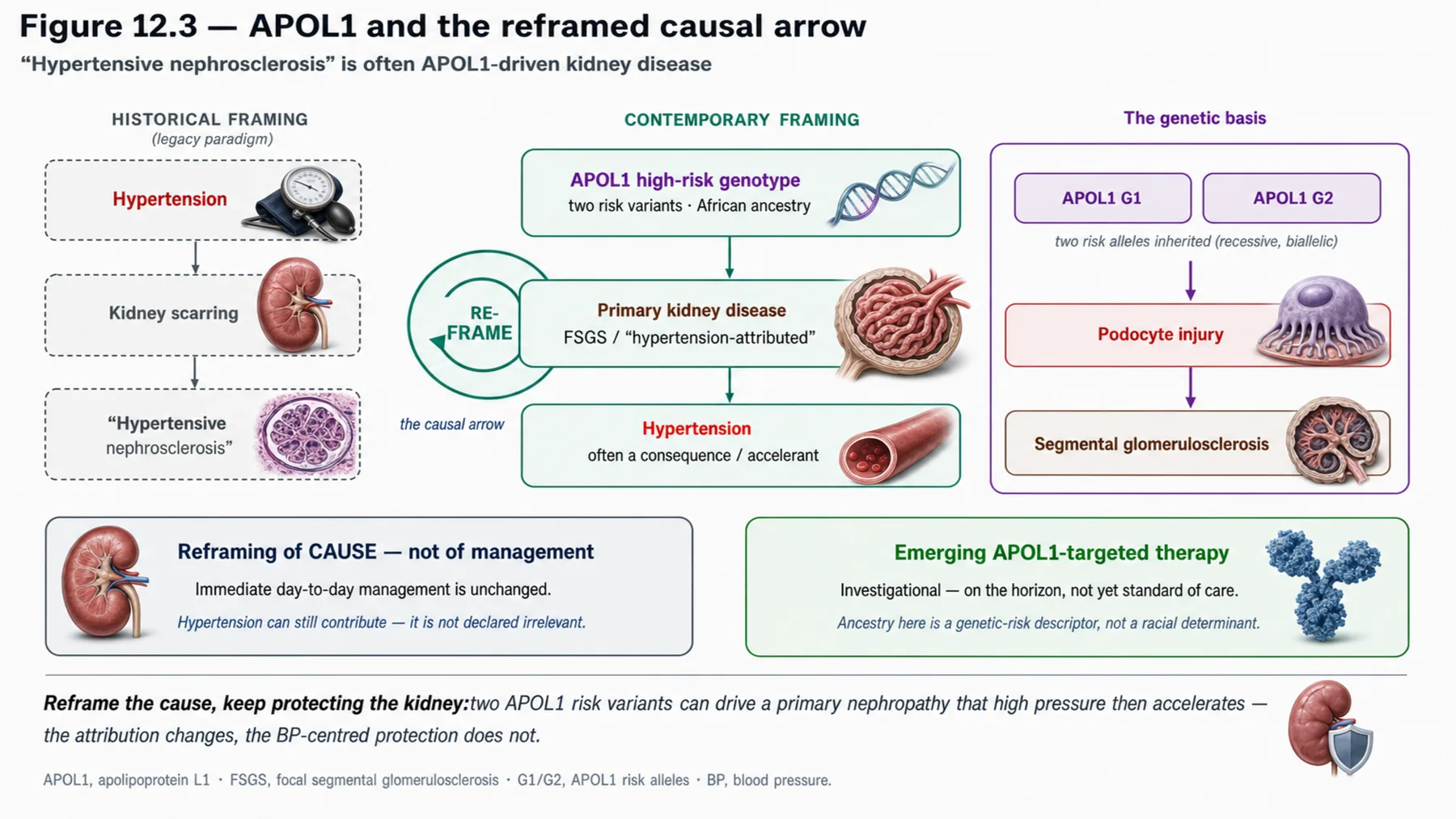
A major modern insight reframes much of 'hypertensive nephrosclerosis,' particularly in Black patients. The APOL1 gene, which carries risk variants (G1 and G2) that arose in West Africa and are common in people of recent African ancestry, is strongly associated with non-diabetic kidney disease — including focal segmental glomerulosclerosis and the kidney disease historically attributed to hypertension. The recognition is that a substantial part of the markedly higher rate of 'hypertensive' kidney disease and end-stage kidney disease in Black populations reflects APOL1 nephropathy — a primary, genetically driven kidney disease — rather than hypertension alone, with the hypertension often a consequence or accelerant rather than the sole cause. This matters for understanding (it explains the disproportionate burden), for research (APOL1-targeted therapies are emerging), and for humility about the label: 'hypertensive nephrosclerosis' in a Black patient may be an APOL1 nephropathy. It does not change the immediate management — blood-pressure control remains central — but it changes the framing, and reminds us that the kidney disease attributed to hypertension is heterogeneous.
— Recognising and protecting the kidney
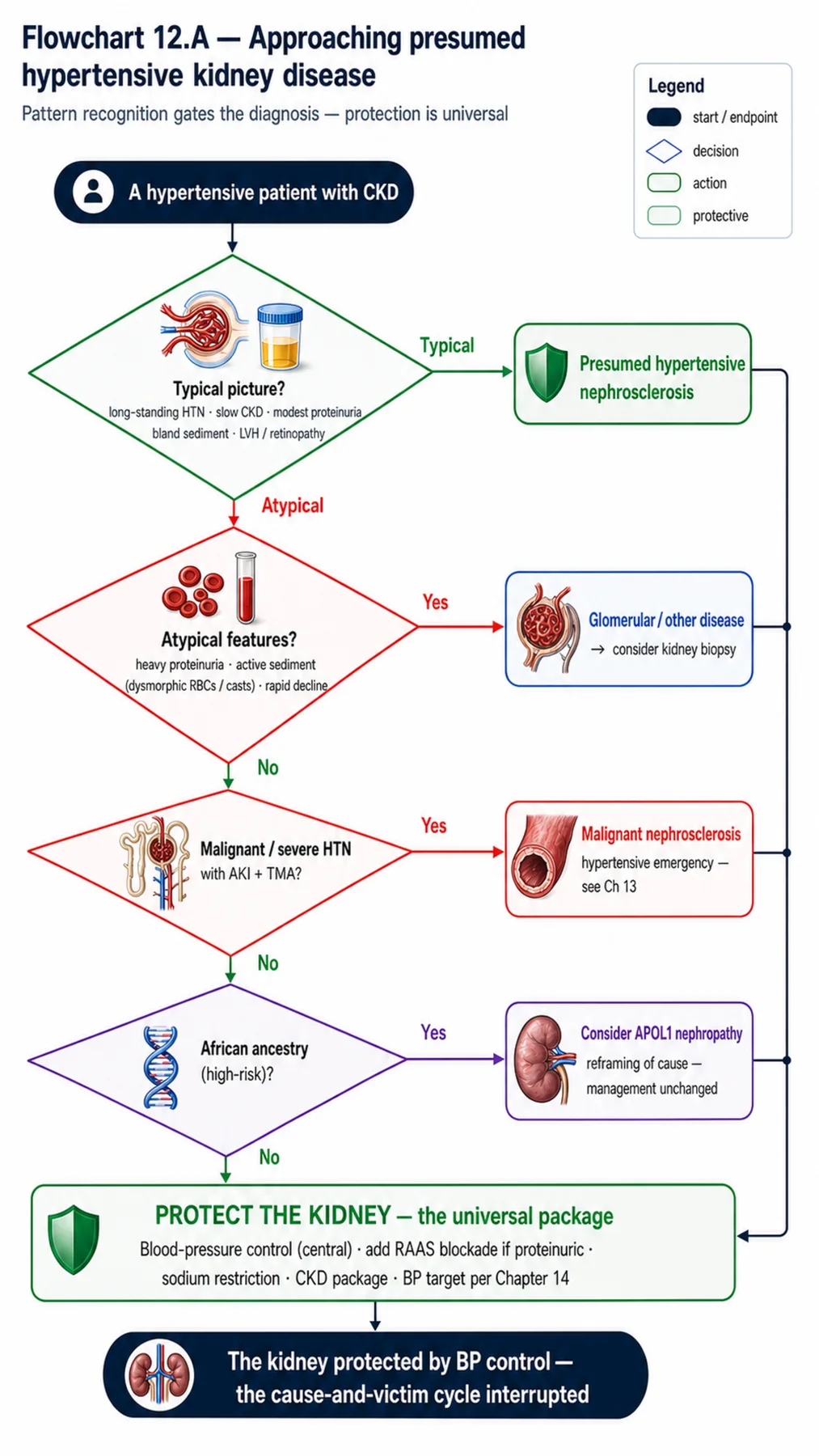
Hypertensive nephrosclerosis is usually a clinical, presumptive diagnosis rather than a biopsy one. The typical picture is a patient with long-standing hypertension who develops slowly progressive CKD with modest (sub-nephrotic) proteinuria, a bland urinary sediment, and other evidence of hypertensive target-organ damage (left ventricular hypertrophy, retinopathy) — and a biopsy is reserved for atypical features. The crucial differential is glomerular disease: heavy (nephrotic-range) proteinuria, an active sediment with red cells and casts, or a rapid decline points away from simple nephrosclerosis toward a glomerulonephritis or other intrinsic disease, which would change the management. The protective treatment is, above all, blood-pressure control, which slows the progression of the kidney damage — the central intervention. RAAS blockade is added where there is proteinuria, lowering the intraglomerular pressure that drives the hyperfiltration injury and providing renoprotection, alongside sodium restriction and the broader CKD management package, with the blood-pressure target as developed in the CKD-specific chapter. The unifying message returns to the opening chapter: hypertension and kidney disease form a cause-and-victim cycle, each worsening the other, and controlling the blood pressure protects the kidney and interrupts the cycle — which is why blood-pressure control is as much a renal-protective therapy as a cardiovascular one.
| 04 | PHASE A · LEVEL 4 · ORIENTATION & KNOWLEDGE Reference Tables |
Table 12.1 — Pathogenesis of hypertensive nephrosclerosis
| Element | Detail |
| Vascular injury | Chronic high pressure thickens/narrows renal arterioles and small arteries |
| Ischaemia | Reduced flow → ischaemic glomerular and tubular injury |
| Pressure transmission | Where autoregulation fails → glomerular hypertension |
| Result | Arteriolosclerosis + glomerulosclerosis + tubulointerstitial fibrosis → progressive CKD |
Table 12.2 — Benign versus malignant nephrosclerosis
| Benign | Malignant / accelerated | |
| Hypertension | Chronic, moderate | Malignant / severely accelerated |
| Histology | Hyaline arteriolosclerosis, glomerulosclerosis | Fibrinoid necrosis, onion-skin, thrombotic microangiopathy |
| Course | Slowly progressive CKD | Acute / rapidly progressive injury (emergency) |
Table 12.3 — Autoregulation and injury routes
| Aspect | Detail |
| Normal autoregulation | Afferent arteriole constricts → protects the glomerulus from systemic pressure |
| Failure | Severe HTN / CKD / diabetes / APOL1 → pressure transmitted to glomerulus |
| Ischaemic route | Vascular narrowing → reduced flow → ischaemic sclerosis (bland, low proteinuria) |
| Hyperfiltration route | Transmitted pressure → glomerular hypertension (proteinuria; RAAS blockade helps) |
Table 12.4 — Clinical picture and diagnosis
| Feature | Detail |
| Typical picture | Long-standing HTN, slowly progressive CKD, modest proteinuria, bland sediment |
| Supporting | Other target-organ damage (LVH, retinopathy) |
| Diagnosis | Usually clinical/presumptive; biopsy for atypical features |
| Points away | Heavy proteinuria or active sediment → glomerular disease |
Table 12.5 — APOL1 and high-risk groups
| Point | Detail |
| APOL1 risk variants | G1/G2 (African ancestry) — strong risk of non-diabetic kidney disease |
| Reframing | Much 'hypertensive nephropathy' in Black patients is APOL1 nephropathy |
| Implication | Explains the disproportionate burden; APOL1-targeted therapies emerging |
| Management | Blood-pressure control remains central; the framing changes |
Table 12.6 — Protective treatment
| Element | Detail |
| Blood-pressure control | The central protective intervention — slows progression |
| RAAS blockade | Where proteinuric — lowers intraglomerular pressure (renoprotective) |
| Sodium restriction / CKD package | Supportive; BP target per the CKD chapter |
| The principle | Control the hypertension to protect the kidney and break the cause-victim cycle |
| 05 | PHASE B · LEVEL 5 · VISUALISE & MAP Imaging & Flowchart Specifications |
| 06 | PHASE B · LEVEL 6 · VISUALISE & MAP Concept Maps |
Each chain runs from mechanism to a named bedside action; read the arrows as “leads to.”
Nephrosclerosis pathogenesis. Chronic hypertension → arteriolar thickening/narrowing → ischaemia + transmitted pressure → glomerulosclerosis + fibrosis → progressive CKD → ACTION: control the blood pressure to slow the damage.
Autoregulation. Afferent constriction normally protects the glomerulus → its failure (severe HTN/CKD/diabetes/APOL1) transmits systemic pressure → glomerular hypertension/injury → ACTION: lower the systemic pressure and use RAAS blockade to lower glomerular pressure.
Benign vs malignant. Benign (hyaline arteriolosclerosis, slow CKD) vs malignant (fibrinoid necrosis/TMA, acute injury) → ACTION: manage benign as chronic CKD; treat malignant as an emergency (Chapter 13).
APOL1. APOL1 risk variants (African ancestry) → primary genetic kidney disease → much 'hypertensive nephropathy' in Black patients is APOL1 nephropathy → ACTION: reframe the diagnosis; blood-pressure control remains central.
Cause-and-victim cycle. Nephrosclerosis impairs sodium handling → worsens hypertension → more renal damage → ACTION: control the blood pressure to protect the kidney and interrupt the cycle.
| 07 | PHASE B · LEVEL 7 · VISUALISE & MAP Decision Pathways |
| R1 | IF a long-standing hypertensive develops slowly progressive CKD with modest proteinuria and a bland sediment, THEN presume hypertensive nephrosclerosis. |
| R2 | IF there is heavy proteinuria, an active sediment, or a rapid decline, THEN reconsider a glomerular or other intrinsic disease and consider biopsy. |
| R3 | IF a patient has malignant or severely accelerated hypertension with acute kidney injury and a thrombotic microangiopathy, THEN recognise malignant nephrosclerosis and treat it as an emergency. |
| R4 | IF a patient of African ancestry has 'hypertensive' kidney disease, THEN consider an APOL1 nephropathy — a reframing that does not change the central role of blood-pressure control. |
| R5 | IF protecting the kidney, THEN control the blood pressure — the central intervention that slows progression. |
| R6 | IF there is proteinuria, THEN add RAAS blockade to lower the intraglomerular pressure that drives the hyperfiltration injury. |
| R7 | IF a kidney has impaired autoregulation (CKD, diabetes), THEN recognise its heightened vulnerability to transmitted pressure and lower the systemic pressure accordingly. |
| R8 | IF managing hypertension and CKD together, THEN control the blood pressure to interrupt the cause-and-victim cycle. |
| 08 | PHASE C · LEVEL 8 · CLINICAL REASONING Clinical Cases |
| CASE 1 | THE SLOW DECLINE Presumptive diagnosis, protective treatment Benign nephrosclerosis |
Presentation
A patient with two decades of hypertension has slowly progressive CKD, modest sub-nephrotic proteinuria, a bland urinary sediment, and left ventricular hypertrophy. The team wonders whether a biopsy is needed to diagnose the cause of the CKD.
❖ Pause and reflect Is a biopsy needed, and what is the likely diagnosis? |
Analysis
This is the classic presumptive picture of benign hypertensive nephrosclerosis, and a biopsy is generally not needed. Long-standing hypertension, slowly progressive CKD, modest (sub-nephrotic) proteinuria, a bland sediment, and other target-organ damage (the left ventricular hypertrophy) together make hypertensive nephrosclerosis the likely diagnosis without biopsy, which is reserved for atypical features. The key check is that nothing points to glomerular disease — there is no heavy proteinuria, active sediment, or rapid decline here — so the presumptive diagnosis stands. The management is protective: blood-pressure control to slow progression, RAAS blockade for the proteinuria, and the CKD package.
Plan
Make the presumptive diagnosis of benign hypertensive nephrosclerosis without biopsy, and protect the kidney with blood-pressure control, RAAS blockade for the proteinuria, and the CKD package. Treat presumptively and protect with blood-pressure control.
Teaching point
Hypertensive nephrosclerosis is usually a presumptive clinical diagnosis (long-standing HTN, slow CKD, modest proteinuria, bland sediment) — protect with blood-pressure control.
Cross-reference
Exercises rules R1 and R5; the nephrosclerosis-pathogenesis concept map; Figure 12.1; Tables 12.4, 12.6.
| CASE 2 | WHEN AUTOREGULATION FAILS Transmitted glomerular pressure Autoregulation and RAAS blockade |
Presentation
A patient with CKD and diabetes has proteinuria, and the team is considering how to slow the progression. A trainee asks why a 'normal' systemic blood pressure still seems to damage this kidney.
❖ Pause and reflect Why does even a modest systemic pressure damage this kidney? |
Analysis
Because autoregulation has failed. Normally the afferent arteriole constricts to protect the glomerulus from the systemic pressure, but in CKD and diabetes that protective autoregulation is impaired, so even a modest systemic pressure is transmitted into the glomerulus, causing glomerular hypertension and the hyperfiltration injury that drives the proteinuria and progression. This is why a kidney with impaired autoregulation is so much more vulnerable than a healthy one. The specific intervention is RAAS blockade, which dilates the efferent arteriole and lowers the intraglomerular pressure (the renoprotective mechanism), reducing the proteinuria and slowing progression — alongside good systemic blood-pressure control.
Plan
Recognise the impaired autoregulation transmitting pressure to the glomerulus, add RAAS blockade to lower the intraglomerular pressure (reducing proteinuria and slowing progression), and control the systemic blood pressure. Use RAAS blockade to lower glomerular pressure where autoregulation has failed.
Teaching point
When autoregulation fails (CKD, diabetes), systemic pressure transmits to the glomerulus — RAAS blockade lowers the intraglomerular pressure and protects the kidney.
Cross-reference
Exercises rules R6 and R7; the autoregulation concept map; Figure 12.2; Table 12.3; RAAS blockade in Chapter 6.
| CASE 3 | MORE THAN HYPERTENSION The APOL1 reframing APOL1 nephropathy |
Presentation
A Black patient with moderate hypertension has disproportionately severe, progressive kidney disease, and the team has labelled it 'hypertensive nephrosclerosis,' puzzled that the kidney disease seems out of proportion to the blood pressure.
❖ Pause and reflect Why might the kidney disease be out of proportion to the hypertension here? |
Analysis
Because much of what is labelled 'hypertensive nephrosclerosis' in Black patients is in fact an APOL1 nephropathy. The APOL1 risk variants (G1 and G2), common in people of recent African ancestry, cause a primary, genetically driven kidney disease (including focal segmental glomerulosclerosis), with the hypertension often a consequence or accelerant rather than the sole cause — which explains kidney disease out of proportion to the blood pressure and the disproportionate burden of kidney failure in Black populations. The reframing matters for understanding and for emerging APOL1-targeted therapies, though it does not change the immediate management: blood-pressure control remains central. The lesson is humility about the 'hypertensive' label.
Plan
Recognise that this may be an APOL1 nephropathy rather than hypertension alone (explaining the disproportionate kidney disease), maintain central blood-pressure control, and be aware of emerging APOL1-targeted approaches. Reframe disproportionate 'hypertensive' kidney disease in Black patients as possible APOL1 nephropathy.
Teaching point
Much 'hypertensive nephrosclerosis' in Black patients is APOL1 nephropathy — a primary genetic kidney disease; the framing changes, but blood-pressure control remains central.
Cross-reference
Exercises rule R4; the APOL1 concept map; Figure 12.3; Table 12.5.
| CASE 4 | THE ACUTE FORM Fibrinoid necrosis and TMA Malignant nephrosclerosis |
Presentation
A patient presents with severely accelerated hypertension, acute kidney injury, and laboratory features of a thrombotic microangiopathy. The team is treating it as chronic hypertensive kidney disease.
❖ Pause and reflect Is this the chronic benign form, or something more urgent? |
Analysis
This is malignant (accelerated) nephrosclerosis — the acute, urgent form, not the chronic benign one. Severely accelerated hypertension causes fibrinoid necrosis of the arterioles, a hyperplastic 'onion-skin' arteriolosclerosis, and a thrombotic microangiopathy, producing acute or rapidly progressive kidney injury rather than the slow decline of benign nephrosclerosis. This is the renal manifestation of the hypertensive emergency (the next chapter) and demands urgent, controlled blood-pressure reduction to halt the ongoing vascular injury — quite different from the outpatient management of benign nephrosclerosis. Mistaking it for chronic disease would dangerously delay the emergency treatment.
Plan
Recognise malignant nephrosclerosis as the renal face of a hypertensive emergency and treat it urgently with controlled blood-pressure reduction (Chapter 13), not as chronic disease. Treat malignant nephrosclerosis as an emergency.
Teaching point
Malignant nephrosclerosis (fibrinoid necrosis, thrombotic microangiopathy, acute injury) is the renal face of a hypertensive emergency — treat it urgently, not as chronic disease.
Cross-reference
Exercises rule R3; the benign-vs-malignant concept map; Table 12.2; hypertensive emergencies in Chapter 13.
| 09 | PHASE C · LEVEL 9 · CLINICAL REASONING Clinical Implications |
One triad per mechanism the narrative exposed: the physiology, why it matters, and the bedside move.
MECHANISM Chronic hypertension thickens and narrows the renal small vessels. |
WHY IT MATTERS The resulting ischaemia and sclerosis cause progressive CKD — the kidney as victim. |
ACTION Control the blood pressure to slow the nephrosclerosis. |
MECHANISM Autoregulation normally protects the glomerulus from systemic pressure. |
WHY IT MATTERS When it fails, systemic pressure transmits to the glomerulus and injures it. |
ACTION Lower the systemic pressure, and use RAAS blockade to lower the glomerular pressure. |
MECHANISM Benign and malignant nephrosclerosis differ in histology and tempo. |
WHY IT MATTERS Benign is slowly progressive CKD; malignant is acute injury and an emergency. |
ACTION Manage benign as chronic CKD and malignant as a hypertensive emergency. |
MECHANISM APOL1 risk variants cause a primary kidney disease in people of African ancestry. |
WHY IT MATTERS Much 'hypertensive nephrosclerosis' in Black patients is an APOL1 nephropathy. |
ACTION Reframe the diagnosis while keeping blood-pressure control central. |
MECHANISM Nephrosclerosis impairs sodium handling, which worsens the hypertension. |
WHY IT MATTERS Hypertension and kidney disease form a self-reinforcing cause-and-victim cycle. |
ACTION Control the blood pressure to protect the kidney and interrupt the cycle. |
| 10 | PHASE C · LEVEL 10 · CLINICAL REASONING Clinical Pearls |
| Hypertensive nephrosclerosis = the kidney as victim of chronic hypertension. | A leading cause of end-stage kidney disease (esp in Black populations). |
| Chronic HTN → arteriolar thickening/narrowing → ischaemia + transmitted pressure. | Result: arteriolosclerosis + glomerulosclerosis + tubulointerstitial fibrosis. |
| Benign: hyaline arteriolosclerosis, slowly progressive CKD, bland urine, modest proteinuria. | Malignant: fibrinoid necrosis, onion-skin, TMA → acute injury (emergency). |
| Autoregulation: afferent constriction protects the glomerulus. | Failure (severe HTN/CKD/diabetes/APOL1) → pressure transmitted to glomerulus. |
| Two injury routes: ischaemic (bland) and hyperfiltration (proteinuria). | RAAS blockade lowers intraglomerular pressure (renoprotective if proteinuric). |
| APOL1 risk variants (African ancestry) → primary kidney disease. | Much 'hypertensive nephropathy' in Black patients = APOL1 nephropathy. |
| Diagnosis usually presumptive; biopsy for atypical features. | Heavy proteinuria / active sediment → glomerular disease (not nephrosclerosis). |
| Blood-pressure control is the central protective intervention. | Control the BP to protect the kidney and break the cause-victim cycle. |
| 11 | PHASE D · LEVEL 11 · SAFETY & EVIDENCE Red Flags & Never-Do |
Panel A — Red flags
| ▲ | Heavy (nephrotic-range) proteinuria or an active sediment — points to glomerular disease, not simple nephrosclerosis. |
| ▲ | Severe/accelerated hypertension with acute kidney injury and a thrombotic microangiopathy — malignant nephrosclerosis; an emergency. |
| ▲ | Disproportionate kidney disease in a Black patient — consider APOL1 nephropathy. |
| ▲ | A kidney with impaired autoregulation (CKD, diabetes) — heightened vulnerability to transmitted pressure; lower it. |
| ▲ | Worsening kidney function as blood pressure rises — the cause-and-victim cycle; control the pressure. |
Panel B — Never do
| ✖ NEVER — assume bland CKD is nephrosclerosis without checking for glomerular features. |
| ✖ NEVER — treat malignant nephrosclerosis as chronic disease — it is an emergency. |
| ✖ NEVER — overlook an APOL1 nephropathy behind 'hypertensive' kidney disease in a Black patient. |
| ✖ NEVER — neglect blood-pressure control — it is the central renal-protective therapy. |
| 12 | PHASE D · LEVEL 12 · SAFETY & EVIDENCE Common Pitfalls |
Pitfall 1 — Missing glomerular disease
| ✖ | WRONG Labelling CKD with heavy proteinuria as nephrosclerosis. |
| ✓ | RIGHT Reconsidering glomerular disease and considering biopsy. |
| ✉ | WHY Heavy proteinuria or an active sediment points away from nephrosclerosis. |
Pitfall 2 — Treating malignant as chronic
| ✖ | WRONG Managing malignant nephrosclerosis as chronic hypertensive kidney disease. |
| ✓ | RIGHT Treating it urgently as a hypertensive emergency. |
| ✉ | WHY Fibrinoid necrosis and TMA cause acute, ongoing injury. |
Pitfall 3 — Ignoring APOL1
| ✖ | WRONG Attributing disproportionate kidney disease in a Black patient to hypertension alone. |
| ✓ | RIGHT Recognising a possible APOL1 nephropathy. |
| ✉ | WHY APOL1 variants cause a primary kidney disease. |
Pitfall 4 — Forgetting autoregulation
| ✖ | WRONG Treating a diabetic/CKD kidney as if autoregulation still protects it. |
| ✓ | RIGHT Recognising its heightened vulnerability and lowering the pressure (with RAAS blockade). |
| ✉ | WHY Failed autoregulation transmits systemic pressure to the glomerulus. |
Pitfall 5 — Neglecting blood-pressure control
| ✖ | WRONG Underprioritising blood-pressure control in hypertensive kidney disease. |
| ✓ | RIGHT Making blood-pressure control the central protective intervention. |
| ✉ | WHY It slows progression and breaks the cause-and-victim cycle. |
| 13 | PHASE D · LEVEL 13 · SAFETY & EVIDENCE Evidence Grading |
GRADE A HIGH CONFIDENCE The effect is real and the estimate is stable. RCTs at low risk of bias; multiple concordant prospective cohorts; meta-analyses. |
GRADE B MODERATE CONFIDENCE The effect is likely real but may shift with new data. Observational studies, registries, mechanistic human studies. |
GRADE C LOW CONFIDENCE Rests on physiology, reasoning, or consensus rather than outcomes. Pathophysiological reasoning; extrapolation; consensus without outcomes. |
Graded statements (by evidence type)
| Statement | Grade | Basis (evidence type) |
| Chronic hypertension causes nephrosclerosis and progressive CKD. | A | Histopathological and clinical data |
| Failed autoregulation transmits systemic pressure to the glomerulus. | A | Established physiology |
| RAAS blockade is renoprotective in proteinuric kidney disease. | A | RCTs |
| Blood-pressure control slows progression of hypertensive kidney disease. | A | RCTs |
| APOL1 risk variants strongly associate with non-diabetic kidney disease. | A | Genetic association studies |
| Malignant nephrosclerosis is the renal manifestation of a hypertensive emergency. | A | Clinical and histopathological data |
| Heavy proteinuria points away from simple nephrosclerosis. | A | Clinical reasoning and data |
| 14 | PHASE E · LEVEL 14 · PATIENT DECISIONS Absolute Risk in Natural Frequency |
Natural-frequency estimates for orientation, from hypertensive-kidney-disease data; they vary with the population. They convey the size of the decisions, expressed per 100 comparable patients.
| Per 100 patients… | Outcome | Roughly how many | See |
| Hypertensive kidney disease with controlled vs uncontrolled BP | Slow their CKD progression | More with controlled blood pressure | L13 row 4 |
| Proteinuric hypertensive kidney disease given RAAS blockade | Slow progression / reduce proteinuria | More than without it | L13 row 3 |
| Black patients with 'hypertensive' kidney disease | Carry APOL1 risk variants | A substantial share — hence the reframing | L13 row 5 |
| Malignant nephrosclerosis treated urgently vs as chronic | Avoid ongoing acute injury | More with urgent treatment | L13 row 6 |
★ How to read these Read these as orientation, not promises; outcomes vary with the population. The stable signals: blood-pressure control slows progression, RAAS blockade protects the proteinuric kidney, APOL1 underlies much of the burden in Black patients, and malignant nephrosclerosis needs urgent treatment. Communicate them as people out of 100, not as a hazard ratio. |
| 17 | PHASE F · LEVEL 17 · APPLY & TEST Documentation Templates |
Paste-ready notes. Tick the boxes that apply and delete the rest; make the presumptive diagnosis, the differential, and the protective plan explicit.
Template 1 — Presumptive nephrosclerosis assessment
Template 2 — Renal-protective plan
| 18 | PHASE F · LEVEL 18 · APPLY & TEST Cheat Sheet |
| Nephrosclerosis = the kidney as victim of chronic HTN. | Leading cause of ESKD (esp Black populations). |
| Chronic HTN → arteriolar thickening → ischaemia + transmitted pressure. | Result: arteriolosclerosis + glomerulosclerosis + fibrosis. |
| Benign: hyaline arteriolosclerosis, slow CKD, bland urine, modest proteinuria. | Malignant: fibrinoid necrosis, onion-skin, TMA → acute injury (emergency). |
| Autoregulation: afferent constriction protects the glomerulus. | Failure (severe HTN/CKD/diabetes/APOL1) → pressure to glomerulus. |
| Two routes: ischaemic (bland) + hyperfiltration (proteinuria). | RAAS blockade lowers intraglomerular pressure (renoprotective). |
| APOL1 variants (African ancestry) → primary kidney disease. | Much 'hypertensive nephropathy' in Black patients = APOL1 nephropathy. |
| Diagnosis presumptive; biopsy for atypical features. | Heavy proteinuria/active sediment → glomerular disease. |
| Blood-pressure control = central protective intervention. | Control BP → protect the kidney + break the cause-victim cycle. |
| 19 | PHASE F · LEVEL 19 · APPLY & TEST Flashcards |
| CARD 1 | Q. How does chronic hypertension damage the kidney? A. By injuring the renal small vessels — thickening and narrowing them — which causes ischaemic injury and, where autoregulation fails, transmits pressure to the glomerulus, producing arteriolosclerosis, glomerulosclerosis, and tubulointerstitial fibrosis (nephrosclerosis) and progressive CKD. DETAILED. It is the kidney as victim. CLINICAL. Control the blood pressure to slow the damage. |
| CARD 2 | Q. How do benign and malignant nephrosclerosis differ? A. Benign nephrosclerosis (chronic, moderate hypertension) shows hyaline arteriolosclerosis and slowly progressive CKD with a bland urine; malignant (accelerated) nephrosclerosis shows fibrinoid necrosis, an onion-skin arteriolosclerosis, and a thrombotic microangiopathy with acute kidney injury — a hypertensive emergency. DETAILED. Benign is chronic; malignant is acute. CLINICAL. Manage benign as CKD and malignant as an emergency. |
| CARD 3 | Q. What is renal autoregulation and why does its failure matter? A. The afferent arteriole normally constricts to protect the glomerulus from the systemic pressure; when autoregulation fails or is exhausted (severe hypertension, CKD, diabetes, APOL1), the systemic pressure is transmitted into the glomerulus, causing glomerular hypertension and injury. DETAILED. It makes diseased kidneys far more vulnerable. CLINICAL. Lower the systemic pressure and use RAAS blockade to lower the glomerular pressure. |
| CARD 4 | Q. What are the two routes of hypertensive glomerular injury? A. Ischaemic injury (vascular narrowing reducing flow, giving bland, low-proteinuria CKD) and hyperfiltration injury (transmitted glomerular hypertension, giving proteinuria) — both converging on glomerulosclerosis. DETAILED. The hyperfiltration route is the one RAAS blockade addresses. CLINICAL. Use RAAS blockade for the proteinuric, hyperfiltration component. |
| CARD 5 | Q. What is the APOL1 contribution to hypertensive kidney disease? A. APOL1 risk variants (G1, G2), common in people of recent African ancestry, cause a primary kidney disease (including FSGS), so much of what is labelled 'hypertensive nephrosclerosis' in Black patients is actually an APOL1 nephropathy, with hypertension often a consequence or accelerant. DETAILED. It explains the disproportionate burden. CLINICAL. Reframe the diagnosis while keeping blood-pressure control central. |
| CARD 6 | Q. How is hypertensive nephrosclerosis diagnosed? A. Usually clinically and presumptively — long-standing hypertension, slowly progressive CKD, modest proteinuria, a bland sediment, and other target-organ damage — with biopsy reserved for atypical features; heavy proteinuria or an active sediment points to glomerular disease instead. DETAILED. It is a diagnosis of pattern and exclusion. CLINICAL. Diagnose presumptively, but reconsider if glomerular features appear. |
| CARD 7 | Q. What is the central protective treatment? A. Blood-pressure control, which slows the progression of the kidney damage; RAAS blockade is added where there is proteinuria to lower the intraglomerular pressure, alongside sodium restriction and the CKD management package. DETAILED. It is as much a renal therapy as a cardiovascular one. CLINICAL. Control the blood pressure (and use RAAS blockade if proteinuric) to protect the kidney. |
| CARD 8 | Q. What is the cause-and-victim cycle? A. Hypertension damages the kidney (nephrosclerosis), and the damaged kidney impairs sodium handling and worsens the hypertension, which causes further damage — a self-reinforcing cycle that blood-pressure control interrupts. DETAILED. Each worsens the other. CLINICAL. Control the blood pressure to break the cycle. |
| 20 | PHASE F · LEVEL 20 · APPLY & TEST One-Minute Preceptor |
| SCENE 1 | The intern requesting a biopsy |
GET A COMMITMENT. “You want to biopsy this long-standing hypertensive with slow CKD and modest proteinuria — why?”
PROBE FOR EVIDENCE. “To find the cause” — ask: “What does the picture — bland sediment, modest proteinuria, target-organ damage — already suggest, and what would point away from it?”
TEACH A GENERAL RULE. Hypertensive nephrosclerosis is usually a presumptive clinical diagnosis; biopsy is reserved for atypical features such as heavy proteinuria, an active sediment, or rapid decline.
REINFORCE WHAT WAS RIGHT. Wanting to confirm the cause was reasonable.
CORRECT A MISTAKE. Diagnose presumptively and protect with blood-pressure control unless atypical features appear.
| SCENE 2 | The resident missing the malignant form |
GET A COMMITMENT. “You're managing this severely accelerated hypertensive with acute kidney injury as chronic disease — is that right?”
PROBE FOR EVIDENCE. “It's hypertensive kidney disease” — ask: “What do the acute injury and the thrombotic microangiopathy tell you about the tempo?”
TEACH A GENERAL RULE. Malignant nephrosclerosis — fibrinoid necrosis and a thrombotic microangiopathy with acute injury — is the renal face of a hypertensive emergency and needs urgent, controlled blood-pressure reduction.
REINFORCE WHAT WAS RIGHT. Recognising hypertensive kidney involvement was correct.
CORRECT A MISTAKE. Treat it urgently as an emergency, not as chronic disease.
| 22 | PHASE F · LEVEL 22 · APPLY & TEST Board-Style Questions |
| Q 01 | Hypertensive nephrosclerosis is best understood as: |
| A | The kidney causing hypertension |
| B | The kidney as victim of chronic hypertension — vascular injury, glomerulosclerosis, fibrosis |
| C | An acute glomerulonephritis |
| D | A drug effect |
Rationale Nephrosclerosis is the chronic kidney damage caused by hypertension — the kidney as victim (Figure 12.1, Table 12.1). A is the cause side; C and D are different. |
| Q 02 | Benign and malignant nephrosclerosis are distinguished by: |
| A | Both being acute |
| B | Benign = hyaline arteriolosclerosis, slow CKD; malignant = fibrinoid necrosis/TMA, acute injury |
| C | Both being chronic |
| D | Neither affecting the kidney |
Rationale Benign is the chronic form; malignant is acute with fibrinoid necrosis and a thrombotic microangiopathy (case 4, Table 12.2). A, C, and D are wrong. |
| Q 03 | Why does failed renal autoregulation damage the glomerulus? |
| A | It lowers the glomerular pressure |
| B | It transmits the systemic pressure into the glomerulus, causing glomerular hypertension |
| C | It blocks filtration |
| D | It has no effect |
Rationale Loss of the protective afferent constriction transmits systemic pressure to the glomerulus (case 2, Figure 12.2, rule R7). A, C, and D are incorrect. |
| Q 04 | Which intervention specifically lowers the intraglomerular pressure in proteinuric hypertensive kidney disease? |
| A | A calcium-channel blocker |
| B | RAAS blockade (efferent dilation) |
| C | A diuretic |
| D | A beta-blocker |
Rationale RAAS blockade dilates the efferent arteriole, lowering intraglomerular pressure — renoprotective (case 2, Table 12.6, rule R6). A, C, and D do not act this way. |
| Q 05 | Disproportionately severe 'hypertensive' kidney disease in a Black patient suggests: |
| A | Pure hypertensive nephrosclerosis |
| B | A possible APOL1 nephropathy |
| C | Renal artery stenosis |
| D | A drug effect |
Rationale APOL1 risk variants cause a primary kidney disease underlying much 'hypertensive nephropathy' in Black patients (case 3, Figure 12.3, rule R4). A understates; C and D are different. |
| Q 06 | Which feature points AWAY from simple hypertensive nephrosclerosis? |
| A | Modest sub-nephrotic proteinuria |
| B | Heavy (nephrotic-range) proteinuria or an active sediment |
| C | A bland sediment |
| D | Left ventricular hypertrophy |
Rationale Heavy proteinuria or an active sediment points to glomerular disease (case 1, Table 12.4, rule R2). A, C, and D fit nephrosclerosis. |
| Q 07 | The central protective treatment in hypertensive kidney disease is: |
| A | A statin |
| B | Blood-pressure control |
| C | An antiplatelet |
| D | Dialysis |
Rationale Blood-pressure control is the central intervention that slows progression (Table 12.6, rule R5). A, C, and D are not central here. |
| Q 08 | Malignant nephrosclerosis should be treated as: |
| A | Chronic kidney disease |
| B | A hypertensive emergency requiring urgent controlled blood-pressure reduction |
| C | An outpatient problem |
| D | Requiring no specific treatment |
Rationale Malignant nephrosclerosis is the renal face of a hypertensive emergency (case 4, Table 12.2, rule R3; Chapter 13). A, C, and D dangerously delay treatment. |