Chapter Preamble
Signals declared
Sig-D — Diagnostic (primary). Recognise the volume-dependent nature of hypertension in CKD and dialysis, and interpret blood pressure correctly — including in the dialysis patient.
Sig-T — Therapeutic (strong). Set the target, use RAAS blockade, diuretics, and the newer agents in CKD, and control volume in the dialysis patient.
Sig-V — Evidence-dense (strong). The SPRINT and KDIGO evidence on intensive targets, the renoprotection trials, and the dialysis blood-pressure paradoxes — graded and reflected on.
Levels populated and omitted
Populated (18): L1–L5, L7, L8, L10–L14, L17–L22. The evidence and therapeutic signals fire the absolute-risk table (L14), the templates (L17), and the reflective prompts (L21); the diagnostic signal drives the tables, rules, cases, pitfalls, and board items.
L6 / L9 mechanism levels — omitted. No Sig-M; the mechanisms were built in Chapters 1 and 12 and in Volume 6, and this is a management and evidence chapter.
L15 / L16 preference-sensitive map and SDM scripts — omitted. No Sig-E; the target and treatment are evidence-driven (with individualisation noted), the preference-sensitive frailty decisions living in the elderly chapter.
| 01 | PHASE A · LEVEL 1 · ORIENTATION & KNOWLEDGE Learning Objectives |
By the end of this chapter you should be able to:
Explain why hypertension in CKD is largely volume-dependent.
State the blood-pressure target in CKD and the evidence behind it (SPRINT, KDIGO).
Explain why the measurement method matters when applying the target.
Use RAAS blockade, diuretics, and the newer agents (finerenone, SGLT2 inhibitors) in CKD.
Explain why volume control is the central treatment of hypertension in dialysis.
Interpret blood pressure in the dialysis patient, including its paradoxes.
Recognise the reverse-epidemiology association of low pre-dialysis blood pressure.
Apply the loop-diuretic and chlorthalidone evidence in advanced CKD.
| 02 | PHASE A · LEVEL 2 · ORIENTATION & KNOWLEDGE Executive Summary |
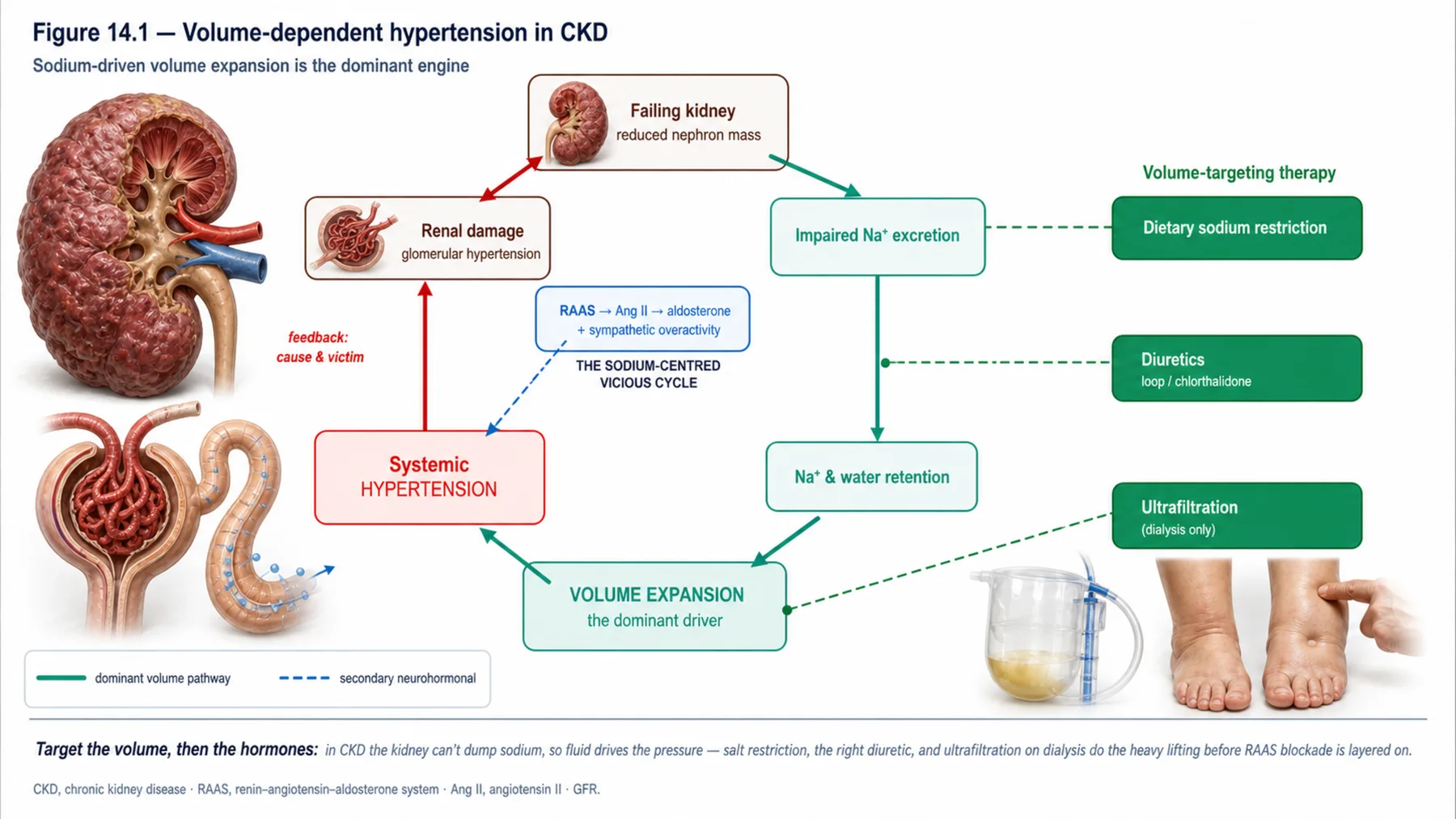
Hypertension is nearly universal in CKD and is largely volume-dependent — driven by sodium and water retention, with the RAAS and sympathetic system contributing.
It is both a cause and a consequence of the kidney disease, the cause-and-victim cycle of the earlier chapters.
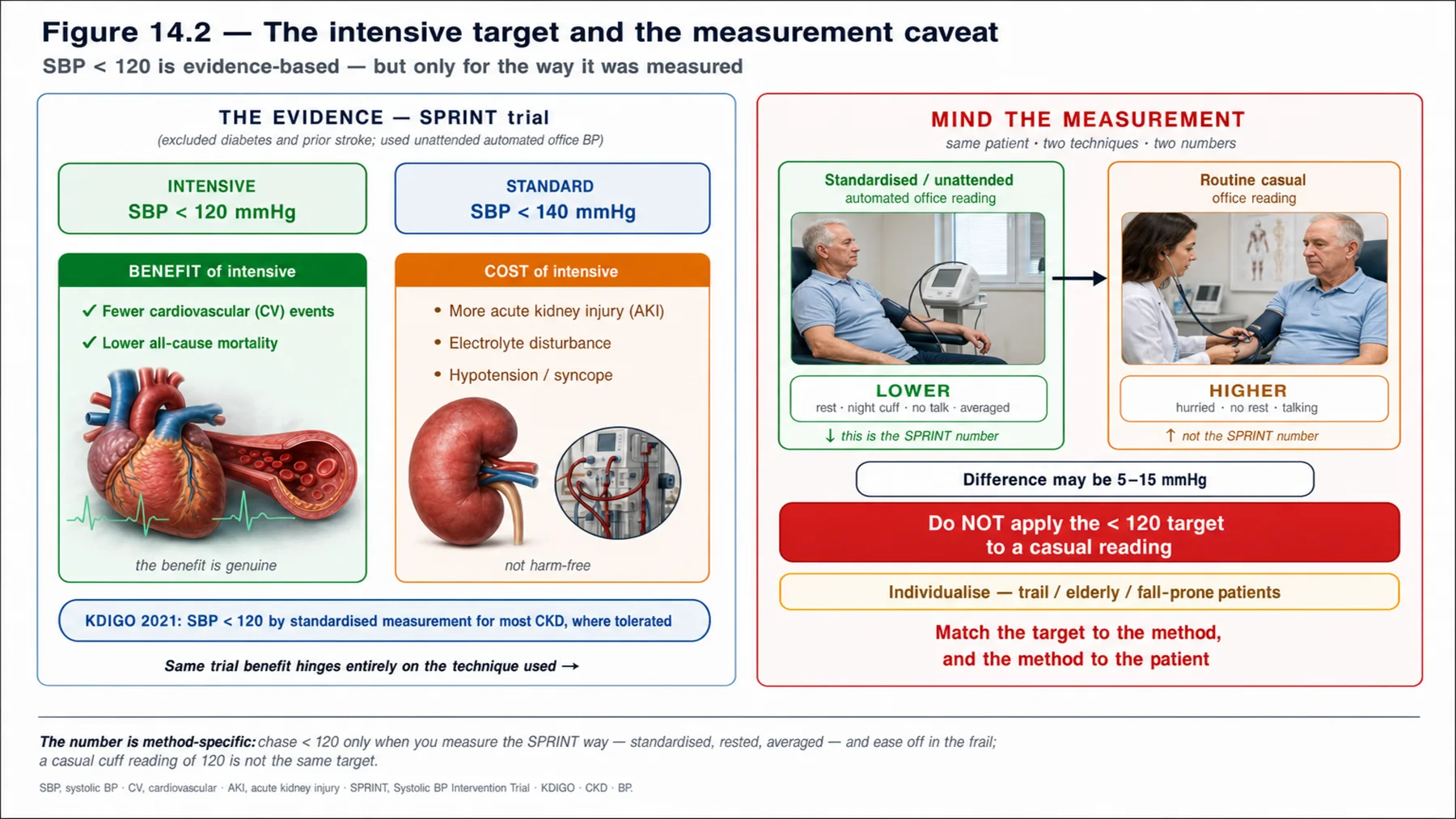
The SPRINT trial showed that an intensive systolic target (below 120, by standardised automated office measurement) reduced cardiovascular events and mortality versus a standard target, at the cost of more acute kidney injury and electrolyte disturbance.
On that evidence, KDIGO recommends a systolic target below 120 for most CKD patients not on dialysis, where tolerated, measured by standardised office technique.
The measurement method is crucial: the SPRINT and KDIGO targets are based on standardised, often unattended readings that run lower than routine office measurement, so the target must not be applied to a casual office reading.
The target is individualised — less intensive in the frail, the fall-prone, and where harms outweigh benefits.
RAAS blockade is first-line where there is albuminuria, for its renoprotection, with monitoring of creatinine and potassium.
Diuretics are essential because the hypertension is volume-dependent — loop diuretics in advanced CKD, where thiazides lose efficacy, though chlorthalidone retains some effect.
The newer agents — the non-steroidal mineralocorticoid antagonist finerenone and the SGLT2 inhibitors — add cardiovascular and renal protection.
In dialysis, volume overload from interdialytic fluid gain is the dominant driver, so achieving the target (dry) weight by ultrafiltration, with dietary sodium and fluid restriction, is the central treatment — before adding drugs.
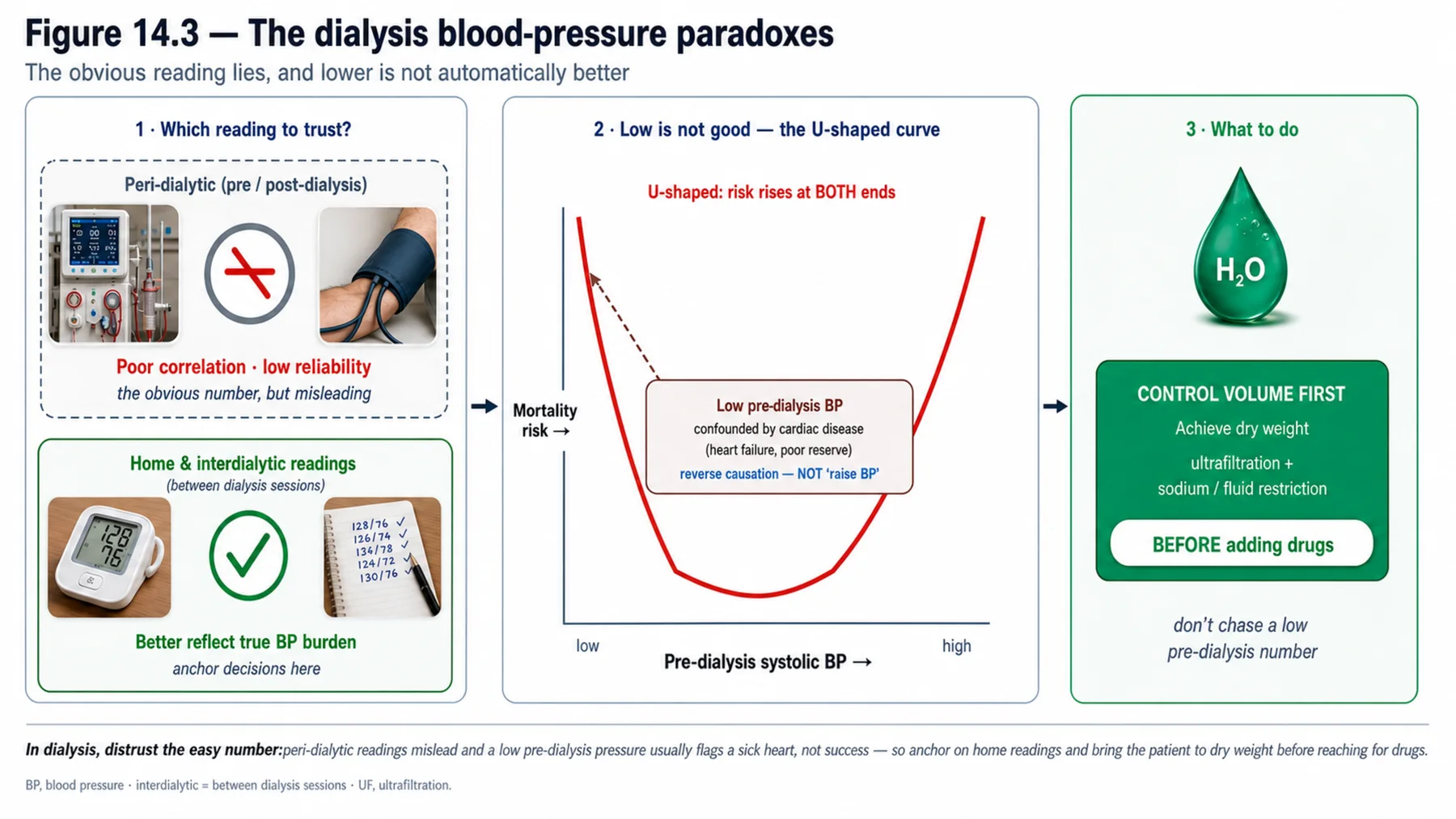
Blood-pressure measurement in dialysis is complex: peri-dialytic readings correlate poorly with outcomes, while home and interdialytic readings are better.
A reverse-epidemiology association means a low pre-dialysis blood pressure is paradoxically linked to worse outcomes, confounded by underlying cardiac disease.
Antihypertensive drugs are added after volume control, with attention to dialysability and the avoidance of intradialytic hypotension.
The unifying theme is that hypertension in kidney disease is, above all, a problem of sodium and volume.
| 03 | PHASE A · LEVEL 3 · ORIENTATION & KNOWLEDGE Main Narrative |
Hypertension in kidney disease is, more than anywhere else, a problem of sodium and volume — and managing it well means controlling volume before reaching for more drugs. This chapter covers the blood-pressure target in CKD (and the SPRINT evidence that lowered it), the agents that protect the kidney, and the distinctive world of the dialysis patient, where volume overload dominates and the blood-pressure reading itself behaves paradoxically. It builds directly on the CKD and dialysis volumes and on the autoregulation and pharmacology of the earlier chapters.
— Why CKD hypertension is volume-dependent
Hypertension is nearly universal in CKD, and its dominant mechanism is sodium and volume retention. As the failing kidney loses its capacity to excrete sodium (the rightward-shifted pressure-natriuresis of the opening chapter), volume expands and blood pressure rises, with the RAAS and the sympathetic system adding further drive — and the hypertension in turn damages the kidney, the bidirectional cause-and-victim cycle of the nephrosclerosis chapter. The practical consequence of the volume-dependence is large: it makes sodium restriction and diuretics central to treatment (not optional add-ons), and it explains why CKD hypertension is often resistant to drugs that do not address volume. Recognising that the hypertension of kidney disease is, at its core, a sodium-and-volume problem reframes its management around volume control — a theme that becomes absolute in the dialysis patient.
— The blood-pressure target and the SPRINT evidence
The blood-pressure target in CKD has been reshaped by the SPRINT trial, the central piece of evidence here. SPRINT compared an intensive systolic target (below 120) against a standard one (below 140) in high-cardiovascular-risk patients (including a CKD subgroup) and found that the intensive target reduced cardiovascular events and all-cause mortality — but at the cost of more acute kidney injury, electrolyte disturbance, and hypotension. On this evidence, KDIGO now recommends a systolic target below 120 for most CKD patients not on dialysis, where tolerated. But there is a crucial and frequently missed caveat: SPRINT (and KDIGO) used standardised, often unattended automated office measurements, which run several mmHg lower than a routine, hurried office reading — so a 'target below 120' by the SPRINT method is not the same as below 120 on a casual office reading, and applying the intensive target to a routine reading would overtreat. The target is therefore intensive but method-specific, and individualised: less intensive in the frail, the fall-prone, and those in whom the harms (AKI, hypotension, falls) outweigh the cardiovascular benefit. The intensive target is evidence-based but must be applied with the right measurement and the right patient.
— The agents in CKD
Drug treatment in CKD follows the volume-dependence and the renoprotection evidence. RAAS blockade (an ACE inhibitor or ARB) is first-line where there is albuminuria, because it is renoprotective — lowering intraglomerular pressure and reducing proteinuria — with the monitoring of creatinine and potassium and the acceptable functional creatinine rise of the pharmacotherapy chapter. Diuretics are essential, given the volume-dependence: a thiazide may suffice in earlier CKD, but in advanced CKD a loop diuretic is needed as thiazides lose efficacy (though the CLICK trial showed chlorthalidone retains useful effect even in advanced CKD). A calcium-channel blocker is a common addition. And two newer agents have transformed CKD management: the non-steroidal mineralocorticoid antagonist finerenone reduces cardiovascular and kidney events in CKD with type 2 diabetes, and the SGLT2 inhibitors provide major renoprotection with a modest blood-pressure reduction — both now central to the CKD package alongside the antihypertensives. Sodium restriction underlies all of it. The combination — sodium restriction, RAAS blockade for albuminuria, effective diuresis, and the newer renoprotective agents — addresses both the blood pressure and the progression of the kidney disease.
— Hypertension in dialysis: volume is king
In the dialysis patient, the volume-dependence of CKD hypertension becomes absolute: volume overload from interdialytic fluid gain is the dominant driver of the blood pressure, so the central treatment is volume control — achieving the target ('dry') weight by ultrafiltration, supported by dietary sodium and fluid restriction and an appropriate dialysate sodium — before adding antihypertensive drugs. This is the key conceptual point: in dialysis, the first and most effective antihypertensive intervention is not a drug but the removal of fluid to the correct target weight, and much dialysis hypertension that appears 'resistant' to drugs is in fact uncontrolled volume. Antihypertensive drugs are added after volume optimisation, with attention to their dialysability (some are removed by dialysis, affecting timing and dosing) and to the avoidance of intradialytic hypotension (the over-rapid ultrafiltration problem of the electrolyte volume). The dialysis patient is the clearest illustration of the chapter's thesis: control the volume, and the blood pressure largely follows.
— The dialysis blood-pressure paradoxes
Measuring and interpreting blood pressure in the dialysis patient is genuinely tricky, with two paradoxes that must be understood. First, the peri-dialytic readings (pre- and post-dialysis, taken in the unit) correlate poorly with the true blood-pressure burden and with outcomes, because they are distorted by the fluid shifts and the timing around the session; home and interdialytic ambulatory readings correlate much better and are preferred for guiding management. Second, and more striking, is the reverse-epidemiology (or U-shaped) association: a low pre-dialysis blood pressure is paradoxically associated with higher mortality in dialysis patients — not because low blood pressure is protective above, but because the low reading is confounded by underlying cardiac disease and poor cardiac function (a failing heart cannot generate a high pressure), so the low pressure is a marker of bad cardiac disease rather than good blood-pressure control. The practical danger is over-interpreting a low pre-dialysis reading as 'good control' or, worse, an isolated high pre-dialysis reading as needing aggressive drug treatment when the real issue is volume. The lesson is to interpret dialysis blood pressure with home/interdialytic readings, to address volume first, and to be cautious about both the low-reading paradox and the unreliability of peri-dialytic measurement.
— The evidence, and the unifying theme
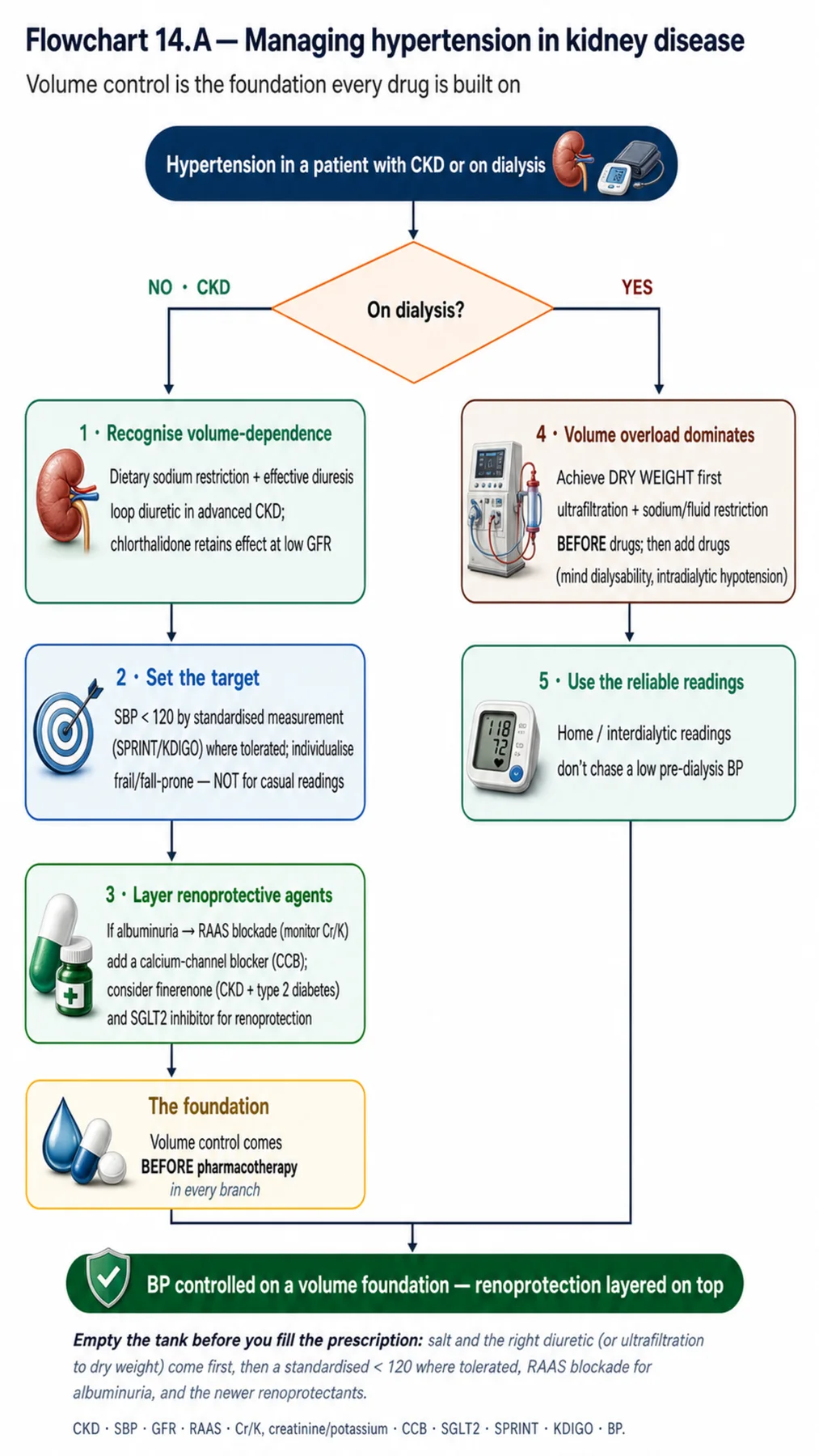
The evidence across this chapter converges on a few robust conclusions tempered by genuine uncertainty. The intensive blood-pressure target in CKD is supported by SPRINT and endorsed by KDIGO, but is method-specific and individualised, with real harms (AKI, hypotension, falls) to weigh. RAAS blockade is firmly renoprotective in albuminuric CKD, and the newer agents (finerenone, SGLT2 inhibitors) add proven cardiovascular and renal benefit. In dialysis, the evidence is messier — the optimal target is debated, the peri-dialytic readings are unreliable, and the reverse-epidemiology association complicates interpretation — but the consistent signal is that volume control is the foundation. The unifying theme, which ties the chapter to the whole volume's physiology, is that hypertension in kidney disease is fundamentally a problem of sodium and volume: the failing kidney cannot excrete sodium, so volume expands and pressure rises, and the most effective interventions — sodium restriction, diuretics, and in dialysis ultrafiltration to dry weight — are those that address volume. Drugs and targets matter, but in kidney disease they sit on a foundation of volume control, and the clinician who remembers that manages the hypertension of kidney disease far better than one who reaches reflexively for another pill.
| 04 | PHASE A · LEVEL 4 · ORIENTATION & KNOWLEDGE Reference Tables |
Table 14.1 — CKD hypertension: mechanisms
| Mechanism | Detail |
| Sodium/volume retention | The dominant driver — impaired pressure-natriuresis |
| RAAS / sympathetic | Additional drive |
| Cause and consequence | Bidirectional cause-and-victim cycle with the kidney disease |
| Practical consequence | Sodium restriction and diuretics are central, not optional |
Table 14.2 — The blood-pressure target and the evidence
| Point | Detail |
| SPRINT | Intensive SBP < 120 (standardised) vs < 140 → fewer CV events/deaths; more AKI/electrolyte/hypotension |
| KDIGO | SBP < 120 for most non-dialysis CKD, where tolerated (standardised measurement) |
| Measurement caveat | Standardised/unattended readings run lower than routine office — don't apply to a casual reading |
| Individualise | Less intensive in the frail, fall-prone, or where harms outweigh benefit |
Table 14.3 — Agents in CKD
| Agent | Role |
| RAAS blockade | First-line if albuminuria — renoprotective; monitor Cr/K |
| Diuretics | Essential (volume) — loop in advanced CKD; chlorthalidone retains effect (CLICK) |
| Calcium-channel blocker | Common addition |
| Newer agents | Finerenone (CKD + type 2 diabetes); SGLT2 inhibitors (renoprotection + modest BP fall) |
Table 14.4 — Hypertension in dialysis: volume
| Point | Detail |
| Dominant driver | Volume overload from interdialytic fluid gain |
| Central treatment | Achieve target (dry) weight by ultrafiltration + sodium/fluid restriction |
| Drugs | Added AFTER volume control; mind dialysability and intradialytic hypotension |
| Key point | Much 'resistant' dialysis hypertension is uncontrolled volume |
Table 14.5 — Blood-pressure measurement in dialysis
| Aspect | Detail |
| Peri-dialytic readings | Correlate poorly with outcomes — distorted by fluid shifts/timing |
| Home / interdialytic | Correlate better — preferred for management |
| Reverse epidemiology | Low pre-dialysis BP paradoxically linked to worse outcomes |
| Why | Confounded by cardiac disease (a failing heart can't generate a high pressure) |
Table 14.6 — The evidence summary
| Conclusion | Detail |
| Intensive target | SPRINT/KDIGO support SBP < 120 — method-specific, individualised, real harms |
| Renoprotection | RAAS blockade in albuminuria; finerenone and SGLT2 inhibitors add benefit |
| Dialysis volume | Volume control is the foundation; the optimal target is debated |
| Unifying theme | Hypertension in kidney disease is fundamentally a sodium-and-volume problem |
| 05 | PHASE B · LEVEL 5 · VISUALISE & MAP Imaging & Flowchart Specifications |
| 08 | PHASE C · LEVEL 8 · CLINICAL REASONING Clinical Cases |
| CASE 1 | BELOW 120 — BY WHICH METHOD? The target and the measurement The CKD blood-pressure target |
Presentation
A clinician, citing SPRINT and KDIGO, aims for a systolic below 120 in a CKD patient and is titrating drugs aggressively against routine, hurried office readings — with the patient now reporting dizziness.
❖ Pause and reflect Is the target being applied correctly here? |
Analysis
No — the target is being applied to the wrong measurement. SPRINT and KDIGO derived the 'below 120' target using standardised, often unattended automated readings, which run several mmHg lower than a routine, hurried office measurement; aiming for below 120 on a casual office reading therefore means driving the true blood pressure substantially lower than the trials intended — hence the dizziness, and the risk of hypotension, falls, and acute kidney injury. The intensive target is evidence-based but method-specific. The fix is to measure correctly (standardised technique) and to individualise — a CKD patient who is frail or fall-prone, or in whom the harms appear, warrants a less aggressive target. The target is intensive, but only when measured and applied correctly.
Plan
Measure the blood pressure with standardised (ideally automated/unattended) technique before applying the < 120 target, individualise given the dizziness, and ease back if harms appear. Apply the SPRINT/KDIGO target with the right measurement method and patient.
Teaching point
The SPRINT/KDIGO < 120 target is based on standardised readings that run lower than routine office — apply it with the right method, and individualise.
Cross-reference
Exercises the target content; Figure 14.2; Tables 14.2, 14.6; measurement in Chapter 2.
| CASE 2 | PROTECT THE KIDNEY RAAS blockade and the newer agents Agents in albuminuric CKD |
Presentation
A patient with CKD, type 2 diabetes, and albuminuria has hypertension managed with a calcium-channel blocker alone. The team asks how to optimise both the blood pressure and the kidney protection.
❖ Pause and reflect What agents would best protect this albuminuric diabetic kidney? |
Analysis
The regimen is missing the renoprotective agents. With albuminuria, RAAS blockade (an ACE inhibitor or ARB) is first-line for its renoprotection — lowering intraglomerular pressure and reducing proteinuria — with monitoring of creatinine and potassium. Given the volume-dependence, an effective diuretic should be ensured (a loop diuretic if the CKD is advanced). And in this patient with CKD and type 2 diabetes, the newer agents add proven benefit: the non-steroidal mineralocorticoid antagonist finerenone reduces cardiovascular and kidney events, and an SGLT2 inhibitor provides major renoprotection with a modest blood-pressure reduction. The calcium-channel blocker alone controls neither the proteinuria nor the progression; the renoprotective package is what this kidney needs.
Plan
Add RAAS blockade (first-line for the albuminuria, monitored), ensure effective diuresis, and add an SGLT2 inhibitor and consider finerenone (CKD with type 2 diabetes) for renoprotection, alongside sodium restriction. Build the renoprotective package, not a calcium-channel blocker alone.
Teaching point
In albuminuric CKD, use RAAS blockade (renoprotective) plus effective diuresis, and add SGLT2 inhibitors and finerenone (CKD + diabetes) for proven renal and cardiovascular benefit.
Cross-reference
Exercises the agents content; Table 14.3; RAAS blockade in Chapter 6; CKD management in Volume 6.
| CASE 3 | IT'S THE VOLUME Ultrafiltration before drugs Dialysis hypertension |
Presentation
A haemodialysis patient has persistent hypertension and large interdialytic weight gains, and the team keeps adding antihypertensive drugs without effect. The patient is above their prescribed target weight.
❖ Pause and reflect Why are the added drugs not controlling this dialysis patient's blood pressure? |
Analysis
Because the problem is volume, not a need for more drugs. In the dialysis patient, volume overload from interdialytic fluid gain is the dominant driver of the blood pressure, and this patient — with large interdialytic weight gains and a weight above the prescribed target — is volume-overloaded. Much dialysis hypertension that appears 'resistant' to drugs is in fact uncontrolled volume, and the central treatment is to achieve the target (dry) weight by ultrafiltration, supported by dietary sodium and fluid restriction, before adding antihypertensives. Stacking drugs on an overloaded patient is ineffective and risks intradialytic hypotension; removing the excess fluid to dry weight is what will control the pressure.
Plan
Reassess and achieve the target (dry) weight by ultrafiltration, with dietary sodium and fluid restriction, rather than adding more drugs; add antihypertensives only after volume optimisation, minding dialysability and intradialytic hypotension. Control the volume first.
Teaching point
In dialysis, volume overload drives the blood pressure — achieve dry weight by ultrafiltration before adding drugs; much 'resistant' dialysis hypertension is uncontrolled volume.
Cross-reference
Exercises the dialysis-volume content; Figure 14.1; Table 14.4; ultrafiltration/intradialytic hypotension in Volume 2 and Vol 7.
| CASE 4 | THE LOW READING TRAP The reverse-epidemiology paradox Dialysis blood-pressure interpretation |
Presentation
A dialysis patient has a low pre-dialysis blood pressure, and a clinician concludes the blood pressure is 'well controlled' and reassuring — unaware the patient has significant underlying cardiac disease.
❖ Pause and reflect Is the low pre-dialysis blood pressure reassuring here? |
Analysis
No — this is the reverse-epidemiology trap. In dialysis patients, a low pre-dialysis blood pressure is paradoxically associated with higher mortality — not because low pressure is harmful in itself, but because the low reading is confounded by underlying cardiac disease and poor cardiac function (a failing heart cannot generate a high pressure), so the low pressure is a marker of serious cardiac disease rather than good control. Reading it as reassuring misses the underlying cardiac problem. Moreover, peri-dialytic readings correlate poorly with the true burden anyway; home and interdialytic readings are more reliable. The low pre-dialysis reading should prompt concern about cardiac disease, not reassurance about blood-pressure control.
Plan
Interpret the low pre-dialysis reading with caution (it may mark underlying cardiac disease, not good control), use home/interdialytic readings to assess the true burden, and evaluate the cardiac status rather than being reassured. Beware the low-pre-dialysis-BP paradox.
Teaching point
A low pre-dialysis blood pressure is paradoxically linked to worse outcomes (confounded by cardiac disease) — not reassuring; use home/interdialytic readings and assess the heart.
Cross-reference
Exercises the dialysis-measurement content; Figure 14.3; Table 14.5.
| 10 | PHASE C · LEVEL 10 · CLINICAL REASONING Clinical Pearls |
| Hypertension is nearly universal in CKD and largely VOLUME-DEPENDENT. | Sodium retention is the dominant driver; RAAS and sympathetic add to it. |
| Cause-and-victim cycle with the kidney disease. | SPRINT: intensive SBP < 120 (standardised) → fewer CV events/deaths; more AKI/hypotension. |
| KDIGO: SBP < 120 for most non-dialysis CKD, where tolerated. | Standardised/unattended readings run LOWER than routine office — don't apply the target to a casual reading. |
| Individualise the target (frail, fall-prone, harms outweigh benefit). | RAAS blockade first-line if albuminuria (renoprotective); monitor Cr/K. |
| Diuretics essential — loop in advanced CKD; chlorthalidone retains effect (CLICK). | Finerenone (CKD + type 2 diabetes) reduces CV/kidney events. |
| SGLT2 inhibitors: major renoprotection + modest BP fall. | Sodium restriction underlies all CKD BP management. |
| Dialysis: volume overload (interdialytic gain) is the dominant driver. | Achieve dry weight by ultrafiltration BEFORE adding drugs. |
| Peri-dialytic BP correlates poorly; use home/interdialytic readings. | Low pre-dialysis BP paradoxically linked to worse outcomes (cardiac confounding). |
| 11 | PHASE D · LEVEL 11 · SAFETY & EVIDENCE Red Flags & Never-Do |
Panel A — Red flags
| ▲ | Aiming for SBP < 120 against routine office readings — the target is for standardised measurement; risk of overtreatment. |
| ▲ | Albuminuric CKD without RAAS blockade — missing the renoprotection. |
| ▲ | A dialysis patient with large interdialytic weight gains and 'resistant' hypertension — it is volume; achieve dry weight. |
| ▲ | A reassuringly low pre-dialysis blood pressure — may mark cardiac disease (reverse epidemiology). |
| ▲ | A thiazide as sole diuretic in advanced CKD — use a loop diuretic (or chlorthalidone). |
Panel B — Never do
| ✖ NEVER — apply the SPRINT/KDIGO < 120 target to a casual office reading. |
| ✖ NEVER — manage dialysis hypertension with drugs before controlling volume. |
| ✖ NEVER — read a low pre-dialysis blood pressure as straightforwardly reassuring. |
| ✖ NEVER — omit RAAS blockade in albuminuric CKD without good reason. |
| 12 | PHASE D · LEVEL 12 · SAFETY & EVIDENCE Common Pitfalls |
Pitfall 1 — Target on the wrong reading
| ✖ | WRONG Driving to < 120 against routine, hurried office readings. |
| ✓ | RIGHT Applying the target to standardised measurement and individualising. |
| ✉ | WHY Standardised readings run lower than routine office. |
Pitfall 2 — No renoprotection
| ✖ | WRONG Treating albuminuric CKD with a calcium-channel blocker alone. |
| ✓ | RIGHT Adding RAAS blockade and the newer renoprotective agents. |
| ✉ | WHY RAAS blockade, SGLT2 inhibitors, and finerenone protect the kidney. |
Pitfall 3 — Drugs before volume in dialysis
| ✖ | WRONG Stacking antihypertensives on an overloaded dialysis patient. |
| ✓ | RIGHT Achieving dry weight by ultrafiltration first. |
| ✉ | WHY Volume overload is the dominant driver in dialysis. |
Pitfall 4 — The low-reading trap
| ✖ | WRONG Reading a low pre-dialysis blood pressure as good control. |
| ✓ | RIGHT Recognising it may mark cardiac disease (reverse epidemiology). |
| ✉ | WHY A failing heart cannot generate a high pressure. |
Pitfall 5 — Thiazide in advanced CKD
| ✖ | WRONG Relying on a thiazide alone in advanced CKD. |
| ✓ | RIGHT Using a loop diuretic (or chlorthalidone, per CLICK). |
| ✉ | WHY Thiazides lose efficacy as the GFR falls. |
| 13 | PHASE D · LEVEL 13 · SAFETY & EVIDENCE Evidence Grading |
GRADE A HIGH CONFIDENCE The effect is real and the estimate is stable. RCTs at low risk of bias; multiple concordant prospective cohorts; meta-analyses. |
GRADE B MODERATE CONFIDENCE The effect is likely real but may shift with new data. Observational studies, registries, mechanistic human studies. |
GRADE C LOW CONFIDENCE Rests on physiology, reasoning, or consensus rather than outcomes. Pathophysiological reasoning; extrapolation; consensus without outcomes. |
Graded statements (by evidence type)
| Statement | Grade | Basis (evidence type) |
| An intensive systolic target reduces cardiovascular events in high-risk/CKD patients. | A | RCT (SPRINT) |
| The intensive target is based on standardised measurement and is individualised. | A | Trial methodology and guidelines |
| RAAS blockade is renoprotective in albuminuric CKD. | A | RCTs |
| Finerenone reduces CV and kidney events in CKD with type 2 diabetes. | A | RCTs (FIDELIO/FIGARO) |
| SGLT2 inhibitors provide renoprotection with a modest BP reduction. | A | RCTs |
| Volume control is central to dialysis hypertension. | A | Clinical and physiological data |
| Low pre-dialysis blood pressure is associated with worse outcomes (confounded). | B | Observational data |
| 14 | PHASE E · LEVEL 14 · PATIENT DECISIONS Absolute Risk in Natural Frequency |
Natural-frequency estimates for orientation, from the CKD/dialysis evidence; they vary with the population. They convey the size of the decisions, expressed per 100 comparable patients.
| Per 100 patients… | Outcome | Roughly how many | See |
| High-risk/CKD treated to the intensive vs standard target | Avoid a cardiovascular event | A few more with the intensive target | L13 row 1 |
| Treated to the intensive target | Suffer AKI/electrolyte/hypotension harm | More than with the standard target | L13 row 1 |
| Albuminuric CKD given RAAS blockade + newer agents | Slow progression / avoid events | More than without them | L13 rows 3–5 |
| Overloaded dialysis patients managed by volume vs drugs | Achieve blood-pressure control | More with volume control | L13 row 6 |
★ How to read these Read these as orientation, not promises; outcomes vary with the population. The stable signals: the intensive target prevents events but causes harm (so individualise), the renoprotective agents help, and volume control beats drugs in the overloaded dialysis patient. Communicate them as people out of 100, not as a hazard ratio. |
| 17 | PHASE F · LEVEL 17 · APPLY & TEST Documentation Templates |
Paste-ready notes. Tick the boxes that apply and delete the rest; make the target, the measurement method, and the volume control explicit.
Template 1 — CKD hypertension management
Template 2 — Dialysis hypertension management
| 18 | PHASE F · LEVEL 18 · APPLY & TEST Cheat Sheet |
| CKD hypertension = nearly universal, VOLUME-DEPENDENT. | Sodium retention dominant; RAAS/sympathetic add. |
| SPRINT: intensive SBP < 120 (standardised) → fewer CV events; more AKI/hypotension. | KDIGO: SBP < 120 for most non-dialysis CKD (where tolerated). |
| Standardised readings run lower than routine office — mind the method. | Individualise (frail/fall-prone). |
| RAAS blockade first-line if albuminuria (monitor Cr/K). | Diuretics essential; loop in advanced CKD; chlorthalidone (CLICK). |
| Finerenone (CKD + diabetes) → CV/kidney benefit. | SGLT2 inhibitors → renoprotection + modest BP fall. |
| Sodium restriction underlies all. | Dialysis: volume overload dominates. |
| Dry weight by ultrafiltration BEFORE drugs. | Peri-dialytic BP unreliable; use home/interdialytic. |
| Low pre-dialysis BP → worse outcomes (cardiac confounding). | Hypertension in kidney disease = a sodium-and-volume problem. |
| 19 | PHASE F · LEVEL 19 · APPLY & TEST Flashcards |
| CARD 1 | Q. Why is hypertension in CKD largely volume-dependent? A. Because the failing kidney cannot excrete sodium normally, so volume expands and blood pressure rises (with RAAS and sympathetic contributions); this makes sodium restriction and diuretics central rather than optional. DETAILED. It is both cause and consequence of the kidney disease. CLINICAL. Manage CKD hypertension around volume control. |
| CARD 2 | Q. What does SPRINT show, and what does KDIGO recommend? A. SPRINT showed an intensive systolic target (below 120, by standardised measurement) reduced cardiovascular events and mortality versus below 140, at the cost of more acute kidney injury, electrolyte disturbance, and hypotension; KDIGO recommends a systolic target below 120 for most non-dialysis CKD, where tolerated. DETAILED. The target is intensive but has real harms. CLINICAL. Aim for < 120 where tolerated, individualising for frailty and falls. |
| CARD 3 | Q. Why does the measurement method matter for the CKD target? A. Because SPRINT and KDIGO used standardised, often unattended automated readings that run several mmHg lower than a routine office reading, so aiming for below 120 on a casual reading would drive the true pressure too low and cause harm. DETAILED. The target is method-specific. CLINICAL. Apply the < 120 target only with standardised measurement. |
| CARD 4 | Q. What agents are used in CKD hypertension? A. RAAS blockade first-line where there is albuminuria (renoprotective, monitored), diuretics for the volume component (a loop diuretic in advanced CKD; chlorthalidone retains effect), a calcium-channel blocker, and the newer agents — finerenone (CKD with type 2 diabetes) and SGLT2 inhibitors — for renal and cardiovascular protection. DETAILED. Sodium restriction underlies all of it. CLINICAL. Build the renoprotective package, not antihypertensives alone. |
| CARD 5 | Q. Why is volume control central in dialysis hypertension? A. Because volume overload from interdialytic fluid gain is the dominant driver of the blood pressure, so achieving the target (dry) weight by ultrafiltration, with sodium and fluid restriction, is the central treatment — much 'resistant' dialysis hypertension is uncontrolled volume. DETAILED. Drugs are added after volume control. CLINICAL. Achieve dry weight by ultrafiltration before adding drugs. |
| CARD 6 | Q. Why are peri-dialytic blood-pressure readings unreliable? A. Because pre- and post-dialysis readings are distorted by the fluid shifts and timing around the session and correlate poorly with the true burden and with outcomes; home and interdialytic ambulatory readings correlate much better. DETAILED. Use the better-correlating readings to guide management. CLINICAL. Manage by home/interdialytic readings, not peri-dialytic ones. |
| CARD 7 | Q. What is the reverse-epidemiology paradox in dialysis? A. A low pre-dialysis blood pressure is paradoxically associated with higher mortality — not because low pressure is harmful, but because it is confounded by underlying cardiac disease and poor cardiac function (a failing heart cannot generate a high pressure), so the low reading marks bad cardiac disease. DETAILED. It must not be read as good control. CLINICAL. Interpret a low pre-dialysis reading with caution and assess the heart. |
| CARD 8 | Q. What is the unifying theme of hypertension in kidney disease? A. That it is fundamentally a problem of sodium and volume — the failing kidney cannot excrete sodium, so volume expands and pressure rises, and the most effective interventions (sodium restriction, diuretics, ultrafiltration to dry weight) address volume. DETAILED. Drugs and targets sit on a foundation of volume control. CLINICAL. Control volume first in the hypertension of kidney disease. |
| 20 | PHASE F · LEVEL 20 · APPLY & TEST One-Minute Preceptor |
| SCENE 1 | The intern chasing < 120 on casual readings |
GET A COMMITMENT. “You're titrating hard to get this CKD patient below 120 on the clinic readings — and they're dizzy. Why below 120?”
PROBE FOR EVIDENCE. “SPRINT and KDIGO say below 120” — ask: “What kind of blood-pressure measurement did SPRINT use, and how does it compare to a routine office reading?”
TEACH A GENERAL RULE. The < 120 target is based on standardised, often unattended readings that run lower than routine office, so applying it to a casual reading overtreats — measure correctly and individualise.
REINFORCE WHAT WAS RIGHT. Knowing the evidence-based target was good.
CORRECT A MISTAKE. Measure with standardised technique, individualise, and ease back given the dizziness.
| SCENE 2 | The resident stacking drugs in dialysis |
GET A COMMITMENT. “This dialysis patient's hypertension isn't responding, so you've added a fourth drug — what's driving the pressure?”
PROBE FOR EVIDENCE. “It's resistant hypertension” — ask: “What are the interdialytic weight gains, and is the patient at dry weight?”
TEACH A GENERAL RULE. In dialysis, volume overload is the dominant driver, so much 'resistant' hypertension is uncontrolled volume — achieve dry weight by ultrafiltration before adding drugs.
REINFORCE WHAT WAS RIGHT. Recognising the poor control was correct.
CORRECT A MISTAKE. Reassess and control volume to dry weight before more drugs.
| 21 | PHASE F · LEVEL 21 · APPLY & TEST Reflective Prompts |
Genuine tensions this evidence leaves open; sit with them rather than resolving them too quickly.
SPRINT lowered the target on standardised readings that almost no clinic actually uses. How should a trial's measurement method shape — or limit — how we apply its target?
The intensive target prevents cardiovascular events but causes more acute kidney injury and falls. How do you weigh a cardiovascular gain against a renal and a safety harm in the same patient?
In dialysis, the most effective antihypertensive is not a drug but fluid removal — yet drugs are easier to prescribe than dry weight is to achieve. How does that asymmetry distort practice?
A low blood pressure, usually reassuring, predicts death in dialysis. How do you hold a reversed relationship in mind without overcorrecting into treating the number the other way?
Almost everything in kidney-disease hypertension comes back to sodium and volume, yet the conversation defaults to drug choice. Why is volume so consistently under-addressed?
| 22 | PHASE F · LEVEL 22 · APPLY & TEST Board-Style Questions |
| Q 01 | Hypertension in CKD is best characterised as: |
| A | Purely RAAS-driven |
| B | Largely volume-dependent (sodium retention dominant) |
| C | Independent of sodium |
| D | Always resistant to diuretics |
Rationale Sodium and volume retention is the dominant mechanism (Figure 14.1, Table 14.1). A and C are wrong; D is the opposite — diuretics are central. |
| Q 02 | SPRINT showed that an intensive systolic target (below 120): |
| A | Had no benefit |
| B | Reduced cardiovascular events and mortality, with more AKI and hypotension |
| C | Was harmful overall |
| D | Applied only to dialysis patients |
Rationale Intensive control reduced events/deaths at the cost of more AKI/electrolyte/hypotension (Table 14.2, L13 row 1). A, C, and D mischaracterise it. |
| Q 03 | Why must the < 120 target be applied carefully? |
| A | It is not evidence-based |
| B | It is based on standardised readings that run lower than routine office measurement |
| C | It applies to everyone equally |
| D | It ignores the kidney |
Rationale SPRINT/KDIGO used standardised readings lower than casual office, so the target is method-specific (case 1, Figure 14.2, rule on measurement). A, C, and D are wrong. |
| Q 04 | In albuminuric CKD, the first-line antihypertensive class is: |
| A | A calcium-channel blocker |
| B | RAAS blockade (renoprotective) |
| C | A beta-blocker |
| D | A vasodilator |
Rationale RAAS blockade is first-line for the renoprotection in albuminuria (case 2, Table 14.3). A is an add-on; C and D are not first-line here. |
| Q 05 | Which newer agents add renal and cardiovascular protection in CKD? |
| A | None |
| B | Finerenone (CKD + type 2 diabetes) and SGLT2 inhibitors |
| C | Beta-blockers |
| D | Alpha-blockers |
Rationale Finerenone and SGLT2 inhibitors provide proven benefit (Table 14.3, L13 rows 4–5). A, C, and D are incorrect. |
| Q 06 | The central treatment of hypertension in a dialysis patient is: |
| A | Adding more antihypertensive drugs |
| B | Achieving target (dry) weight by ultrafiltration and volume control |
| C | Sublingual nifedipine |
| D | Ignoring it |
Rationale Volume overload dominates, so volume control is central before drugs (case 3, Table 14.4, rule on volume). A, C, and D are wrong. |
| Q 07 | Blood-pressure readings in dialysis patients are best assessed by: |
| A | Peri-dialytic readings |
| B | Home and interdialytic readings |
| C | A single pre-dialysis reading |
| D | Post-dialysis readings only |
Rationale Home/interdialytic readings correlate better than peri-dialytic ones (case 4, Table 14.5). A, C, and D are unreliable. |
| Q 08 | A low pre-dialysis blood pressure is: |
| A | Reassuring — good control |
| B | Paradoxically associated with worse outcomes (confounded by cardiac disease) |
| C | Always due to over-medication |
| D | Irrelevant |
Rationale Reverse epidemiology: a low pre-dialysis BP marks underlying cardiac disease and worse outcomes (case 4, Table 14.5). A, C, and D misread it. |