Chapter Preamble
Signals declared
Sig-D — Diagnostic (primary). Read the hypertensive patient through one integrated framework — measure, classify, risk-stratify, find the cause, and individualise.
Sig-T — Therapeutic (strong). Hypertension stewardship: lifelong, evidence-based, risk-driven, patient-centred management of a silent risk factor.
Sig-M — Mechanistic (strong). The recurring principles that unify the volume — above all, the kidney at the centre of blood pressure.
Sig-V — Evidence-dense (strong). The evidence that grounds the approach — risk-based treatment, the equivalence of the classes, the renoprotection, the targets — graded and reflected on.
Levels populated and omitted
Populated (20): L1–L14, L17–L22. As the four-signal capstone it fires nearly everything — concept maps and triads (Sig-M), the absolute-risk table and templates (Sig-T), and the reflective prompts (Sig-V) that close the volume.
L15 / L16 preference-sensitive map and SDM scripts — omitted. No Sig-E; this synthesis integrates the whole volume, with the preference-sensitive decisions held in the elderly and resistant-hypertension chapters.
| 01 | PHASE A · LEVEL 1 · ORIENTATION & KNOWLEDGE Learning Objectives |
By the end of this chapter you should be able to:
State the recurring principles that unify the volume.
Explain why the kidney is at the centre of hypertension.
Apply a single integrated framework — measure, classify, risk-stratify, find the cause, treat, individualise, follow up.
Map the drug classes and the special-population adjustments onto that framework.
Explain hypertension stewardship and why the lifelong, asymptomatic nature makes adherence central.
Summarise the evidence that grounds modern hypertension management.
Keep total cardiovascular risk and the whole patient at the centre.
See the clinician as the steward of the patient's blood pressure over a lifetime.
| 02 | PHASE A · LEVEL 2 · ORIENTATION & KNOWLEDGE Executive Summary |
Hypertension management rests on a set of recurring principles, and the deepest is that the kidney is at the centre of blood pressure.
The kidney sets the long-term blood pressure through pressure-natriuresis, renal sodium handling is the final common pathway of primary hypertension, the kidney is both the trigger and the target of much secondary and hypertensive disease, and volume dominates the hypertension of kidney disease — so hypertension is, at its core, a renal matter.
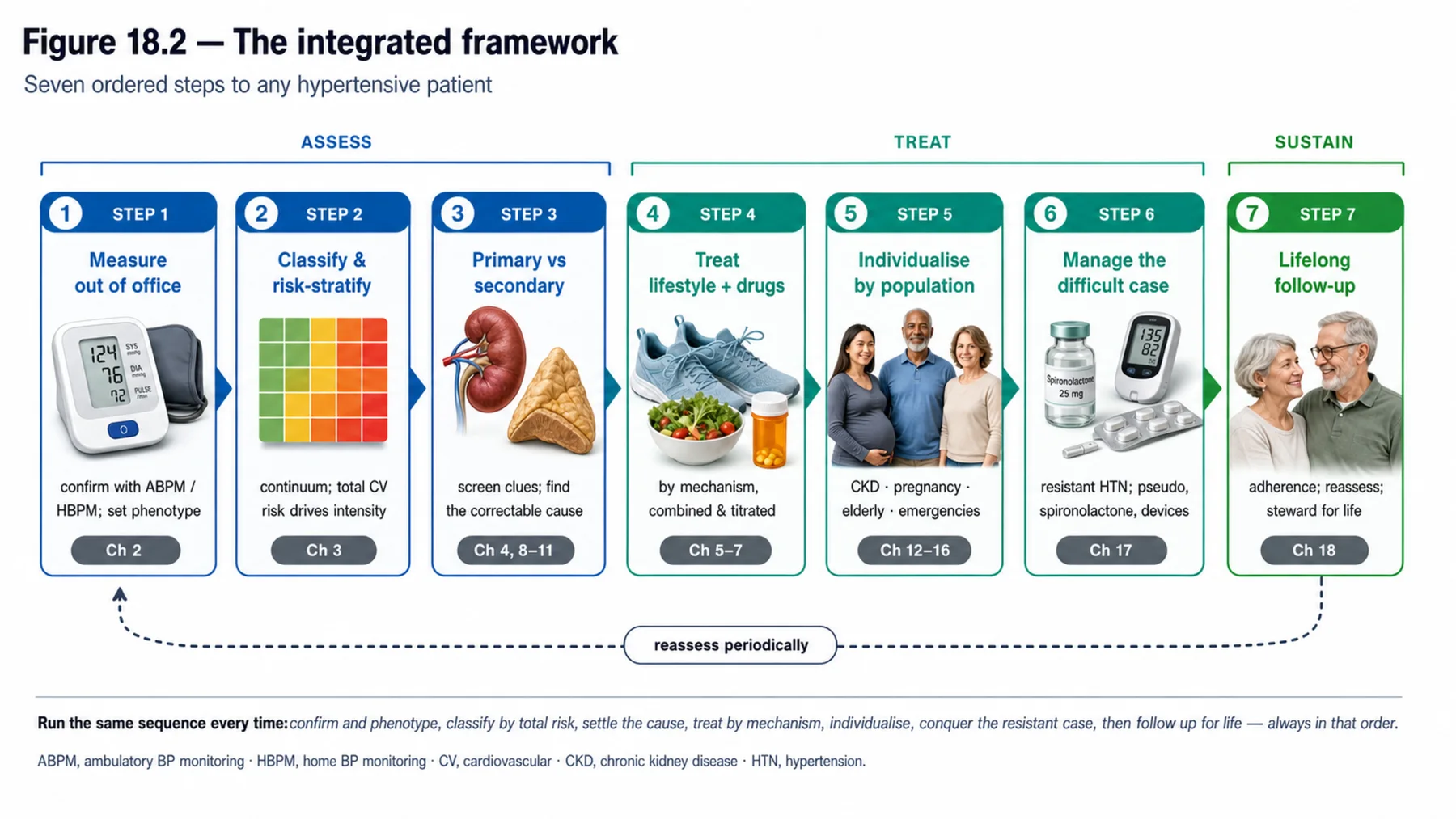
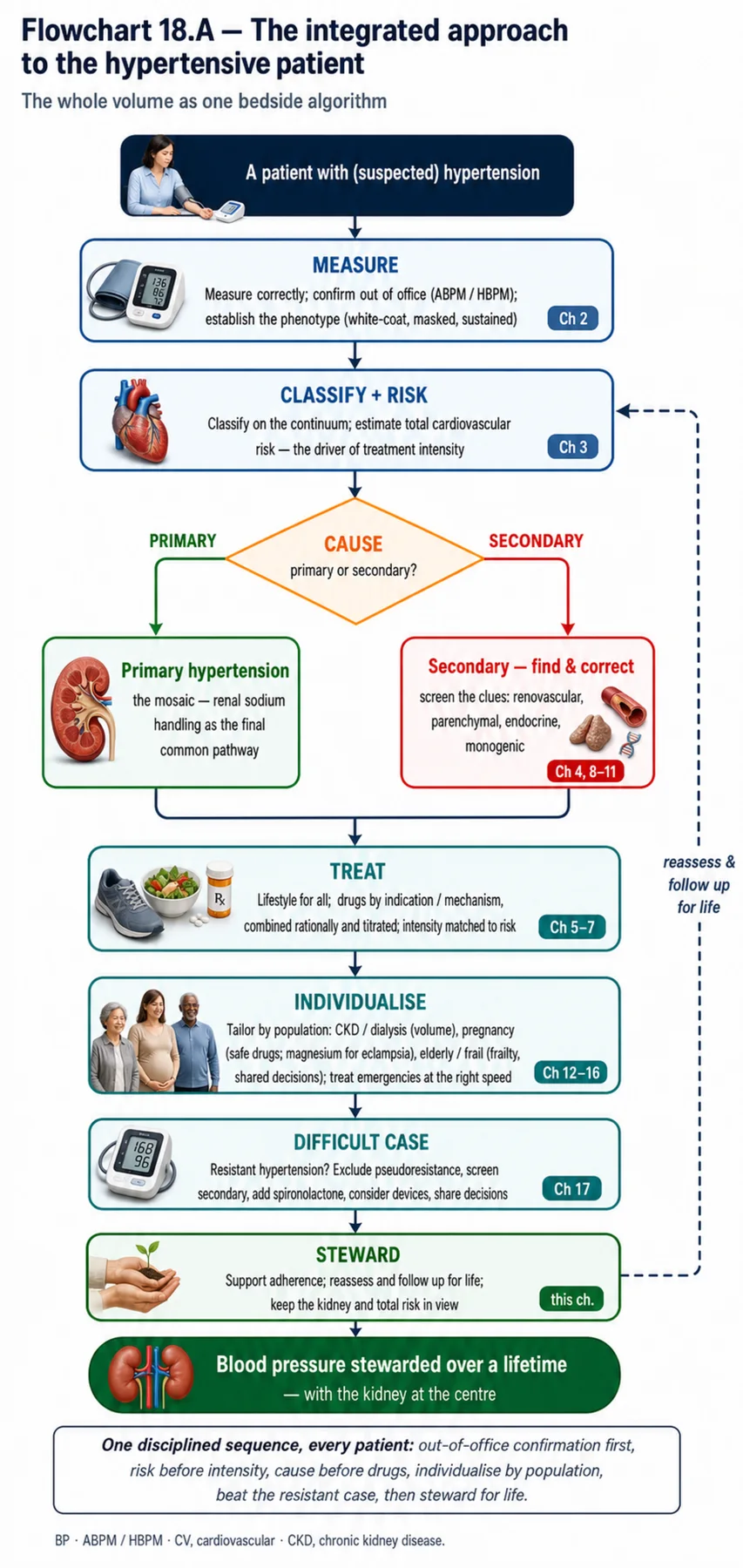
The integrated approach reads every hypertensive patient through one framework: measure the blood pressure correctly (and out of office), classify and risk-stratify, determine whether it is primary or secondary, treat with lifestyle and drugs matched to mechanism and risk, individualise by population, and follow up for life.
Blood pressure is the product of cardiac output and resistance, defended over seconds by baroreceptors, over hours by the RAAS, and over days by the kidney.
It is measured correctly and confirmed out of office, classified on a continuum of risk, and managed by total cardiovascular risk rather than the number alone.
Primary hypertension is a multifactorial mosaic converging on renal sodium handling; secondary hypertension is sought by its clues and treated at its cause.
Lifestyle change is the foundation, and the drug classes — each acting on a regulator — are combined rationally, with the classes broadly equivalent when blood pressure is lowered equally.
Special populations — CKD and dialysis (volume), pregnancy, the elderly and frail — require their own adjustments, and the difficult resistant case its own work-up.
Hypertension stewardship is the lifelong, evidence-based, patient-centred management of a usually silent risk factor.
Because hypertension is asymptomatic and lifelong, the central challenge is sustained adherence and engagement — it is managed over decades, not fixed once.
Stewardship means treating to benefit (risk-based), avoiding over-treatment (the frail, the severe-asymptomatic), individualising, and sharing the preference-sensitive decisions.
The whole patient — total cardiovascular risk, comorbidity, kidney, and preferences — stays at the centre.
The clinician is the steward of the patient's blood pressure over a lifetime, with the kidney at the heart of the matter.
| 03 | PHASE A · LEVEL 3 · ORIENTATION & KNOWLEDGE Main Narrative |
This volume has moved from the physiology of blood pressure to its measurement, classification, causes, consequences, treatment, and special settings. This closing chapter draws it together: the recurring principles that unify it, a single framework for the hypertensive patient, the thread that runs through every chapter — the kidney at the centre — and the discipline that turns the knowledge into lifelong care: hypertension stewardship. It is where the whole volume meets the patient in front of you.
— The recurring principles
A handful of principles recur across every chapter and, learned once, organise the field. Blood pressure is the product of cardiac output and resistance, defended over different timescales — baroreceptors over seconds, the RAAS over hours, the kidney over days — with the kidney the long-term arbiter through pressure-natriuresis. The measurement must be done correctly and confirmed out of office, because the number drives everything. Hypertension is a cardiovascular risk factor on a continuum, managed by total risk rather than a threshold. Primary hypertension is a multifactorial mosaic converging on renal sodium handling; secondary hypertension is sought by its clues. Lifestyle is the foundation, the drug classes each act on a regulator and are combined rationally, and they are broadly equivalent for outcomes when blood pressure is lowered equally. The kidney is both a cause and a victim. Severe hypertension is lowered at the right speed. Special populations differ. And the difficult case is worked up before it is escalated. These principles, woven through the volume, are its conceptual spine.
— The kidney at the centre
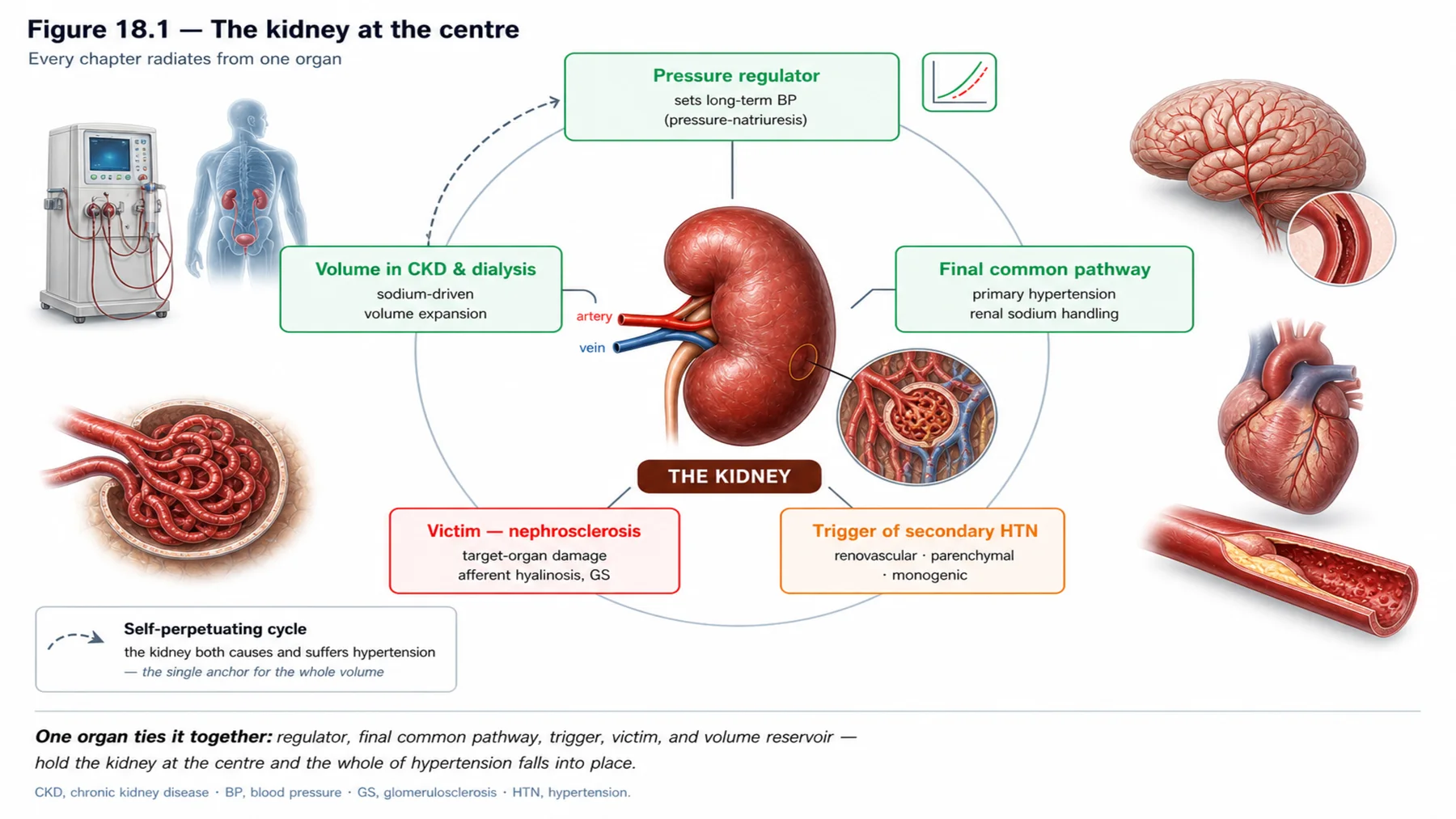
If one thread runs through the entire volume — fittingly, for a nephrology atlas — it is that the kidney is at the centre of blood pressure. The kidney sets the long-term blood pressure through pressure-natriuresis, so sustained hypertension requires a renal sodium-handling shift (the opening chapter). Renal sodium handling is the final common pathway of primary hypertension's many mechanisms (the mosaic chapter). The kidney is the trigger of major secondary hypertension — renovascular disease activating the RAAS, renal parenchymal disease impairing sodium excretion, the monogenic syndromes altering tubular sodium transport — and the target of hypertensive damage (nephrosclerosis), so that it is both cause and victim, locked in a vicious cycle. Volume — a renal matter — dominates the hypertension of CKD and dialysis. Even the endocrine causes act, in the end, on renal sodium handling, and the most effective resistant-hypertension drug (spironolactone) and the foundational diuretics act on the kidney. The recurring return to the kidney is not incidental: hypertension is, at its core, a renal disease, and understanding the kidney is understanding hypertension. This is the unifying insight of the volume.
— One framework for the hypertensive patient
The integrated approach reads every hypertensive patient through a single, ordered framework. First, measure the blood pressure correctly and confirm a new diagnosis out of the office, establishing the true phenotype. Second, classify and risk-stratify — place the pressure on the continuum and, crucially, estimate the total cardiovascular risk, because that (not the number alone) drives the decision and intensity of treatment. Third, determine primary versus secondary — screen for secondary causes when the clues are present (resistant, young, severe, abrupt, hypokalaemic), because a correctable cause may cure the hypertension. Fourth, treat: lifestyle change for all, and drugs chosen by compelling indication and by the regulator they target, combined rationally and titrated to target, with the intensity set by the risk. Fifth, individualise by population — the volume-driven approach in CKD and dialysis, the safe drugs and magnesium of pregnancy, the frailty-based, shared decisions of the elderly. Sixth, manage the difficult case by excluding pseudoresistance and adding the evidence-based agents. And seventh, follow up for life. This ordered framework — measure, classify and risk-stratify, find the cause, treat, individualise, manage the difficult case, follow up — turns the volume's many chapters into a single coherent approach to the patient.
— Hypertension stewardship
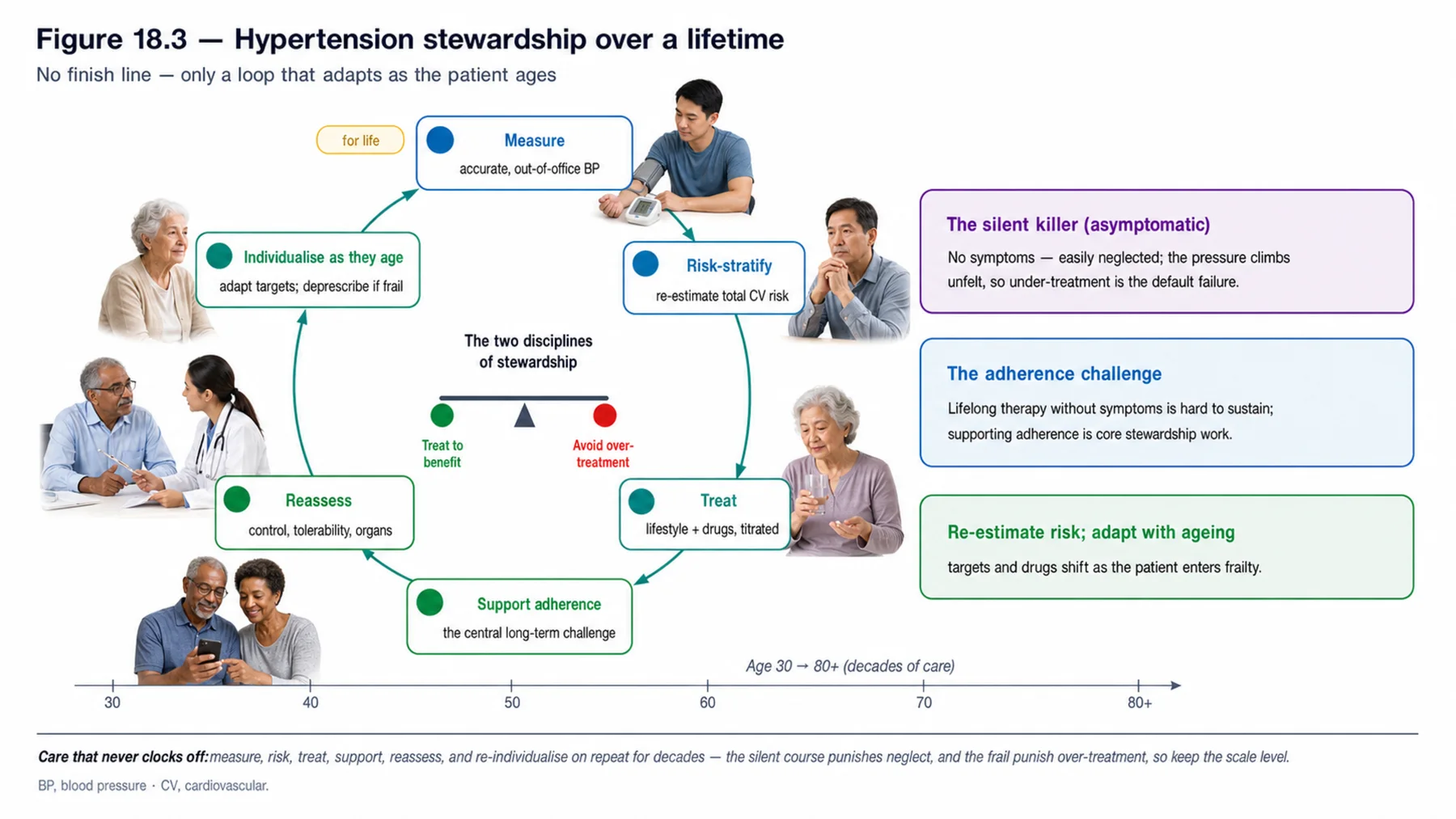
The therapeutic spine of the chapter, and a fitting close to the volume, is hypertension stewardship: the lifelong, evidence-based, patient-centred management of a usually silent risk factor. Two features of hypertension shape the stewardship. First, it is almost always asymptomatic — the 'silent killer' — so the patient feels no better for being treated and no worse for stopping, which makes adherence and engagement the central, perennial challenge; much of the work of hypertension management is not choosing the drug but sustaining the treatment over decades, supporting adherence, and keeping the patient engaged in a condition they cannot feel. Second, it is lifelong — a chronic risk factor managed over a lifetime, not a problem fixed once — so stewardship means continuity: regular measurement, periodic reassessment of risk and targets, adjustment as the patient ages and comorbidities accrue, and follow-up that does not lapse. Good stewardship is also disciplined in both directions: treating to benefit where the risk justifies it (and not under-treating the fit elderly or the high-risk), while avoiding over-treatment (the frail, the severe-asymptomatic elevation, the over-medicated), individualising, and sharing the genuinely preference-sensitive decisions. Hypertension stewardship is what converts the volume's knowledge into decades of safe, beneficial care.
— The evidence that grounds it
Stewardship is evidence-based, and the volume's evidence converges on a coherent set of conclusions. Treatment benefit scales with baseline risk, so management is risk-based, with the threshold mattering less than the total assessment. The four first-line classes lower events similarly when blood pressure is equalised, so the magnitude of lowering matters more than the class, and the classes are chosen by indication and tolerability. RAAS blockade is renoprotective in albuminuric kidney disease, and the newer agents (SGLT2 inhibitors, finerenone) add benefit. Out-of-office measurement predicts outcomes better than office readings. Intensive targets benefit high-risk patients (SPRINT) but with real harms, so they are individualised and measured correctly. Spironolactone is the best fourth-line drug (PATHWAY-2). Renal denervation gives a modest, real effect. Lifestyle change, combined, can equal a drug. The honest reading is that much of the evidence points to a disciplined moderation — risk-based treatment, equivalent classes, individualised targets, the right drug for the cause — and to the primacy of getting the blood pressure controlled, by whatever rational means, over agonising about small differences. The evidence grounds the stewardship; it does not replace the judgement of applying it to the individual.
— The steward of a lifetime of blood pressure
The volume closes on an image of the clinician's role: the steward of the patient's blood pressure over a lifetime, with the kidney at the heart of the matter. Hypertension is the commonest chronic disease and a leading cause of stroke, heart, and kidney disease worldwide, yet it is silent, lifelong, and eminently treatable — so the difference between good and poor management is measured not in a single clever decision but in decades of consistent, evidence-based, patient-centred care: measuring correctly, stratifying by risk, finding the correctable causes, treating to benefit without over-treating, individualising to the population and the person, and sustaining the treatment and the relationship over a lifetime. And throughout, the kidney is at the centre — as the setter of the long-term pressure, the final common pathway of primary hypertension, the trigger and the victim of secondary and hypertensive disease, and the organ whose protection is among the chief goals of treatment. The expert in hypertension is not the one who knows the most drugs but the one who reads the patient through the integrated framework, keeps the kidney and the total risk in view, and stewards the blood pressure over the long arc of a life. That is the integrated approach, and it is where this volume — from the first chapter's pressure-natriuresis to this last one's call to stewardship — has been leading.
| 04 | PHASE A · LEVEL 4 · ORIENTATION & KNOWLEDGE Reference Tables |
Table 18.1 — The recurring principles
| Principle | Where it recurs |
| The kidney is the centre of blood pressure | Pressure-natriuresis; cause and victim (Ch 1, 12) |
| Measure correctly, confirm out of office | The number drives everything (Ch 2) |
| Manage by total cardiovascular risk | On a continuum, not a threshold (Ch 3) |
| Renal sodium handling is the final common pathway | The mosaic of primary hypertension (Ch 4) |
| Lifestyle foundation; drugs by mechanism; classes equivalent | Treatment (Ch 5–7) |
| Find the correctable cause; lower at the right speed; populations differ | Secondary, emergencies, special populations (Ch 8–17) |
Table 18.2 — The kidney at the centre
| Role | Detail |
| Sets the long-term pressure | Pressure-natriuresis (the kidney is the arbiter) |
| Final common pathway | Renal sodium handling underlies primary hypertension |
| Trigger of secondary HTN | Renovascular, parenchymal, monogenic (tubular sodium) |
| Victim and volume | Nephrosclerosis; volume dominates CKD/dialysis hypertension |
Table 18.3 — The integrated framework
| Step | Action |
| 1. Measure | Correctly; confirm out of office; establish the phenotype |
| 2. Classify & risk-stratify | Place on the continuum; estimate total cardiovascular risk |
| 3. Primary vs secondary | Screen for secondary causes when clues present |
| 4. Treat | Lifestyle for all; drugs by indication/mechanism, combined, titrated; intensity by risk |
| 5. Individualise / 6. Difficult case / 7. Follow up | Adjust by population; work up resistance; lifelong follow-up |
Table 18.4 — Hypertension stewardship
| Element | Detail |
| Definition | Lifelong, evidence-based, patient-centred management of a silent risk factor |
| The silent killer | Asymptomatic — adherence and engagement are the central challenge |
| Lifelong | Managed over decades, not fixed once — continuity and reassessment |
| Disciplined both ways | Treat to benefit; avoid over-treatment; individualise; share preference-sensitive decisions |
Table 18.5 — The evidence that grounds the approach
| Conclusion | Note |
| Benefit scales with baseline risk | Risk-based treatment; the threshold matters less |
| Classes equivalent when BP equalised | Choose by indication/tolerability; lower the pressure |
| RAAS blockade renoprotective; newer agents add benefit | Albuminuric CKD; SGLT2 inhibitors, finerenone |
| Out-of-office BP predicts better; intensive targets benefit but harm | Confirm out of office; individualise targets |
| Spironolactone best fourth-line; lifestyle can equal a drug | Resistant HTN; the foundation |
Table 18.6 — The whole-patient synthesis
| Step | Action |
| Read through the framework | Measure, classify, risk-stratify, find the cause, treat, individualise |
| Keep the kidney in view | The setter, the pathway, the trigger, the victim |
| Keep total risk central | Manage the risk, not the number |
| Steward over a lifetime | Sustain adherence and follow-up; the patient at the centre |
| 05 | PHASE B · LEVEL 5 · VISUALISE & MAP Imaging & Flowchart Specifications |
| 06 | PHASE B · LEVEL 6 · VISUALISE & MAP Concept Maps |
Each chain runs from principle to a named clinical action; read the arrows as “leads to.”
The kidney at the centre. Pressure-natriuresis sets the long-term pressure + renal sodium handling is the final common pathway + the kidney is trigger and victim → hypertension is a renal disease → ACTION: keep the kidney in view in every hypertensive patient.
Measure, classify, risk-stratify. Correct measurement (out of office) → classification on a continuum → total cardiovascular risk → ACTION: let total risk, not the number, drive the decision and intensity.
Primary vs secondary. Primary (mosaic converging on renal sodium handling) vs secondary (clue-driven, often correctable) → ACTION: screen for secondary causes when the clues are present, and find the curable.
Treat by mechanism and risk. Lifestyle foundation + drugs mapped to the regulators + rational combination + classes equivalent → ACTION: choose by indication and tolerability, combine rationally, and lower the pressure to a risk-set target.
Stewardship over a lifetime. Silent, lifelong risk factor → adherence and engagement are the challenge → ACTION: steward the blood pressure over decades — sustain treatment, reassess, individualise, keep the patient central.
| 07 | PHASE B · LEVEL 7 · VISUALISE & MAP Decision Pathways |
| R1 | IF approaching any hypertensive patient, THEN read them through one framework — measure, classify and risk-stratify, find the cause, treat, individualise, and follow up. |
| R2 | IF thinking about hypertension at all, THEN keep the kidney in view — it sets the long-term pressure and is the trigger, the pathway, and the victim. |
| R3 | IF deciding whether and how intensively to treat, THEN be driven by total cardiovascular risk, not the blood-pressure number alone. |
| R4 | IF a screening clue is present, THEN look for a correctable secondary cause before committing to lifelong drug therapy. |
| R5 | IF choosing drugs, THEN match them to the indication and the regulator, combine rationally, and remember the classes are broadly equivalent — so lower the pressure. |
| R6 | IF the patient belongs to a special population, THEN individualise — volume in CKD/dialysis, safe drugs and magnesium in pregnancy, frailty and shared decisions in the elderly. |
| R7 | IF managing hypertension over time, THEN steward it — support adherence in a silent disease, reassess, and follow up for life. |
| R8 | IF managing the hypertensive patient, THEN keep the whole patient — total risk, comorbidity, kidney, and preferences — at the centre, not the number. |
| 08 | PHASE C · LEVEL 8 · CLINICAL REASONING Clinical Cases |
| CASE 1 | THE WHOLE FRAMEWORK Read the patient systematically The integrated assessment |
Presentation
A newly referred hypertensive patient is presented, and a trainee jumps straight to choosing a drug. The patient's measurement method, total risk, possible secondary causes, and population factors have not been considered.
❖ Pause and reflect What should come before choosing a drug? |
Analysis
The integrated framework, in order, before the drug choice. First, is the blood pressure measured correctly and confirmed out of office — is this even sustained hypertension, or white-coat? Second, what is the total cardiovascular risk, which drives whether and how intensively to treat? Third, is there a secondary, correctable cause (any clues — resistant, young, severe, hypokalaemic)? Fourth, then treat — lifestyle for all, and drugs by indication and mechanism. Fifth, individualise by population (CKD, pregnancy, elderly). Jumping straight to a drug skips the steps that determine whether to treat, how intensively, and whether a cure is possible. The framework — measure, classify and risk-stratify, find the cause, treat, individualise, follow up — is what turns a reflex prescription into considered care.
Plan
Work through the framework in order — confirm the measurement out of office, estimate total risk, screen for secondary causes if clues are present, then treat with lifestyle and risk-matched drugs, individualising by population — before settling on a regimen. Read the patient through the whole framework.
Teaching point
Read every hypertensive patient through the integrated framework — measure, classify and risk-stratify, find the cause, then treat — rather than jumping to a drug.
Cross-reference
Exercises rules R1 and R3; the framework concept map; Figure 18.2; Tables 18.3, 18.6.
| CASE 2 | ALWAYS THE KIDNEY Recognise the renal thread The kidney at the centre |
Presentation
A student, having studied the volume, asks what single idea ties together pressure-natriuresis, salt sensitivity, renovascular hypertension, nephrosclerosis, dialysis hypertension, and the effectiveness of diuretics and spironolactone.
❖ Pause and reflect What single thread runs through all of these? |
Analysis
The kidney. It is the unifying thread of the whole volume. The kidney sets the long-term blood pressure through pressure-natriuresis; salt sensitivity is impaired renal sodium handling; renovascular hypertension is the kidney triggering the RAAS; nephrosclerosis is the kidney as victim; dialysis hypertension is renal volume; and the diuretics and spironolactone work on the kidney's sodium handling. Even the endocrine and monogenic causes act on renal sodium transport. The recurring return to the kidney is the deepest insight of the volume: hypertension is, at its core, a renal disease, which is why a nephrology atlas devotes a volume to it and why keeping the kidney in view illuminates every hypertensive patient. The single idea the student is looking for is the kidney at the centre.
Plan
Recognise the kidney as the unifying thread — the setter of the long-term pressure, the final common pathway, the trigger, and the victim — and keep it in view in every hypertensive patient. See hypertension as, at its core, a renal disease.
Teaching point
The kidney is the thread through the whole volume — it sets the pressure, is the final common pathway, the trigger, and the victim; hypertension is at its core a renal disease.
Cross-reference
Exercises rule R2; the kidney-at-the-centre concept map; Figure 18.1; Tables 18.1, 18.2; the whole volume.
| CASE 3 | THE SILENT KILLER Stewardship over a lifetime Adherence and follow-up |
Presentation
A patient well-controlled on therapy stops taking it because he 'feels fine,' and is lost to follow-up, returning years later with a stroke and advanced kidney disease.
❖ Pause and reflect What is the central challenge this case illustrates? |
Analysis
It illustrates the central challenge of hypertension management: it is a silent, lifelong disease, so the patient feels no better for treatment and no worse for stopping, and adherence and engagement — not the choice of drug — are the perennial difficulty. This patient stopped because he 'felt fine' (the hypertension was asymptomatic) and was lost to follow-up, and the silent disease did its damage over the intervening years. Good stewardship would have anticipated this: explaining that hypertension is asymptomatic but harmful, supporting adherence, simplifying the regimen (single-pill combinations), and maintaining follow-up that does not lapse. Hypertension is managed over decades, not fixed once, and the work of stewardship is sustaining the treatment and the relationship in a condition the patient cannot feel.
Plan
Practise stewardship — explain the silent, lifelong nature, support and simplify adherence, and maintain durable follow-up — recognising that sustaining treatment over decades, not the drug choice, is the central challenge. Steward the silent, lifelong disease.
Teaching point
Hypertension is a silent, lifelong disease — adherence and follow-up over decades, not the drug choice, are the central challenge of stewardship.
Cross-reference
Exercises rule R7; the stewardship concept map; Figure 18.3; Table 18.4.
| CASE 4 | THE WHOLE PATIENT Risk-based, individualised, patient-centred The synthesis |
Presentation
A complex older patient with hypertension, CKD, diabetes, frailty, and polypharmacy is being managed by a team fixated on driving the blood-pressure number to a fixed target, without regard to her total risk, her kidney, her frailty, or her preferences.
❖ Pause and reflect What is missing from this number-focused management? |
Analysis
The integrated, patient-centred synthesis that the volume has been building toward. The team is chasing a number rather than reading the patient through the framework, keeping the kidney and total risk in view, individualising by her frailty and CKD, and sharing the preference-sensitive decisions. For this patient, the right approach integrates everything: her total cardiovascular risk and her CKD (favouring treatment and RAAS-blockade renoprotection), her frailty and polypharmacy (favouring a less intensive target and deprescribing), and her own preferences (a shared decision). The single fixed target ignores all of this. The expert reads the whole patient — risk, kidney, frailty, preferences — through the integrated framework and stewards her blood pressure accordingly, which is the synthesis of the volume.
Plan
Step back and manage the whole patient — read her through the framework, weigh her total risk and CKD against her frailty and polypharmacy, individualise the target, and share the decision — rather than driving a number to a fixed target. Keep the whole patient, not the number, at the centre.
Teaching point
Expertise is reading the whole patient — total risk, kidney, frailty, preferences — through the integrated framework and stewarding the blood pressure, not chasing a number.
Cross-reference
Exercises rules R6 and R8; the framework and stewardship concept maps; Table 18.6; the special-population chapters (14–17).
| 09 | PHASE C · LEVEL 9 · CLINICAL REASONING Clinical Implications |
One triad per principle the synthesis exposed: the idea, why it matters, and the clinical move.
MECHANISM The kidney sets the long-term pressure and is the trigger, the pathway, and the victim of hypertension. |
WHY IT MATTERS Hypertension is, at its core, a renal disease. |
ACTION Keep the kidney in view in every hypertensive patient. |
MECHANISM The hypertensive patient is best read through one ordered framework. |
WHY IT MATTERS It turns the volume's many chapters into a single coherent approach. |
ACTION Measure, classify and risk-stratify, find the cause, treat, individualise, follow up. |
MECHANISM Treatment benefit scales with baseline risk, and the classes are broadly equivalent. |
WHY IT MATTERS The total risk, not the number or the class, drives the decision. |
ACTION Manage by total risk, choose by indication and tolerability, and lower the pressure. |
MECHANISM Hypertension is a silent, lifelong risk factor. |
WHY IT MATTERS Adherence and engagement over decades, not the drug choice, are the central challenge. |
ACTION Steward the blood pressure over a lifetime — sustain treatment and follow-up. |
MECHANISM The hypertensive patient is a whole person with risk, comorbidity, a kidney, and preferences. |
WHY IT MATTERS A fixed number ignores what should drive the management. |
ACTION Keep the whole patient — not the number — at the centre. |
| 10 | PHASE C · LEVEL 10 · CLINICAL REASONING Clinical Pearls |
| The KIDNEY is at the centre of blood pressure — the volume's unifying thread. | Pressure-natriuresis: the kidney sets the long-term pressure. |
| Renal sodium handling = the final common pathway of primary hypertension. | The kidney is the trigger (renovascular/parenchymal/monogenic) and the victim (nephrosclerosis). |
| Volume (renal) dominates CKD/dialysis hypertension. | Hypertension is, at its core, a renal disease. |
| One framework: measure → classify/risk-stratify → cause → treat → individualise → follow up. | Measure correctly and confirm out of office. |
| Manage by TOTAL cardiovascular risk, not the number. | Find the correctable secondary cause when clues are present. |
| Lifestyle foundation; drugs by mechanism; classes equivalent — lower the pressure. | Individualise by population (CKD/dialysis, pregnancy, elderly/frail). |
| Stewardship: lifelong, evidence-based, patient-centred care of a SILENT risk factor. | Adherence and follow-up over decades are the central challenge. |
| Treat to benefit; avoid over-treatment; share preference-sensitive decisions. | Be the STEWARD of the blood pressure over a lifetime — keep the whole patient central. |
| 11 | PHASE D · LEVEL 11 · SAFETY & EVIDENCE Red Flags & Never-Do |
Panel A — Red flags
| ▲ | Jumping to a drug before measuring out of office, risk-stratifying, and considering a cause — work through the framework. |
| ▲ | Managing hypertension without the kidney in view — it is the setter, the pathway, the trigger, and the victim. |
| ▲ | Chasing a number rather than the total cardiovascular risk — manage the risk. |
| ▲ | A well-controlled patient lost to follow-up — the silent killer; stewardship requires durable follow-up. |
| ▲ | A fixed target imposed on a complex patient — individualise and keep the whole patient central. |
Panel B — Never do
| ✖ NEVER — manage a hypertensive patient by the number alone, ignoring total risk and the whole patient. |
| ✖ NEVER — lose sight of the kidney in hypertension. |
| ✖ NEVER — treat hypertension as a one-time fix rather than a lifelong stewardship. |
| ✖ NEVER — skip the framework's earlier steps by jumping straight to a drug. |
| 12 | PHASE D · LEVEL 12 · SAFETY & EVIDENCE Common Pitfalls |
Pitfall 1 — Drug before framework
| ✖ | WRONG Choosing a drug before measuring, risk-stratifying, and finding the cause. |
| ✓ | RIGHT Working through the framework in order first. |
| ✉ | WHY The earlier steps determine whether, how intensively, and what to treat. |
Pitfall 2 — Forgetting the kidney
| ✖ | WRONG Managing hypertension as a vascular problem without the kidney. |
| ✓ | RIGHT Keeping the kidney in view as the centre of blood pressure. |
| ✉ | WHY The kidney sets the pressure and is trigger, pathway, and victim. |
Pitfall 3 — Chasing the number
| ✖ | WRONG Driving a number to a fixed target regardless of risk. |
| ✓ | RIGHT Managing by total cardiovascular risk and the whole patient. |
| ✉ | WHY Benefit scales with risk; the number is not the goal. |
Pitfall 4 — The one-time fix
| ✖ | WRONG Treating hypertension as a problem solved once. |
| ✓ | RIGHT Stewarding it over a lifetime with adherence support and follow-up. |
| ✉ | WHY Hypertension is silent and lifelong; adherence is the challenge. |
Pitfall 5 — Ignoring the whole patient
| ✖ | WRONG Applying a fixed target to a complex, frail, CKD patient. |
| ✓ | RIGHT Integrating risk, kidney, frailty, and preferences. |
| ✉ | WHY The whole patient, not the number, should drive management. |
| 13 | PHASE D · LEVEL 13 · SAFETY & EVIDENCE Evidence Grading |
GRADE A HIGH CONFIDENCE The effect is real and the estimate is stable. RCTs at low risk of bias; multiple concordant prospective cohorts; meta-analyses. |
GRADE B MODERATE CONFIDENCE The effect is likely real but may shift with new data. Observational studies, registries, mechanistic human studies. |
GRADE C LOW CONFIDENCE Rests on physiology, reasoning, or consensus rather than outcomes. Pathophysiological reasoning; extrapolation; consensus without outcomes. |
Graded statements (by evidence type)
| Statement | Grade | Basis (evidence type) |
| The kidney sets the long-term blood pressure (pressure-natriuresis). | A | Established physiology |
| Treatment benefit scales with baseline cardiovascular risk. | A | Meta-analyses of RCTs |
| The first-line classes lower events similarly when BP is equalised. | A | RCTs and meta-analyses |
| Out-of-office blood pressure predicts outcomes better than office. | A | Prospective cohorts |
| RAAS blockade and the newer agents protect the kidney. | A | RCTs |
| Adherence is a major determinant of hypertension outcomes. | A | Observational and adherence data |
| Hypertension is a leading, treatable cause of cardiovascular and renal disease. | A | Epidemiological data |
| 14 | PHASE E · LEVEL 14 · PATIENT DECISIONS Absolute Risk in Natural Frequency |
Natural-frequency estimates for orientation, summarising the volume's evidence; they vary with context. They convey the size of the decisions, expressed per 100 comparable patients.
| Per 100 patients… | Outcome | Roughly how many | See |
| High-risk patients treated vs low-risk, same BP reduction | Events prevented | More in the high-risk group | L13 row 2 |
| New diagnoses confirmed out of office | Avoid misclassification (white-coat/masked) | Many — the office misclassifies | L13 row 4 |
| Albuminuric CKD given RAAS blockade and newer agents | Slow progression / avoid events | More than without them | L13 row 5 |
| Patients who remain adherent over years | Stay controlled and avoid events | More than the non-adherent | L13 row 6 |
★ How to read these Read these as orientation, not promises; outcomes depend on context. The stable signals of the volume: benefit scales with risk, out-of-office measurement matters, the kidney-protective agents help, and adherence over years is decisive. Communicate them as people out of 100, not as a hazard ratio. |
| 17 | PHASE F · LEVEL 17 · APPLY & TEST Documentation Templates |
Paste-ready notes. Tick the boxes that apply and delete the rest; make the integrated assessment and the stewardship plan explicit.
Template 1 — The integrated assessment
Template 2 — The stewardship plan
| 18 | PHASE F · LEVEL 18 · APPLY & TEST Cheat Sheet |
| The KIDNEY is the centre of blood pressure — the volume's thread. | Pressure-natriuresis: kidney sets the long-term pressure. |
| Renal sodium handling = final common pathway of primary HTN. | Kidney = trigger (renovascular/parenchymal/monogenic) + victim (nephrosclerosis). |
| Volume dominates CKD/dialysis hypertension. | Hypertension is, at its core, a renal disease. |
| Framework: measure → classify/risk → cause → treat → individualise → follow up. | Measure correctly; confirm out of office. |
| Manage by TOTAL risk, not the number. | Find the correctable secondary cause. |
| Lifestyle foundation; drugs by mechanism; classes equivalent. | Individualise by population. |
| Stewardship: lifelong, evidence-based, patient-centred (SILENT killer). | Adherence and follow-up over decades are the challenge. |
| Treat to benefit; avoid over-treatment; share decisions. | Be the STEWARD — keep the whole patient central. |
| 19 | PHASE F · LEVEL 19 · APPLY & TEST Flashcards |
| CARD 1 | Q. What are the recurring principles that unify the volume? A. The kidney at the centre of blood pressure; correct measurement confirmed out of office; management by total cardiovascular risk on a continuum; primary hypertension as a mosaic converging on renal sodium handling; lifestyle foundation with drugs by mechanism (classes equivalent); finding the correctable secondary cause; lowering at the right speed; individualising by population; and working up the difficult case. DETAILED. They form the conceptual spine of the field. CLINICAL. Apply the recurring principles to any hypertensive patient. |
| CARD 2 | Q. Why is the kidney said to be at the centre of hypertension? A. Because it sets the long-term pressure through pressure-natriuresis, renal sodium handling is the final common pathway of primary hypertension, the kidney is the trigger of major secondary hypertension and the victim (nephrosclerosis), and volume dominates the hypertension of kidney disease — so hypertension is, at its core, a renal disease. DETAILED. It is the unifying thread of the volume. CLINICAL. Keep the kidney in view in every hypertensive patient. |
| CARD 3 | Q. What is the integrated framework for the hypertensive patient? A. An ordered approach: measure correctly (and out of office), classify and risk-stratify, determine primary versus secondary, treat with lifestyle and drugs matched to mechanism and risk, individualise by population, manage the difficult case, and follow up for life. DETAILED. It turns the volume's chapters into one approach. CLINICAL. Read every patient through the framework before choosing a drug. |
| CARD 4 | Q. Why is hypertension managed by total cardiovascular risk? A. Because treatment benefit scales with baseline risk, and the same blood pressure carries very different absolute risk depending on the rest of the picture — so the total risk, not the number, drives whether and how intensively to treat. DETAILED. The threshold matters less than the assessment. CLINICAL. Manage the risk, not the number. |
| CARD 5 | Q. What is hypertension stewardship? A. The lifelong, evidence-based, patient-centred management of a usually silent risk factor — sustaining treatment and follow-up over decades, supporting adherence, treating to benefit while avoiding over-treatment, individualising, and sharing the preference-sensitive decisions. DETAILED. Hypertension is managed over a lifetime, not fixed once. CLINICAL. Steward the blood pressure over the long arc of a life. |
| CARD 6 | Q. Why does the silent, asymptomatic nature of hypertension matter? A. Because the patient feels no better for treatment and no worse for stopping, so adherence and engagement — not the choice of drug — are the perennial challenge, and much of the work is sustaining treatment in a condition the patient cannot feel. DETAILED. It is the 'silent killer.' CLINICAL. Support adherence and maintain durable follow-up. |
| CARD 7 | Q. What does the volume's evidence broadly conclude? A. That benefit scales with risk (treat by risk), the classes are equivalent when blood pressure is equalised (choose by indication, lower the pressure), out-of-office measurement predicts better, the kidney-protective agents help, intensive targets benefit high-risk patients with harms, and lifestyle can equal a drug — a disciplined moderation. DETAILED. It grounds the stewardship without replacing judgement. CLINICAL. Apply the evidence to the individual through the framework. |
| CARD 8 | Q. What is the mark of expertise in hypertension? A. Reading the patient through the integrated framework, keeping the kidney and total cardiovascular risk in view, individualising to the population and person, and stewarding the blood pressure over a lifetime — not knowing the most drugs or chasing a number. DETAILED. The whole patient stays at the centre. CLINICAL. Be the steward of the patient's blood pressure over a lifetime. |
| 20 | PHASE F · LEVEL 20 · APPLY & TEST One-Minute Preceptor |
| SCENE 1 | The intern jumping to a drug |
GET A COMMITMENT. “You've gone straight to choosing a drug for this new hypertensive — what came before that?”
PROBE FOR EVIDENCE. “The blood pressure is high” — ask: “Have you confirmed it out of office, estimated the total risk, and considered a secondary cause?”
TEACH A GENERAL RULE. Read every hypertensive patient through the framework — measure, classify and risk-stratify, find the cause — before choosing a drug; the earlier steps determine whether, how intensively, and what to treat.
REINFORCE WHAT WAS RIGHT. Recognising the need to treat was reasonable.
CORRECT A MISTAKE. Work through the framework in order first.
| SCENE 2 | The resident chasing the number |
GET A COMMITMENT. “You're driving this frail, CKD patient's number to a fixed target — why that target?”
PROBE FOR EVIDENCE. “It's the guideline number” — ask: “What about her total risk, her kidney, her frailty, and her preferences?”
TEACH A GENERAL RULE. Manage the whole patient — total risk, kidney, frailty, preferences — not a number; the integrated approach individualises and stewards the blood pressure.
REINFORCE WHAT WAS RIGHT. Wanting good control was well-intentioned.
CORRECT A MISTAKE. Individualise the target to the whole patient and share the decision.
| 21 | PHASE F · LEVEL 21 · APPLY & TEST Reflective Prompts |
Genuine tensions this synthesis leaves open; sit with them as the volume closes.
The volume taught hypertension chapter by chapter, yet the patient is one whole person. How do you hold the detailed knowledge and the integrated reading at once, without losing either?
Hypertension is the commonest, most treatable chronic disease, and the hardest to treat well — because it is silent. What would it take to make adherence to an invisible disease as natural as treating a painful one?
The evidence points to moderation — risk-based treatment, equivalent classes, individualised targets — yet guidelines and clinicians crave a single number. Why is a clean threshold so much more appealing than a considered judgement?
The kidney is at the centre of hypertension, yet hypertension is managed mostly by cardiologists and generalists. What is lost when the renal thread is not kept in view?
The expert is defined not by knowing the most drugs but by stewarding a blood pressure over a lifetime. What does it take to value the long, quiet work of stewardship over the single clever decision?
| 22 | PHASE F · LEVEL 22 · APPLY & TEST Board-Style Questions |
| Q 01 | What is the unifying thread of this volume on hypertension? |
| A | The heart |
| B | The kidney at the centre of blood pressure |
| C | The brain |
| D | The blood vessels alone |
Rationale The kidney sets the long-term pressure and is the pathway, trigger, and victim — the volume's thread (case 2, Figure 18.1, Table 18.2). A, C, and D are partial. |
| Q 02 | The integrated framework for the hypertensive patient is: |
| A | Choose a drug first |
| B | Measure → classify/risk-stratify → find the cause → treat → individualise → follow up |
| C | Treat only the number |
| D | Screen everyone for secondary causes |
Rationale The ordered framework turns the volume into one approach (case 1, Figure 18.2, Table 18.3). A skips the steps; C and D are wrong. |
| Q 03 | Hypertension should be managed primarily by: |
| A | The blood-pressure number alone |
| B | Total cardiovascular risk |
| C | The diastolic only |
| D | Symptoms |
Rationale Benefit scales with risk, so total risk drives management (Table 18.5, rule R3). A, C, and D are inadequate. |
| Q 04 | Why is the kidney central to primary hypertension? |
| A | It is irrelevant |
| B | Renal sodium handling is the final common pathway |
| C | Only the heart matters |
| D | It is only a victim |
Rationale Renal sodium handling is the final common pathway of the mosaic (Table 18.2). A, C, and D are incorrect. |
| Q 05 | Hypertension stewardship is best described as: |
| A | A one-time fix |
| B | Lifelong, evidence-based, patient-centred management of a silent risk factor |
| C | Treating only when symptomatic |
| D | Maximal drug therapy for all |
Rationale Stewardship sustains care over decades for a silent, lifelong disease (Figure 18.3, Table 18.4, rule R7). A, C, and D mischaracterise it. |
| Q 06 | Why does the silent nature of hypertension matter most? |
| A | It makes it harmless |
| B | It makes adherence and engagement the central challenge |
| C | It means no treatment is needed |
| D | It only affects the elderly |
Rationale Patients feel no better treated or worse off treatment, so adherence is the challenge (case 3, Table 18.4). A, C, and D are wrong. |
| Q 07 | When blood pressure is lowered equally, the first-line classes: |
| A | Differ greatly in benefit |
| B | Reduce events similarly — so choose by indication and tolerability and lower the pressure |
| C | Only the diuretic helps |
| D | Only RAAS blockers help |
Rationale The classes are broadly equivalent for outcomes (Table 18.5, rule R5). A, C, and D are incorrect. |
| Q 08 | The mark of expertise in hypertension is: |
| A | Knowing the most drugs |
| B | Reading the patient through the framework, keeping the kidney and total risk in view, and stewarding over a lifetime |
| C | Driving every number to target |
| D | Acting fastest |
Rationale Expertise is the integrated, patient-centred stewardship, not drug recall or number-chasing (case 4, rule R8, L3). A, C, and D miss the synthesis. |