Chapter Preamble
Signals declared
Sig-D — Diagnostic (primary). Select the right patients for disease-modifying treatment, and monitor them safely.
Sig-T — Therapeutic (strong). Tolvaptan for rapid progressors, rigorous blood-pressure control, and the supportive management package.
Sig-M — Mechanistic (strong). How tolvaptan works through the vasopressin-cAMP axis — and why its on-target effect is aquaresis.
Sig-V — Evidence-dense (strong). The TEMPO and REPRISE trials of tolvaptan and the HALT-PKD trials of blood-pressure control — graded and reflected on.
Levels populated and omitted
Populated (20): L1–L14, L17–L22. As the four-signal flagship it fires the concept maps (L6) and triads (L9), the absolute-risk table (L14), the templates (L17), and the reflective prompts (L21).
L15 / L16 preference-sensitive map and SDM scripts — omitted. No Sig-E; treatment is evidence-driven by risk-stratification, with the tolerability trade-off discussed as part of selection rather than as a formal preference-sensitive decision.
| 01 | PHASE A · LEVEL 1 · ORIENTATION & KNOWLEDGE Learning Objectives |
By the end of this chapter you should be able to:
Explain how tolvaptan works through the vasopressin-cAMP axis.
Summarise the TEMPO and REPRISE evidence for tolvaptan.
Select the rapid progressors who benefit from tolvaptan.
Recognise and monitor tolvaptan's side effects — aquaresis and hepatotoxicity.
Apply rigorous blood-pressure control with RAAS blockade (HALT-PKD).
Describe the supportive management package.
Weigh the benefit of tolvaptan against its burden.
Outline ESKD management and emerging therapies.
| 02 | PHASE A · LEVEL 2 · ORIENTATION & KNOWLEDGE Executive Summary |
Tolvaptan is the first disease-modifying treatment for ADPKD — a vasopressin V2-receptor antagonist that lowers cyst-cell cAMP, slowing cyst growth and the decline in kidney function.
Its mechanism follows directly from the pathogenesis: vasopressin drives cyst growth through cAMP, so blocking the V2 receptor reduces that signal.
Its main side effect, aquaresis (marked polyuria, nocturia, and thirst), is the on-target consequence of V2 blockade and is the chief limit on tolerability and adherence.
The TEMPO trial showed tolvaptan slowed the growth of total kidney volume and the decline in GFR in earlier ADPKD; REPRISE showed it slowed GFR decline in later-stage disease.
Tolvaptan is offered to rapid progressors — identified by the Mayo classification, the PROPKD score, rapid GFR decline, and family history — at appropriate CKD stages, not to every patient.
Beyond the aquaresis, tolvaptan carries a risk of idiosyncratic hepatotoxicity, requiring regular liver-function monitoring, and can raise uric acid.
So tolvaptan offers a real but modest slowing of progression at the cost of a substantial lifestyle burden and mandatory monitoring — a trade-off weighed in selecting and counselling patients.
Rigorous blood-pressure control is the other pillar: RAAS blockade is first-line, and the HALT-PKD trials showed that tighter control in younger patients with preserved function slowed the growth of total kidney volume.
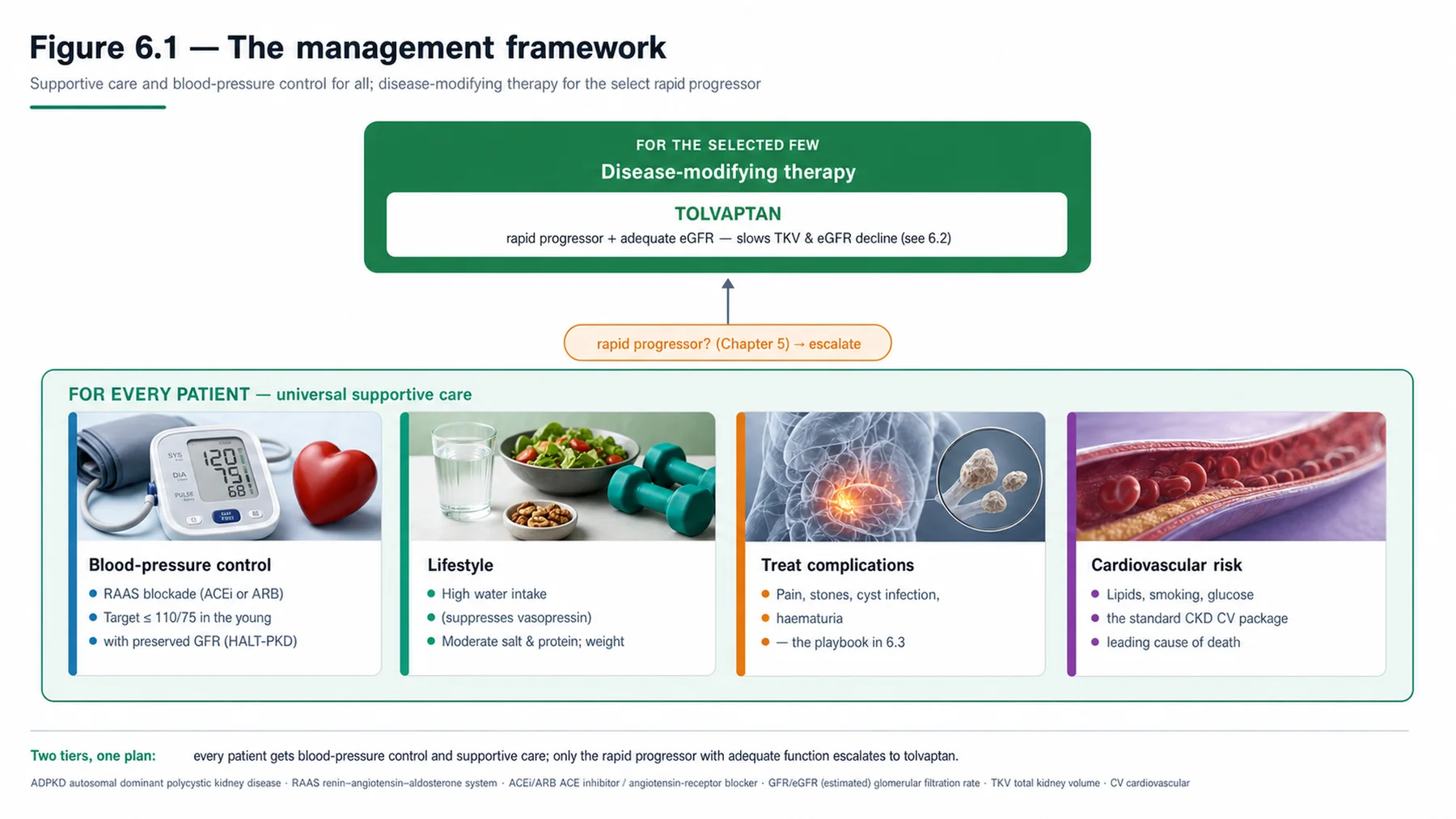
The supportive package adds high water intake (to suppress vasopressin), dietary sodium restriction, moderate protein, avoidance of nephrotoxins, cardiovascular risk management, and management of the manifestations.
Emerging therapies, including somatostatin analogues, are under study.
At end-stage disease, ADPKD patients do well with transplantation, sometimes after native nephrectomy for massive kidneys.
The chapter draws the ADPKD arc together: the vasopressin-cAMP mechanism yields tolvaptan, risk-stratification selects who receives it, the evidence quantifies the benefit, and the supportive package and blood-pressure control complete the care.
| 03 | PHASE A · LEVEL 3 · ORIENTATION & KNOWLEDGE Main Narrative |
For decades ADPKD had no disease-modifying treatment — only blood-pressure control and the management of complications. Tolvaptan changed that, and its story is the elegant payoff of the mechanism: vasopressin drives cyst growth through cAMP, so blocking vasopressin slows the disease. This flagship chapter draws the ADPKD arc together — the mechanism yielding the treatment, the evidence quantifying its benefit, risk-stratification selecting who receives it, and the trade-off, the blood-pressure control, and the supportive package completing comprehensive ADPKD care.
— Tolvaptan: mechanism and the on-target side effect
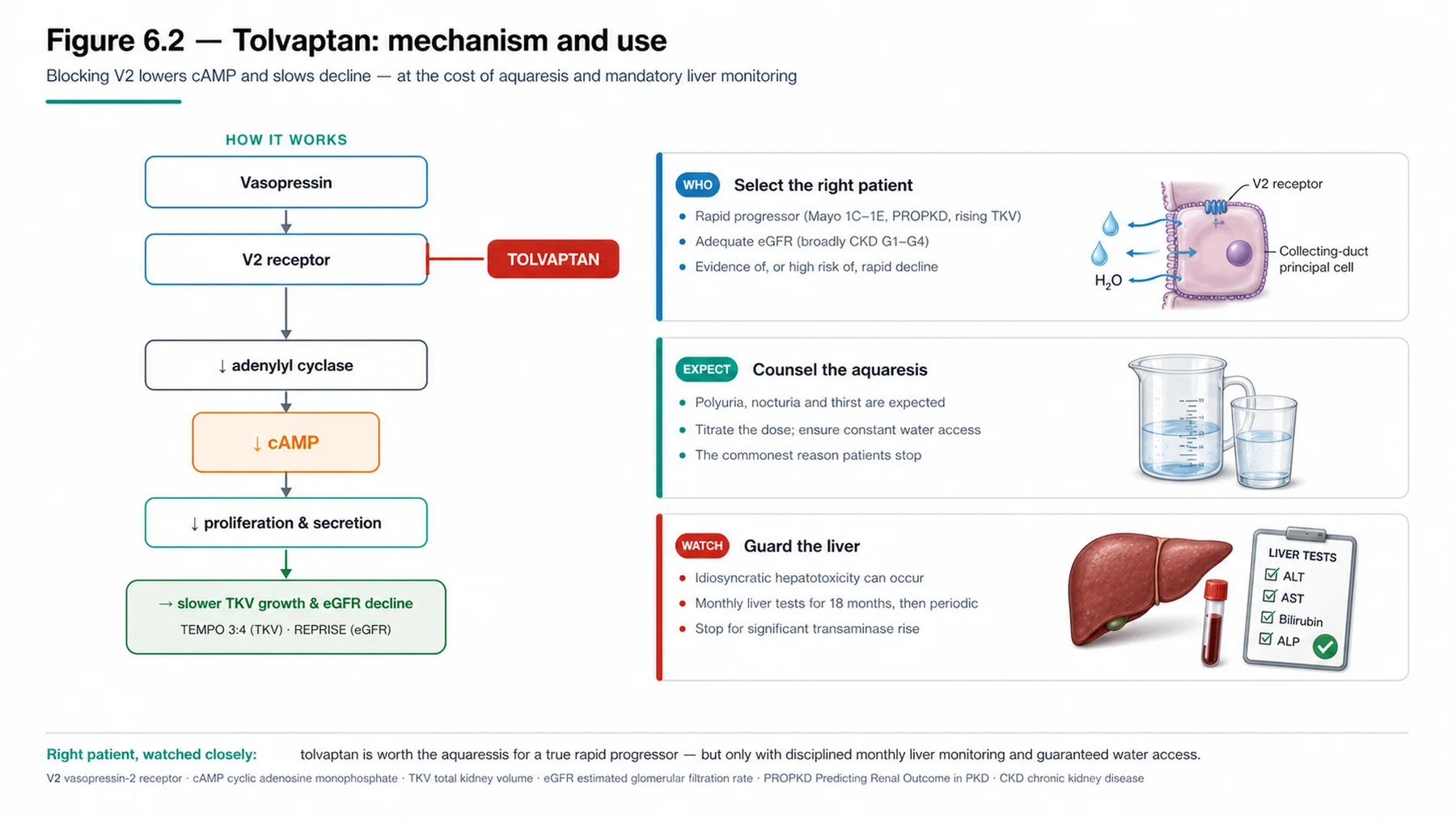
Tolvaptan is a selective vasopressin V2-receptor antagonist, and its mechanism follows directly from the pathogenesis of the earlier chapter. Vasopressin, acting on the V2 receptor in the cyst epithelium, raises intracellular cAMP — the signal that drives the cyst-cell proliferation and fluid secretion that grow cysts. Tolvaptan blocks that receptor, lowering cyst cAMP, and thereby slows cyst growth and the consequent decline in kidney function. This is the elegant link between mechanism and therapy: tolvaptan does not fix the genetic defect, but it interrupts the vasopressin-cAMP axis through which the defect grows cysts. The same mechanism produces tolvaptan's defining side effect: blocking the V2 receptor blocks vasopressin's normal action of concentrating the urine, so the patient cannot concentrate their urine and develops marked aquaresis — polyuria, nocturia, and the thirst and polydipsia that follow. This aquaresis is not a toxicity but the on-target consequence of the drug working, and it is the chief limit on tolerability: patients pass large volumes of urine day and night, must drink correspondingly, and many find this burden hard to sustain. So the mechanism explains both the benefit (lower cyst cAMP, slower growth) and the main side effect (aquaresis from blocked urinary concentration) — two faces of the same V2 blockade.
— The evidence: TEMPO and REPRISE
Two landmark trials established tolvaptan's benefit across the disease course. TEMPO 3:4 studied patients with earlier ADPKD (preserved GFR and enlarged kidneys) and showed that tolvaptan slowed the growth of total kidney volume (roughly halving the annual rate of increase) and slowed the decline in GFR — the first demonstration that a drug could modify the course of ADPKD. Because TEMPO enrolled earlier-stage patients, a question remained about later-stage disease, which REPRISE answered: in patients with later-stage ADPKD (CKD stages 2 to 4), tolvaptan slowed the decline in eGFR, extending the benefit to more advanced disease. Together, TEMPO and REPRISE provide the evidence base for tolvaptan as a disease-modifying therapy across the CKD spectrum in which it has been studied, and led to its approval for rapidly progressing ADPKD. The benefit is real but modest — a slowing of progression, not a halt or reversal — which, together with the side-effect burden, shapes how the drug is used: for those with the most to gain (the rapid progressors), in whom a modest slowing translates into meaningfully delayed kidney failure.
— Patient selection: the rapid progressors
Tolvaptan is not for every ADPKD patient — it is targeted to the rapid progressors, in whom the benefit justifies the burden, and identifying them is exactly the purpose of the risk-stratification developed in the previous chapter. The candidates are those at high risk of rapid progression: a high Mayo imaging class (the higher classes, reflecting a large total kidney volume for age), a high PROPKD score, a documented rapid decline in eGFR, significant total kidney volume growth, and a family history of early kidney failure — at appropriate CKD stages (broadly the stages studied in the trials, where benefit was shown, and where enough kidney function remains to protect). Selecting these patients concentrates the treatment on those most likely to benefit and spares slow progressors the burden of a drug they need less. This is why the diagnosis-and-risk chapter is the necessary precursor to this one: the risk tools are not academic exercises but the means of deciding who receives the first disease-modifying treatment for ADPKD. The decision also weighs the patient's ability to tolerate the aquaresis and commit to the monitoring — a treatment that demands a great deal of the patient.
— Monitoring and the trade-off
Beyond the aquaresis, tolvaptan carries a specific and important safety concern: idiosyncratic hepatotoxicity — potentially serious, idiosyncratic liver injury that mandates regular liver-function monitoring (frequent at first, then periodic) so that it is detected early and the drug stopped before serious harm. It can also raise uric acid (with a risk of gout). So a patient on tolvaptan requires ongoing monitoring — liver function tests, attention to volume status and sodium (the aquaresis risks dehydration and hypernatraemia if water is not maintained), and uric acid — and counselling about the aquaresis and the need to drink. The overall picture is a genuine trade-off: tolvaptan offers a real but modest slowing of progression — meaningful over years for a rapid progressor — at the cost of a substantial lifestyle burden (the relentless aquaresis), mandatory monitoring, and a small risk of serious liver injury. This trade-off is why the drug is reserved for rapid progressors and why the decision to start it, and to continue it, involves an honest discussion of the benefit against the burden, with the patient's tolerance and adherence central to success. The treatment works, but it asks a lot of the patient.
— Blood-pressure control and the supportive package
Tolvaptan is the headline, but the foundation of ADPKD management remains rigorous blood-pressure control, and the evidence here is also strong. Hypertension is early and common in ADPKD and accelerates progression, and RAAS blockade is the first-line agent (renoprotective, targeting the activated renin-angiotensin system of the enlarging kidneys). The HALT-PKD trials sharpened this: in younger patients with preserved kidney function, more rigorous (lower) blood-pressure control, compared with standard control, slowed the growth of total kidney volume (and reduced left ventricular mass and albuminuria) — supporting a lower blood-pressure target in early ADPKD where tolerated (and showing that combining an ACE inhibitor with an ARB added no benefit). Around this sit the supportive measures: high water intake (to suppress vasopressin and so, in theory, lower cyst cAMP — an adjunct with modest evidence, and a natural complement to tolvaptan's mechanism), dietary sodium restriction, moderate protein intake, avoidance of nephrotoxins, cardiovascular risk management, and the management of the manifestations (pain, haematuria, cyst infection, stones) from the previous chapter. So comprehensive ADPKD management is tolvaptan for the rapid progressor on a foundation of rigorous, RAAS-based blood-pressure control and supportive measures.
— ESKD, emerging therapies, and the synthesis
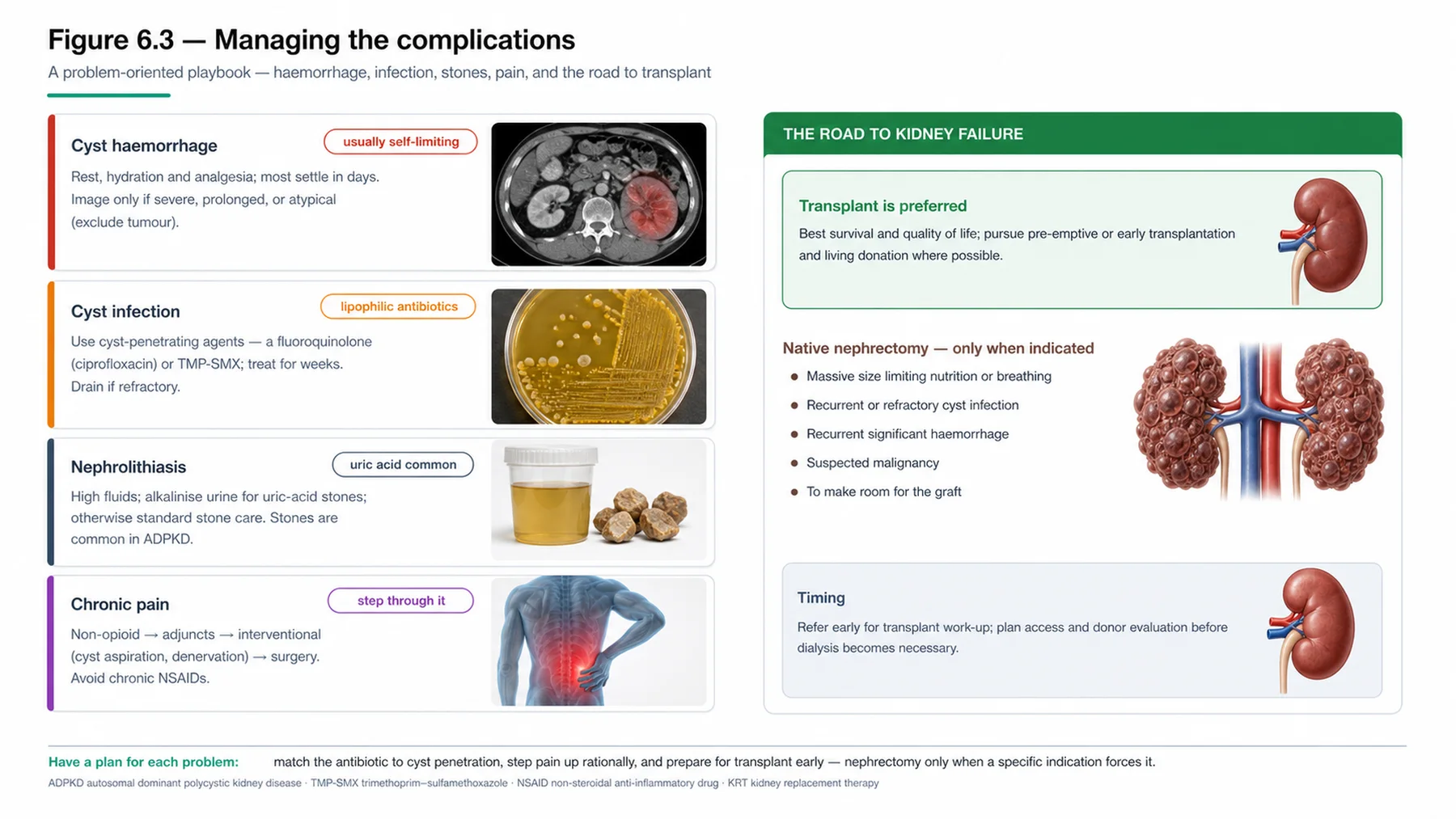
Despite the best management, many ADPKD patients still reach end-stage kidney disease, and their care there has its own features. ADPKD patients generally do well with kidney transplantation (often better than some other causes of ESKD), and transplantation is the preferred modality; native nephrectomy is sometimes needed — for massively enlarged kidneys (to make room for the graft), or for recurrent cyst infection, bleeding, or intractable pain. On the horizon, emerging therapies — notably the somatostatin analogues (octreotide, lanreotide), which reduce kidney and liver volume growth — are under study and may add to the armamentarium, and other agents target the cystogenic pathways. The synthesis of the chapter, and of the ADPKD arc, is the chain from mechanism to comprehensive care: the polycystin defect raises cAMP, vasopressin drives that cAMP, tolvaptan blocks vasopressin to slow cyst growth (TEMPO, REPRISE), risk-stratification (Mayo, PROPKD) selects the rapid progressors who benefit, the aquaresis and hepatotoxicity define the trade-off and the monitoring, rigorous RAAS-based blood-pressure control (HALT-PKD) and the supportive package form the foundation, and transplantation awaits those who still progress. ADPKD has moved, in a generation, from an untreatable inherited disease to one with a mechanism-based disease-modifying therapy targeted by validated risk tools — a model of applied, mechanism-to-bedside nephrology, and a fitting close to the cystic-disease part of the volume.
| 04 | PHASE A · LEVEL 4 · ORIENTATION & KNOWLEDGE Reference Tables |
Table 6.1 — Tolvaptan: mechanism
| Element | Detail |
| Drug | Selective vasopressin V2-receptor antagonist |
| Mechanism | Blocks V2 → ↓ cyst-cell cAMP → slows cyst growth and GFR decline |
| On-target side effect | Blocks urinary concentration → aquaresis (polyuria, nocturia, thirst) |
| Key idea | Same V2 blockade gives both the benefit and the main side effect |
Table 6.2 — The evidence (TEMPO, REPRISE)
| Trial | Finding |
| TEMPO 3:4 | Earlier ADPKD — slowed TKV growth (~halved) and GFR decline |
| REPRISE | Later-stage ADPKD (CKD 2–4) — slowed eGFR decline |
| Overall | First disease-modifying therapy; benefit real but modest |
| Approved for | Rapidly progressing ADPKD |
Table 6.3 — Patient selection
| Criterion | Detail |
| Rapid progressor | High Mayo class, high PROPKD, rapid eGFR decline, TKV growth, early family ESKD |
| CKD stage | Appropriate stages (as studied); enough function remaining to protect |
| Not for all | Slow progressors spared the burden of a drug they need less |
| Also weigh | Ability to tolerate aquaresis and commit to monitoring |
Table 6.4 — Side effects and monitoring
| Issue | Detail |
| Aquaresis | On-target — polyuria, nocturia, thirst; ensure water access (dehydration/hypernatraemia risk) |
| Hepatotoxicity | Idiosyncratic, potentially serious — regular LFT monitoring; stop if significant rise |
| Hyperuricaemia | May raise uric acid (gout risk) |
| Monitoring | LFTs (frequent then periodic), volume/sodium, uric acid; counsel on aquaresis |
Table 6.5 — Blood-pressure control (HALT-PKD)
| Point | Detail |
| First-line | RAAS blockade (ACE inhibitor or ARB) — renoprotective |
| HALT-PKD | Younger, preserved function: rigorous (lower) BP control slowed TKV growth |
| No added benefit | ACE inhibitor + ARB combination added nothing |
| Target | Lower BP target in early ADPKD where tolerated |
Table 6.6 — Supportive package, ESKD, and emerging
| Element | Detail |
| Supportive | High water intake (suppress vasopressin); sodium restriction; moderate protein; avoid nephrotoxins; CV risk; manage manifestations |
| Emerging | Somatostatin analogues (octreotide, lanreotide) — reduce kidney/liver volume growth |
| ESKD | Transplantation preferred (ADPKD patients do well); dialysis |
| Native nephrectomy | For massive kidneys (graft room), recurrent infection, bleeding, or pain |
| 05 | PHASE B · LEVEL 5 · VISUALISE & MAP Imaging & Flowchart Specifications |
| 06 | PHASE B · LEVEL 6 · VISUALISE & MAP Concept Maps |
Each chain runs from mechanism to a named bedside action; read the arrows as “leads to.”
Vasopressin-cAMP-tolvaptan. Vasopressin → V2 → ↑cyst cAMP → cyst growth; tolvaptan blocks V2 → ↓cAMP → slows growth → ACTION: use tolvaptan to interrupt the cyst-growth driver.
Benefit and the on-target side effect. V2 blockade → ↓cyst cAMP (benefit) + ↓urinary concentration (aquaresis) → the same mechanism gives both → ACTION: counsel on the unavoidable aquaresis as the price of the benefit.
Patient selection. Risk tools (Mayo, PROPKD, eGFR decline, family ESKD) → identify rapid progressors → the benefit justifies the burden → ACTION: offer tolvaptan to rapid progressors, not all patients.
Blood-pressure control. Hypertension accelerates ADPKD; RAAS blockade + rigorous control (HALT-PKD) slows TKV growth → ACTION: control BP rigorously with RAAS blockade, especially in early disease.
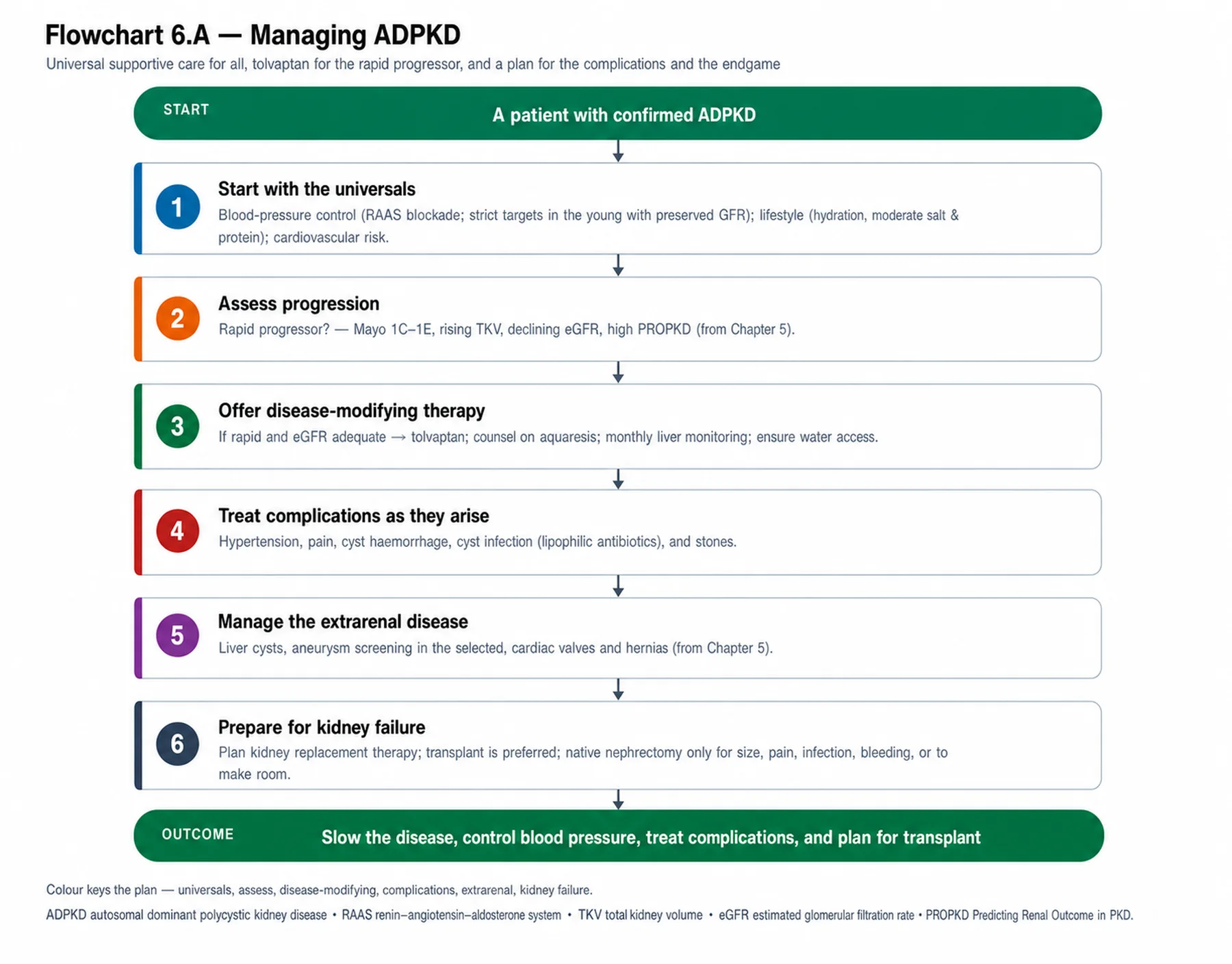
The management package. Tolvaptan (rapid progressors) + BP control + supportive measures + manifestation management + transplantation at ESKD → ACTION: build comprehensive, layered ADPKD care.
| 07 | PHASE B · LEVEL 7 · VISUALISE & MAP Decision Pathways |
| R1 | IF explaining how tolvaptan works, THEN attribute it to V2-receptor blockade lowering cyst cAMP — the same blockade that causes the aquaresis. |
| R2 | IF considering tolvaptan, THEN offer it to rapid progressors (high Mayo/PROPKD, rapid eGFR decline, family ESKD) at appropriate CKD stages — not to every patient. |
| R3 | IF starting tolvaptan, THEN counsel on the aquaresis and ensure water access — it is the on-target effect and the main burden. |
| R4 | IF a patient is on tolvaptan, THEN monitor liver function regularly (and volume/sodium and uric acid) and stop for significant hepatotoxicity. |
| R5 | IF deciding to start or continue tolvaptan, THEN weigh its real but modest benefit against the aquaresis burden and monitoring. |
| R6 | IF managing blood pressure in ADPKD, THEN use RAAS blockade first-line and aim for rigorous control, especially in early disease (HALT-PKD). |
| R7 | IF building the management package, THEN add high water intake, sodium restriction, moderate protein, CV risk management, and manifestation care. |
| R8 | IF an ADPKD patient reaches ESKD, THEN favour transplantation, with native nephrectomy for massive, infected, or bleeding kidneys. |
| 08 | PHASE C · LEVEL 8 · CLINICAL REASONING Clinical Cases |
| CASE 1 | WHO GETS TOLVAPTAN Target the rapid progressor Patient selection |
Presentation
Two ADPKD patients are seen: one a slow progressor (low Mayo class, stable eGFR, no family history of early ESKD) and one a rapid progressor (high Mayo class, rapid eGFR decline, early family ESKD). A clinician proposes starting tolvaptan in both — or neither.
❖ Pause and reflect Should tolvaptan be offered to both, neither, or selectively? |
Analysis
Selectively — tolvaptan is targeted to the rapid progressor, not given to all or withheld from all. The drug offers a real but modest slowing of progression at the cost of a substantial aquaresis burden, mandatory monitoring, and a hepatotoxicity risk, so it is reserved for those with the most to gain: the rapid progressors, identified by exactly the risk tools used here — a high Mayo imaging class, a documented rapid eGFR decline, and a family history of early kidney failure. The rapid progressor stands to have meaningfully delayed kidney failure from the modest slowing, justifying the burden; the slow progressor has less to gain and is spared a demanding drug they need less. So the rapid progressor should be offered tolvaptan (at an appropriate CKD stage, if willing and able to tolerate it and commit to monitoring), and the slow progressor managed with blood-pressure control and supportive measures. Risk-stratification is precisely the means of this selection.
Plan
Offer tolvaptan to the rapid progressor (high Mayo class, rapid eGFR decline, early family ESKD) after counselling on the trade-off, and manage the slow progressor with blood-pressure control and supportive measures rather than tolvaptan. Target tolvaptan to the rapid progressor.
Teaching point
Tolvaptan is targeted to rapid progressors (identified by Mayo/PROPKD, eGFR decline, family ESKD), not given to all — the benefit justifies the burden in those with the most to gain.
Cross-reference
Exercises rules R2 and R5; the patient-selection concept map; Figure 6.2; Tables 6.2, 6.3; risk-stratification in Chapter 5.
| CASE 2 | POLYURIA AND THE LIVER Aquaresis and hepatotoxicity Side effects and monitoring |
Presentation
A patient started on tolvaptan complains of relentless thirst and passing huge volumes of urine day and night, and asks whether the drug is harming them. The team has not arranged liver-function monitoring.
❖ Pause and reflect What is causing the polyuria, and what monitoring is essential? |
Analysis
The polyuria is the expected aquaresis — the on-target effect of the drug — and the missing piece is liver-function monitoring. Tolvaptan blocks the V2 receptor, which not only lowers cyst cAMP (the benefit) but also blocks vasopressin's normal concentrating action, so the patient cannot concentrate their urine and develops marked aquaresis (polyuria, nocturia, thirst). This is not the drug harming the kidney; it is the on-target consequence of V2 blockade and the price of the benefit, requiring adequate water access (with attention to the risk of dehydration and hypernatraemia if water is not maintained). The genuine safety concern that has been overlooked is hepatotoxicity: tolvaptan can cause idiosyncratic, potentially serious liver injury, mandating regular liver-function monitoring (frequent at first, then periodic) so it is caught early and the drug stopped. So the patient should be reassured about the aquaresis (while ensuring hydration) and have liver-function monitoring instituted immediately.
Plan
Explain the aquaresis as the expected on-target effect (ensuring adequate water access and watching sodium), and institute the mandatory regular liver-function monitoring for hepatotoxicity that was missing. Counsel on aquaresis and monitor the liver.
Teaching point
Tolvaptan's aquaresis is the on-target effect (counsel and hydrate); its hepatotoxicity is the key safety concern, mandating regular liver-function monitoring.
Cross-reference
Exercises rules R3 and R4; the benefit-and-side-effect concept map; Figure 6.1; Tables 6.1, 6.4.
| CASE 3 | CONTROL THE PRESSURE Rigorous RAAS-based control Blood-pressure control |
Presentation
A young ADPKD patient with preserved kidney function has a blood pressure that is 'a little high but acceptable,' managed loosely with a calcium-channel blocker. The team is unsure whether to tighten control or change the agent.
❖ Pause and reflect How rigorously, and with what agent, should this young patient's blood pressure be controlled? |
Analysis
Rigorously, and with RAAS blockade first-line. In ADPKD, hypertension is early, common, and accelerates progression, and RAAS blockade (an ACE inhibitor or ARB) is the preferred first-line agent, targeting the activated renin-angiotensin system of the enlarging kidneys — so the calcium-channel blocker alone is suboptimal. Moreover, the HALT-PKD trials showed that in younger patients with preserved kidney function (like this one), more rigorous (lower) blood-pressure control slowed the growth of total kidney volume (and reduced left ventricular mass and albuminuria) compared with standard control — so 'a little high but acceptable' is not good enough; a lower target should be pursued where tolerated. The management should therefore switch to (or add) RAAS blockade and aim for rigorous control. Blood-pressure control is the foundation of ADPKD management, and the evidence supports tightening it in this young, preserved-function patient.
Plan
Use RAAS blockade as first-line and aim for rigorous (lower) blood-pressure control given the young age and preserved function (HALT-PKD), rather than loose control with a calcium-channel blocker alone. Control the pressure rigorously with RAAS blockade in early ADPKD.
Teaching point
In ADPKD, control blood pressure rigorously with RAAS blockade first-line — the HALT-PKD trials support a lower target in young patients with preserved function.
Cross-reference
Exercises rule R6; the blood-pressure concept map; Table 6.5; hypertension in Chapter 5.
| CASE 4 | BEYOND THE DRUG The package and ESKD Comprehensive management |
Presentation
An ADPKD patient on tolvaptan is managed as though the drug is the whole of treatment, with no attention to supportive measures, manifestation management, or planning for eventual kidney failure.
❖ Pause and reflect Is tolvaptan the whole of ADPKD management? |
Analysis
No — tolvaptan is one (important) component of a comprehensive package, not the whole of it. Even on tolvaptan, the patient needs the foundation of rigorous RAAS-based blood-pressure control and the supportive measures: high water intake (which complements tolvaptan's mechanism by suppressing vasopressin), dietary sodium restriction, moderate protein, avoidance of nephrotoxins, and cardiovascular risk management. The manifestations — pain, haematuria, cyst infection, stones — must be managed as they arise, and the systemic disease (liver cysts, aneurysms) surveyed. And because tolvaptan slows but does not halt progression, many patients still reach end-stage disease, so planning for kidney failure is part of care: ADPKD patients do well with transplantation (the preferred modality), sometimes after native nephrectomy for massive kidneys. Treating tolvaptan as the whole of management neglects the foundation, the manifestations, and the planning. Comprehensive ADPKD care is the layered package, of which tolvaptan is one layer.
Plan
Provide the comprehensive package alongside tolvaptan — rigorous BP control, supportive measures, manifestation management, systemic surveillance, and planning for transplantation at ESKD — rather than treating the drug as the whole of management. Build the comprehensive, layered care.
Teaching point
Tolvaptan is one layer of comprehensive ADPKD care — add rigorous BP control, supportive measures, manifestation management, and planning for transplantation at ESKD.
Cross-reference
Exercises rules R7 and R8; the management-package concept map; Figure 6.3; Table 6.6; manifestations in Chapter 5; systemic disease in Chapter 4.
| 09 | PHASE C · LEVEL 9 · CLINICAL REASONING Clinical Implications |
One triad per mechanism the narrative exposed: the physiology, why it matters, and the bedside move.
MECHANISM Vasopressin drives cyst growth through V2-receptor cAMP signalling. |
WHY IT MATTERS Blocking the V2 receptor lowers cyst cAMP and slows growth. |
ACTION Use tolvaptan to interrupt the cyst-growth driver in rapid progressors. |
MECHANISM The same V2 blockade also blocks urinary concentration. |
WHY IT MATTERS Aquaresis is the unavoidable on-target effect and the main burden. |
ACTION Counsel on the aquaresis and ensure water access. |
MECHANISM Tolvaptan can cause idiosyncratic, serious liver injury. |
WHY IT MATTERS Undetected hepatotoxicity can cause serious harm. |
ACTION Monitor liver function regularly and stop for a significant rise. |
MECHANISM Hypertension in ADPKD is early and accelerates progression. |
WHY IT MATTERS Rigorous RAAS-based control slows total kidney volume growth. |
ACTION Control the pressure rigorously with RAAS blockade, especially in early disease. |
MECHANISM Tolvaptan slows but does not halt progression. |
WHY IT MATTERS Many patients still reach end-stage disease. |
ACTION Build a comprehensive package and plan for transplantation. |
| 10 | PHASE C · LEVEL 10 · CLINICAL REASONING Clinical Pearls |
| Tolvaptan = vasopressin V2-receptor antagonist — first disease-modifying ADPKD therapy. | Mechanism: ↓ cyst-cell cAMP → slows cyst growth and GFR decline. |
| Aquaresis (polyuria, nocturia, thirst) is the ON-TARGET side effect. | TEMPO: earlier ADPKD — slowed TKV growth and GFR decline. |
| REPRISE: later-stage (CKD 2–4) — slowed eGFR decline. | Benefit is real but MODEST (slows, not halts). |
| Offer to RAPID PROGRESSORS (high Mayo/PROPKD, eGFR decline, family ESKD). | Not for every patient — spare slow progressors the burden. |
| Hepatotoxicity: idiosyncratic, serious — regular LFT monitoring mandatory. | Also monitor volume/sodium and uric acid; ensure water access. |
| Trade-off: modest benefit vs aquaresis burden + monitoring + liver risk. | BP control: RAAS blockade first-line. |
| HALT-PKD: rigorous (lower) BP control slowed TKV growth in young/preserved function. | Supportive: high water intake, sodium restriction, moderate protein, CV risk. |
| ESKD: transplantation preferred (ADPKD patients do well); native nephrectomy if massive. | Emerging: somatostatin analogues (octreotide, lanreotide). |
| 11 | PHASE D · LEVEL 11 · SAFETY & EVIDENCE Red Flags & Never-Do |
Panel A — Red flags
| ▲ | Tolvaptan being started in a slow progressor — it is targeted to rapid progressors; reassess the indication. |
| ▲ | A patient on tolvaptan without liver-function monitoring — hepatotoxicity risk; institute monitoring. |
| ▲ | Aquaresis with poor water access — risk of dehydration and hypernatraemia; ensure hydration. |
| ▲ | Loose blood-pressure control in young ADPKD — tighten it with RAAS blockade (HALT-PKD). |
| ▲ | Tolvaptan treated as the whole of management — the package, manifestations, and ESKD planning are missing. |
Panel B — Never do
| ✖ NEVER — give tolvaptan to every ADPKD patient regardless of progression risk. |
| ✖ NEVER — prescribe tolvaptan without regular liver-function monitoring. |
| ✖ NEVER — neglect rigorous blood-pressure control while focusing on tolvaptan. |
| ✖ NEVER — treat tolvaptan as the entirety of ADPKD management. |
| 12 | PHASE D · LEVEL 12 · SAFETY & EVIDENCE Common Pitfalls |
Pitfall 1 — Treating everyone
| ✖ | WRONG Starting tolvaptan in slow progressors. |
| ✓ | RIGHT Targeting it to rapid progressors by the risk tools. |
| ✉ | WHY The benefit justifies the burden only in those with the most to gain. |
Pitfall 2 — No liver monitoring
| ✖ | WRONG Prescribing tolvaptan without liver-function monitoring. |
| ✓ | RIGHT Monitoring liver function regularly and stopping for a significant rise. |
| ✉ | WHY Tolvaptan causes idiosyncratic, potentially serious hepatotoxicity. |
Pitfall 3 — Misreading the aquaresis
| ✖ | WRONG Treating the aquaresis as kidney harm or stopping the drug for it alone. |
| ✓ | RIGHT Recognising it as the on-target effect and ensuring hydration. |
| ✉ | WHY Aquaresis is the expected consequence of V2 blockade. |
Pitfall 4 — Loose BP control
| ✖ | WRONG Accepting loose blood-pressure control in young ADPKD. |
| ✓ | RIGHT Rigorous RAAS-based control (HALT-PKD). |
| ✉ | WHY Tighter control slows total kidney volume growth in early disease. |
Pitfall 5 — Drug-only management
| ✖ | WRONG Treating tolvaptan as the whole of ADPKD care. |
| ✓ | RIGHT Providing the comprehensive layered package and planning for ESKD. |
| ✉ | WHY Tolvaptan is one component; it slows but does not halt the disease. |
| 13 | PHASE D · LEVEL 13 · SAFETY & EVIDENCE Evidence Grading |
GRADE A HIGH CONFIDENCE The effect is real and the estimate is stable. RCTs at low risk of bias; multiple concordant prospective cohorts; meta-analyses. |
GRADE B MODERATE CONFIDENCE The effect is likely real but may shift with new data. Observational studies, registries, mechanistic human studies. |
GRADE C LOW CONFIDENCE Rests on physiology, reasoning, or consensus rather than outcomes. Pathophysiological reasoning; extrapolation; consensus without outcomes. |
Graded statements (by evidence type)
| Statement | Grade | Basis (evidence type) |
| Tolvaptan slows TKV growth and GFR decline in earlier ADPKD. | A | RCT (TEMPO 3:4) |
| Tolvaptan slows eGFR decline in later-stage ADPKD. | A | RCT (REPRISE) |
| Tolvaptan causes aquaresis as an on-target effect. | A | Pharmacology and trial data |
| Tolvaptan can cause idiosyncratic hepatotoxicity requiring monitoring. | A | Trial and pharmacovigilance data |
| Rigorous BP control slows TKV growth in young ADPKD. | A | RCT (HALT-PKD) |
| RAAS blockade is the preferred first-line antihypertensive in ADPKD. | A | Trials and guidelines |
| ADPKD patients do well with kidney transplantation. | A | Registry and clinical data |
| 14 | PHASE E · LEVEL 14 · PATIENT DECISIONS Absolute Risk in Natural Frequency |
Natural-frequency estimates for orientation, from the ADPKD treatment trials; they vary with the population and stage. They convey the size of the decisions, expressed per 100 comparable patients.
| Per 100 patients… | Outcome | Roughly how many | See |
| Rapid progressors given tolvaptan vs not | Have slower TKV growth / GFR decline | More with tolvaptan — benefit real but modest | L13 rows 1–2 |
| Started on tolvaptan | Experience troublesome aquaresis | Many — the main burden and adherence limit | L13 row 3 |
| On tolvaptan | Develop significant liver-enzyme rises | A minority — hence mandatory monitoring | L13 row 4 |
| Young ADPKD given rigorous vs standard BP control | Have slower TKV growth | More with rigorous control | L13 row 5 |
★ How to read these Read these as orientation, not promises; outcomes vary with population and stage. The stable signals: tolvaptan modestly slows progression in rapid progressors, aquaresis is common and burdensome, hepatotoxicity is uncommon but mandates monitoring, and rigorous BP control helps the young. Communicate them as people out of 100, not as a hazard ratio. |
| 17 | PHASE F · LEVEL 17 · APPLY & TEST Documentation Templates |
Paste-ready notes. Tick the boxes that apply and delete the rest; make the selection, the monitoring, and the package explicit.
Template 1 — Tolvaptan initiation and monitoring
Template 2 — The management package
| 18 | PHASE F · LEVEL 18 · APPLY & TEST Cheat Sheet |
| Tolvaptan = V2-receptor antagonist — first disease-modifying ADPKD drug. | Mechanism: ↓ cyst cAMP → slows cyst growth/GFR decline. |
| Aquaresis = ON-TARGET side effect (polyuria/nocturia/thirst). | TEMPO: earlier ADPKD — slowed TKV growth + GFR decline. |
| REPRISE: later-stage (CKD 2–4) — slowed eGFR decline. | Benefit real but MODEST. |
| Offer to RAPID PROGRESSORS only. | Hepatotoxicity → mandatory regular LFT monitoring. |
| Also monitor volume/sodium, uric acid; ensure water access. | Trade-off: modest benefit vs aquaresis + monitoring + liver risk. |
| BP: RAAS blockade first-line. | HALT-PKD: rigorous BP control slows TKV growth (young/preserved). |
| Supportive: water, sodium restriction, moderate protein, CV risk. | ESKD: transplantation preferred; native nephrectomy if massive. |
| Emerging: somatostatin analogues. | Tolvaptan is one layer of comprehensive care. |
| 19 | PHASE F · LEVEL 19 · APPLY & TEST Flashcards |
| CARD 1 | Q. How does tolvaptan work in ADPKD? A. It is a selective vasopressin V2-receptor antagonist; by blocking the V2 receptor it lowers cyst-cell cAMP — the signal that drives cyst proliferation and fluid secretion — thereby slowing cyst growth and the decline in kidney function, without correcting the genetic defect. DETAILED. It interrupts the vasopressin-cAMP cyst-growth axis. CLINICAL. Use tolvaptan to slow cyst growth in rapid progressors. |
| CARD 2 | Q. Why does tolvaptan cause aquaresis, and what does it require? A. Because blocking the V2 receptor also blocks vasopressin's normal urinary-concentrating action, so the patient cannot concentrate their urine and develops marked polyuria, nocturia, and thirst — the on-target effect and the main tolerability limit, requiring adequate water access to avoid dehydration and hypernatraemia. DETAILED. It is the price of the benefit, not a toxicity. CLINICAL. Counsel on the aquaresis and ensure hydration. |
| CARD 3 | Q. What did TEMPO and REPRISE show? A. TEMPO 3:4 showed tolvaptan slowed the growth of total kidney volume and the decline in GFR in earlier ADPKD; REPRISE showed it slowed eGFR decline in later-stage disease (CKD stages 2 to 4) — together establishing tolvaptan as a disease-modifying therapy across the studied CKD spectrum. DETAILED. The benefit is real but modest. CLINICAL. Use the evidence to support tolvaptan in rapid progressors. |
| CARD 4 | Q. Who should be offered tolvaptan? A. Rapid progressors — identified by a high Mayo imaging class, a high PROPKD score, rapid eGFR decline, significant total kidney volume growth, and a family history of early kidney failure — at appropriate CKD stages, and who can tolerate the aquaresis and commit to monitoring; not every ADPKD patient. DETAILED. The benefit justifies the burden in those with most to gain. CLINICAL. Target tolvaptan to rapid progressors. |
| CARD 5 | Q. What is the key safety concern with tolvaptan, and how is it managed? A. Idiosyncratic, potentially serious hepatotoxicity — managed by mandatory regular liver-function monitoring (frequent at first, then periodic) so that it is detected early and the drug stopped before serious harm; it can also raise uric acid. DETAILED. The aquaresis is on-target; the hepatotoxicity is the safety issue. CLINICAL. Monitor liver function regularly on tolvaptan. |
| CARD 6 | Q. How should blood pressure be managed in ADPKD? A. Rigorously, with RAAS blockade as the first-line agent (targeting the activated renin-angiotensin system); the HALT-PKD trials showed that more rigorous (lower) blood-pressure control in younger patients with preserved function slowed total kidney volume growth, supporting a lower target in early disease where tolerated. DETAILED. Hypertension accelerates progression. CLINICAL. Control the pressure rigorously with RAAS blockade in early ADPKD. |
| CARD 7 | Q. What does the supportive management package include? A. High water intake (to suppress vasopressin), dietary sodium restriction, moderate protein intake, avoidance of nephrotoxins, cardiovascular risk management, and the management of the manifestations (pain, haematuria, cyst infection, stones) — the foundation on which tolvaptan is layered. DETAILED. It complements tolvaptan's mechanism. CLINICAL. Provide the supportive package alongside any disease-modifying drug. |
| CARD 8 | Q. How is end-stage ADPKD managed? A. With kidney transplantation as the preferred modality (ADPKD patients generally do well), and dialysis; native nephrectomy is sometimes needed for massively enlarged kidneys (to make room for a graft), recurrent cyst infection, bleeding, or intractable pain; emerging therapies such as somatostatin analogues are under study. DETAILED. Tolvaptan slows but does not halt progression. CLINICAL. Plan for transplantation, with nephrectomy when needed. |
| 20 | PHASE F · LEVEL 20 · APPLY & TEST One-Minute Preceptor |
| SCENE 1 | The intern treating everyone |
GET A COMMITMENT. “You want to start tolvaptan in this slow-progressing ADPKD patient — why?”
PROBE FOR EVIDENCE. “It's a disease-modifying drug” — ask: “What is the benefit, what is the burden, and who has the most to gain?”
TEACH A GENERAL RULE. Tolvaptan offers a modest slowing at a real cost (aquaresis, monitoring, liver risk), so it is targeted to rapid progressors identified by the risk tools — not given to slow progressors.
REINFORCE WHAT WAS RIGHT. Knowing tolvaptan is disease-modifying was correct.
CORRECT A MISTAKE. Reserve it for rapid progressors; manage this patient with BP control and supportive care.
| SCENE 2 | The resident skipping liver monitoring |
GET A COMMITMENT. “You've started tolvaptan but arranged no liver-function monitoring — is that safe?”
PROBE FOR EVIDENCE. “The main effect is just polyuria” — ask: “What serious idiosyncratic toxicity does tolvaptan carry, and how is it detected?”
TEACH A GENERAL RULE. Tolvaptan can cause idiosyncratic, serious hepatotoxicity — regular liver-function monitoring is mandatory so it is caught early and the drug stopped; the aquaresis is the on-target effect, not the safety concern.
REINFORCE WHAT WAS RIGHT. Recognising the aquaresis was correct.
CORRECT A MISTAKE. Institute regular liver-function monitoring immediately.
| 21 | PHASE F · LEVEL 21 · APPLY & TEST Reflective Prompts |
Genuine tensions this evidence leaves open; sit with them rather than resolving them too quickly.
Tolvaptan's benefit is real but modest, and its burden — relentless aquaresis — is daily and lifelong. How do you help a well patient weigh years of thirst and urination against a slower path to a kidney failure that is still decades away?
The drug's main effect, aquaresis, is the same mechanism as its benefit. What does it mean to ask a patient to endure the therapeutic effect as a side effect?
Risk tools select who gets an expensive, demanding drug. How confident should we be drawing a line — 'rapid progressor' or not — on a patient whose future is a probability, not a certainty?
ADPKD went from untreatable to disease-modifying in a generation, yet the treatment only slows the inevitable. How do you frame 'buying time' honestly without overselling or underselling it?
Mandatory monthly liver tests, lifelong aquaresis, and a small risk of serious harm — the price of a modest benefit. Where, for you, does a worthwhile disease-modifying therapy shade into too much to ask?
| 22 | PHASE F · LEVEL 22 · APPLY & TEST Board-Style Questions |
| Q 01 | Tolvaptan slows ADPKD progression by: |
| A | Correcting the PKD1 mutation |
| B | Blocking the vasopressin V2 receptor, lowering cyst cAMP |
| C | Increasing cyst cAMP |
| D | Blocking aldosterone |
Rationale Tolvaptan is a V2 antagonist that lowers cyst cAMP (Figure 6.1, Table 6.1). A is not how it works; C is the opposite; D is unrelated. |
| Q 02 | The main side effect of tolvaptan, aquaresis, occurs because: |
| A | It is a toxic off-target effect |
| B | V2 blockade also blocks urinary concentration (on-target) |
| C | It damages the tubules |
| D | It raises vasopressin |
Rationale Aquaresis is the on-target consequence of V2 blockade (case 2, Table 6.1). A, C, and D are wrong. |
| Q 03 | TEMPO and REPRISE together showed that tolvaptan: |
| A | Has no benefit |
| B | Slows TKV growth/GFR decline (earlier) and eGFR decline (later-stage) |
| C | Cures ADPKD |
| D | Only helps the liver |
Rationale TEMPO (earlier) and REPRISE (later-stage) established disease-modifying benefit (Table 6.2). A, C, and D mischaracterise it. |
| Q 04 | Tolvaptan should be offered to: |
| A | Every ADPKD patient |
| B | Rapid progressors (high Mayo/PROPKD, eGFR decline, family ESKD) |
| C | Only those at ESKD |
| D | No one |
Rationale It is targeted to rapid progressors (case 1, Table 6.3). A, C, and D are incorrect. |
| Q 05 | The key safety monitoring required on tolvaptan is: |
| A | Renal ultrasound monthly |
| B | Regular liver-function tests (hepatotoxicity) |
| C | Echocardiography |
| D | None |
Rationale Idiosyncratic hepatotoxicity mandates regular LFT monitoring (case 2, Table 6.4). A, C, and D are not the key requirement. |
| Q 06 | First-line antihypertensive treatment in ADPKD is: |
| A | A calcium-channel blocker |
| B | RAAS blockade |
| C | A beta-blocker |
| D | A diuretic alone |
Rationale RAAS blockade is first-line and renoprotective (case 3, Table 6.5). A, C, and D are not first-line. |
| Q 07 | The HALT-PKD trials showed that in young ADPKD with preserved function: |
| A | BP control makes no difference |
| B | Rigorous (lower) BP control slowed total kidney volume growth |
| C | Higher BP is better |
| D | Only diuretics help |
Rationale Rigorous control slowed TKV growth (case 3, Table 6.5). A, C, and D are wrong. |
| Q 08 | At end-stage ADPKD, the preferred modality is: |
| A | Indefinite dialysis only |
| B | Kidney transplantation (with native nephrectomy if massive/infected) |
| C | No treatment |
| D | Tolvaptan alone |
Rationale ADPKD patients do well with transplantation (case 4, Table 6.6). A, C, and D are incorrect. |