Chapter Preamble
Signals declared
Sig-D — Diagnostic (primary). Recognise Fabry disease from its multisystem picture and diagnose it correctly — including the female-enzyme caveat — and recognise the other inherited metabolic kidney diseases.
Sig-T — Therapeutic (strong). Treat Fabry with enzyme replacement or chaperone therapy, started early, plus adjunctive renoprotection and multidisciplinary care.
Sig-M — Mechanistic (strong). The enzyme deficiency, glycosphingolipid storage, and multisystem damage of Fabry, and how they produce the disease.
Sig-V — Evidence-dense (strong). The enzyme-replacement and chaperone evidence and the importance of early treatment — graded and reflected on.
Levels populated and omitted
Populated (20): L1–L14, L17–L22. As the four-signal flagship it fires the concept maps (L6) and triads (L9), the absolute-risk table (L14), the templates (L17), and the reflective prompts (L21).
L15 / L16 preference-sensitive map and SDM scripts — omitted. No Sig-E; diagnosis and treatment here are established care, with testing decisions in Chapter 2.
| 01 | PHASE A · LEVEL 1 · ORIENTATION & KNOWLEDGE Learning Objectives |
By the end of this chapter you should be able to:
Explain the enzyme deficiency and glycosphingolipid storage of Fabry disease.
Describe the multisystem manifestations of Fabry disease.
Explain the X-linked inheritance and why females are not merely carriers.
Diagnose Fabry by enzyme assay, genetics, biomarkers, and biopsy.
Recognise why the enzyme assay can be normal in affected females.
Treat Fabry with enzyme replacement or chaperone therapy and adjuncts.
Explain why early treatment, before irreversible damage, matters.
Recognise the other inherited metabolic kidney diseases.
| 02 | PHASE A · LEVEL 2 · ORIENTATION & KNOWLEDGE Executive Summary |
Fabry disease is an X-linked lysosomal storage disorder caused by deficiency of the enzyme alpha-galactosidase A, leading to accumulation of globotriaosylceramide (Gb3) in lysosomes throughout the body.
The storage damages multiple organs: the kidney (proteinuria and progressive CKD), the heart (left ventricular hypertrophy and cardiomyopathy), the brain (early stroke), the peripheral nerves (neuropathic pain), the skin (angiokeratomas), and the eye (cornea verticillata).
It is X-linked, so hemizygous males are classically and severely affected, but heterozygous females are variably affected — from asymptomatic to as severe as males — so females are not merely carriers.
Diagnosis in males rests on a low or absent alpha-galactosidase A enzyme activity, which is diagnostic.
Crucially, the enzyme activity can be normal in affected females, so females require genetic testing (GLA sequencing) to diagnose — a normal enzyme does not exclude Fabry in a woman.
Plasma lyso-Gb3 is a useful biomarker, and biopsy shows the characteristic lamellated 'zebra bodies' on electron microscopy.
Treatment is disease-modifying: enzyme replacement therapy (recombinant alpha-galactosidase A) clears stored Gb3 and slows organ damage, and an oral pharmacological chaperone (migalastat) is an option for amenable mutations.
Treatment works best when started early, before irreversible organ fibrosis — the key therapeutic principle.
Adjunctive care includes RAAS blockade for proteinuria, cardiovascular and stroke risk management, neuropathic pain management, and multidisciplinary input.
Fabry is frequently underdiagnosed, so it should be actively considered in unexplained proteinuric CKD, unexplained left ventricular hypertrophy, or early stroke with multisystem clues.
Other inherited metabolic kidney diseases include cystinosis (lysosomal cystine accumulation causing Fanconi syndrome, treated with cysteamine) and primary hyperoxaluria (oxalate overproduction causing stones and oxalosis).
Fabry is the model treatable inherited metabolic kidney disease — a missed diagnosis is a missed opportunity to treat.
| 03 | PHASE A · LEVEL 3 · ORIENTATION & KNOWLEDGE Main Narrative |
Fabry disease is the model treatable inherited metabolic kidney disease — a single enzyme deficiency that fills the body's cells with stored fat, damaging kidney, heart, brain, and nerves, yet one for which a disease-modifying treatment exists. Its lesson is twofold: a mechanism that explains a bewildering multisystem disease, and the imperative to look for it, because it is frequently missed, and a missed diagnosis is a missed chance to treat before the damage is irreversible. This flagship chapter covers Fabry in depth and points to the other inherited metabolic kidney diseases.
— The enzyme deficiency and storage
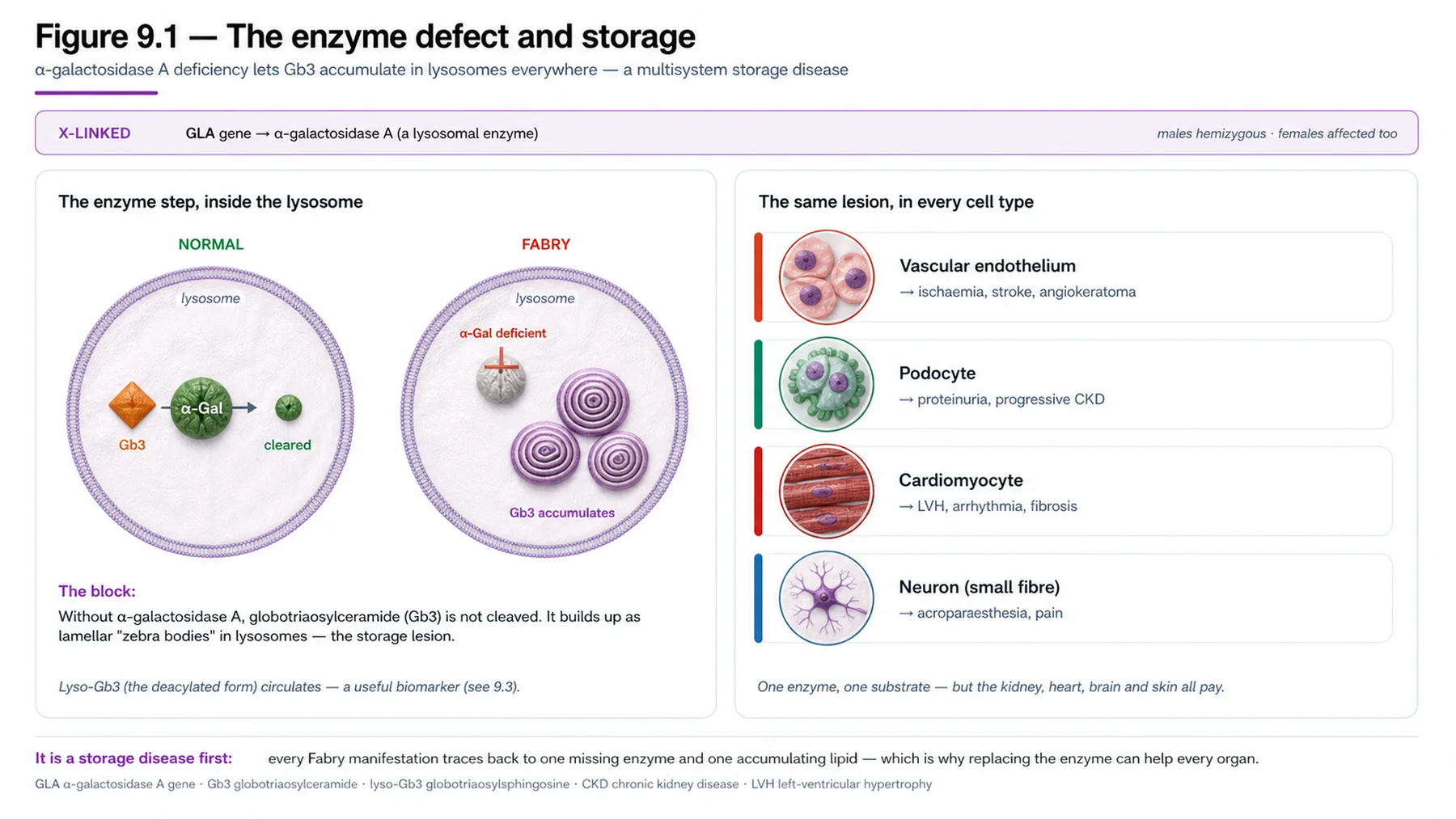
Fabry disease is a lysosomal storage disorder, and its mechanism is a single enzyme deficiency with system-wide consequences. The enzyme alpha-galactosidase A (encoded by the GLA gene on the X chromosome) normally degrades a glycosphingolipid, globotriaosylceramide (Gb3, also called GL-3), within lysosomes. When the enzyme is deficient, Gb3 cannot be broken down and accumulates progressively in the lysosomes of cells throughout the body — especially the vascular endothelium, the podocytes and tubular cells of the kidney, the cardiomyocytes of the heart, and the neurons — with the deacylated form, lyso-Gb3, also accumulating and being both toxic and a useful biomarker. This progressive storage of Gb3 in the cells of multiple organs is the unifying mechanism: a fat that cannot be cleared builds up everywhere the enzyme is needed, and the affected cells malfunction and die, producing the multisystem disease. The kidney is heavily affected because podocytes and tubular and endothelial cells all store Gb3, leading to proteinuria and progressive CKD. So one enzyme deficiency, one stored lipid, and damage wherever it accumulates — the simplicity of the mechanism belies the complexity of the clinical picture.
— The multisystem disease
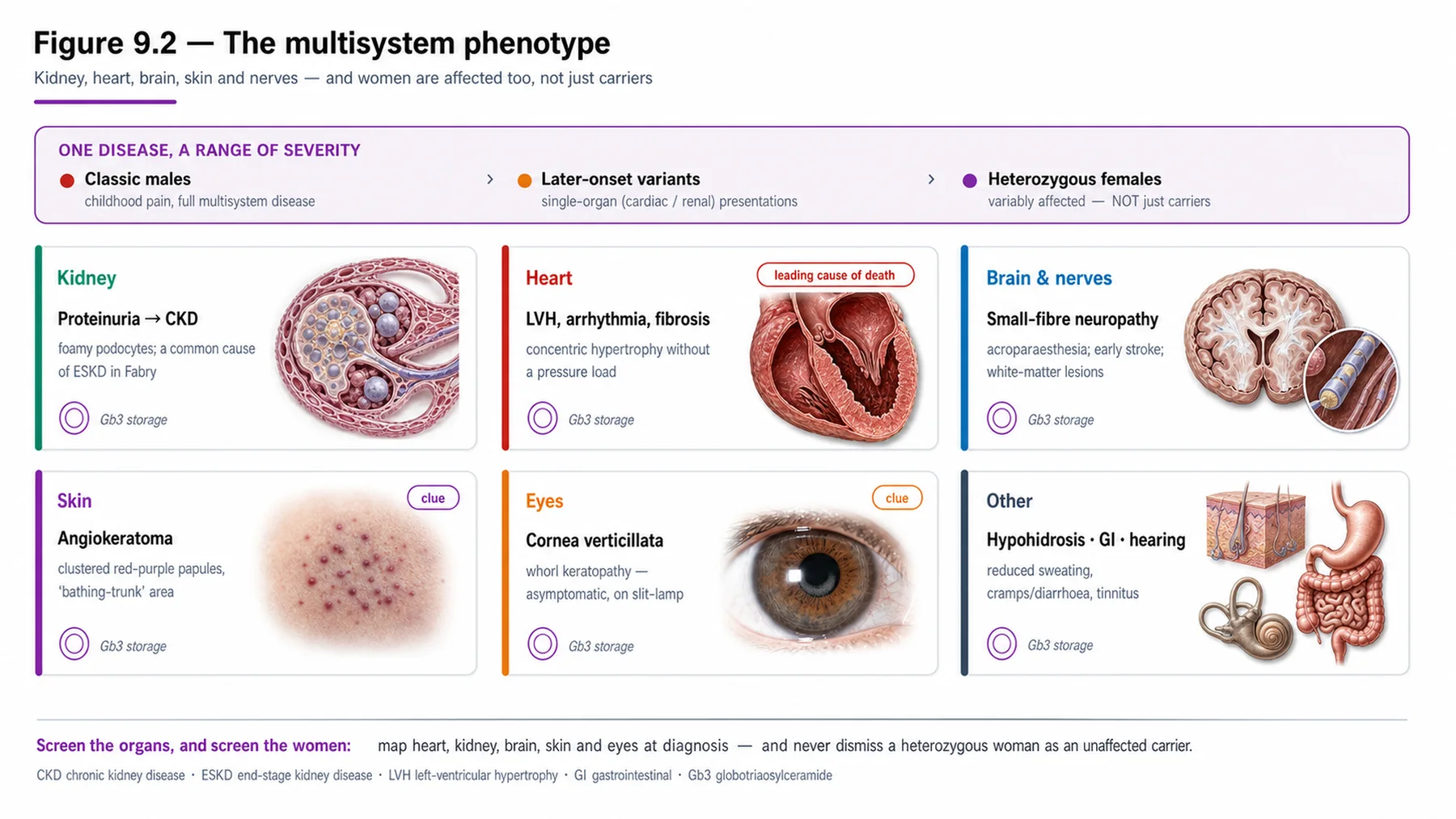
Because Gb3 accumulates throughout the body, Fabry is a multisystem disease, and recognising the constellation is the diagnostic key. The kidney shows progressive proteinuria and CKD, a major cause of morbidity. The heart develops left ventricular hypertrophy and hypertrophic cardiomyopathy, conduction disease, and arrhythmia — a leading cause of death. The brain suffers early ischaemic stroke and transient ischaemic attacks (cerebrovascular disease at a young age). The peripheral nerves cause a small-fibre neuropathy with acroparaesthesia and episodic neuropathic pain crises (often from childhood, a classic early symptom). The skin shows angiokeratomas (clusters of small dark vascular lesions, classically in a 'bathing-trunk' distribution). The eye shows cornea verticillata (a whorl-like corneal opacity) and tortuous vessels. And there are further features — hypohidrosis (reduced sweating), gastrointestinal symptoms, fatigue, and hearing loss. The point is that no single feature is specific, but the combination — a young person with unexplained proteinuric CKD, left ventricular hypertrophy, neuropathic pain, angiokeratomas, and perhaps an early stroke — should trigger the diagnosis. Because the features span specialties (nephrology, cardiology, neurology, dermatology), Fabry is easily missed when each is viewed in isolation; seeing them together is what makes the diagnosis.
— X-linked inheritance: females are not just carriers
Fabry is X-linked (the GLA gene being on the X chromosome), and understanding the inheritance corrects a common and important misconception. Hemizygous males, with a single X, are classically and severely affected — the full multisystem disease. But heterozygous females are not merely unaffected 'carriers': because of X-inactivation (lyonisation), the proportion of cells expressing the mutant versus the normal X varies, so females are variably affected — ranging from genuinely asymptomatic, through mild or organ-limited disease, to disease as severe as in males. This is a crucial clinical point: a woman with a Fabry mutation may have significant kidney, heart, or brain disease and deserves assessment and treatment, not dismissal as a 'carrier'. The inheritance also shapes the pedigree (transmission through the maternal line, no male-to-male transmission, affected males and variably affected females) and the family screening (cascade testing of relatives, with attention to at-risk females). And there are phenotypes: the classic early-onset multisystem form (very low or absent enzyme) and later-onset or variant forms (with residual enzyme), including cardiac-predominant variants that may present to cardiology. Recognising that females can be significantly affected, and that variant forms exist, widens the net for a frequently missed diagnosis.
— Diagnosis: the female-enzyme caveat
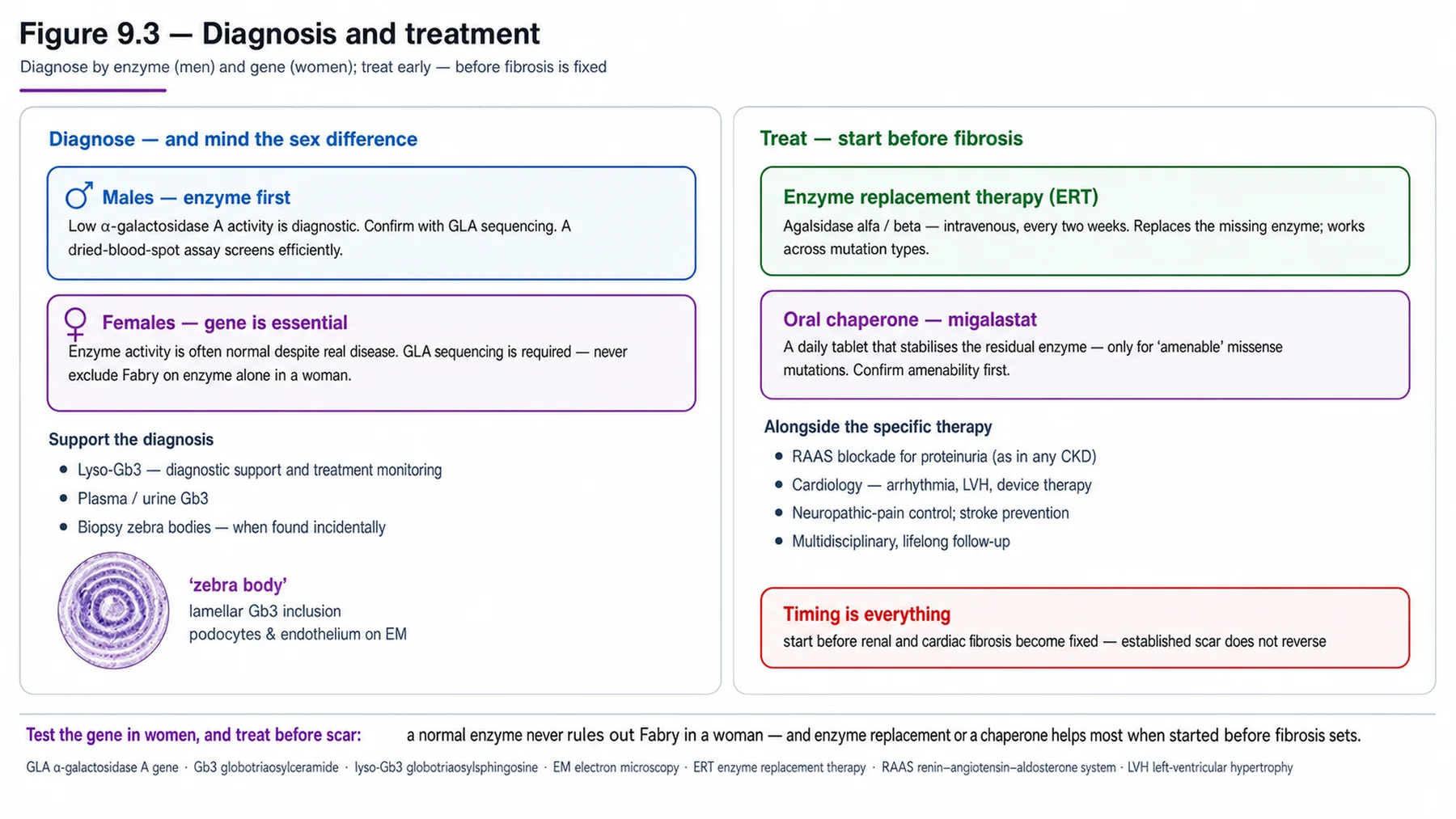
Diagnosing Fabry hinges on the enzyme assay — with one critical caveat about females. In males, measuring alpha-galactosidase A enzyme activity is diagnostic: it is low or absent, confirming the disease. But in females, the enzyme activity can be normal or near-normal despite significant disease (because of X-inactivation — some cells make normal enzyme), so a normal enzyme assay does not exclude Fabry in a woman, and females require genetic testing (GLA sequencing) to diagnose. This female-enzyme caveat is one of the most important practical points in Fabry: relying on the enzyme assay in a woman will miss the diagnosis, and any female suspected of Fabry (by symptoms or family history) must have genetic testing regardless of the enzyme result. Beyond the enzyme and genetics, the diagnosis is supported by biomarkers (plasma and urine Gb3, and especially plasma lyso-Gb3, which is elevated) and by biopsy, which on electron microscopy shows the characteristic lamellated osmiophilic inclusions — the 'zebra bodies' (myelin figures) of stored Gb3 in podocytes and other cells (met in the diagnostic-toolkit chapter). Once an index case is diagnosed, family screening (X-linked cascade testing) identifies affected relatives — including the at-risk females the enzyme assay would miss. So: enzyme assay in males, genetic testing in females (and to confirm), with biomarkers and biopsy supporting, and family cascade screening to follow.
— Treatment: enzyme replacement, started early
Fabry is treatable — the feature that makes diagnosing it so worthwhile — and the treatment is disease-modifying. The mainstay is enzyme replacement therapy: recombinant alpha-galactosidase A (agalsidase), given intravenously, replaces the deficient enzyme, clears stored Gb3 from tissues, and stabilises or slows the organ damage; the evidence shows it reduces Gb3 and slows renal and cardiac progression. An oral alternative exists for suitable patients: the pharmacological chaperone migalastat, which stabilises residual mutant enzyme in patients whose GLA mutation is 'amenable' to it — an oral option avoiding the intravenous infusions. The single most important therapeutic principle, however, is timing: treatment works best when started early, before irreversible organ damage (fibrosis of the kidney, scarring of the heart) has occurred — once organs are fibrosed, the enzyme cannot reverse the damage, only slow further accumulation. This is why early diagnosis matters so much, and why the frequent under-diagnosis of Fabry (years of unexplained pain, proteinuria, or LVH before the diagnosis is made) costs patients the treatable window. Around the disease-specific treatment sit the adjuncts: RAAS blockade for the proteinuria (renoprotective), cardiovascular and stroke risk management, neuropathic pain management, and, at end-stage disease, dialysis and transplantation (transplantation replaces the kidney but not the systemic enzyme deficiency, so enzyme therapy continues). Care is multidisciplinary — nephrology, cardiology, neurology — reflecting the multisystem disease. The therapeutic message is: diagnose early and treat early, because the treatment can only protect organs that are not yet destroyed.
— The other metabolic diseases, and the synthesis
Fabry is the exemplar, but a few other inherited metabolic diseases affect the kidney and deserve recognition. Cystinosis is an autosomal recessive lysosomal disorder in which a transport defect causes cystine to accumulate within lysosomes, presenting in infancy with a renal Fanconi syndrome and progressing to CKD; it is treated with cysteamine, which depletes the stored cystine (also met in the tubulopathy chapter). Primary hyperoxaluria is an autosomal recessive defect of glyoxylate metabolism causing oxalate overproduction, with recurrent calcium oxalate stones, nephrocalcinosis, progressive kidney failure, and systemic oxalosis (covered in the stone chapter, where the newer RNA-based therapies are noted). Others — lecithin-cholesterol acyltransferase deficiency, glycogen storage diseases, and mitochondrial cytopathies — are rarer. The synthesis of the chapter, and the reason Fabry leads it, is the model of a treatable inherited metabolic kidney disease: a defined enzyme or metabolic defect produces storage or accumulation that damages the kidney (and often other organs), and a specific therapy — enzyme replacement, a chaperone, cysteamine, an RNA therapy — can slow or halt the damage if started before it is irreversible. The recurring clinical imperative is to recognise these diseases, because each carries a specific treatment that a missed diagnosis forfeits. For Fabry above all: consider it in unexplained proteinuric CKD, unexplained LVH, or early stroke, remember that the enzyme assay misses affected females, and treat early — because the diagnosis you make is the treatment you can give.
| 04 | PHASE A · LEVEL 4 · ORIENTATION & KNOWLEDGE Reference Tables |
Table 9.1 — Fabry: mechanism and genetics
| Element | Detail |
| Defect | X-linked deficiency of alpha-galactosidase A (GLA gene) |
| Storage | Globotriaosylceramide (Gb3) accumulates in lysosomes body-wide; lyso-Gb3 also |
| Cells affected | Endothelium, podocytes, tubular cells, cardiomyocytes, neurons |
| Result | One enzyme deficiency → one stored lipid → multisystem damage |
Table 9.2 — Multisystem manifestations
| System | Feature |
| Kidney / heart | Proteinuria → progressive CKD; LVH/cardiomyopathy, arrhythmia |
| Brain / nerves | Early stroke/TIA; small-fibre neuropathy (acroparaesthesia, pain crises) |
| Skin / eye | Angiokeratomas; cornea verticillata |
| Other | Hypohidrosis, GI symptoms, fatigue, hearing loss |
Table 9.3 — X-linked inheritance
| Aspect | Detail |
| Males (hemizygous) | Classically, severely affected (full multisystem disease) |
| Females (heterozygous) | VARIABLY affected (X-inactivation) — not merely carriers |
| Phenotypes | Classic (early, multisystem) vs later-onset/variant (cardiac/renal-predominant) |
| Pedigree | Maternal-line transmission; no male-to-male; cascade screen (incl. females) |
Table 9.4 — Diagnosis
| Modality | Detail |
| Enzyme assay | Alpha-galactosidase A — low/absent in males (diagnostic) |
| FEMALE CAVEAT | Enzyme may be NORMAL in affected females → GLA genetic testing required |
| Biomarkers / biopsy | Plasma lyso-Gb3 (and Gb3); EM 'zebra bodies' in podocytes |
| Family | X-linked cascade screening (identifies at-risk females) |
Table 9.5 — Treatment
| Element | Detail |
| Enzyme replacement | Recombinant alpha-galactosidase A (IV) — clears Gb3, slows organ damage |
| Oral chaperone | Migalastat — for amenable GLA mutations (stabilises residual enzyme) |
| Key principle | Start EARLY — before irreversible fibrosis; cannot reverse established damage |
| Adjuncts | RAAS blockade (proteinuria), CV/stroke risk, pain management, dialysis/transplant; multidisciplinary |
Table 9.6 — Other inherited metabolic kidney diseases
| Disease | Detail |
| Cystinosis | Recessive lysosomal cystine accumulation → Fanconi syndrome, CKD; treat cysteamine |
| Primary hyperoxaluria | Recessive oxalate overproduction → stones, nephrocalcinosis, oxalosis (Chapter 16) |
| Others | LCAT deficiency, glycogen storage, mitochondrial cytopathies (rarer) |
| Common theme | A metabolic defect with a specific treatment — recognise it to treat it |
| 05 | PHASE B · LEVEL 5 · VISUALISE & MAP Imaging & Flowchart Specifications |
| 06 | PHASE B · LEVEL 6 · VISUALISE & MAP Concept Maps |
Each chain runs from mechanism to a named bedside action; read the arrows as “leads to.”
Fabry mechanism. Alpha-galactosidase A deficiency → Gb3 accumulates in lysosomes body-wide → multisystem organ damage → ACTION: recognise the multisystem picture as one enzyme defect.
Multisystem disease. Gb3 in kidney + heart + brain + nerves + skin + eye → proteinuric CKD, LVH, early stroke, neuropathic pain, angiokeratomas, cornea verticillata → ACTION: see the features together to make the diagnosis.
X-linked inheritance. X-linked (GLA) → males severe; females variably affected (X-inactivation) — not just carriers → ACTION: assess and treat affected females; cascade-screen the family.
Diagnosis / female caveat. Enzyme assay diagnoses males, but is unreliable in females → females need GLA genetic testing → ACTION: never exclude Fabry in a woman on a normal enzyme assay.
Treatment / timing. Enzyme replacement (or chaperone) clears Gb3 and slows damage, but cannot reverse fibrosis → ACTION: diagnose and treat early, within the treatable window.
| 07 | PHASE B · LEVEL 7 · VISUALISE & MAP Decision Pathways |
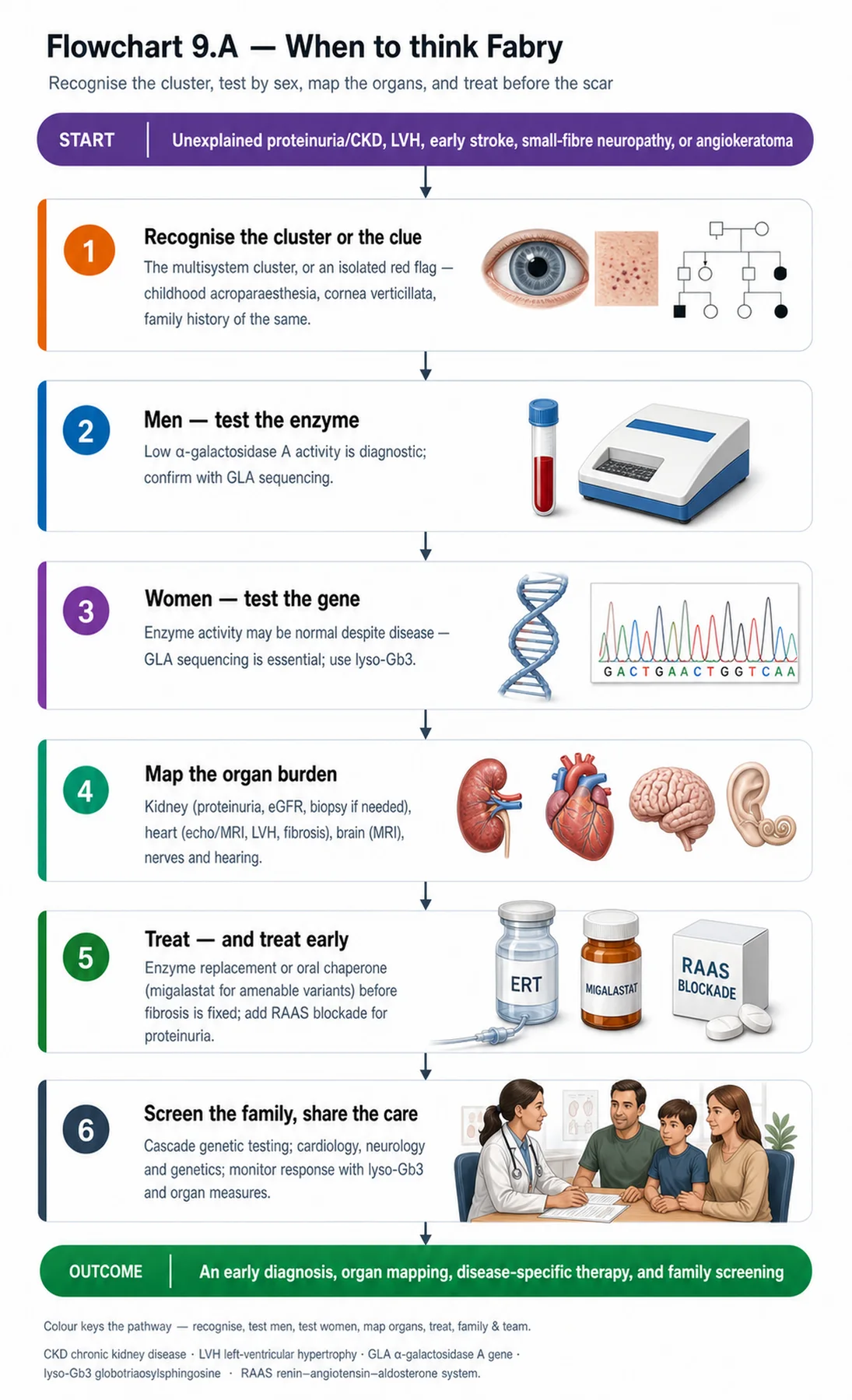
| R1 | IF a patient has unexplained proteinuric CKD with multisystem features (LVH, neuropathic pain, angiokeratomas, early stroke), THEN consider Fabry disease. |
| R2 | IF Fabry is suspected in a male, THEN measure alpha-galactosidase A activity — a low/absent level is diagnostic. |
| R3 | IF Fabry is suspected in a female, THEN perform GLA genetic testing — the enzyme assay can be normal and does not exclude it. |
| R4 | IF a female has a Fabry mutation, THEN assess and treat her organ involvement — she is not merely a carrier. |
| R5 | IF an index case is confirmed, THEN cascade-screen the family (X-linked), including at-risk females. |
| R6 | IF Fabry is confirmed, THEN start disease-modifying treatment (enzyme replacement, or migalastat for amenable mutations) EARLY, before irreversible damage. |
| R7 | IF treating Fabry, THEN add adjuncts — RAAS blockade for proteinuria, cardiovascular/stroke risk management, pain control — and provide multidisciplinary care. |
| R8 | IF an inherited metabolic kidney disease is suspected, THEN remember each (Fabry, cystinosis, primary hyperoxaluria) has a specific treatment worth diagnosing for. |
| 08 | PHASE C · LEVEL 8 · CLINICAL REASONING Clinical Cases |
| CASE 1 | THE PIECES FIT TOGETHER Recognise the multisystem disease Suspecting Fabry |
Presentation
A man with unexplained proteinuric CKD has, on review, left ventricular hypertrophy, a long history of burning pains in his hands and feet, clusters of small dark skin lesions, and an early stroke. Each has been managed in isolation by a different specialty.
❖ Pause and reflect What single diagnosis unites these scattered problems? |
Analysis
Fabry disease — the scattered problems are one multisystem disease. Each feature, viewed alone, has been managed separately: the proteinuric CKD by nephrology, the left ventricular hypertrophy by cardiology, the burning hand-and-foot pains (acroparaesthesia/neuropathic pain crises) by neurology, the skin lesions (angiokeratomas) by dermatology, and the early stroke by yet another team. But together they are the classic multisystem picture of Fabry disease, in which alpha-galactosidase A deficiency causes Gb3 to accumulate body-wide and damage kidney, heart, brain, nerves, and skin. No single feature is specific, but the combination — especially unexplained proteinuric CKD with LVH, neuropathic pain, and angiokeratomas in a young man — should trigger the diagnosis. This is why Fabry is so often missed: the features cross specialties and are managed in isolation. Seeing them together makes the diagnosis, which should be confirmed by the enzyme assay (diagnostic in this male).
Plan
Recognise the unifying multisystem picture as Fabry disease and confirm with the alpha-galactosidase A enzyme assay (diagnostic in a male), then assess all organs and screen the family. See the features together to make the diagnosis.
Teaching point
Fabry is a multisystem disease often missed because its features cross specialties — unexplained proteinuric CKD with LVH, neuropathic pain, and angiokeratomas should trigger it.
Cross-reference
Exercises rules R1 and R2; the Fabry-mechanism and multisystem concept maps; Figure 9.1; Tables 9.1, 9.2.
| CASE 2 | NORMAL ENZYME, STILL FABRY The female-enzyme caveat Diagnosing Fabry in a woman |
Presentation
A woman with a brother known to have Fabry disease, and herself with proteinuria and neuropathic pain, has a normal alpha-galactosidase A enzyme activity, and a clinician concludes she does not have Fabry.
❖ Pause and reflect Does the normal enzyme assay exclude Fabry in this woman? |
Analysis
No — this is the critical female-enzyme caveat. In females, the alpha-galactosidase A enzyme activity can be normal or near-normal despite significant Fabry disease, because of X-inactivation (some cells express the normal X and make enzyme), so a normal enzyme assay does not exclude Fabry in a woman. This woman has a brother with Fabry (she is at risk through the X-linked maternal line), and her own proteinuria and neuropathic pain are suggestive — so the normal enzyme is falsely reassuring. The correct test is GLA genetic testing, which is required to diagnose Fabry in females regardless of the enzyme result. Concluding she does not have Fabry on the normal enzyme would miss a treatable disease and leave her organ involvement untreated. Females are not merely carriers and can be significantly affected; the diagnosis in a woman rests on genetics, not the enzyme.
Plan
Do not exclude Fabry on the normal enzyme; perform GLA genetic testing (required in females), assess her organ involvement, and treat if confirmed. In a woman, diagnose Fabry by genetics, not the enzyme assay.
Teaching point
The alpha-galactosidase A enzyme assay can be normal in affected females — a normal enzyme does NOT exclude Fabry in a woman; use GLA genetic testing.
Cross-reference
Exercises rules R3 and R4; the X-linked and diagnosis concept maps; Figure 9.2; Tables 9.3, 9.4; genetic testing in Chapter 2.
| CASE 3 | THE TREATABLE WINDOW Start early; enzyme or chaperone Treating Fabry |
Presentation
A young man newly diagnosed with Fabry has early proteinuria and mild LVH but preserved organ function. A clinician proposes deferring disease-modifying treatment 'until the organs are more affected.'
❖ Pause and reflect Should disease-modifying treatment be deferred until organ damage advances? |
Analysis
No — the key principle in Fabry treatment is to start early, before irreversible organ damage, so deferring is exactly wrong. Disease-modifying treatment (enzyme replacement therapy with recombinant alpha-galactosidase A, or the oral chaperone migalastat for an amenable mutation) clears stored Gb3 and slows organ damage, but it works best before the organs are fibrosed: once the kidney is scarred or the heart fibrosed, the enzyme cannot reverse that damage, only slow further accumulation. This young man, with early proteinuria and mild LVH but preserved function, is in the treatable window — precisely the patient who should be treated now, to protect organs that are not yet destroyed. Waiting 'until the organs are more affected' forfeits the very window in which treatment is most effective. So treatment should start now, alongside adjuncts (RAAS blockade for the proteinuria, cardiovascular and stroke risk management), with multidisciplinary care. Early diagnosis is valuable precisely because early treatment is.
Plan
Start disease-modifying treatment now (enzyme replacement, or migalastat if the mutation is amenable) given the early, treatable-window disease, with RAAS blockade and multidisciplinary care — not deferring until damage advances. Treat Fabry early, before irreversible fibrosis.
Teaching point
Treat Fabry early — enzyme replacement (or migalastat) protects organs not yet fibrosed; deferring until damage advances forfeits the treatable window.
Cross-reference
Exercises rules R6 and R7; the treatment/timing concept map; Figure 9.3; Table 9.5.
| CASE 4 | OTHER METABOLIC DISEASE Cystinosis and hyperoxaluria Inherited metabolic kidney disease |
Presentation
Two children are seen: one with a renal Fanconi syndrome and failure to thrive from infancy, and one with recurrent calcium oxalate stones and nephrocalcinosis progressing toward kidney failure. The team is unsure of the inherited metabolic diagnoses and their specific treatments.
❖ Pause and reflect What inherited metabolic diseases, and treatments, do these suggest? |
Analysis
Cystinosis and primary hyperoxaluria — two inherited metabolic kidney diseases with specific treatments. The infant with a renal Fanconi syndrome and failure to thrive has cystinosis: an autosomal recessive lysosomal disorder in which a transport defect causes cystine to accumulate in lysosomes, presenting in infancy with Fanconi syndrome (proximal tubular wasting) and progressing to CKD — treated with cysteamine, which depletes the stored cystine and slows progression (the earlier it is started, the better). The child with recurrent calcium oxalate stones, nephrocalcinosis, and progressive kidney failure has primary hyperoxaluria: an autosomal recessive defect of glyoxylate metabolism causing oxalate overproduction, with stones, nephrocalcinosis, and systemic oxalosis — managed with hydration, citrate, and increasingly the newer RNA-based therapies (the stone chapter develops this). Both illustrate the chapter's theme: an inherited metabolic defect with a specific treatment, where recognising the disease unlocks the therapy. Like Fabry, they reward recognition with targeted treatment.
Plan
Diagnose cystinosis in the Fanconi-syndrome infant (treat with cysteamine) and primary hyperoxaluria in the stone-forming child (hydration, citrate, RNA-based therapy), recognising that each inherited metabolic disease carries a specific treatment. Recognise the metabolic disease to unlock its treatment.
Teaching point
Other inherited metabolic kidney diseases — cystinosis (Fanconi syndrome, cysteamine) and primary hyperoxaluria (stones/oxalosis) — each have specific treatments; recognise them to treat them.
Cross-reference
Exercises rule R8; Table 9.6; cystinosis in Chapter 11; primary hyperoxaluria in Chapter 16.
| 09 | PHASE C · LEVEL 9 · CLINICAL REASONING Clinical Implications |
One triad per mechanism the narrative exposed: the physiology, why it matters, and the bedside move.
MECHANISM Alpha-galactosidase A deficiency causes Gb3 to accumulate in cells body-wide. |
WHY IT MATTERS One enzyme defect produces a multisystem disease. |
ACTION Recognise the multisystem picture as a single, treatable disease. |
MECHANISM Gb3 storage damages kidney, heart, brain, nerves, skin, and eye. |
WHY IT MATTERS No single feature is specific, but the combination is. |
ACTION See the features together — proteinuric CKD, LVH, pain, angiokeratomas — to make the diagnosis. |
MECHANISM X-inactivation makes heterozygous females variably affected. |
WHY IT MATTERS Females are not merely carriers and can have significant disease. |
ACTION Assess and treat affected females; never dismiss them as carriers. |
MECHANISM The enzyme assay can be normal in affected females. |
WHY IT MATTERS A normal enzyme falsely reassures and misses the diagnosis. |
ACTION Diagnose Fabry in women by GLA genetic testing, not the enzyme. |
MECHANISM Enzyme replacement clears Gb3 but cannot reverse established fibrosis. |
WHY IT MATTERS The treatable window closes once organs are scarred. |
ACTION Diagnose and treat early, within the treatable window. |
| 10 | PHASE C · LEVEL 10 · CLINICAL REASONING Clinical Pearls |
| Fabry = X-linked deficiency of alpha-galactosidase A (GLA gene). | Gb3 (and lyso-Gb3) accumulates in lysosomes body-wide. |
| Multisystem: kidney (proteinuria/CKD), heart (LVH), brain (early stroke), nerves (pain). | Skin: angiokeratomas; eye: cornea verticillata; also hypohidrosis, GI. |
| No single feature is specific — the COMBINATION makes the diagnosis. | Often missed (features cross specialties). |
| X-linked: males severe; females VARIABLY affected (not just carriers). | Enzyme assay diagnoses MALES (low/absent). |
| FEMALE CAVEAT: enzyme can be normal → GLA genetic testing required. | Biomarker: plasma lyso-Gb3; biopsy: 'zebra bodies' (EM). |
| Cascade-screen the family (X-linked, including at-risk females). | Enzyme replacement therapy (recombinant alpha-galactosidase A) — clears Gb3. |
| Oral chaperone (migalastat) for amenable GLA mutations. | Treat EARLY — before irreversible fibrosis (cannot reverse established damage). |
| Adjuncts: RAAS blockade (proteinuria), CV/stroke risk, pain; multidisciplinary. | Other metabolic: cystinosis (Fanconi, cysteamine), primary hyperoxaluria (stones). |
| 11 | PHASE D · LEVEL 11 · SAFETY & EVIDENCE Red Flags & Never-Do |
Panel A — Red flags
| ▲ | Unexplained proteinuric CKD with LVH, neuropathic pain, or angiokeratomas — consider Fabry. |
| ▲ | A normal enzyme assay in a woman suspected of Fabry — it does not exclude it; do genetic testing. |
| ▲ | A female with a Fabry mutation dismissed as a 'carrier' — she may have significant disease; assess and treat. |
| ▲ | Deferring Fabry treatment until organ damage advances — the treatable window is now. |
| ▲ | An infant with Fanconi syndrome — consider cystinosis (treatable with cysteamine). |
Panel B — Never do
| ✖ NEVER — manage the features of Fabry in isolation without considering the unifying diagnosis. |
| ✖ NEVER — exclude Fabry in a woman on a normal enzyme assay. |
| ✖ NEVER — dismiss a Fabry-mutation female as merely a carrier. |
| ✖ NEVER — defer Fabry treatment until irreversible organ damage has occurred. |
| 12 | PHASE D · LEVEL 12 · SAFETY & EVIDENCE Common Pitfalls |
Pitfall 1 — Siloed features
| ✖ | WRONG Managing the CKD, LVH, pain, and skin lesions separately. |
| ✓ | RIGHT Recognising the unifying multisystem diagnosis of Fabry. |
| ✉ | WHY No single feature is specific, but the combination is. |
Pitfall 2 — Trusting the enzyme in women
| ✖ | WRONG Excluding Fabry in a woman on a normal enzyme assay. |
| ✓ | RIGHT Performing GLA genetic testing. |
| ✉ | WHY The enzyme can be normal in affected females (X-inactivation). |
Pitfall 3 — 'Just a carrier'
| ✖ | WRONG Dismissing a Fabry-mutation female as an unaffected carrier. |
| ✓ | RIGHT Assessing and treating her organ involvement. |
| ✉ | WHY Females are variably but often significantly affected. |
Pitfall 4 — Waiting to treat
| ✖ | WRONG Deferring disease-modifying treatment until organs are damaged. |
| ✓ | RIGHT Treating early, within the treatable window. |
| ✉ | WHY Treatment cannot reverse established fibrosis. |
Pitfall 5 — Missing the treatable metabolic disease
| ✖ | WRONG Leaving an inherited metabolic kidney disease unrecognised. |
| ✓ | RIGHT Recognising it (Fabry, cystinosis, hyperoxaluria) and giving its specific treatment. |
| ✉ | WHY Each carries a specific therapy a missed diagnosis forfeits. |
| 13 | PHASE D · LEVEL 13 · SAFETY & EVIDENCE Evidence Grading |
GRADE A HIGH CONFIDENCE The effect is real and the estimate is stable. RCTs at low risk of bias; multiple concordant prospective cohorts; meta-analyses. |
GRADE B MODERATE CONFIDENCE The effect is likely real but may shift with new data. Observational studies, registries, mechanistic human studies. |
GRADE C LOW CONFIDENCE Rests on physiology, reasoning, or consensus rather than outcomes. Pathophysiological reasoning; extrapolation; consensus without outcomes. |
Graded statements (by evidence type)
| Statement | Grade | Basis (evidence type) |
| Fabry is an X-linked alpha-galactosidase A deficiency with Gb3 storage. | A | Biochemistry and genetics |
| Fabry is a multisystem disease (kidney, heart, brain, nerve, skin). | A | Clinical cohort data |
| Heterozygous females can be significantly affected. | A | Cohort data |
| The enzyme assay can be normal in affected females. | A | Biochemical data |
| Enzyme replacement therapy clears Gb3 and slows organ damage. | A | RCTs and registries |
| Earlier treatment, before irreversible damage, improves outcomes. | B | Registry and observational data |
| Migalastat is effective in patients with amenable GLA mutations. | A | RCTs |
| 14 | PHASE E · LEVEL 14 · PATIENT DECISIONS Absolute Risk in Natural Frequency |
Natural-frequency estimates for orientation, from Fabry cohorts; they vary with phenotype and sex. They convey the size of the decisions, expressed per 100 comparable patients.
| Per 100 patients… | Outcome | Roughly how many | See |
| Affected females tested by enzyme assay alone | Are missed (normal enzyme) | A substantial share — hence genetic testing | L13 row 4 |
| Fabry patients treated early vs late | Preserve organ function | More with early treatment | L13 row 6 |
| Unexplained-LVH or proteinuric-CKD patients | Have undiagnosed Fabry | A small but real share — hence consider it | L13 row 2 |
| Patients on enzyme replacement | Clear Gb3 and slow progression | Most — the disease-modifying effect | L13 row 5 |
★ How to read these Read these as orientation, not promises; outcomes vary with phenotype and sex. The stable signals: the enzyme assay misses affected females, early treatment preserves organs, Fabry hides behind unexplained LVH/CKD, and enzyme replacement modifies the disease. Communicate them as people out of 100, not as a hazard ratio. |
| 17 | PHASE F · LEVEL 17 · APPLY & TEST Documentation Templates |
Paste-ready notes. Tick the boxes that apply and delete the rest; make the diagnosis, the female caveat, and the early treatment explicit.
Template 1 — Fabry diagnosis
Template 2 — Fabry treatment
| 18 | PHASE F · LEVEL 18 · APPLY & TEST Cheat Sheet |
| Fabry = X-linked alpha-galactosidase A deficiency (GLA). | Gb3/lyso-Gb3 accumulates body-wide. |
| Multisystem: kidney, heart (LVH), brain (stroke), nerves (pain), skin, eye. | Combination of features makes the diagnosis (often missed). |
| X-linked: males severe; females variably affected (not just carriers). | Enzyme assay diagnoses MALES (low/absent). |
| FEMALES: enzyme may be NORMAL → GLA genetic testing required. | Biomarker: lyso-Gb3; biopsy: zebra bodies. |
| Cascade-screen the family (incl. at-risk females). | Enzyme replacement therapy clears Gb3, slows damage. |
| Migalastat (oral chaperone) for amenable mutations. | Treat EARLY — before irreversible fibrosis. |
| Adjuncts: RAAS blockade, CV/stroke risk, pain; multidisciplinary. | Transplant doesn't cure systemic disease — continue enzyme therapy. |
| Cystinosis: Fanconi syndrome → cysteamine. | Primary hyperoxaluria: stones/oxalosis (Ch 16). |
| 19 | PHASE F · LEVEL 19 · APPLY & TEST Flashcards |
| CARD 1 | Q. What is the mechanism of Fabry disease? A. An X-linked deficiency of the lysosomal enzyme alpha-galactosidase A (GLA gene) prevents the breakdown of globotriaosylceramide (Gb3), which accumulates in the lysosomes of cells throughout the body — endothelium, podocytes, tubular cells, cardiomyocytes, and neurons — causing multisystem damage. DETAILED. One enzyme deficiency produces a multisystem disease. CLINICAL. Recognise the multisystem picture as a single, treatable defect. |
| CARD 2 | Q. What are the multisystem features of Fabry? A. Renal (proteinuria, progressive CKD), cardiac (left ventricular hypertrophy, cardiomyopathy, arrhythmia), cerebrovascular (early stroke), peripheral nerve (acroparaesthesia and neuropathic pain crises), skin (angiokeratomas), eye (cornea verticillata), plus hypohidrosis, GI symptoms, and hearing loss. DETAILED. No single feature is specific, but the combination is. CLINICAL. See the features together to make the diagnosis. |
| CARD 3 | Q. Why are females with Fabry not merely carriers? A. Because the GLA gene is X-linked and X-inactivation (lyonisation) varies the proportion of cells expressing the mutant versus normal X, so heterozygous females are variably affected — from asymptomatic to as severe as males — and can have significant kidney, heart, or brain disease. DETAILED. They deserve assessment and treatment, not dismissal. CLINICAL. Assess and treat affected females. |
| CARD 4 | Q. How is Fabry diagnosed, and what is the female caveat? A. In males, a low or absent alpha-galactosidase A enzyme activity is diagnostic; but in females the enzyme can be normal despite significant disease, so females require GLA genetic testing — a normal enzyme does not exclude Fabry in a woman. Plasma lyso-Gb3 and biopsy 'zebra bodies' support the diagnosis. DETAILED. The enzyme assay misses affected females. CLINICAL. Diagnose women by genetic testing, not the enzyme. |
| CARD 5 | Q. What is the disease-modifying treatment of Fabry? A. Enzyme replacement therapy — intravenous recombinant alpha-galactosidase A — which clears stored Gb3 and slows organ damage; an oral pharmacological chaperone (migalastat) is an alternative for patients with amenable GLA mutations. DETAILED. It modifies the disease, not just the symptoms. CLINICAL. Offer enzyme replacement or migalastat to confirmed patients. |
| CARD 6 | Q. Why must Fabry treatment be started early? A. Because enzyme replacement clears Gb3 and slows organ damage but cannot reverse established fibrosis — once the kidney is scarred or the heart fibrosed, treatment only slows further accumulation — so the treatable window is before irreversible damage. DETAILED. Under-diagnosis costs patients that window. CLINICAL. Diagnose and treat early. |
| CARD 7 | Q. What adjunctive care does Fabry require? A. RAAS blockade for the proteinuria (renoprotective), cardiovascular and stroke risk management, neuropathic pain management, dialysis or transplantation at end-stage disease (with enzyme therapy continued, as transplant does not cure the systemic enzyme deficiency), and multidisciplinary care across nephrology, cardiology, and neurology. DETAILED. It is a multisystem disease needing multisystem care. CLINICAL. Add the adjuncts and coordinate multidisciplinary care. |
| CARD 8 | Q. What other inherited metabolic kidney diseases should be recognised? A. Cystinosis (autosomal recessive lysosomal cystine accumulation causing a renal Fanconi syndrome and CKD, treated with cysteamine) and primary hyperoxaluria (autosomal recessive oxalate overproduction causing stones, nephrocalcinosis, and oxalosis) — each, like Fabry, an inherited metabolic defect with a specific treatment. DETAILED. Recognising the disease unlocks the treatment. CLINICAL. Recognise the metabolic disease to give its specific therapy. |
| 20 | PHASE F · LEVEL 20 · APPLY & TEST One-Minute Preceptor |
| SCENE 1 | The intern excluding Fabry in a woman |
GET A COMMITMENT. “You've ruled out Fabry in this woman with a Fabry brother because her enzyme is normal — are you sure?”
PROBE FOR EVIDENCE. “The enzyme is normal” — ask: “Why can the enzyme be normal in an affected woman, and what test diagnoses her?”
TEACH A GENERAL RULE. Because of X-inactivation, the enzyme assay can be normal in affected females — it does not exclude Fabry; women need GLA genetic testing.
REINFORCE WHAT WAS RIGHT. Recognising her risk and testing her was right.
CORRECT A MISTAKE. Do GLA genetic testing; don't exclude Fabry on the enzyme in a woman.
| SCENE 2 | The resident deferring treatment |
GET A COMMITMENT. “You want to defer Fabry treatment in this newly diagnosed young man until his organs are more affected — why?”
PROBE FOR EVIDENCE. “He's barely affected” — ask: “Can enzyme replacement reverse fibrosis, and when does it work best?”
TEACH A GENERAL RULE. Treatment cannot reverse established fibrosis — it works best before irreversible damage, so early disease is exactly when to treat, not when to wait.
REINFORCE WHAT WAS RIGHT. Recognising the early-stage disease was correct.
CORRECT A MISTAKE. Start treatment now, within the treatable window.
| 21 | PHASE F · LEVEL 21 · APPLY & TEST Reflective Prompts |
Genuine tensions this evidence leaves open; sit with them rather than resolving them too quickly.
Fabry is treatable yet routinely diagnosed years late, after irreversible damage. What would it take to make clinicians across specialties think of one rare disease when each sees only their organ?
Enzyme replacement is hugely expensive and its clinical benefit, while real, is modest and clearest when started early. How do you weigh a costly therapy whose value depends on treating before there is much to show for it?
Women with Fabry have been dismissed as carriers for decades. How much disease has been missed by a framing — 'X-linked, so women are carriers' — that the biology never supported?
The enzyme assay, the obvious test, is the one that misses affected women. How do you build the reflex to override an apparently normal result with genetics?
For these treatable metabolic diseases, the diagnosis is the treatment. What does that place on the clinician's duty to look — and on the cost of not looking?
| 22 | PHASE F · LEVEL 22 · APPLY & TEST Board-Style Questions |
| Q 01 | Fabry disease is caused by deficiency of: |
| A | Fibrocystin |
| B | Alpha-galactosidase A (with Gb3 accumulation) |
| C | Type IV collagen |
| D | Polycystin |
Rationale Fabry is an alpha-galactosidase A deficiency with Gb3 storage (Figure 9.1, Table 9.1). A is ARPKD; C is Alport; D is ADPKD. |
| Q 02 | Which combination suggests Fabry disease? |
| A | Isolated haematuria |
| B | Proteinuric CKD + LVH + neuropathic pain + angiokeratomas |
| C | Hypertension alone |
| D | A single simple cyst |
Rationale The multisystem combination makes the diagnosis (case 1, Table 9.2). A, C, and D are not the Fabry picture. |
| Q 03 | Heterozygous females with a Fabry mutation are: |
| A | Always unaffected carriers |
| B | Variably affected and can have significant disease |
| C | Always as severe as males |
| D | Never affected |
Rationale X-inactivation makes females variably affected, not mere carriers (case 2, Table 9.3). A, C, and D are wrong. |
| Q 04 | A normal alpha-galactosidase A enzyme assay in a woman suspected of Fabry: |
| A | Excludes Fabry |
| B | Does not exclude Fabry — perform GLA genetic testing |
| C | Confirms Fabry |
| D | Means no testing needed |
Rationale The enzyme can be normal in affected females; genetics is required (case 2, Figure 9.2, Table 9.4). A, C, and D are incorrect. |
| Q 05 | The disease-modifying treatment of Fabry is: |
| A | RAAS blockade alone |
| B | Enzyme replacement therapy (or migalastat for amenable mutations) |
| C | A vasopressin antagonist |
| D | Immunosuppression |
Rationale Enzyme replacement (or the oral chaperone migalastat) is disease-modifying (case 3, Table 9.5). A is adjunctive; C and D are wrong. |
| Q 06 | Why should Fabry treatment be started early? |
| A | It is cheaper early |
| B | It cannot reverse established fibrosis — the treatable window is before irreversible damage |
| C | Late treatment is equally effective |
| D | It is only for ESKD |
Rationale Treatment protects organs not yet fibrosed (case 3, Figure 9.3, rule R6). A, C, and D are incorrect. |
| Q 07 | The characteristic biopsy finding in Fabry is: |
| A | A basket-weave basement membrane |
| B | Lamellated 'zebra bodies' in podocytes |
| C | Immune deposits |
| D | Collecting-duct dilatation |
Rationale Fabry shows zebra bodies (Table 9.4; Chapter 3). A is Alport; C is immune GN; D is ARPKD. |
| Q 08 | An infant with a renal Fanconi syndrome and failure to thrive suggests which treatable inherited metabolic disease? |
| A | Fabry disease |
| B | Cystinosis (treated with cysteamine) |
| C | Alport syndrome |
| D | ADPKD |
Rationale Cystinosis presents with Fanconi syndrome and is treated with cysteamine (case 4, Table 9.6). A, C, and D do not present this way. |